Iran's carpet exports collapse from $2.5 billion to near zero, official says
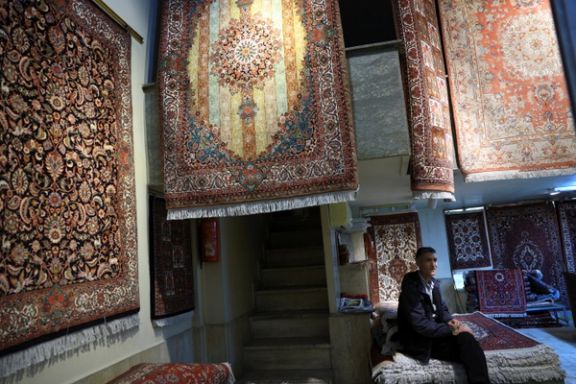
A vendor sits inside his shop selling hand-woven carpets at Tehran’s Grand Bazaar, Iran, April 13, 2026.
Iran's handwoven carpet exports, once worth nearly $2.5 billion annually, have now "virtually stopped," a provincial industry official said, reflecting the steep decline of one of the country's best-known exports.
"At the moment, carpet exports have nearly reached zero," Abdolrahman Tasmim Ghatee, head of the union of handicrafts sellers and handwoven carpet producers in Fars province, told the Iranian Labor News Agency (ILNA), a semi-official labor-focused news outlet.
He said exports, which once stood at close to $2.5 billion, had fallen to less than $50 million in recent years, with little trade now taking place.
Market slump hits producers
Tasmim Ghatee said around 90% of the sector depended on tourism, especially foreign visitors, but international tourism had largely dried up.
"Some shops do not make a single sale during the week because there are simply no buyers," he said. "After paying for food and daily expenses, people have nothing left to spend on decorative goods, handicrafts and carpets."
He said the market downturn had worsened after the war that began in late February between Iran, Israel and the United States, which disrupted trade and deepened economic uncertainty, even as a fragile ceasefire remains in place.
Fighting has largely stopped, but tensions persist amid stalled negotiations between Washington, Tehran and Israel over sanctions, regional security and Iran's nuclear program.
Decades-long decline
Iranian handwoven carpet exports generated more than $2 billion in revenue in 1994, one of the industry's strongest years, before entering a long decline driven by sanctions, rising competition and weaker global demand.
Exports fell to $69 million in 2019 and just $2 million in the second quarter of 2020, according to customs data and industry reports. By March 2024, exports had dropped to $39.7 million from $426 million in 2017, according to officials cited by ILNA.
Industry figures have blamed US sanctions, trade restrictions, currency rules and stronger competition from India, Turkey, Afghanistan, China and Pakistan for the downturn. The United States, once a major market for Iranian carpets, reimposed restrictions on Iranian rug imports after Washington withdrew from the 2015 nuclear deal in 2018.
Weavers leave the trade
The number of carpet weavers in Fars province has dropped by about 80% from around 6,000 in 2018 to roughly 1,000 now, Tasmim Ghatee said.
"When carpets and handicrafts are not sold, naturally the weaver will not continue working," he said.
He described how rural women could spend six months weaving a carpet while covering raw material costs and household duties, only to find no market for the finished product.
"How can she start again?" he said.
Officials push digital sales
Gholamhossein Zanhari, head of the carpet department at Fars province's industry and trade office, said the sector needed safer export routes and stronger online sales to survive.
He pointed to regional markets including Armenia, Georgia, Oman and Turkey, as well as Japan, South Korea and Singapore, as potential destinations and said platforms such as Etsy and eBay could help producers reach consumers directly.
"Digitalization is not just a sales tool, but a way to maintain business continuity" during crises, he said.
Members of the Islamic Revolutionary Guard Corps (IRGC) attend an exercise in southern Iran, in this handout image obtained on February 16, 2026.
Australia sanctioned seven Iranian individuals and four entities on Tuesday over what it called the Islamic Republic’s crackdown on protesters and women and its destabilizing activity through missile and shadow-banking networks.
The Australian foreign ministry said the measures targeted senior officials and entities involved in violence against women and children, mass arrests, torture, forced confessions, internet restrictions and the wrongful detention of foreign nationals.
It said the sanctions were also aimed at parts of Iran’s shadow banking system, which it said helps fund groups such as Hamas, support Tehran’s ballistic missile program and enable other destabilizing activity.
Among those sanctioned was Interior Minister Eskandar Momeni Kalagari, who Australia said is also deputy commander-in-chief of the Law Enforcement Forces, one of the entities listed over its role in the crackdown.
Australia also sanctioned Ruhollah Momen Nasab, saying he was responsible for deploying 80,000 forces to surveil women and girls in schools, universities, public spaces and online and enforce mandatory hijab rules.
Another listed individual was accused of establishing neighborhood intelligence databases through door-to-door data collection and patrols to identify and punish opponents of the Islamic Republic, while others were sanctioned over the wrongful detention of foreign nationals, the government said.
The sanctioned individuals were Momeni, Momen Nasab, Majid Feiz Jafari, Ghorban Mohammad Valizadeh, Mohsen Ebrahimi, Nasser Zarringhalam and Mansour Zarringhalam.
The listed entities were the Law Enforcement Forces of the Islamic Republic of Iran; Seraj Cyberspace Organization, an IRGC-established cyber outfit accused of recruiting and mobilizing pro-Islamic Republic internet users to spread disinformation and attack opponents online; and the exchange firms Berelian Exchange and GCM Exchange.
“Australia continues to stand with the brave people of Iran against a brutal, oppressive regime,” the government said.
The announcement was made alongside new UK sanctions targeting 12 individuals and entities linked to Iran over what Britain called hostile activity, including plotting attacks and providing financial services to groups seeking to destabilize the United Kingdom.
The United States also imposed sanctions on Monday on three individuals and nine companies accused of helping Iran ship oil to China, while EU foreign policy chief Kaja Kallas said the bloc would expand its Iran sanctions to include those responsible for obstructing freedom of navigation.
Australia said Prime Minister Anthony Albanese’s government has imposed more than 230 sanctions on Iranian individuals and entities, including more than 100 linked to the Islamic Revolutionary Guard Corps.
A Bahraini court sentenced a woman to life in prison after convicting her of communicating with Iran's Revolutionary Guards with intent to carry out hostile acts against the kingdom and harm its national interests, Bahrain's public prosecution said on Tuesday.
The prosecution said the woman used a social media account to post photos and coordinates of key sites and facilities in Bahrain and shared content that harmed the kingdom's military, political and economic standing.
Authorities said the account also promoted what the prosecution described as Iranian attacks against Bahrain.
The woman admitted to the charges during questioning, prosecutors said, adding that she told investigators she used her social media account to assist those targeting Bahrain by sharing images and coordinates of vital sites alongside messages indicating they could be targeted.
The prosecution said the court also ordered the confiscation of seized items. It did not identify the woman or say when the alleged acts took place.
Bahrain-Iran tensions
The ruling comes days after Bahrain said it had arrested 41 people allegedly linked to a group tied to Iran's Islamic Revolutionary Guard Corps and the ideology of Velayat-e Faqih, or Guardianship of the Jurist – the doctrine underpinning the Islamic Republic’s system of clerical rule and giving Iran’s supreme leader ultimate religious and political authority.
Authorities said legal proceedings were underway and investigations were continuing.
Bahrain's Foreign Minister Abdullatif bin Rashid Al Zayani on Saturday accused Tehran of interfering in the kingdom's internal affairs after the arrests, calling it a violation of international law and good neighborly principles. Iran has not publicly responded to the accusations.
The visitation area of the women’s ward at Evin Prison in Tehran - Photo by Maggie Parvaneh
Eight women political prisoners held in Tehran’s Evin Prison have been barred from meeting family members and lawyers following tighter security measures and pressure linked to collective protest activities inside the ward, according to information obtained by Iran International.
Shiva Esmaili, Golrokh Iraee, Sakineh Parvaneh, Forough Taghipour, Zahra Safaei, Marzieh Farsi, Elaheh Fouladi and Varisheh Moradi were denied visitation rights in recent weeks after participating in memorial gatherings and protest-related events inside the women’s ward, sources familiar with the situation said.
Prison authorities have also increased surveillance and patrols inside the ward, with officers entering cells daily and sometimes at night under the pretext of inspections, a source close to prisoners’ families told Iran International.
Women prisoners in Evin had for years marked political and ideological occasions through gatherings, songs, readings and commemorations for killed protesters and veteran activists, the source said. Prison officials have recently intervened directly in such activities and threatened participants, the source added.
The source said some women recently transferred to the ward were also warned by prison and security officials after attending a small number of the gatherings.
Prison staff have in recent months used insulting language toward detainees and threatened them with transfer to solitary confinement, another source familiar with conditions in the ward told Iran International.
Prisoners face solitary confinement threats
Ghazal Marzban, another woman prisoner in Evin, was recently held in solitary confinement for five nights after protesting the handling of her case, a source familiar with the situation said.
File photo of Eight women political prisoners held in Tehran’s Evin Prison who have been barred from meeting family members.
The women’s ward in Evin, often described by activists as a focal point of the “Woman, Life, Freedom” movement, has repeatedly issued statements and organized protests over executions, arrests, economic hardship and the suppression of demonstrations in Iran.
Prisoners in the ward have also staged sit-ins and hunger strikes against death sentences in recent years, after which some faced punitive measures including restrictions on phone calls, visits and new legal cases.
A source close to prisoners’ families said the growing restrictions and threats of solitary confinement reflected efforts by prison and security authorities to silence dissent inside the ward.
Prisoner with tumors denied urgent treatment
Separate information obtained by Iran International shows that Mohtaram Parandin, an imprisoned artist and painter known as Mahshar, has been denied urgent medical treatment despite suffering from two tumors near the cerebellum and throat as well as severe heart disease.
A source familiar with her condition said prison doctors had warned that immediate surgery was necessary because the tumor near her cerebellum had affected her vision, speech and movement.
“The effects of the illness are visible in the way she walks and speaks,” the source said.
Despite recommendations from prison medical staff, authorities have not approved her transfer for treatment and have also rejected requests for medical leave and conditional release although she has served more than half of her sentence, the source added.
The source said documentation required for temporary medical leave had already been submitted to the prosecutor’s office.
Parandin, the mother of a teenage son, became the head of her household after the death of her husband. Her son also suffers from a chronic illness and has faced difficulties during her imprisonment.
Rights groups and prisoners’ families have for years accused Iranian prison authorities of denying political prisoners adequate medical care, with several detainees dying in custody after prolonged illness or delayed treatment.
People walk through Tehran’s Grand Bazaar beneath a banner of Iran’s slain supreme leader Ali Khamenei, April 20, 2026
As prices continue to soar across Iran, hardline clerics and pro-government figures are increasingly attempting to shift blame away from the state even as economic pressure deepens for ordinary citizens.
In Mashhad, firebrand Friday prayer leader Ahmad Alamolhoda claimed that “US Army infantry is responsible for rising prices.” He later said the remark was metaphorical, arguing that the war had triggered hyperinflation and that “profiteers and the main culprits behind rising prices are the US army’s infantry.”
Earlier in the week, Hossein Shariatmadari, editor of the hardline daily Kayhan, wrote that “rising prices and hoarding are the products of the enemy’s infiltration in the government.”
While Iran’s armed forces were “working miracles,” he argued, the economy had been left undefended, allowing enemies to undermine battlefield gains.
Shariatmadari, who for decades attacked previous administrations over inflation and economic mismanagement, remained notably quiet during the ultraconservative governments of Mahmoud Ahmadinejad and Ebrahim Raisi.
In 2024, he claimed rising prices had “nothing to do with the performance of the government or parliament,” describing inflation as part of a foreign conspiracy.
Last week, he questioned why parliament had stopped monitoring the government’s performance. Days later, lawmakers held an online session with Agriculture Minister Gholamreza Nouri Ghezeljeh to discuss food prices, a move widely mocked in Iranian media as ineffective and detached from public hardship.
While Alamolhoda urged Iranians to embrace a vague “jihadist economy,” Shariatmadari called on officials to confront an unspecified “economic mafia.”
Moderate outlets, however, framed the crisis differently. The daily Arman Melli argued on Sunday that the latest surge in prices could not be explained solely by wartime conditions, pointing instead to years of structural economic problems, rising state expenditures and populist policymaking.
The paper also called for “effective use of diplomacy” to end the conflict while safeguarding national interests, arguing that renewed negotiations could help stabilize the economy.
The reformist website Rouydad24 described a society undergoing “economic and psychological erosion,” where inflation was no longer an abstract statistic but a daily reality.
Families were removing meat from their diets, patients cutting medication in half and tenants being pushed toward cheaper outskirts of major cities.
Economic newspapers described parliament’s online session as “a bitter confession” that authorities were losing control of the situation, reflected in shrinking household budgets, disappearing essentials and rising public anxiety.
Despite government claims of wage increases of up to 60 percent for workers, many public employees say they have not received the raises. Unemployment is rising, layoffs are spreading and businesses are shutting down, while temporary contracts leave many workers with little protection against dismissal.
Iranian media now report complaints about living costs even among government supporters attending nightly demonstrations. Families that once lived modest but stable lives increasingly struggle to afford housing, medical treatment, tuition and other basic necessities.
Many workers say they are still earning salaries set years ago in an economy where prices change almost daily, leaving much of Iran’s working and middle classes crushed by relentless inflation.
AI-generated image shows two residents in Iran using their phones at home amid ongoing internet restrictions.
Millions of people in Iran have spent more than 70 days dealing with widespread internet disruptions and restrictions that many residents say have disrupted their work, healthcare, daily lives and mental well-being.
Yet much of the international coverage surrounding Iran during this period has focused mainly on statements by officials of the Islamic Republic rather than the experiences of people living under the restrictions.
Businesses collapse
Hossein, a 33-year-old music teacher who previously held many of his classes online, said his work has effectively stopped since the beginning of the 12-day war in June.
“My students are inside and outside Iran, but because of the internet disruptions they can no longer attend classes,” he said. “My income has almost dropped to zero.”
Hossein said the economic pressure on his family has become severe.
“The Islamic Republic does not care about us, and the world also seems not to care about the swamp we are struggling in,” he said.
His wife, Mohaddeseh, used Instagram to sell homemade sweets and tomato paste before the restrictions intensified.
“We spent four years trying to move our lives forward despite all the difficulties, but these 70 days destroyed everything we had,” she said. “We spent the savings we had put aside to buy a house, and now we do not know how we will pay rent and living costs.”
Internet; a class-based commodity
Shahla, a 56-year-old mother of a son with autism, said online gaming had been one of the few calming spaces available for her child before the internet restrictions deepened.
“My son can no longer play online,” she said. “He is full of stress and aggression now and constantly clashes with us.”
AI-generated image shows jars of homemade tomato paste prepared by a woman at home in Iran, reflecting how internet disruptions have affected small online businesses and household livelihoods.
Shahla criticized the rising cost of stable internet access and what she described as the “class-based” nature of internet availability in Iran.
“Do the people who turned the internet into a class privilege understand what families are going through?” she said.
She said she had spent years trying to create a calmer life for her son through counseling and therapy programs, but described the past 70 days as “a real hell.”
‘Not seen grandchildren for 70 days’
Mozhdeh, a 70-year-old retiree, said she was recently told to install the Iranian messaging app Baleh to book doctor appointments and receive medical test results.
“To register for a doctor’s appointment, I now have to install an application that people have repeatedly warned about in terms of security,” she said.
Mozhdeh’s children and grandchildren live outside Iran. Before the restrictions, she said she spoke with them daily through video calls. Now she relies mainly on short phone conversations.
“I am retired and cannot afford expensive internet access,” she said. “Why should people be forced into these conditions without any serious reaction?”
Public discussion about Iran, she said, often focuses almost entirely on the nuclear issue while the impact of restrictions on ordinary people receives little attention.
“If another country had cut internet access for 70 days and carried out arrests and executions every day, the global reaction would certainly be different,” she said.
Restrictions hit women-led businesses
Mahan, a fashion designer who has worked with Baluch women producing traditional needlework, said the restrictions have severely affected independent online businesses.
“For more than 70 days, we have not been able to register any new orders,” she said. “I am not only worried about myself. I am worried about the women whose only source of income depended on this work.”
AI-generated image depicts an Iranian music teacher amid internet disruptions.
Online sales, she said, had helped improve the economic situation of the women she worked with before the restrictions began.
Living in online silence
As internet restrictions in Iran entered a third month, many residents say they feel their voices are not being heard.
From education and healthcare to business activity and family communication, internet access has become an essential part of daily life for millions of people in Iran, residents say.
But amid political and security debates surrounding Iran, the experiences of people paying the daily cost of the restrictions continue to receive far less attention.