Tehran is pricing out its daughters

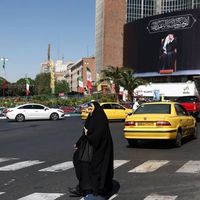
For years, young women from smaller cities and conservative families came to Tehran to study, to work, to breathe. Now, one by one, many are being forced to leave.
Firsthand reports from contributors inside Iran

For years, young women from smaller cities and conservative families came to Tehran to study, to work, to breathe. Now, one by one, many are being forced to leave.
Tehran was supposed to be the place they came to become themselves. They got into top universities, found jobs, rented apartments with friends. They built lives of their own.
A year of protests, crackdown, war and economic freefall has pushed many to the edge. Rent has become unbearable. Prices rise by the week. Incomes shrink or disappear.
They are moving back to Ahvaz, Shiraz or smaller towns to live with family because they can no longer afford Tehran. Some are selling gold, burning through savings or taking on debt to survive one more month.
The economic shock is everywhere. Layoffs are spreading. Inflation has become so absurd that people joke shops are still full of staples only because no one can afford to buy them.
And now, as if rent and inflation were not enough, officials say metro, bus and taxi fares in Tehran will rise next month. Even getting to work is becoming more expensive.
But for many, the deepest blow has come from the collapse of the digital economy.
In Iran, Instagram was more than an app. It was a shopfront, a beauty salon, a classroom, an office. Women sold clothes and cosmetics, baked cakes, offered beauty services, taught languages, designed logos and built small businesses from their bedrooms.
Now much of that is gone.
After two months of severe internet disruption, many online businesses are collapsing. Orders have dried up. Customers cannot browse. Payments are delayed. Messages do not go through.
Sima, 29, runs a small online clothing business. For two months, she says, almost no orders have come in. What once brought in modest but steady income has become little more than an empty storefront.
Baran, 34, says she feels herself “going crazy” thinking about how quickly life is unraveling. The online business she spent years building is collapsing. Payments are not arriving. Debts are piling up.
“Everything we built with blood and tears is going up in smoke,” she says.
What makes it worse is the silence. No explanation. No accountability. Just the slow erasure of livelihoods.
Layoffs in offices and shops appear to hit women especially hard. There are no official figures, but many suspect employers assume men are more likely to be breadwinners. A woman, they think, may have a husband or father to fall back on. But many do not—or do not want to.
For many women here, losing a job is not just losing income. It can mean losing a home, a city and a life they fought hard to build.
And so Tehran is losing its daughters.
The city that once offered escape is beginning to send them back. Back to smaller cities. Back to family homes. Back to dependence—often to the lives they thought they had escaped for good.


Iran has once again tapped its sovereign wealth reserves to fund essential imports, highlighting the growing strain on an economy battered by war, inflation and a rapidly weakening currency.
The government’s Task Force for Food Security and Livelihood Improvement has announced that $1 billion from the National Development Fund will be allocated to import basic goods such as sugar, rice, red meat and animal feed.
The move comes alongside a broader policy decision to continue subsidizing critical imports despite earlier plans to scale back such support. It marks the second time in two years that the fund has been tapped to finance basic imports.
With reserves estimated at around $40 billion, the fund is also expected to help rebuild war-damaged industries, particularly steel and petrochemicals, highlighting growing tension over how these resources are prioritized.
'Nothing left'
For many Iranians, the strain is already becoming unbearable.
Nader, a 42-year-old film industry worker, says he has had no income since January, when nationwide protests began, and is preparing to leave his rental home and move his family into his parents’ house in another city.
“My wife’s job depended on the internet, and she has also become unemployed,” he said. “We’ve been using our savings to pay rent, but if we continue, soon nothing will be left for food or unexpected medical costs.”
The move also marks a reversal of the government’s “economic surgery” policy introduced four months ago to reduce import subsidies.
Authorities are continuing to allocate foreign currency for essential imports, including medicine, at a fixed rate of 285,000 rials per dollar—far below the open market rate of around 1.5 million rials and the official budget rate of 1.23 million.
This subsidized rate, capped at $3.5 billion, applies to critical imports including wheat, medicine, pharmaceutical ingredients and infant formula. An additional $1 billion withdrawal from the sovereign fund is intended to help sustain the system.
Wheat and infant formula remain among the government’s highest priorities because shortages or price spikes could trigger social unrest.
Rising unemployment
To offset price hikes after January’s subsidy cuts on goods such as meat and cooking oil, the government reintroduced a coupon system. Around 87 million people receive monthly vouchers, initially worth 10 million rials per person.
But their value has eroded rapidly. Monthly inflation reached 7 percent and point-to-point inflation 67 percent, according to the Central Bank of Iran.
Consumers describe day-to-day increases in the price of basic goods and services, leaving many households unable to afford necessities.
At the same time, unemployment is rising sharply.
War-related damage to steel and petrochemical hubs has left large numbers of workers jobless and disrupted downstream industries reliant on their output.
'Hunger riots'
A prolonged internet shutdown—now entering its third month—has compounded the crisis, cutting off income for millions. Tourism has also collapsed, with airlines, hotels and local accommodations nearly inactive after the 12-day war.
Even those who remain employed are watching their purchasing power evaporate.
At a petrochemical terminals company in Bandar Mahshahr, representatives for more than 700 workers say their employer has eliminated overtime, holiday pay and welfare benefits.
In some cases, workers report wages have gone unpaid for months.
Political analyst Shahin Shahid-Saless warned that a naval blockade restricting oil exports and broader trade could accelerate the currency’s collapse.
“The national currency will collapse at an unbelievable speed, and hyperinflation will emerge,” he said. “The country may face … hunger riots whose intensity and violence would be entirely different from [recent] movements.”
Iran’s near-total shutdown of the global internet reached 60 days on Tuesday, worsening economic losses and social restrictions as authorities move toward selective access for some users and businesses.
The disruption began on February 28, when connectivity dropped to a fraction of normal levels, according to internet monitor NetBlocks, and has since stretched beyond 1,400 hours with most users still cut off from global networks.
“Exactly two months ago … Iran was thrown into digital darkness,” NetBlocks said, adding that the blackout persists despite limited access for privileged users.
Economic toll runs into billions
The prolonged shutdown has transformed internet access into a central economic constraint, with losses mounting daily across multiple sectors.
Estimates from Iran’s Chamber of Commerce put direct daily losses at $30 million to $40 million, rising to as much as $70 million to $80 million when indirect damage is included.
Communications Minister Sattar Hashemi said the disruption threatens the livelihoods of around 10 million people, pointing to the limited resilience of small and medium-sized businesses.
Zahra Behrouz-Azar, the vice president for women’s affairs, said women have been disproportionately affected, with many home-based businesses collapsing under the restrictions.
“The situation has been imposed like a war, and the damages should not be denied,” Behrouz-Azar said.
Export industries have also struggled to maintain international ties. Mohsen Ehtesham, the head of the National Saffron Council, said exporters had been unable to communicate with overseas clients or verify deliveries.
“Exporters … did not have direct contact with international customers, and could not even confirm whether goods had reached them,” Ehtesham said.
He added the disruption had weakened Iran’s position in global markets and created openings for competitors such as Afghanistan to rebrand Iranian saffron.
Social divide deepens
Beyond the economic toll, the blackout has disrupted daily life and created a two-tier digital reality, with limited access granted to select groups while most Iranians remain cut off.
For younger Iranians, internet access is closely tied to education, identity and social life, making the prolonged shutdown especially disruptive.
The divide has become more visible as officials and connected groups retain access to platforms blocked for ordinary users, while much of the population remains limited to a heavily restricted domestic network.
Human rights groups say such shutdowns restrict access to information, make abuses harder to document and leave crises with less public scrutiny.
‘Internet Pro’ plan fuels backlash
Authorities have sought to manage the fallout by advancing a plan known as “Internet Pro,” which would restore global access for selected businesses and institutions while most users remain restricted.
Under the proposal, approved by the Supreme National Security Council, commercial entities and later industrial sectors would receive connectivity, with officials presenting the measure as a form of economic management.
Government spokesperson Fatemeh Mohajerani said the plan aims to preserve business operations during crisis conditions.
“Internet Pro has been approved … to preserve business connections under current conditions,” Mohajerani said, adding that access could change once authorities declare conditions normal.
The plan has drawn criticism for formalizing unequal access. Reports show some connections have been sold at high prices, prompting judiciary chief Gholamhossein Mohseni Ejei to order an investigation, describing the practice as discriminatory and potentially corrupt.
Civil society pushes back
Professional groups and users have rejected the proposal, describing it as institutionalizing digital inequality.
The Iranian Graphic Designers Guild said it would not submit a collective request for the service, calling it an insult and reaffirming the need for open and affordable access for all.
Public reaction has echoed that stance, with users criticizing the idea of restricting connectivity in an era where digital access underpins economic survival and social participation.
At the same time, authorities are accelerating development of domestic infrastructure aimed at reducing reliance on the global internet, a move critics view as enabling longer-term isolation.
Iran’s foreign trade has suffered a sharp contraction in the first month of war with the United States and Israel, newly released customs data show, signaling a severe blow to the country’s already fragile economy.
Figures from Iran’s customs administration show non-oil trade collapsed in the final month of the previous Iranian fiscal year (February 21–March 22), falling to just $6.4 billion—down 30% from the previous month and 50% from a year earlier.
The plunge coincided with military escalation that began on February 28, when US and Israel attacked Iran and Iran retaliated with strikes against Arab neighbours across the Persian Gulf.
The conflict disrupted shipping routes and strained regional trade links.
The fallout has been especially visible in trade with Iran’s main commercial partners. The United Arab Emirates, Iran’s second-largest trading partner, reportedly suspended trade with Tehran in early March.
Chinese customs data also point to a steep decline in bilateral trade. China’s non-oil trade with Iran fell to just $184 million in March, compared with more than $907 million in the same month last year—roughly one-fifth of its level a year earlier.
While Iranian customs data exclude crude oil exports, tanker-tracking data from Kpler indicate Iranian crude deliveries to Chinese ports averaged around 1.53 million barrels per day in March, about 15% lower than in March 2025, suggesting energy exports are also under pressure.
In total, Iran’s non-oil foreign trade during the last fiscal year stood at $109 billion, down 16% from the previous year. Imports accounted for 53% of the total, underscoring the economy’s reliance on foreign supplies at a time of escalating geopolitical disruption.
The outlook may worsen in the months ahead.
Following Israeli strikes on petrochemical facilities, Iran has banned petrochemical exports. On Monday, the Iran Trade Promotion Organization ordered a halt to exports of steel slabs and sheets until May 30 as the country’s steel industry came under pressure following US-Israeli strikes.
The secretary of Iran’s steel producers’ association said work was underway on an urgent plan to import steel slabs and hot-rolled sheets, underscoring the scale of the disruption.
At the same time, steel production facilities in Isfahan and Khuzestan—which account for roughly 70% of Iran’s steel output—have reportedly suffered major damage.
Together, petrochemicals and steel generate an estimated $18 billion to $20 billion in annual exports, accounting for more than one-third of Iran’s non-oil export revenues. Prolonged disruption in those sectors would hit government revenues, industrial output and access to foreign currency.
Additional pressure is also emerging at sea. In response to Iran’s move to block the Strait of Hormuz, the United States has begun enforcing a naval blockade on Iran, a development likely to further restrict both oil and non-oil trade.
With US-Iran diplomacy still deadlocked and sanctions relief appearing distant, the outlook could worsen further in the absence of a deal to ease pressure on trade and energy exports.
Taken together, the data suggest Iran may be facing not a temporary slowdown but the early stages of a historic external shock.
Amid Iran’s closure of the Strait of Hormuz and the ensuing US blockade, an old energy fantasy has resurfaced that cutting off a country’s oil exports works like flipping a switch. But reality is less cinematic and far more uncomfortable.
If Iran faced a serious maritime blockade, its oil system would not collapse overnight. It would absorb the shock, adapt, and only gradually tighten under pressure.
That distinction between sudden failure and slow strain is not just technical. It is the difference between a crisis markets can price instantly and one that unfolds in uneasy stages.
As Washington says its blockade is tightening around Tehran, understanding that distinction matters.
Kharg Island: The pressure point
Nearly all of Iran’s crude exports flow through Kharg Island, which handles about 90 percent of outbound shipments. On a typical day, that means roughly 1.5 to 2 million barrels moving through its loading facilities.
Kharg is more than a transit point. It is also a buffer. With storage capacity estimated at between 20 and 30 million barrels, the island allows Iran to keep producing even when export schedules fluctuate.
Under blockade conditions, that flexibility becomes a liability. If tankers cannot load or leave reliably, crude begins accumulating in storage. At current export levels, even the upper bound of capacity could be filled in a matter of weeks.
The island would not fail immediately. But it would begin operating under a visible constraint: every additional barrel has fewer places to go.
When storage becomes a bottleneck
Oil systems are built with redundancy. Storage tanks, pipelines and floating storage options all provide breathing room. That is why disruption rarely produces instant collapse.
In a blockade scenario, Iran would likely continue exporting in reduced and irregular ways at first. Some cargoes might slip through via evasive shipping practices. Others could be rerouted or delayed. Meanwhile, crude that cannot be exported would accumulate in storage tanks on Kharg and elsewhere.
But storage is finite. As tanks fill, flexibility narrows. The system shifts from optimizing flows to managing congestion.
Operators are no longer asking how to move oil efficiently, but how to avoid hitting physical limits. This is the quiet phase of disruption: no dramatic cutoff, just a steady tightening that forces increasingly constrained choices.
Adaptation under pressure
Iran’s oil sector is no stranger to operating under constraint. Years of sanctions have trained it to improvise.
Cargoes could still move through ship-to-ship transfers and opaque shipping routes designed to obscure origin and destination. Parts of the tanker fleet could be repurposed as floating storage to buy time offshore as onshore tanks fill.
Production would not stop overnight but would likely be trimmed gradually, with operators calibrating output to avoid overwhelming storage while trying to preserve reservoir integrity.
Domestic refiners could absorb some additional crude, and inland storage might be stretched, though both options are limited and cannot fully offset lost export capacity.
These responses would not neutralize the impact of a blockade. But they would slow its effects, allowing the system to continue functioning in a constrained and increasingly inefficient state.
The result is not resilience so much as endurance: the ability to delay more severe disruptions.
The limits beneath the surface
What happens underground imposes its own discipline.
Oil reservoirs are not infinitely flexible. Shutting in production, especially in mature fields, can damage reservoir pressure and reduce long-term recovery.
That means Iran cannot simply halt output the moment storage fills. Production cuts must be sequenced carefully, prioritizing fields that can be shut in safely while protecting long-term capacity.
The system slows, recalibrates and absorbs damage where it must, all while trying to avoid irreversible losses.
Pressure builds, markets adjust
For global markets and policymakers, the difference between a sudden cutoff and a gradual squeeze is critical.
A sharp disruption would trigger immediate price spikes and emergency responses. A slower, adaptive contraction produces a different dynamic. Prices may rise in stages. Other producers have time to respond.
Strategic reserves can be deployed more deliberately. Trade flows can be rerouted.
Yet this slower progression carries its own risks. It creates uncertainty rather than clarity and tempts decision-makers to underestimate the severity of the situation, even as constraints tighten.
No switch, just strain
A blockade of Iran’s oil exports would not look like a sudden shutdown. It would resemble a system under mounting pressure, adapting in real time while steadily losing room to maneuver.
For Iran, the effect is less a collapse than a managed deterioration. Revenues would erode, costs would rise, and each workaround would become harder to sustain.
For global markets, the danger lies in misreading that slow burn as stability.
By the time constraints converge into something more acute, the system may already be far closer to its limits than it appears.
Recent tracking data suggesting Iran is still moving millions of barrels of crude despite a US naval blockade has raised fresh questions about the effectiveness of Washington’s effort to choke off Tehran’s oil exports.
TankerTrackers.com on Sunday cited satellite images that it said showed Iran loaded at least 4.6 million barrels of crude at export terminals in recent days, with another four million barrels appearing to have crossed the US blockade line.
The figures suggest Tehran retains at least some ability to keep oil flowing despite a US naval blockade launched nearly two weeks ago and repeated claims from Washington that the operation is crippling Iran’s maritime trade.
How effective has the blockade been?
US Central Command has portrayed the blockade as increasingly effective.
In its latest update on April 25, CENTCOM said US forces had “redirected” 37 vessels since the blockade began against ships entering or departing Iranian ports on April 13.
US forces have also expanded enforcement beyond the Persian Gulf, intercepting or seizing tankers in the Indian Ocean and Arabian Sea suspected of carrying Iranian crude.
Washington has framed the operation less as a hermetic seal than an economic squeeze. US officials argue the blockade’s effectiveness should be measured by whether Iran’s revenues are being cut.
Independent maritime trackers, however, paint a more complicated picture.
How is Iran still moving oil?
Shipping intelligence firm Lloyd’s List Intelligence reported this week that at least 26 vessels linked to Iran, including 11 oil and gas tankers and two very large crude carriers, have sailed in and out of Iranian ports since the blockade began.
The Financial Times, citing cargo tracking firm Vortexa, reported the figure could be as high as 34 Iran-linked tankers bypassing the blockade line in the Strait of Hormuz, including six outbound tankers carrying around 10.7 million barrels of crude.
Vortexa has also identified multiple fully laden tankers slipping past US warships. Bloomberg reported that a wider flotilla may have moved roughly nine million barrels around the blockade in recent days.
Iran’s so-called shadow fleet has long relied on tactics such as switching off AIS transponders, spoofing vessel locations, conducting ship-to-ship transfers, relabeling cargoes and using front companies to disguise ownership and destinations.
Since the blockade began, shipping analysts have observed vessels “going dark” near Iranian terminals before reappearing beyond the enforcement line.
Others have hugged coastal routes or moved through narrow shipping lanes where interception becomes more politically and operationally difficult.
What impact is the blockade having?
Even so, the blockade appears to be having an impact.
Traffic through the Strait of Hormuz has dropped sharply from normal levels, insurers have raised premiums, and some buyers have reportedly delayed or canceled purchases amid legal and logistical uncertainty.
Higher freight rates and longer voyages are also increasing costs for Iranian exports and for customers, chiefly in China.
The longer the blockade persists, the greater the chance Iran faces storage bottlenecks at export terminals or is forced to shut in production.
For now, the blockade appears to be functioning less as an impenetrable wall than as a bottleneck: slowing, complicating and raising the cost of Iran’s oil trade without stopping it entirely.
That may be enough for Washington to claim success and enough for Tehran to claim survival.