• العربية
  • فارسی
Brand
  • Iran Insight
  • Politics
  • Economy
  • Analysis
  • Special Report
  • Opinion
  • Podcast
  • Iran Insight
  • Politics
  • Economy
  • Analysis
  • Special Report
  • Opinion
  • Podcast
  • Theme
  • Language
    • العربية
    • فارسی
  • Iran Insight
  • Politics
  • Economy
  • Analysis
  • Special Report
  • Opinion
  • Podcast
All rights reserved for Volant Media UK Limited
volant media logo
INSIGHT

Iran taps reserves again as inflation bites and layoffs mount

Maryam Sinaiee
Maryam Sinaiee

Iran International

Apr 29, 2026, 05:37 GMT+1
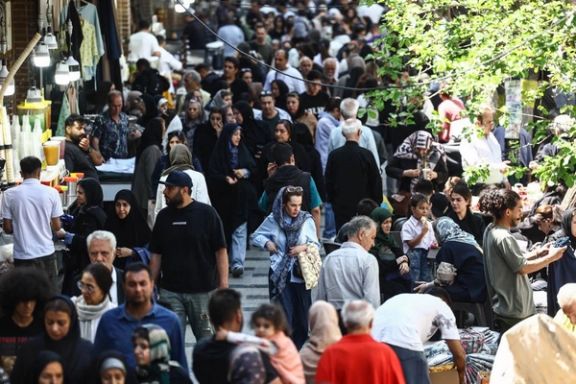
People walk in Tehran's Grand Bazaar, April 21, 2026

Iran has once again tapped its sovereign wealth reserves to fund essential imports, highlighting the growing strain on an economy battered by war, inflation and a rapidly weakening currency.

The government’s Task Force for Food Security and Livelihood Improvement has announced that $1 billion from the National Development Fund will be allocated to import basic goods such as sugar, rice, red meat and animal feed.

The move comes alongside a broader policy decision to continue subsidizing critical imports despite earlier plans to scale back such support. It marks the second time in two years that the fund has been tapped to finance basic imports.

With reserves estimated at around $40 billion, the fund is also expected to help rebuild war-damaged industries, particularly steel and petrochemicals, highlighting growing tension over how these resources are prioritized.

'Nothing left'

For many Iranians, the strain is already becoming unbearable.

Nader, a 42-year-old film industry worker, says he has had no income since January, when nationwide protests began, and is preparing to leave his rental home and move his family into his parents’ house in another city.

“My wife’s job depended on the internet, and she has also become unemployed,” he said. “We’ve been using our savings to pay rent, but if we continue, soon nothing will be left for food or unexpected medical costs.”

The move also marks a reversal of the government’s “economic surgery” policy introduced four months ago to reduce import subsidies.

Authorities are continuing to allocate foreign currency for essential imports, including medicine, at a fixed rate of 285,000 rials per dollar—far below the open market rate of around 1.5 million rials and the official budget rate of 1.23 million.

This subsidized rate, capped at $3.5 billion, applies to critical imports including wheat, medicine, pharmaceutical ingredients and infant formula. An additional $1 billion withdrawal from the sovereign fund is intended to help sustain the system.

Wheat and infant formula remain among the government’s highest priorities because shortages or price spikes could trigger social unrest.

Rising unemployment

To offset price hikes after January’s subsidy cuts on goods such as meat and cooking oil, the government reintroduced a coupon system. Around 87 million people receive monthly vouchers, initially worth 10 million rials per person.

But their value has eroded rapidly. Monthly inflation reached 7 percent and point-to-point inflation 67 percent, according to the Central Bank of Iran.

Consumers describe day-to-day increases in the price of basic goods and services, leaving many households unable to afford necessities.

At the same time, unemployment is rising sharply.

War-related damage to steel and petrochemical hubs has left large numbers of workers jobless and disrupted downstream industries reliant on their output.

'Hunger riots'

A prolonged internet shutdown—now entering its third month—has compounded the crisis, cutting off income for millions. Tourism has also collapsed, with airlines, hotels and local accommodations nearly inactive after the 12-day war.

Even those who remain employed are watching their purchasing power evaporate.

At a petrochemical terminals company in Bandar Mahshahr, representatives for more than 700 workers say their employer has eliminated overtime, holiday pay and welfare benefits.

In some cases, workers report wages have gone unpaid for months.

Political analyst Shahin Shahid-Saless warned that a naval blockade restricting oil exports and broader trade could accelerate the currency’s collapse.

“The national currency will collapse at an unbelievable speed, and hyperinflation will emerge,” he said. “The country may face … hunger riots whose intensity and violence would be entirely different from [recent] movements.”

Most Viewed

Iran's top security council holds meeting over fears of renewed protests
1
EXCLUSIVE

Iran's top security council holds meeting over fears of renewed protests

2
EXCLUSIVE

New intelligence exposes IRGC-linked network targeting Israeli, Western sites

3
INSIGHT

US talks trigger unprecedented rift in Iran’s hardline camp

4
ANALYSIS

Three layers of mistrust behind US-Iran deadlock

5
ANALYSIS

Why a blockade would not halt Iran’s oil overnight

Banner
Banner

Spotlight

  • Tehran is pricing out its daughters
    TEHRAN INSIDER

    Tehran is pricing out its daughters

  • US talks trigger unprecedented rift in Iran’s hardline camp
    INSIGHT

    US talks trigger unprecedented rift in Iran’s hardline camp

  • Calls for secrecy in Tehran reflect divisions over US talks
    INSIGHT

    Calls for secrecy in Tehran reflect divisions over US talks

  • Three layers of mistrust behind US-Iran deadlock
    ANALYSIS

    Three layers of mistrust behind US-Iran deadlock

  • Iran’s water crisis: Mafia or destruction by design?
    SPECIAL REPORT

    Iran’s water crisis: Mafia or destruction by design?

  • Iran’s foreign trade suffers wartime collapse
    ANALYSIS

    Iran’s foreign trade suffers wartime collapse

  • Why a blockade would not halt Iran’s oil overnight
    ANALYSIS

    Why a blockade would not halt Iran’s oil overnight

•
•
•

More Stories

US talks trigger unprecedented rift in Iran’s hardline camp

Apr 28, 2026, 21:36 GMT+1

A widening split over how to deal with the United States has reached the deepest layers of Iran’s hardline establishment, surfacing in state-linked media and among factions that have long presented a united front under the banner of revolutionary loyalty.

The divide became unusually public this week as several ultraconservative MPs refused to sign a letter backing Iran’s negotiating team. The dispute then spilled into hardline media, triggering an unprecedented public clash between Raja News and the Revolutionary Guards-linked Tasnim News Agency.

The confrontation largely pits supporters of former nuclear negotiator and National Security Council member Saeed Jalili against allies of his longtime rival, parliament speaker Mohammad Bagher Ghalibaf, who recently led Iran’s delegation in talks in Islamabad.

On Monday, Iranian media reported that 27 members of parliament—including seven affiliated with Jalili’s ultraconservative camp—refused to sign a letter backing the negotiating team and Ghalibaf’s leadership in the Islamabad talks.

One of them, Mahmoud Nabavian, who had traveled to Islamabad with the delegation, later claimed that Mojtaba Khamenei’s “red lines” had been violated. He alleged that negotiators had engaged with the United States on nuclear issues against those guidelines.

Continue reading

Saeed Jalili (left), a former chief negotiator and current member of Iran's Supreme National Security Council, listens to slain Supreme Leader Ali Khamenei in this file photo from 2025
100%
Saeed Jalili (left), a former chief negotiator and current member of Iran's Supreme National Security Council, listens to slain Supreme Leader Ali Khamenei in this file photo from 2025

US talks trigger unprecedented rift in Iran’s hardline camp

Apr 28, 2026, 21:12 GMT+1
•
Maryam Sinaiee

A widening split over how to deal with the United States has reached the deepest layers of Iran’s hardline establishment, surfacing in state-linked media and among factions that have long presented a united front under the banner of revolutionary loyalty.

The divide became unusually public this week as several ultraconservative MPs refused to sign a letter backing Iran’s negotiating team. The dispute then spilled into hardline media, triggering an unprecedented public clash between Raja News and the Revolutionary Guards-linked Tasnim News Agency.

The confrontation largely pits supporters of former nuclear negotiator and National Security Council member Saeed Jalili against allies of his longtime rival, parliament speaker Mohammad Bagher Ghalibaf, who recently led Iran’s delegation in talks in Islamabad.

On Monday, Iranian media reported that 27 members of parliament—including seven affiliated with Jalili’s ultraconservative camp—refused to sign a letter backing the negotiating team and Ghalibaf’s leadership in the Islamabad talks.

One of them, Mahmoud Nabavian, who had traveled to Islamabad with the delegation, later claimed that Mojtaba Khamenei’s “red lines” had been violated. He alleged that negotiators had engaged with the United States on nuclear issues against those guidelines.

In recent days, hardline lawmakers and commentators have increasingly criticized the negotiating team.

Jalili himself appeared to escalate tensions when he called on Mojtaba Khamenei to clarify publicly whether ongoing actions reflected his directives. In a now-deleted post, he wrote that if no such message was issued, “there is one hundred percent a ‘sedition of officials,’ and all these statements are written by the coup plotter himself.”

The remark was widely seen as aimed at Ghalibaf.

The feud escalated further after a Tasnim editorial said demanding the United States lift all sanctions or agree to a comprehensive ceasefire with Iran’s armed allies in the region amounted to unrealistic expectations like a “magic beanstalk.”

The article also argued that negotiations with the United States should not be seen as a final solution and that “the power of the people in the streets” could serve as Iran’s main leverage.

Raja News published a harsh response.

Tasnim later removed the article, saying it had republished it from another outlet, but responded in an unusually sharp tone, accusing Raja of inciting division and acting against national security.

It said the outlet was “seeking to complete Trump’s project in Iran” and noted that some individuals had recently been arrested over “suspicious movements to undermine sacred unity.”

A Telegram post by Saberin News, a channel linked to security institutions, went further, labeling the Paydari Party as the Kharijites—a historical term for extremist dissenters who opposed and ultimately assassinated Imam Ali, the first Shia imam.

The post accused them of “sowing division on the battlefield” and “playing in favor of Israel and the United States.”

Iran’s state broadcaster (IRIB) has also come under scrutiny for alleged bias. Its deputy for cultural affairs, Vahid Jalili, is Saeed Jalili’s brother.

Moderate outlet Khabar Online reported that by its count, 8 out of 10 of pundits appearing on IRIB during the recent conflict have been conservatives, with 15 percent linked to the ultraconservative Paydari Front.

“The problem is not just the elimination of reformists; the data shows that even moderate conservatives or critical insiders have almost no presence in these programs,” the outlet wrote.

Raja News later said it would avoid prolonging the dispute in public and would instead pursue legal action. But as the stakes rise—whether through renewed talks with Washington or a return to war—it may prove difficult to put the genie back in the bottle.

Calls for secrecy in Tehran reflect divisions over US talks

Apr 28, 2026, 18:36 GMT+1

As efforts continue to revive talks with the United States, Iranian lawmakers and state-linked outlets are increasingly calling for secrecy around negotiations.

The growing calls for secrecy may reflect an effort to control the narrative as divisions emerge at home over how far Iran should go in any negotiations.

Ahmad Bakhshayesh Ardestani, a member of parliament’s National Security and Foreign Policy Committee, told reporters on Monday that “not everything about the negotiations needs to be stated openly.”

He compared diplomacy to marriage negotiations, where each side conceals parts of its background until after an agreement is reached, insisting that secrecy does not contradict transparency with the public.

Continue reading

Women covering their faces attend a state-sponsored rally against Israel and the United States, Tehran, Iran, April 22, 2026
100%
Women covering their faces attend a state-sponsored rally against Israel and the United States, Tehran, Iran, April 22, 2026

Calls for secrecy in Tehran reflect divisions over US talks

Apr 28, 2026, 18:08 GMT+1
•
Behrouz Turani

As efforts continue to revive talks with the United States, Iranian lawmakers and state-linked outlets are increasingly calling for secrecy around negotiations.

The growing calls for secrecy may reflect an effort to control the narrative as divisions emerge at home over how far Iran should go in any negotiations.

Ahmad Bakhshayesh Ardestani, a member of parliament’s National Security and Foreign Policy Committee, told reporters on Monday that “not everything about the negotiations needs to be stated openly.”

He compared diplomacy to marriage negotiations, where each side conceals parts of its background until after an agreement is reached, insisting that secrecy does not contradict transparency with the public.

Iran used similar tactics at least twice in recent history: during the release of American hostages in January 1981 after 444 days in captivity, and in August 1988 when it accepted the ceasefire that ended the eight-year war with Iraq.

On Tuesday, ultraconservative lawmaker Amir Hossein Sabeti, a prominent anti-US figure, called for “nuclear ambiguity,” arguing that the United States and Israel would have used nuclear weapons against Iran had they known the exact location of Iran’s enriched uranium stockpiles.

His remarks coincided with similar statements from other lawmakers urging officials not to speak publicly about Iran’s positions on the nuclear issue or the Strait of Hormuz—two of the central obstacles in diplomatic efforts to break the deadlock in Iran-US relations.

US President Donald Trump said on Tuesday that Tehran had told Washington it wanted the Strait of Hormuz reopened “as soon as possible,” suggesting efforts to revive talks may include discussions over shipping through the strategic waterway.

In a Truth Social post, Trump said Iran was in a “state of collapse” and was trying to resolve “their leadership situation,” though Tehran has not publicly commented on the claim.

In Tehran, conflicting public statements have underscored divisions within the political establishment over the talks.

Ultraconservative MP Ali Khezrian told state broadcaster that all doors of negotiation with the United States were shut down” adding that no messages were being exchanged through intermediaries.

Yet other lawmakers have acknowledged that talks are continuing, including Ardestani, who said, “we cannot stop negotiating … we have won the war, and we need to establish our victory in negotiations.”

Khezrian and Ardestani both said hardline cleric and lawmaker Mahmoud Nabavian—who accompanied the Iranian delegation to Islamabad during the first round of talks—was there only to brief parliament afterward.

Nabavian later said it had been “a mistake” to include the nuclear issue in the discussions.

In a report published on April 27, Khabar Online cited conservative commentator Mohammad Mohajeri criticizing lawmakers and some officials for making “uncalculated” statements on foreign-policy matters, including Iran’s position on the Strait of Hormuz.

According to the report, remarks about imposing taxes on shipping, proposing a “new legal regime” for the waterway, or using the term “closure of the strait” instead of “control” have raised concerns they could harm Iran’s national interests and create legal complications.

Khabar Online also warned lawmakers not to undermine the authority of the Supreme National Security Council, which coordinates national-security and foreign-policy positions.

Iran’s foreign trade suffers wartime collapse

Apr 28, 2026, 04:36 GMT+1
•
Dalga Khatinoglu

Iran’s foreign trade has suffered a sharp contraction in the first month of war with the United States and Israel, newly released customs data show, signaling a severe blow to the country’s already fragile economy.

Figures from Iran’s customs administration show non-oil trade collapsed in the final month of the previous Iranian fiscal year (February 21–March 22), falling to just $6.4 billion—down 30% from the previous month and 50% from a year earlier.

The plunge coincided with military escalation that began on February 28, when US and Israel attacked Iran and Iran retaliated with strikes against Arab neighbours across the Persian Gulf.

The conflict disrupted shipping routes and strained regional trade links.

The fallout has been especially visible in trade with Iran’s main commercial partners. The United Arab Emirates, Iran’s second-largest trading partner, reportedly suspended trade with Tehran in early March.

Chinese customs data also point to a steep decline in bilateral trade. China’s non-oil trade with Iran fell to just $184 million in March, compared with more than $907 million in the same month last year—roughly one-fifth of its level a year earlier.

While Iranian customs data exclude crude oil exports, tanker-tracking data from Kpler indicate Iranian crude deliveries to Chinese ports averaged around 1.53 million barrels per day in March, about 15% lower than in March 2025, suggesting energy exports are also under pressure.

In total, Iran’s non-oil foreign trade during the last fiscal year stood at $109 billion, down 16% from the previous year. Imports accounted for 53% of the total, underscoring the economy’s reliance on foreign supplies at a time of escalating geopolitical disruption.

The outlook may worsen in the months ahead.

Following Israeli strikes on petrochemical facilities, Iran has banned petrochemical exports. On Monday, the Iran Trade Promotion Organization ordered a halt to exports of steel slabs and sheets until May 30 as the country’s steel industry came under pressure following US-Israeli strikes.

The secretary of Iran’s steel producers’ association said work was underway on an urgent plan to import steel slabs and hot-rolled sheets, underscoring the scale of the disruption.

At the same time, steel production facilities in Isfahan and Khuzestan—which account for roughly 70% of Iran’s steel output—have reportedly suffered major damage.

Together, petrochemicals and steel generate an estimated $18 billion to $20 billion in annual exports, accounting for more than one-third of Iran’s non-oil export revenues. Prolonged disruption in those sectors would hit government revenues, industrial output and access to foreign currency.

Additional pressure is also emerging at sea. In response to Iran’s move to block the Strait of Hormuz, the United States has begun enforcing a naval blockade on Iran, a development likely to further restrict both oil and non-oil trade.

With US-Iran diplomacy still deadlocked and sanctions relief appearing distant, the outlook could worsen further in the absence of a deal to ease pressure on trade and energy exports.

Taken together, the data suggest Iran may be facing not a temporary slowdown but the early stages of a historic external shock.