Disputes within Iran leadership blocked negotiators’ trip to Islamabad
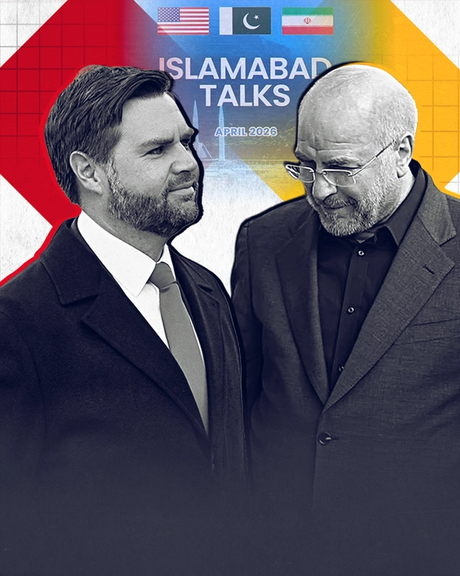
Divisions within Iran’s leadership prevented a negotiating team from traveling to Islamabad for talks with the US, Iran International has learned.
Tensions between allies of President Masoud Pezeshkian and figures close to Supreme Leader Mojtaba Khamenei’s office derailed the trip at the last minute.
According to the sources familiar with the matter, the delegation was ready to leave when a message from Khamenei’s inner circle ruled out discussing nuclear issues and reprimanded the foreign ministry team over earlier negotiations.




Babak Kharbo, a 33-year-old protester jailed in Isfahan, is facing charges that could carry the death penalty, a source close to his family told Iran International.
Kharbo was arrested in February in the town of Dizicheh and is currently held in Dastgerd prison without access to a lawyer. The source said he was subjected to interrogation and torture after his arrest, and that his family had been warned not to pursue efforts for his release.
Link to protest killings
He is the uncle of Alireza Kharbo, a 20-year-old protester killed during demonstrations in January. According to sources close to their family, Alireza was shot by Basij forces and later died in custody, with his body returned to the family bearing multiple gunshot wounds.
At least three other protesters were also killed during the same unrest.
Iran is facing severe shortages of key petrochemical products after recent strikes on its main production hubs, according to two informed sources inside the country.
Earlier this month, Israel targeted facilities in Mahshahr and Asaluyeh, Iran’s two principal petrochemical centers, which together account for roughly three-quarters of the country’s output.
According to commercial sources who spoke on condition of anonymity, several petrochemical products have become acutely scarce, particularly polymer grades used in food packaging, plastics and basic manufacturing.
The shortages have forced authorities to explore emergency import options, even as logistical and geopolitical constraints complicate procurement.
The scale of disruption is still being assessed, but industry sources say the impact on domestic supply chains has been immediate.
Najmeh Jamshidi, editor-in-chief of Energy Press, previously reported, citing senior executives at petrochemical complexes, that restoring damaged units and associated infrastructure could take anywhere from six months to two years, depending on the extent of damage.
One source said Russia declined Iran’s request to supply certain polymers, citing a sharp rise in global petrochemical prices linked to disruptions in the Strait of Hormuz. According to the source, Moscow is prioritizing domestic supply to prevent further inflationary pressure in its own market.
Ilham Shaban, head of the Caspian Oil Studies Center, said Russia itself is facing constraints, as some of its petrochemical facilities have been damaged in Ukrainian attacks. This has further limited the country’s ability to meet external demand, particularly for higher-value polymer products.
Before the recent disruptions, Iran exported about 30 million tons of petrochemical products worth roughly $15 billion annually, with polymers accounting for around 12 percent of that volume.
In response to the supply shock, Iranian authorities have moved to ban exports of several petrochemical goods in an effort to stabilize the domestic market.
Another commercial source said Iran has approached Azerbaijan as a potential supplier of polymers, but the country’s limited production capacity makes it unable to significantly offset Iran’s shortfall.
Azerbaijan is also expected to prioritize maintaining its established export markets in Europe and Turkey.
Some of Iran’s Arab neighbours have the scale to potentially offset part of the supply gap. Saudi Arabia alone has about 19 million tons of annual polymer production capacity, while the United Arab Emirates and Qatar are also major exporters.
However, given Iran’s recent attacks on these countries during the conflict, they are unlikely to assist in covering Iran’s shortages.
At the same time, disruptions affecting shipping routes through the Strait of Hormuz over the past two months have pushed global polymer prices up by about 50 percent.
The combination of domestic supply disruptions and tightening international markets has deepened shortages, raising concerns about broader impacts on downstream industries and the availability of consumer goods.
A 14-year-old student disappeared during protests near Tehran on January 8, only for his family to receive his body 60 days later with a gunshot wound to the temple, Iran International has learned.
Amir-Mohammad Shahkarami, an eighth-grade student, vanished as security forces suppressed demonstrations in Shahre Qods, located west of Tehran. For two months, his family faced a series of conflicting reports from Iranian authorities regarding his safety.
On January 10, two days after he went missing, the boy's mobile phone was turned on. Government agents used the device to contact the family and tell them he was alive. Officials at the local judiciary later supported this account, telling the parents that the teenager was in custody and that a court had already issued a sentence against him.
The family also tried to find information through the Department of Education, but officials there labeled his file as "confidential" and refused to speak.
A 'finish-off' shot
After 60 days of silence, forensic officials finally called the family to identify a body. The body of the 14-year-old was delivered to the family.
When the family examined the body, they found a gunshot wound to the temple, a type of injury often described by rights groups as a "finish-off" shot. Large bruises also covered his chest and side.
Patterns of deception
The teenager’s death highlights the uncertainty facing many families of young detainees who disappeared during the January protests. Despite the assurances given to his parents in the weeks following his disappearance, the physical evidence on his body pointed to a violent death.
Rights groups have documented cases where Iranian authorities provide families with false information about the health or legal status of detained relatives to delay public reporting or to manage the fallout of deaths in custody.
The Iranian government has not explained why various state agencies told the family the boy was alive and sentenced while he was either already dead or facing terminal abuse in custody.
Iranian authorities have stepped up pressure on families of those killed in January protests, defacing, destroying or covering graves with cement in the northern city of Rasht and the capital Tehran, local sources told Iran International.
In Section 20 of Bagh Rezvan cemetery in Rasht, thick layers of cement had been poured over part of the graves of slain protestors, creating a uniform surface higher than the surrounding gravestones.
In some areas of the cemetery, the cemented section was so large that it was unclear how many graves lay side by side, the sources added.
Some graves showed no names or dates of birth or death, only a grey surface that appeared intended to erase all trace of them. Several others had small headstones roughly the size of an A4 sheet of paper, with only the deceased’s first and last names engraved in small script.
Witnesses said the graves were defaced and damaged in the presence of government agents and plainclothed security forces.
Graves levelled in Tehran
At Tehran’s main cemetery, Behesht Zahra, some graves of those killed were levelled with the ground and covered with cement after third-day mourning ceremonies, a memorial traditionally held three days after burial.
Sources said the graves were covered in a way that made it impossible to determine from a distance how many had been newly dug.
In Section 329 of the cemetery, families also said some gravestones were destroyed or broken in the days following Feb. 11, the anniversary of Iran's 1979 revolution.
Only a small number of families of slain protestors have so far managed to install gravestones, sources told Iran International.
Families said they were pressured to alter inscriptions on the stones.
In some cases, the use of the Persian term Javidnam—meaning eternally remembered and widely used for slain protestors—or the phrase Farzand-e Iran (“Child of Iran”) drew objections from state bodies and threats that the stones would be destroyed.
‘Too costly’
Families also reported threats to destroy the gravestones of Mojtaba Karabi and Azra Bahaderi-Nejad in the northeastern city of Sabzevar. They said paint had been sprayed on the gravestone of Arman Gorjian and a metal plaque at the grave of Maryam Ebrahimzadeh had been defaced.
Some families temporarily removed gravestones to prevent further damage and said they would not reinstall them until restrictions were lifted.
Gravestone sellers advised families to install stones only for the 40th-day memorial ceremony and remove them afterwards to avoid destruction, sources said, adding that many could not afford the cost of reinstalling headstones and its psychological impact.
Iran International previously received an image showing the broken gravestone of slain protestor Behnam Darvishi.
Darvishi was killed on Jan. 8 after being struck by live ammunition on Persian Gulf Boulevard in Tehran and was buried in Nahavand in western Iran.
Precedents
Damage to graves of people killed in the 2022 protests has also been reported in previous years, including those of Majidreza Rahnavard, Siavash Mahmoudi, Kian Pirfalak, Zakaria Khial and Aylar Haghi.
The broader protest movement followed the September 2022 death in custody of Mahsa Jina Amini, which triggered nationwide anti-government demonstrations.
In earlier cases, gravestones were broken while inscriptions were altered or removed.
In August 2023, Amnesty International said it had documented the destruction of graves belonging to more than 20 victims across 17 cities.
The group said graves had been damaged with tar, paint and arson, headstones had been broken, and phrases describing victims as martyrs or stating they died for freedom had been forcibly erased.
Iranian Parliament Speaker Mohammad Bagher Ghalibaf sharply criticized opponents of a potential agreement with the United States in a meeting with advisers, Iran International has learned.
Ghalibaf, who also led Iran’s team in the latest negotiating with Washington, described figures including Saeed Jalili, a member of Iran’s National Security Council, and hardline Iranian MP Amirhossein Sabeti as extremist militia-like actors who would destroy Iran.
He said the camp was using state television and mobilizing hardline supporters to intensify opposition to negotiations and a possible deal with the United States.
Ghalibaf also voiced concern about being removed from the speakership and about Foreign Minister Abbas Araghchi being pushed out of office.