Source says Israeli commandos helped rescue US pilot in Iran
An Israeli source told Iran International that two Israeli commando units, Shaldag and Sayeret Matkal, took part in the operation to rescue the American pilot.
According to the source, the mission lasted about 36 hours.
The source also said a US helicopter came under fire during the operation but was able to return safely to base.
Iranian filmmaker Jafar Panahi has returned to Iran, informed sources told Iran International, after traveling abroad for an international awards campaign.
Panahi entered the country on Tuesday by land via Turkey due to flight restrictions, the sources said.
He had been outside Iran to promote his film It Was Just an Accident, which won the Palme d’Or at the Cannes Film Festival and was shortlisted for the Academy Awards.
Panahi had previously said he would return to Iran after the Oscar campaign despite potential risks. “As soon as the campaign ends, I will return to Iran,” he said in a February interview.
The director has faced years of legal pressure in Iran, including a one-year prison sentence issued in absentia on charges of propaganda against the state, along with a two-year travel ban and other restrictions.
Panahi had faced a long-standing travel ban before being able to travel for the film’s international release. His work, often made despite official restrictions, has focused on social and political issues and drawn on his own experiences of detention and surveillance.
Rising tensions between the Pezeshkian administration and Iran’s military leadership have pushed the president into a “complete political deadlock,” with the Revolutionary Guard effectively assuming control over key state functions, informed sources told Iran International.
The IRGC has blocked presidential appointments and decisions while erecting a security perimeter around the core of power, effectively sidelining the government from executive control.
Efforts by Masoud to appoint a new intelligence minister last Thursday collapsed under direct pressure from IRGC chief-commander Ahmad Vahidi, sources with knowledge of the situation told Iran International.
All proposed candidates, including Hossein Dehghan, were rejected. Vahidi is said to have insisted that, given wartime conditions, all critical and sensitive leadership positions must be selected and managed directly by the IRGC until further notice.
Under Iran’s political system, presidents have traditionally nominated intelligence ministers only after securing the approval of the Supreme Leader, who holds ultimate authority over key security portfolios.
However, with the condition and whereabouts of Supreme Leader Mojtaba Khamenei unclear in recent weeks, the IRGC is now effectively blocking the president from advancing its preferred candidate, further consolidating its grip over the state’s security apparatus.
Security cordon around Khamenei Jr.
Pezeshkian has repeatedly sought an urgent meeting with Mojtaba Khamenei in recent days, but all requests have gone unanswered, with no contact established.
Informed sources say a “military council” composed of senior IRGC officers now exercises full control over the core decision-making structure, enforcing a security cordon around Mojtaba Khamenei and preventing government reports on the country’s situation from reaching him.
Speculation has also emerged regarding whether Mojtaba Khamenei’s health condition may be contributing to the current power dynamics.
Efforts to remove Hejazi
At the same time, an unprecedented internal crisis is reportedly unfolding within Mojtaba Khamenei’s inner circle. Some close associates are said to be pushing to remove Ali Asghar Hejazi, a powerful security figure in the Supreme Leader’s office.
The tensions are rooted in Hejazi’s explicit opposition to Mojtaba Khamenei’s potential succession. He had previously warned members of the Assembly of Experts that Mojtaba lacks the necessary qualifications for leadership and argued that hereditary succession is incompatible with the principles outlined by Supreme Leader Ali Khamenei, according to informed sources.
Hejazi reportedly cautioned that elevating Mojtaba would effectively hand full control of the country to the IRGC and permanently sideline civilian institutions.
In the first week of the ongoing war, Israeli media reported that Hejazi had been targeted in an airstrike in Tehran. However, later reports indicated that he survived the attack.
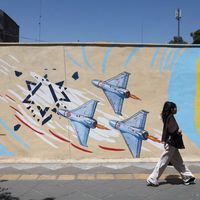
People walk near Iranian missiles in a park in Tehran, March 26, 2026.
A leaked internal directive from the IRGC’s missile command appears to show that the use of civilian locations to conceal, support and in some cases facilitate missile launch operations is not ad hoc, but structured, documented and built into operational planning.
The 33-page document shared with Iran International by the hacktivist group Edalat-e Ali (Ali’s Justice) has been marked “very confidential” and is titled Instruction for Identification, Maintenance, and Use of Positions.
The document is attributed to the Specialized Documents Center of the Intelligence and Operations Deputy of the IRGC's missile command.
A framework for missile operations
What emerges from the directive is a bureaucratic framework for missile deployment that goes well beyond hardened silos or underground “missile cities.”
The text lays out categories of launch positions, inspection procedures, coding systems, site records, chains of responsibility and rules for maintaining access to a wide network of locations that can be used before, during and after missile fire.
Its significance lies not only in the variety of launch positions it defines, but in the explicit inclusion of non-military environments in that system.
In its introduction, the document says missile positions are an inseparable part of missile warfare tactics and argues that the enemy’s growing ability to detect, track and destroy missile systems requires special rules for identifying, selecting, using and maintaining such positions.
It adds that the use of “deception,” “cover” and “normalization” alongside other methods would make the force more successful in using those positions.
That language is important. It suggests the document is not merely about protecting fixed military assets. It is about making missile units harder to distinguish from their surroundings and harder to detect in the first place.
The implication of the directive is that it describes a system for embedding missile activity within ordinary civilian geography.
Rather than relying only on conventional military facilities, the document sets out a model in which missile units can move across a wider landscape of pre-identified sites selected for concealment, access and operational utility.
The result is a structure that appears designed to preserve launch capability while reducing visibility and complicating detection.
The clearest indication comes in the section on what the document describes as artificial dispersion or cover positions. These include service, industrial and sports centers, as well as sheds and warehouses – places that are civilian in function or appearance, but can be repurposed to hide missile units.
The conditions listed for such sites include being enclosed, not overlooked by surrounding buildings, and either lacking CCTV cameras or allowing them to be switched off.
Taken together, those requirements point to a deliberate screening process for civilian sites that can be used as missile cover. The concern is not only protection from attack, but invisibility within the civilian landscape.
The broader structure of the document reinforces that conclusion. It contains sections on site identities, naming and coding, inspections of routes and positions, record maintenance and responsibilities across intelligence, operations, engineering, communications, safety, health and counterintelligence.
This is the language of a standing system, not an improvised wartime workaround.
An Iranian couple walks near Iranian missiles in a park in Tehran, March 26, 2026.
A system for concealment
Farzin Nadimi, a senior defense and security analyst at the Washington Institute who reviewed the document for Iran International’s The Lead with Niusha Saremi, said the text points to a database-driven effort to identify areas around missile bases that can be used for different kinds of positions.
He said the IRGC missile force appears to have mapped not only launch positions, but also dispersal, deception and technical positions – the latter being places suitable for storing launchers and support vehicles and, when needed, preparing missiles for firing.
“These technical positions,” Nadimi said, “can include large, covered spaces such as industrial sheds or sports halls, where missile launchers and support vehicles can be brought inside, and where missiles can be mounted onto launchers, warheads attached and, in the case of liquid-fueled systems, fueling operations carried out.”
That point is critical. If civilian-looking or civilian-owned structures are being used not only to shelter launchers, but also to prepare them for launch, then the document describes more than concealment. It describes the embedding of missile operations inside civilian infrastructure.
A network built for dispersal
Nadimi also said the directive places repeated emphasis on speed – getting launch vehicles into these buildings quickly before launch and returning them to cover quickly afterward.
In his reading, the database tied to these positions includes technical features of each site, access routes and nearby facilities, including the nearest medical center, police station and military post.
It also, he added, records whether use of the property can be coordinated in advance with the owner, including contact details, or whether occupation could occur without prior coordination in urgent cases.
If so, that would suggest the system extends down to the level of property access and local civilian surroundings, turning seemingly ordinary sites into preplanned nodes in a missile network.
The document’s own emphasis on route inspection, site profiles, records and coded classification supports the picture of a missile force operating through a dispersed support architecture rather than through fixed bases alone.
Iranian missiles displayed in a park (March 26, 2026)
Why this puts civilians at risk
Nadimi warned that the use of civilian environments is especially troubling because many IRGC launchers are themselves designed to blend into civilian traffic.
“Many of these launchers essentially resemble civilian vehicles or trailers,” he said.
He added that larger launchers for Khorramshahr missiles can be covered with a white casing that makes them look like an ordinary white civilian trailer, while the towing vehicle is also typically white.
Smaller launchers, he said, are often painted not in conventional camouflage but in ways that make them less conspicuous in civilian surroundings.
That observation fits closely with the document’s emphasis on cover, concealment and post-launch disappearance. The combination of disguised launch vehicles and preidentified civilian sites suggests an operational doctrine built around blending missile units into non-military space.
According to Nadimi, this has direct consequences under the laws of war.
“The use of civilian environments, structures and buildings for this purpose is unlawful under the laws of war,” he said. “It removes the protection those buildings would otherwise have and turns them into legitimate military targets.”
The danger, he added, is that civilians living or working in such places may have no idea a missile launcher is being hidden in their vicinity until they themselves are exposed to attack.
An organized doctrine, not an exception
The leaked directive therefore appears to document something broader than the existence of underground missile facilities or dispersed launch sites.
It points to an organized method for extending missile operations into the civilian sphere – using industrial buildings, service facilities, sports complexes, warehouses and other non-military spaces as part of a launch architecture designed to survive surveillance, evade detection and preserve firing capability under wartime pressure.
In that sense, the document is not just about positions where missiles are launched from. It is about how a military force can fold launch operations into everyday civilian geography – and in doing so, transfer the risks of missile warfare onto places and people that outwardly have nothing to do with it.
Dozens of money changers linked to Iran’s Islamic Revolutionary Guards were arrested in the United Arab Emirates after tensions rose following attacks by the Islamic Republic, sources familiar with the matter told Iran International.
The sources said the detainees had worked with financial entities tied to the Islamic Republic, including companies linked to the Guards, helping transfer funds on their behalf.
They said companies linked to those arrested were shut down and their offices closed.
UAE authorities also summoned some other money changers and told them to leave the country, the sources said.
The development follows earlier measures targeting Iranian nationals in the UAE. In recent days, some Iranian residents outside the country found their residency visas revoked before returning, preventing re-entry, according to accounts received by Iran International on Saturday.
Several affected individuals said the cancellations were carried out without prior notice. One Iranian resident said that after traveling to India with his family following the outbreak of war, he discovered his residency had been revoked, while his non-Iranian family members were still allowed to return to the UAE.
Earlier reports had also pointed to the cancellation of tourist visas for Iranian nationals traveling to the country.
Iran's President Masoud Pezeshkian (left) and Revolutionary Guards Chief-Commander Ahmad Vahidi
Serious disagreements have emerged between Iran’s President Masoud Pezeshkian and IRGC chief-commander Ahmad Vahidi over how to manage the war and its damaging impact on people’s livelihoods and the economy, sources with knowledge of the matter told Iran International.
Pezeshkian has criticized the approach of the Islamic Revolutionary Guard Corps regarding escalating tensions and continuing attacks on neighboring countries, warning about the economic consequences of the situation, according to the sources who spoke on condition of anonymity.
He has stressed that without a ceasefire, Iran’s economy could face total collapse within three weeks to one month, the sources said.
On March 7, Pezeshkian in a video message apologized for what he called “fire at will” attacks by the country’s armed forces on neighboring countries and instructed them to stop such attacks.
However, the attacks continued shortly after the release of his message.
Call for restoration of executive power
Informed sources told Iran International that Pezeshkian has called for executive and managerial powers to be returned to the administration, a demand that has been firmly rejected by Vahidi.
In response to the criticism, the IRGC commander blamed the current situation on the government’s failure to implement structural reforms before the conflict began, the sources said.
In recent days, Israeli media have also reported signs of divisions within Iran’s ruling system. The Times of Israel, citing a senior Israeli official, wrote: “There are signs of cracks in the Iranian regime. We are now creating conditions for its overthrow, but ultimately everything depends on the Iranian people.”
The Israeli outlet Ynet also reported similar internal divisions earlier this month.
Economic impacts
As the war enters its fifth week, its economic effects are increasingly visible. Reports from major cities indicate that many ATMs are out of cash, not functioning, or physically inaccessible, while online banking services for several major banks, including Bank Melli, are periodically disrupted.
Government employees have told Iran International that salaries and benefits for large segments of workers have not been paid regularly over the past three months.
In February, before the outbreak of the ongoing war, average inflation for basic necessities reached triple digits, estimated between 105% and 115%.