Acclaimed filmmaker Jafar Panahi returns to Iran

Iranian filmmaker Jafar Panahi has returned to Iran, informed sources told Iran International, after traveling abroad for an international awards campaign.
Iranian filmmaker Jafar Panahi has returned to Iran, informed sources told Iran International, after traveling abroad for an international awards campaign.
Panahi entered the country on Tuesday by land via Turkey due to flight restrictions, the sources said.
He had been outside Iran to promote his film It Was Just an Accident, which won the Palme d’Or at the Cannes Film Festival and was shortlisted for the Academy Awards.
Panahi had previously said he would return to Iran after the Oscar campaign despite potential risks. “As soon as the campaign ends, I will return to Iran,” he said in a February interview.
The director has faced years of legal pressure in Iran, including a one-year prison sentence issued in absentia on charges of propaganda against the state, along with a two-year travel ban and other restrictions.
Panahi had faced a long-standing travel ban before being able to travel for the film’s international release. His work, often made despite official restrictions, has focused on social and political issues and drawn on his own experiences of detention and surveillance.


Sources familiar with the matter told Iran International that UAE authorities detained dozens of money changers tied to financial entities linked to Iran’s Revolutionary Guards, shut down associated companies and closed their offices.
The crackdown follows days of mounting regional tensions and comes after other measures targeting Iranian nationals, including visa revocations and tighter travel restrictions through Dubai.
For years, Dubai has served as Iran’s main offshore financial artery, where oil proceeds, petrochemical revenues and rial conversions were turned into dollars, dirhams and euros beyond the reach of the country’s battered domestic banking system.
“This is going to be a real problem for Tehran because Dubai was an economic lung for the Iranian regime,” Jason Brodsky of United Against Nuclear Iran told Iran International.
“That is economic pressure and diplomatic isolation in a way that the UAE is able to employ against the Iranian regime, and it will have a very considerable impact.”
'Most critical hub'
According to Miad Maleki, a former senior US Treasury sanctions strategist and now a senior fellow at FDD, the UAE is not just one sanctions-evasion hub among many.
“The UAE is the single most critical jurisdiction in the Iranian regime’s sanctions-evasion architecture,” Maleki said.
Dubai’s exchange houses have long given the IRGC and the Quds Force access to the hard currency needed to finance proxy groups including Hezbollah, Hamas, the Houthis and militias in Iraq.
The detention of trusted IRGC-linked money changers threatens networks that took years to build.
“These trust-based sarraf (money changer) relationships, bank accounts and corporate structures are not quickly replaceable,” Maleki said.
He added that even exchange houses untouched by the crackdown were now likely to think twice before processing Iran-linked transactions, sharply raising both the cost and the risk of doing business with the Guards.
The pressure comes as Iran’s domestic economy is already under severe strain.
Foreign reserves, once estimated at around $120 billion in 2018, had fallen below $9 billion by 2020, leaving Iran increasingly reliant on offshore currency channels.
Dubai as ‘washing machine’
Mohammad Machine-Chian, a senior economic journalist at Iran International, said the UAE remains Iran’s most important economic conduit after China.
“The UAE is Iran’s most critical economic lifeline after China,” he said.
He said Dubai’s free zones host hundreds of Iranian-linked shell companies used to mask oil and petrochemical sales, launder proceeds and channel hard currency back to Tehran.
Bilateral trade has hovered between $16 billion and $28 billion in recent years, with Iranian non-oil exports alone reaching roughly $6 billion to $7 billion annually, according to Machine-Chian.
A sustained crackdown could cost Tehran tens of billions of dollars in revenue streams while severing what he described as Iran’s “USD cash lifeline.”
Dubai has also functioned as a transit point for illicit Iranian funds moving onward to North America, including transfers routed to the United States and Canada through correspondent banking and hawala networks.
As Maleki put it, “Dubai is the washing machine: Iranian oil proceeds and rial conversions go in, sanitized dirham and dollar transactions come out.”
From diplomacy to backlash
Beyond the financial damage, analysts say the crackdown reflects a broader political rupture between Tehran and the Persian Gulf states.
Brodsky said Iran’s attacks on neighboring countries had transformed the strategic environment in the region.
“The relationship between Iran and the GCC countries is not going to go back to the way it was before Operation Epic Fury,” he said.
Where Persian Gulf states had once pushed for diplomacy, Iran’s retaliation has instead driven them closer to Washington and Israel.
For years, Tehran sought to encircle Israel in what it called a “ring of fire” through regional proxies.
Now, Brodsky said, the Islamic Republic has reversed that dynamic.
“They wanted to encircle Israel in a ring of fire,” he said. “Now they are basically encircling themselves in a ring of fire because they’ve been angering their neighbors with all of their attacks.”
He said that reversal could carry long-term consequences, including deeper Persian Gulf-Israel security coordination and new openings for the Abraham Accords.
“The missile threat and drone threat have become paramount in this conflict,” Brodsky said. “That could drive these countries even closer to the US and Israel.”
'Collapse within weeks'
The UAE crackdown comes as signs of mounting economic distress are mounting inside Iran.
Sources previously told Iran International that President Masoud Pezeshkian had warned senior officials that without a ceasefire, the economy could face collapse within weeks.
Across major cities, ATMs have been running short of cash, banking services have faced intermittent disruptions and government workers have reported months of delayed salary payments.
With inflation in essential goods already above 100 percent before the war, the loss of Dubai’s financial channels could deepen the regime’s crisis.
For Tehran, the arrests in the UAE are more than a financial disruption.
They may signal that one of Iran’s most dependable external pressure valves is starting to close.
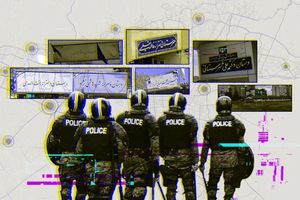
The 33-page document shared with Iran International by the hacktivist group Edalat-e Ali (Ali’s Justice) has been marked “very confidential” and is titled Instruction for Identification, Maintenance, and Use of Positions.
The document is attributed to the Specialized Documents Center of the Intelligence and Operations Deputy of the IRGC's missile command.
A framework for missile operations
What emerges from the directive is a bureaucratic framework for missile deployment that goes well beyond hardened silos or underground “missile cities.”
The text lays out categories of launch positions, inspection procedures, coding systems, site records, chains of responsibility and rules for maintaining access to a wide network of locations that can be used before, during and after missile fire.
Its significance lies not only in the variety of launch positions it defines, but in the explicit inclusion of non-military environments in that system.
In its introduction, the document says missile positions are an inseparable part of missile warfare tactics and argues that the enemy’s growing ability to detect, track and destroy missile systems requires special rules for identifying, selecting, using and maintaining such positions.
It adds that the use of “deception,” “cover” and “normalization” alongside other methods would make the force more successful in using those positions.
That language is important. It suggests the document is not merely about protecting fixed military assets. It is about making missile units harder to distinguish from their surroundings and harder to detect in the first place.
Civilian locations as missile cover
The implication of the directive is that it describes a system for embedding missile activity within ordinary civilian geography.
Rather than relying only on conventional military facilities, the document sets out a model in which missile units can move across a wider landscape of pre-identified sites selected for concealment, access and operational utility.
The result is a structure that appears designed to preserve launch capability while reducing visibility and complicating detection.
The clearest indication comes in the section on what the document describes as artificial dispersion or cover positions. These include service, industrial and sports centers, as well as sheds and warehouses – places that are civilian in function or appearance, but can be repurposed to hide missile units.
The conditions listed for such sites include being enclosed, not overlooked by surrounding buildings, and either lacking CCTV cameras or allowing them to be switched off.
Taken together, those requirements point to a deliberate screening process for civilian sites that can be used as missile cover. The concern is not only protection from attack, but invisibility within the civilian landscape.
The broader structure of the document reinforces that conclusion. It contains sections on site identities, naming and coding, inspections of routes and positions, record maintenance and responsibilities across intelligence, operations, engineering, communications, safety, health and counterintelligence.
This is the language of a standing system, not an improvised wartime workaround.
A system for concealment
Farzin Nadimi, a senior defense and security analyst at the Washington Institute who reviewed the document for Iran International’s The Lead with Niusha Saremi, said the text points to a database-driven effort to identify areas around missile bases that can be used for different kinds of positions.
He said the IRGC missile force appears to have mapped not only launch positions, but also dispersal, deception and technical positions – the latter being places suitable for storing launchers and support vehicles and, when needed, preparing missiles for firing.
“These technical positions,” Nadimi said, “can include large, covered spaces such as industrial sheds or sports halls, where missile launchers and support vehicles can be brought inside, and where missiles can be mounted onto launchers, warheads attached and, in the case of liquid-fueled systems, fueling operations carried out.”
That point is critical. If civilian-looking or civilian-owned structures are being used not only to shelter launchers, but also to prepare them for launch, then the document describes more than concealment. It describes the embedding of missile operations inside civilian infrastructure.
A network built for dispersal
Nadimi also said the directive places repeated emphasis on speed – getting launch vehicles into these buildings quickly before launch and returning them to cover quickly afterward.
In his reading, the database tied to these positions includes technical features of each site, access routes and nearby facilities, including the nearest medical center, police station and military post.
It also, he added, records whether use of the property can be coordinated in advance with the owner, including contact details, or whether occupation could occur without prior coordination in urgent cases.
If so, that would suggest the system extends down to the level of property access and local civilian surroundings, turning seemingly ordinary sites into preplanned nodes in a missile network.
The document’s own emphasis on route inspection, site profiles, records and coded classification supports the picture of a missile force operating through a dispersed support architecture rather than through fixed bases alone.
Why this puts civilians at risk
Nadimi warned that the use of civilian environments is especially troubling because many IRGC launchers are themselves designed to blend into civilian traffic.
“Many of these launchers essentially resemble civilian vehicles or trailers,” he said.
He added that larger launchers for Khorramshahr missiles can be covered with a white casing that makes them look like an ordinary white civilian trailer, while the towing vehicle is also typically white.
Smaller launchers, he said, are often painted not in conventional camouflage but in ways that make them less conspicuous in civilian surroundings.
That observation fits closely with the document’s emphasis on cover, concealment and post-launch disappearance. The combination of disguised launch vehicles and preidentified civilian sites suggests an operational doctrine built around blending missile units into non-military space.
According to Nadimi, this has direct consequences under the laws of war.
“The use of civilian environments, structures and buildings for this purpose is unlawful under the laws of war,” he said. “It removes the protection those buildings would otherwise have and turns them into legitimate military targets.”
The danger, he added, is that civilians living or working in such places may have no idea a missile launcher is being hidden in their vicinity until they themselves are exposed to attack.
An organized doctrine, not an exception
The leaked directive therefore appears to document something broader than the existence of underground missile facilities or dispersed launch sites.
It points to an organized method for extending missile operations into the civilian sphere – using industrial buildings, service facilities, sports complexes, warehouses and other non-military spaces as part of a launch architecture designed to survive surveillance, evade detection and preserve firing capability under wartime pressure.
In that sense, the document is not just about positions where missiles are launched from. It is about how a military force can fold launch operations into everyday civilian geography – and in doing so, transfer the risks of missile warfare onto places and people that outwardly have nothing to do with it.