Iranians react with joy and disbelief to Khamenei's death

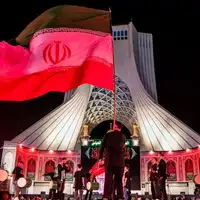
Celebration and stunned disbelief swept across parts of Iran on Saturday evening after US and Israeli officials announced that Supreme Leader Ali Khamenei had been killed.
Iran International

Celebration and stunned disbelief swept across parts of Iran on Saturday evening after US and Israeli officials announced that Supreme Leader Ali Khamenei had been killed.
Across social media and in accounts from residents inside Iran, the news triggered an eruption of emotion—joy, shock and disbelief in equal measure.
One user wrote on X: “I’m crying, laughing, screaming and experiencing every feeling in the world in three seconds.”
According to sources in Tehran who were still able to communicate with the outside world through Starlink satellite internet, residents leaned out of windows or gathered on rooftops soon after the announcement, shouting in celebration.
Farzad, a Tehran resident, said the sound of whistling and honking motorcycles and cars quickly filled the air. “It just erupted all at once,” he said.
Despite severe internet disruptions, videos appearing to show people dancing and celebrating circulated online from cities including Karaj, Qazvin, Shiraz, Kermanshah, Isfahan and Sanandaj.
State media coverage appeared largely unchanged for hours after the reports. It was only in the early hours of Sunday that state television confirmed the news, declaring 40 days of national mourning and a week-long public holiday.
Meanwhile Iranian forces continued missile and drone attacks on Israel and other regional countries, including the United Arab Emirates.
Prince Reza Pahlavi addressed Iranians in a message saying that with Khamenei’s death the Islamic Republic had effectively reached its end and would soon be consigned to “the dustbin of history.”
“Any attempt by the remnants of the regime to appoint a successor to Khamenei is doomed to fail from the outset,” he said. “Whoever they place in his stead will have neither legitimacy nor longevity.”
Iranian authorities are expected to convene the 88 clerical members of the Assembly of Experts—some of whom may currently be outside Tehran—to determine a successor, though doing so could prove difficult under wartime conditions.
Across social media, many diaspora users and some Iranians with internet access described Khamenei as the killer of their dreams and loved ones.
One user posted a video appearing to show young people dancing in the streets of Abdanan, in Fars province—a city where protesters were killed in large numbers less than two months ago.
“You riddled the people of Abdanan with bullets, but today it’s the people of Abdanan dancing on your corpse, criminal Khamenei,” the user wrote.
Others expressed disbelief and demanded proof.
“Khamenei’s death feels so surreal to me that I won’t believe it until I see his body,” one user wrote.
Some said they regretted that he may have died too quickly to answer for decades of repression.
Yet even amid celebration, grief lingered for lives lost under the Islamic Republic.
“If the news is true, how did everything end so suddenly, as if he never existed?” one user posted on X. “Regret for the dear lives lost, regret for years wasted in prisons, regret for lives destroyed.”



Iran’s Supreme Leader Ali Khamenei was killed in Saturday’s airstrikes, marking the end of more than three decades at the helm of the Islamic Republic and closing a chapter in Iran’s modern history that many Iranians had long hoped to see concluded.
While the wound of the massacre of January 2026 where over 36,000 were killed still feels fresh on the body of society, the death of Tehran’s dictator Ali Khamenei has pushed Iran and the region into a sensitive and unprecedented phase.
Khamenei, who for more than three decades was the central pillar of the Islamic Republic, has exited the scene of power at a moment when the Islamic Republic’s political and military structure is on permanent high alert, the economy is under the strain of mass poverty and a severe erosion of legitimacy, society is filled with the anger and mourning of the January massacre, and the Islamic Republic’s future has sunk into a dense fog of ambiguity, fear, and questions about the regime’s own survival.
In his absence, a system whose vital levers—from the judiciary and the armed forces to regional policy and the state broadcaster—were shaped under the guidance at the very top of the pyramid faces a profound crisis: over succession, over managing the consequences of an unfinished war, and over confronting the compressed and accumulated fury that has flared in streets and society in recent years.
Khamenei’s death is not merely the end of one leader’s life, but the end of an era in which ideology, repression, security, and “resistance” were embodied in a single figure.
Now, the Islamic Republic must navigate its future without Khamenei, in an atmosphere of doubt, fear, and intra-elite rivalry.
From Mashhad to the Leader’s Office
Seyyed Ali Hosseini Khamenei was born in April 1939 in Mashhad, a city of major significance in Shiism. His father, Seyyed Javad Khamenei, was a traditional, ascetic cleric who lived simply.
Ali Khamenei entered the seminary as a child and, after studying in Mashhad, went to Qom to continue his religious education—where he became acquainted with figures such as Ruhollah Khomeini and Akbar Hashemi Rafsanjani and, influenced by Khomeini’s political view of Islamic jurisprudence, was drawn into the struggle against the Pahlavi monarchy.

In the 1960s and 1970s, Khamenei was repeatedly arrested, imprisoned, and exiled for revolutionary activities against the Shah’s rule. These experiences—especially alongside his speeches and ideological translations of works by Arab Islamists—played an important role in shaping his intellectual identity.
He also became an active figure in transmitting the concept of “Islamic government” to a younger generation of clerics and revolutionaries.
Consolidation after 1979 Revolution
After the 1979 revolution, Khamenei quickly entered the Islamic Republic’s power structure. He became a member of the Revolutionary Council, played a role in rebuilding the army and establishing the Islamic Revolutionary Guard Corps (IRGC), and was also active in the Islamic Republic’s propaganda apparatus.
In the first decade of the Islamic Republic, Khamenei was considered part of the central decision-making core—both because of his closeness to Khomeini and because of his skill in building networks of loyalty among clerical and military ranks.
In 1981, while delivering a speech at the Abuzar Mosque in Tehran, he was targeted in a bombing. The explosion of a tape recorder placed in front of him permanently paralyzed his right arm.

The incident turned him into a symbol of a “cleric harmed on the path of the revolution” and, symbolically, cemented his standing in the memory of the regime’s supporters.
The presidency and the bond with the IRGC
After the assassination of then-president Mohammad-Ali Rajaei, Khamenei became president in 1981 and remained in office for two four-year terms.
His presidency coincided with the Iran–Iraq war. In practice, he played the role of mediator between the IRGC and the government of the time led by Prime Minister Mir-Hossein Mousavi.

Although the presidency had limited power in the Islamic Republic’s structure, Khamenei—backed by influential Khomeini ally Akbar Hashemi Rafsanjani, who prevented him from being sidelined—used the opportunity to establish strategic ties with IRGC commanders and security circles, networks that later became the foundations of his absolute leadership.
An unexpected selection, powerful consolidation
In June 1989, after Khomeini’s death, the Islamic Republic faced a challenge in choosing his successor.
The Constitution at the time deemed only a “source of emulation” (marjaʿ-e taqlid) qualified to lead, but Khamenei did not hold that clerical rank. Even so, in an emergency session of the Assembly of Experts—and with Hashemi Rafsanjani playing a prominent role—he was chosen as interim leader.

In that session, he openly declared his own opposition to being selected as leader.
In parts of his remarks at the meeting (later released as audio and video), Khamenei stressed that he neither had the requisite jurisprudential qualification for leadership nor agreed with the principle of concentrating power in one person.
He even said in a protesting tone: “One really must weep tears of blood for an Islamic society in which even the possibility [of leadership] of someone like me is raised…”
But after consultations, political pressure within the Assembly, and the prominent and decisive role of Hashemi Rafsanjani—who said in the session, “I heard in the Imam’s will that he considered Mr. Khamenei fit for leadership”—the meeting moved toward selecting Khamenei as interim leader.
At the end of the session, he accepted the responsibility and said: “If you have decided so, I do not object, but I say clearly that this is heavier for me than anything.”
A few months later, the Constitution was amended and the requirement of being a “source of emulation” was removed.
In November 1989, the Assembly of Experts convened again and formally and permanently appointed Khamenei as leader of the Islamic Republic.
That session was one of the most important turning points in the Islamic Republic’s history, because it showed that leadership was shaped not only on the basis of jurisprudential stature, but through a mixture of political expediency, structural cohesion, and behind-the-scenes interventions.
What was initially seen as a temporary and conservative choice, in practice became the beginning of building one of the most powerful and centralized person-centered structures in the Islamic Republic.
Absolute authority: from guardianship of the jurist to a parallel state
Khamenei gradually turned the institution of the Supreme Leader into an all-encompassing power that had the final say in every arena—from security and foreign policy to the economy and culture.
He turned the Execution of Imam Khomeini’s Order Headquarters (Setad) into one of Iran’s wealthiest economic institutions and, through it, oversaw vast holdings in real estate, industry, banks, and media.
Institutions such as the judiciary, the Guardian Council, the IRGC, the state broadcaster, and even the Supreme National Security Council were effectively subordinate to the leader’s direct view. Khamenei became not only commander-in-chief, but also the ultimate arbiter of the judiciary and the Islamic Republic’s principal policymaker.
Under his leadership, the IRGC shifted from a revolutionary military force into the main actor in politics, the economy, and security within the Islamic Republic.
By directly delegating powers, massive budgets, and transnational missions to the IRGC, Khamenei turned it into the backbone of regime preservation and the executive arm of the guardianship of the jurist.
Khamenei’s political mindset was deeply conspiratorial. In most of his speeches, he spoke of an “enemy” using terms such as “global arrogance” and a “network of infiltration,” and attributed every domestic event—from student protests and the Green Movement to the uprisings of 2017, 2019, 2022, and 2025—to designs from London, Washington, and Tel Aviv.
Within this framework, demands such as civil liberties, women’s rights, or protests against the economic crisis were portrayed not as genuine social grievances, but as part of an “enemy project”—both to make repression appear legitimate and to cast any criticism of the system as treason and foreign dependence.
Regional strategy: 'Axis of Resistance'
With the aim of confronting Israel and the United States, Khamenei established a regional strategy known as the “axis of resistance”: an uneven alliance of proxy groups and aligned governments formed through the Islamic Republic’s financial, military, and ideological support.

From Hezbollah in Lebanon and Shiite militias in Iraq to the Houthis in Yemen and Bashar al-Assad’s regime in Syria, this axis expanded over two decades under Khamenei’s direct supervision.
But in 2024 and 2025, this strategy came under repeated blows. Israeli attacks shattered Hamas’s military structure in Gaza; Syria after Bashar al-Assad’s fall moved to redefine its relations with Tehran’s axis; and the United States’ military campaign against the Houthis in the Red Sea and Yemen severely weakened the Islamic Republic’s influence in that region.
Structural hostility to the West, especially the United States, along with chronic distrust of Europe, pushed Khamenei toward the doctrine of “looking to the East.” Throughout his years of leadership, he repeatedly emphasized that “the East should be preferred over the West,” and in practice, by deepening strategic dependence on Russia and China—from long-term economic and military contracts to security coordination—he sought to define the Islamic Republic’s survival under the protective umbrella of those two powers.
This pivot both placed Iran in a more subordinate geopolitical position vis-à-vis Moscow and Beijing and entrenched its isolation from the Western world.
Confrontation with the West, the nuclear program, and isolation
Khamenei was always deeply suspicious of the West, especially the United States, and repeatedly warned that “Western cultural infiltration” was a fundamental threat to the Islamic Republic.
Internationally, Tehran’s nuclear program was one of the central files of his leadership.

Despite a religious decree against nuclear weapons, he advanced the enrichment program and in 2015 gave conditional support to the JCPOA, but after the United States withdrew from it in 2018, he replaced diplomatic engagement with a strategy of “active resistance,” and the Islamic Republic’s ties with Russia and China strengthened.
In June 2025, this approach faced unprecedented military responses by Israel and the United States. Israel launched an operation against nuclear and missile facilities in Iran, including attacks on the enrichment sites at Natanz and Fordow and military facilities in Isfahan.
The strikes were accompanied by the simultaneous killing of nearly 30 senior IRGC commanders and figures tied to Iran’s nuclear program.
A few days later, the United States also carried out an independent operation dubbed “Midnight Hammer,” launching a series of precise airstrikes against Iran’s nuclear infrastructure deep inside the country.
Protests, repression, and the accumulation of grievance
In confronting popular protests, Khamenei consistently resorted to the “foreign enemy” scenario.
From the 1999 student movement to the 2009 Green Movement, the economic protests of 2017 and 2019, the “Woman, Life, Freedom” uprising of 2022, and the 2026 Lion and Sun Revolution, all were met with severe security repression.
During the 2009 protests, in an unusual Friday prayer sermon, instead of listening to the voice of millions of protesters, he complained: “You can’t compete within the framework of the system with those who do not accept the system.”

He portrayed himself as the victim of an enemy plot whose target was not the election but “the very principle of the guardianship of the jurist.” From then on, this became his fixed template for interpreting every form of protest: protests had no social, economic, or gender roots; they were all directed from London, Tel Aviv, and Washington.
In the case of the state killing of Jina (Mahsa) Amini, he even refused to meet the Amini family and in his speeches described the young protesters as duped by “American-Zionist projects.”
His understanding of the uprising of women and youth was largely framed not as a legitimacy crisis but through the language of conspiracy and infiltration.
This approach pushed the gap between the people and the apex of power to its peak, and the question of the regime’s legitimacy became a broad, pervasive, even intergenerational public issue.
The brutal massacre of January 2025
In the final months of Khamenei’s political life, the accumulated social and economic crisis turned into a nationwide explosion in January 2026 whose scale and intensity reached unprecedented dimensions even compared with the uprisings of 1999, 2009, 2017, 2018, 2019, and 2022.
From late December 2025, strikes and protests by merchants and shopkeepers in Tehran against the free fall of the rial and runaway price surges quickly spread to dozens and then hundreds of cities, and in less than two weeks became a full-scale uprising with explicit demands for overthrowing the ruling system and directed against Khamenei personally.
On the evenings of 8 and 9 January 2026, millions poured into the streets across all 31 provinces, and the streets of Tehran, Mashhad, Isfahan, Shiraz, Tabriz, Ahvaz, and dozens of other cities fell out of government control for hours.
Khamenei ordered the protests to be suppressed “by any means necessary,” and security and military forces moved in under an explicit order to “shoot to kill.” The order came alongside a complete cutoff of the internet and communications, paving the way for the bloodiest street crackdown in the Islamic Republic’s history.
Reports from hospitals, leaked security documents, and estimates by international media speak of tens of thousands killed and hundreds of thousands wounded. Some sources have spoken of more than 36,000 deaths in just the two days of 8 and 9 January and hundreds of thousands wounded in clashes in more than 400 cities and flashpoints, while even the government’s official figures acknowledge thousands killed.
The January massacre was not only Khamenei’s last major repressive decision, but also a pivotal point in the complete collapse of his political legitimacy and that of the system he ruled.
From that point on, even parts of the “gray” segment of society—previously suspended between fear, caution, or indifference—came to view the ruling power not as merely an incompetent government, but as an overtly criminal structure and an occupier vis-à-vis its own society.
Regionally and internationally, the January massacre also fixed the image of the Islamic Republic’s leader as a dictator ready to resort to mass killing to preserve power, and it redefined the meaning of “stability” under his rule in the blood of thousands of Iranian citizens.
The end of a dictator
Khamenei steered the Islamic Republic through crises after the revolution’s early years, the war, intra-elite conflicts, and the succession vacuum after Khomeini, bringing it to an apparently durable cohesion. But the cost of that “stability” was paid not by the governing structure but by Iranian society: repeated political repression, social closure, the crushing of civil institutions, exile of dissenting voices, and global isolation.
By turning the office of the Supreme Leader into the center of gravity for all decisions, he effectively concentrated the system around himself and reduced elected structures to ceremonial, ineffectual bodies.
Independent institutions were shut down or absorbed one after another. The state broadcaster, the judiciary, the army, education, culture, even the economy ultimately shared one thing: “the leader’s satisfaction.”
His personality was a mix of an outwardly humble appearance, a literary manner, and an inward intolerance. Though he spoke of morality and justice, in practice he tolerated no discordant voice.
His dealings with opponents—from insiders labeled reformists to street protesters—were either in the language of threat or through the instruments of repression.
He was surrounded not by critical elites but by a narrow circle of loyal security figures, aligned clerics, and IRGC men.
This intellectual closure became political closure and ultimately led to the collapse of the relationship between the system and the people.
Now, without him, the Islamic Republic faces the greatest test of its survival from within and without.
A machinery that had built power around one man must now stand without him.
Khamenei’s death could be the start of collapse, a power vacuum, disorder, and fissures at the apex of the Islamic Republic—or perhaps a historic opportunity for reconstruction and reconsideration.
The Khamenei chapter in Iran’s history has closed—a chapter in which the ruler defined himself as above the law, above society, and even above the revolution.
Whether this end marks the beginning of a transition or the start of a new crisis, the shadow he cast over contemporary history will remain for years to come.
Videos emerging from Iran despite a near-total internet shutdown reflect a rare mix of jubilation, fear and expectation as US and Israeli strikes leave the country’s future suddenly bound to the outcome of the war.
Shortly after the strikes began, Iran’s connection to the global internet was almost entirely severed, dropping to a reported minimum of around four percent—enough to meet what observers describe as government needs.
Nevertheless, some citizens used circumvention tools such as Psiphon and satellite connections via Starlink to share footage from targeted areas or contact relatives abroad.
In one viral clip shared on X, the sound of residents in an apartment complex clapping can be heard. A woman lets out a celebratory ululation, while a man shouts, “Damn Khamenei.”
Another video filmed in Tehran after news spread of the killing of senior official Ali Shamkhani, captures the sound of cheering and car horns. In footage from Shiraz, the steady thud of anti-aircraft fire is heard alongside chants of “Death to Khamenei.”
Some who do not see war as a solution expressed conflicted emotions.
“What a strange morning," one X user wrote. "War was not our choice or decision. Most of us feel a mix of worry, a sense of vindication, anger, hope, scattered thoughts, and many other contradictory emotions. Each person may highlight one feeling at a given moment.”
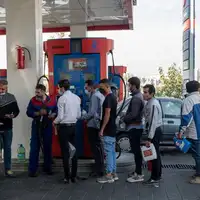
Users with access to social media reported heavy traffic across Tehran, long lines at gas stations, and crowded supermarkets and bakeries.
Arian, a Tehran resident who told Iran International he had chosen to stay, said some people had already left before the strikes began, adding that he witnessed some cars and motorcycles honking in apparent celebration.
One citizen, in a video sent to Iran International, said: “This war is not our war. It’s Trump’s war with the hateful Islamic regime. We pray that Trump wins this war, because if he wins, the people of Iran will be free.”
In yet another clip, residents are heard tracking missiles across the night sky, shouting in excitement as they pass overhead. Videos circulating online also show teenage students in girls’ and boys’ schools chanting and celebrating.
Officials 'safe and sound'
Supporters of the Islamic Republic, too, organized collective displays of loyalty, including public prayers at several universities, declaring resistance against US and Israeli attacks a matter of faith and pledging allegiance to Supreme Leader Ali Khamenei.
The government has not confirmed the death of any top-ranking officials so far.
Satellite imagery circulating online appears to show that Khamenei’s compound in central Tehran—near the presidential complex and other key government buildings—has been largely destroyed. Authorities have not publicly commented on the extent of damage or Khamenei’s condition.
Foreign Minister Abbas Araghchi told NBC News hours after the attack that “almost all officials of the country are safe, secure and alive,” adding: “We may have lost a few commanders may have been killed, but that’s not a big problem.”
Fears of Unrest
Unlike during the 12-day war in June, the Supreme National Security Council issued a statement only hours after the fighting began, advising residents of Tehran and other major cities to leave for safer areas.
Government spokesperson Fatemeh Mohajerani said necessary arrangements had been made in tourist provinces to accommodate those departing the capital and other large cities.
A political activist in Tehran told Iran International that, given US President Donald Trump’s renewed promises to support regime change, the government likely feels a severe threat.
Encouraging residents to leave major cities, he argued, may be aimed at preventing collective opposition movements or attempts to seize government institutions.
Recent reports in Western outlets on alleged shifts inside Iran’s ruling establishment—particularly the growing role of Ali Larijani—have triggered a mix of denials, dismissals and cautious commentary in Tehran.
The reports come amid heightened tensions between Iran and the United States, as indirect talks continue while President Donald Trump has repeatedly warned that military strikes remain an option if diplomacy fails and Washington has expanded its military presence in the region.
The New York Times cited Iranian officials this week as saying Tehran has prepared contingency plans in case of war with the United States or Israel, including scenarios in which senior leaders—even Supreme Leader Ali Khamenei—could be killed.
According to the report, the planning is designed to ensure continuity of the Islamic Republic under extreme circumstances, with several senior figures named as part of that contingency structure, including security chief Larijani, parliament speaker Mohammad Bagher Ghalibaf and former president Hassan Rouhani.
The report also suggested that Larijani’s expanding role has reduced the visible influence of President Masoud Pezeshkian in day-to-day governance.
Separately, Le Figaro published a controversial account alleging that during the height of nationwide protests Khamenei was the target of an internal effort led by Rouhani to sideline him from crisis management.
According to the French newspaper, Rouhani gathered several political figures—including former foreign minister Mohammad Javad Zarif, clerics from Qom and individuals linked to the Revolutionary Guards—to discuss an alternative leadership arrangement.
Le Figaro said the effort ultimately failed, partly because Larijani did not support the initiative. Rouhani’s office rejected the account outright, describing it as a US-Israeli “fabrication” aimed at “creating doubt and concern in Iranian public opinion.”
Larijani has not publicly addressed either report.
Following the 12-day war with Israel, Khamenei appointed Larijani as secretary of the Supreme National Security Council, despite the Guardian Council previously disqualifying him from running in the presidential election.
Salar Velayatmadar, a member of parliament’s National Security and Foreign Policy Commission, said Larijani now plays “a decisive role in policymaking.”
“The council’s view is central in indirect negotiations with the United States,” he said. “Basically, the negotiations are taken from this council, word by word.”
Iranian media widely republished the New York Times and Le Figaro reports but mostly avoided detailed analysis.
The conservative newspaper Farhikhtegan dismissed the French report as a “fictional scenario” and a “diverse basket of strategic lies,” arguing that such narratives were designed to undermine “national cohesion.”
By contrast, the news outlet Eghtesad24 suggested the New York Times report portrays Larijani as a “crisis manager” operating across multiple arenas—from nuclear diplomacy to regional strategy and wartime planning.
Despite relying on unnamed sources, the outlet wrote, the report reflects an apparent effort by Iran’s political system to adapt to a more dangerous regional environment by strengthening internal coordination and resilience.
Tehran appeared noticeably downbeat about the outcome of Thursday’s negotiations with Washington in Geneva, with signs of disappointment emerging first on the website of the government’s news agency.
In a commentary published Friday, IRNA said the two sides’ clashing positions were jeopardizing the talks, laying the blame for such an outcome at Washington’s door.
It also made clear that Tehran is placing considerable hopes in Oman’s foreign minister, Badr Albusaidi, whose quiet mediation has been central to the negotiations.
Albusaidi now carries a “grave responsibility,” the piece argued, with his role beginning in Muscat, continuing through two rounds of talks in Geneva and now entering “another important step” when he meets US Vice President JD Vance in Washington.
Tehran’s official outlet even hinted at the mediator’s message to the American side: a warning that a war with Iran would not remain limited, that regime change is unattainable and that even heavy damage to Iranian targets would not achieve the goals emphasized by President Donald Trump, “just as they did not in the June attacks.”
Iranian media outlets have also begun outlining the main sticking points in the negotiations.
The news website Fararu reported Friday that the talks remain deadlocked over fundamental issues including enrichment levels, sanctions relief and the dismantling of parts of Iran’s nuclear infrastructure.
Another major obstacle, it said, is Iran’s refusal to export enriched nuclear material, with Tehran insisting on maintaining domestic fuel production.
Axios reported that some of Trump’s advisers, including Jared Kushner and Steve Witkoff, were disappointed with Araghchi’s proposals, arguing that they fell short of US expectations.
Trump himself signaled frustration with Tehran on Friday, telling reporters he was “not happy” with Iran but expected further talks to take place.
Asked about the possibility of using military force, the president said he hoped it would not be necessary but did not rule it out.
Speaking before leaving the White House for a trip to Texas, Trump said he still wants to reach an agreement with Iran but reiterated that Tehran “cannot have a nuclear weapon.”
Fararu suggested Washington may be pursuing a dual-track strategy, combining diplomacy with the threat of limited military strikes to maintain pressure.
The negotiations, it concluded, have entered a “complex and decisive” phase: a potential framework is beginning to take shape, but deep structural disagreements and continued US military signaling are sustaining a high level of uncertainty.
In a separate interview with the website, foreign policy analyst and former Iranian diplomat Jalal Sadatian said President Trump’s tone toward Iran had recently become noticeably “sharper, more decisive and more alarming.”
Sadatian also warned that Iran’s “asymmetric capabilities” mean that even limited military action could quickly escalate in unpredictable ways.
A series of Iranian social media accounts fell silent after their owners were shot during January protests, leaving behind final posts that now read like unfinished testimonies and have turned into digital memorials where protesters mourn, vent anger and hail the fallen.
Across platforms, the pattern repeats: a final slogan, a warning, a declaration — and then silence.
Profiles remain searchable, timelines intact, bios unchanged. Friends return to the comment sections to grieve. Strangers leave messages of defiance.
What began as personal accounts have, in death, become public memorials.
Sam Rezaee: a final slogan
Sam Rezaee was 21 years old when he posted, “Long Live the Shah (King).”
Born in Shiraz, he joined X in 2024 and quickly became active in pro-monarchy circles, mixing political commentary with humor and memes. Friends say he followed online trends closely and cared deeply about how he presented himself, both digitally and in person.

On January 8, near Saadi Cinema in Shiraz, Sam was struck by pellets in the neck and chest. A source close to the family confirmed that a viral video circulating online shows the moment he was shot.
“He was still alive here,” the source said. “They took him to the hospital, where he later died.”

“It is very important for us to let the world know this is how Sam was killed and what they did to him,” the source added.
Sam had graduated from Iran’s elite gifted-students school system and worked in his family’s jewelry shop. He planned to study medicine in Italy.

Authorities delayed handing over his body for a week, the source said. Officials tried to pressure the family to declare that he was affiliated with the Basij militia. The family refused and were required to sign a pledge to remain silent.
He was buried under security supervision. Even the 40th-day memorial was sparsely attended.
His timeline remains visible, halted at that final message.

Raha Bohloulipour: a final declaration
Raha Bohloulipour was 23 when she posted her last message.
A first-year Italian literature student at the University of Tehran, she ran a Telegram channel with nearly 24,000 subscribers and had more than 4,500 followers on X.

Her final Telegram post read: “I’ve connected for a moment and I just want to write: Woman, Life, Freedom – forever.” After that, she never returned.
Bohloulipour was killed by live ammunition during protests on January 9 and buried in her hometown of Firouzabad in Fars province, according to colleagues and local sources.

In the days before her death, she wrote openly about exhaustion and fear.
“I’m disgusted – disgusted, disgusted – and so exhausted with the Islamic Republic. From the moment I stepped into the faculty today until I left, I was in tears... I’m unbearably tired and disgusted with the Islamic Republic.”

In another post she wrote: “…when I leave the dorm, deep down I’m not sure whether I’ll come back at night or not. Living under the shadow of the Islamic Republic.”
Students at the University of Tehran commemorated her during a protest gathering and chanted: “For every one person killed, a thousand stand behind them.”
Her channel remains frozen on that final declaration.
Vahid Mohammadlou: a bio left unchanged
Vahid Mohammadlou, 39, described himself on X as: “Former military man → soldier of Reza Shah II Pahlavi → soldier of the land of Iran || ‘Long live Iran, long live the King.’”

Posting under @IraniansWarrior, he had more than 3,700 followers.
On January 8 in Sadeghiyeh (Aryashahr), Tehran, he was shot in the eye and died from his injuries, according to family accounts and obituary posts. He left behind two children, aged 9 and 4.

In a widely circulated video, his four-year-old daughter hugs his photograph and asks those around her to leave. “Leave the room, I would like only my dad to be next to me,” she says in the heart-wrenching video.

His bio remains as he wrote it.
Mosayeb Nezami: a call to the streets
Mosayeb Nezami, 32, was a farmer from Borujerd in Lorestan province. He joined X in 2019 and had more than 1,500 followers.
His final post read: “Anger has to move into the streets – only tweeting lets us vent.”

On January 8 in Kourosh Square, Borujerd, he was shot from behind with live ammunition. The bullets struck his shoulder and heart. He died from his injuries.
Nezami had lost his father at age 10 and became the sole breadwinner for his family, supporting two sisters and a younger brother, according to colleagues.

His account still carries that final line.
Alireza Mousavi Noor: a warning in advance
Alireza Mousavi Noor, 29, known on X as Derakoolaye Ghamgin – Sad Dracula – had more than 10,000 followers.

On January 7, he wrote: “If I don’t come online again, don’t forget me. Know that I didn’t die for nothing. Say my name at the celebration of freedom.”

He was shot and killed the next day during protests in Baharestan, Isfahan.
The message now reads as premonition.

Masoud Zatparvar: from influencer to protester
Masoud (Mehdi) Zatparvar was an international bodybuilding coach and two-time World Classic Bodybuilding Overall Champion. His Instagram account had 242,000 followers, and he ran a website providing training and nutrition programs.


In his final post in January 2026, he wrote: “We only want our rights. A voice that has been stifled in me for forty years must be shouted. You caused what we are going through today. You took our youth, hope, dreams, and even the bare minimum from us. Today I am here – so that tomorrow I don’t look in the mirror and say I had no backbone, no honor. I stood, whatever the cost, I will pay it. I, Masoud Zatparvar, am in the street today. I have neither fear nor worry! I want my rights.”

He was killed on January 8, in Rasht after being struck by live ammunition, according to local accounts and social media posts.
His Instagram page has not been updated since.
Hamed Hamidian: A plea to Trump
Hamed Hamidian, 38, an X user with more than 7,300 followers who joined the platform in 2009, addressed US President Donald Trump in his final post before the January killings.

“Mr. president @realDonaldTrump, since you said you’re watching the situation in Iran, at least 20 people got killed! We can’t beat the devil empty handed, I’m begging you to cut to the chase and finish the Mullahs' regime.”

He was later reported killed during the protests on January 8 in Tehran.

Social media becomes a battleground
Researchers say this transformation — from personal timeline to digital shrine — has become a defining feature of protest movements in Iran.
“In the waves of anti-regime protests sweeping Iran, social media has played a paradoxical yet indispensable role as both a lifeline and a battleground for information and identity,” said Sahar Tahvili, an artificial intelligence and information technology researcher.
“In this environment, control over social media is no longer peripheral to politics — it is the political struggle itself,” she told Iran International.
Even during internet disruptions, users have documented protests through satellite connections, VPNs and diaspora networks, while authorities deployed competing narratives and digital manipulation, she added.
Each account now stands as a frozen timestamp — unfinished testimonies suspended in time. The posts remain, the timestamps fixed, but the authors do not.