• العربية
  • فارسی
Brand
  • Iran Insight
  • Politics
  • Economy
  • Analysis
  • Special Report
  • Opinion
  • Podcast
  • Iran Insight
  • Politics
  • Economy
  • Analysis
  • Special Report
  • Opinion
  • Podcast
  • Theme
  • Language
    • العربية
    • فارسی
  • Iran Insight
  • Politics
  • Economy
  • Analysis
  • Special Report
  • Opinion
  • Podcast
All rights reserved for Volant Media UK Limited
volant media logo
SPECIAL REPORT

How Tehran whitewashes its crimes abroad

Negar MojtahediJay Solomon
Negar Mojtahedi,
Jay Solomon
Feb 23, 2026, 16:38 GMT+0Updated: 19:09 GMT+1
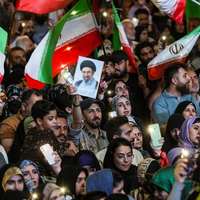
Demonstrators gesture outside the Iranian embassy during a rally in support of nationwide protests in Iran, in London, Britain, January 12, 2026.

As Iran’s security forces crushed protests, a parallel operation unfolded online, blaming a domestic uprising on a global conspiracy.

In late December and early January, as Iranians took to the streets to protest the country’s economic malaise, the Islamic Republic quietly began seeding onto social media its own narrative of events, in preparation for a brutal crackdown.

The uprising wasn’t organic or homegrown, according to posts by state-backed media accounts, but the shadowy work of the Central Intelligence Agency and Israel’s vaunted Mossad spy agency.

“The enemies, particularly the United States and Israeli regime, are focused on fueling insecurity in Iran by making use of the tools of soft warfare,” state-controlled Fars News Agency proclaimed on January 5, citing the chief of staff of Iran’s armed forces.

In the days that followed, particularly January 8 and 9, Iran’s security forces mowed down thousands of ordinary Iranians in an operation that is widely seen as the bloodiest in the country’s modern history.

Twinned with this crackdown has been a sophisticated, state-backed information offensive.

For the Islamic Republic to rely on claims of U.S. and Israeli involvement to justify its repression isn’t new.

The difference between this campaign and the Iranian regime’s frequent efforts to smear dissidents and protesters as foreign agents is that the push launched by the regime this time was not designed only, or even mainly, for domestic consumption.

It was directed just as much at ideological allies and supporters abroad, inserting the Islamic Republic’s propaganda into global political discussions and seeking to whitewash the massacre of Iranian protesters.

That campaign has succeeded in gaining the backing of a wide array of far-left media personalities, MAGA-aligned influencers, Russian-backed X accounts, and global bot farms. In the U.S. alone, white nationalist Nick Fuentes, The Young Turks media host Cenk Uygur, Gen Z influencer Calla Walsh, and the anti-Israel campaigner Max Blumenthal have parroted the regime’s line that the CIA and Mossad stoked the uprising.

Rutgers University’s Network Contagion Research Institute (NCRI) tracked Iran’s government narratives through over 300 X accounts, finding millions of views for posts that amplified Iranian propaganda—some from accounts that appear to be linked to state actors.

A newly released report, which NCRI researchers discussed exclusively with The Free Press, found that this social media narrative has become a key lever of foreign influence for the Islamic Republic. With signs that Iranians are ready to rise up again, and U.S. air and sea power massing outside Iran, regime opponents and human rights activists worry that the information tools that Iran has developed over the last months will be repurposed to shape the narrative of any conflict.

“This episode illustrates a broader mechanism of modern authoritarian resilience: Repression alone does not secure regime stability. Narrative control does,” Joel Finkelstein, co-founder and chief science officer at NCRI, told The Free Press.

“When state-aligned media and decentralized amplification networks converge to externalize blame, they can blunt international solidarity, fracture ideological coalitions, and recast domestic dissent as foreign aggression.

”The unrest in Iran began in late December among merchants protesting a catastrophic drop in Iran’s currency, then quickly spread to more general demonstrations, soon evolving into open calls for the end of the Islamic Republic itself. Iran’s government has officially claimed that around 3,000 Iranians died during January’s unrest. But human rights groups and the United Nations special rapporteur on Iran said the death toll could reach the tens of thousands.

Videos emerged of snipers shooting unarmed civilians from rooftops and body bags flooding local morgues.

As Ayatollah Ali Khamenei’s regime orchestrated its massacre, Tehran intensified its information war in lockstep. NCRI researchers describe a step-by-step sequence—almost a digital playbook—in which Tehran framed the protests as a CIA–Mossad operation, amplified it online, and allowed sympathetic, outside actors to legitimize the narrative in real time. 

How Islamic Republic's information war unfolded:

Iran’s information operation used X posts from a Persian-language account widely identified as affiliated with Israel’s intelligence services, Mossad, and an X post from U.S. Secretary of State and CIA Director Mike Pompeo to lend ballast to its narrative. Early in the protests, the accounts posted comments on X that appeared to lend moral support to the burgeoning Iranian uprising.

“Let’s come out to the streets together. The time has come,” the Mossad-affiliated account proclaimed on December 29.

“We are with you. Not just from afar and verbally. We are also with you on the ground.” Pompeo also posted a message of support on January 2, which included a quip implying that Iran was filled with Mossad agents.

As the Iranian regime intensified its crackdown on dissent, screenshots of the posts circulated rapidly across Persian-language Telegram channels and X, and government and regime-aligned commentators presented the Mossad and Pompeo posts as proof of foreign infiltration.

Iranian Foreign Minister Abbas Araghchi took to X on January 10, just a day after the regime inflicted its worst violence on protestors, and wrote: “According to the US Government, Iran is ‘delusional’ for assessing that Israel and the US are fueling violent riots in our country.”

The diplomat attached a screenshot of Pompeo’s January 2 post. In a sign of the importance that Iran’s regime attached to influencing, Araghchi appeared on Fox News to advance the Mossad conspiracy narrative, and pushed it again in a post-crackdown op-ed in The Wall Street Journal.

NCRI researchers documented a surge in online traffic promoting the regime’s CIA-Mossad narrative—from January 6 through January 16—at a time when most of the country remained in a communications blackout.

NCRI found that most of this online engagement didn’t originate from Iranian state media itself, but from independent influencer accounts that carried the narrative into Western political ecosystems. 

Central to this were two large accounts–@AdameMedia (with over 500,000 followers) and @Megatron_ron (nearly 600,000 followers)–which NCRI believes are likely fronts for foreign governments, potentially Russia. Much of this traffic appeared to utilize bot networks to amplify their messages.

On January 12, the @AdameMedia account described Iranian protesters as “Mossad backed rioters” and circulated footage that the account claimed showed opposition activists burning mosques, declaring: “These scum are the face of the movement.”Those claims were picked up by American social media influencers, both from the far left and MAGA right.

The MAGA-aligned influencer and media personality Nick Fuentes, who has 1.2 million followers on X, posted on January 11: “The chaos in Iran is totally astroturfed by Israel and the US for regime change. . . . Why do you think Iran wanted nuclear weapons? To prevent this exact scenario.”

The same day, far-left Israel critic Max Blumenthal, who has over 800,000 followers on X, claimed: “Mossad rent-a-rioters in Iran throw molotov cocktails at apartments and into a mosque filled with children. Supporters of these nihilistic regime change rampages are openly celebrating the violence.”

U.S. government and independent analysts who study Iran’s information networks told The Free Press that the regime has spent decades developing propaganda networks in the West specifically for times of crisis.

Much of this has been focused on finding ideologically aligned academics, journalists, and politicians, but also, increasingly, social media influencers. Blumenthal visited Iran last May as part of a regime-backed media trip. 

“They have a very sophisticated network and they operate both in a coordinated manner and in a diffused manner,” Stanford University’s Abbas Milani, an Iranian-American scholar and historian, told The Free Press.

“Somebody sheds doubt about the number killed, somebody sheds doubt about who was doing the killing. . . . The goal is to dishearten the opposition.”

The Free Press and Iran International jointly published an investigation in 2023 that documented how Iran’s Foreign Ministry created a network of overseas academic and media influencers to promote its positions on the nuclear negotiations with the Barack Obama administration in 2014 and 2015.

Tehran called the network the Iran Experts Initiative. Now the kind of influence that was achieved piecemeal with individual outreach can be done at scale through social media. NCRI’s researchers said this stealth migration of regime talking points is how modern information warfare succeeds.

State narratives enter polarized digital ecosystems, then are reframed and repeated until the message no longer appears to originate from the state that benefits from it. NCRI and other activists are increasingly concerned that Tehran may be successful in muddying the reality of the January massacres.

The approach also hints at how Iran will likely seek to influence international opinion in any further conflict with the United States.

"The idea that this is somehow an operation from Mossad or the CIA is really an odd assertion given that the people doing the killing, as we see on video, are part of the regime,” said Gissou Nia, a human rights lawyer at the Atlantic Council. Nia and other activists have been stunned by the tepid international response to the massacre.

It took until January 23 for the United Nations Human Rights Council to formally condemn Iran’s crackdown. And leaders across the Arab world and West continue to engage with Iran’s leadership at the highest levels. So far, no state has formally called for an investigation by the International Criminal Court into the nationwide massacre.

Lawdan Bazargan, a human rights activist and former political prisoner in Iran, added: “More than 30,000 people are dead. . . . Not a single foreign agent was found among the victims.”
Most Viewed

Iran negotiators ordered to return after internal rift over Islamabad talks
1
EXCLUSIVE

Iran negotiators ordered to return after internal rift over Islamabad talks

2
INSIGHT

What the US naval blockade would mean for Iran’s economy

3
EXCLUSIVE

Iran’s central bank warns economy may take 12 years to rebuild after war

4
INSIGHT

Iran's digital economy battered by prolonged blackout

5
PODCAST

Iran-US ceasefire nudges sidelined Arab states toward Israel, expert says

Banner
Banner

Spotlight

  • War damage amounts to $3,000 per Iranian, with blockade set to add to losses
    INSIGHT

    War damage amounts to $3,000 per Iranian, with blockade set to add to losses

  • Why the $100 billion Hormuz toll revenue is a myth
    ANALYSIS

    Why the $100 billion Hormuz toll revenue is a myth

  • US blockade targets Iran oil boom amid regional disruption
    ANALYSIS

    US blockade targets Iran oil boom amid regional disruption

  • Iran's digital economy battered by prolonged blackout
    INSIGHT

    Iran's digital economy battered by prolonged blackout

  • Iran-US ceasefire nudges sidelined Arab states toward Israel, expert says
    PODCAST

    Iran-US ceasefire nudges sidelined Arab states toward Israel, expert says

  • What the US naval blockade would mean for Iran’s economy
    INSIGHT

    What the US naval blockade would mean for Iran’s economy

•
•
•

More Stories

Iran students adopt monarchist symbols as protests grow for third day

Feb 23, 2026, 12:32 GMT+0

A wave of Iranian student activism adopting the pre-1979 Lion and Sun emblem has gathered pace in recent days, as protests entered a third consecutive day on Monday and spread across universities in Tehran, Isfahan and Mashhad.

Statements circulated by students at the University of Tehran, Amirkabir University of Technology and Isfahan University of Technology announced the creation of Lion and Sun associations, calling for secular governance, territorial integrity and free elections, and voicing support for exiled Prince Reza Pahlavi as a transitional figure.

At the University of Tehran, a founding statement said students were acting “in solidarity with the people of Iran” and in memory of those killed in recent protests, including four students from the university.

A combination image shows altered university logos featuring the pre-1979 Lion and Sun emblem, shared by student groups during recent campus protests in Iran.
100%
A combination image shows altered university logos featuring the pre-1979 Lion and Sun emblem, shared by student groups during recent campus protests in Iran.

Similar statements were reported at Allameh Tabatabaei University, Iran University of Science and Technology and a branch of Islamic Azad University in Sari.

Videos shared by activists showed students raising the Lion and Sun flag on some campuses and chanting “Javid Shah” (Long live the Shah), alongside slogans such as “Death to the dictator,” “Woman, Life, Freedom,” and “Neither Gaza nor Lebanon, my life for Iran.”

Some students also referenced the former names of their institutions before the 1979 Islamic Revolution.

At Al-Zahra University, protesters chanted that the university should revert to its pre-revolution name, Farah Pahlavi University. A day earlier at Sharif University of Technology, students echoed calls to restore its former name, Aryamehr – a title used by Mohammad Reza Pahlavi during the pre-1979 monarchy.

In several instances, protesters burned the flag of the Islamic Republic.

Pro-government Basij-affiliated students held counter-gatherings on some campuses, where they burned US and Israeli flags and chanted slogans including “Death to the Shah,” a phrase closely associated with the 1979 revolution that toppled the monarchy.

  • Iran students rally at major universities to honor slain protesters

    Iran students rally at major universities to honor slain protesters

  • Grassroots ‘Red Lion and Sun' network emerges in Iran after crackdown

    Grassroots ‘Red Lion and Sun' network emerges in Iran after crackdown

Threats of legal action and dormitory searches

University authorities and security forces signaled a tougher response as demonstrations spread.

The president of Sharif University of Technology, Masoud Tajrishi, warned students that the gatherings were “illegal” and said judicial authorities could intervene.

“The prosecutor has said this is not only a university matter and that we must step in,” he said, adding that some students had already been barred from entering campus and that the university could shift to fully virtual classes if unrest continued.

At Beheshti University in Tehran, security forces reportedly searched dormitory rooms late on Sunday in an effort to identify and detain protesting students.

Some students said they had received text messages informing them that disciplinary cases had been opened and that they were temporarily suspended pending committee decisions.

In Mashhad, students at local universities said participants in rallies had been threatened with expulsion.

At Amirkabir University, videos showed clashes between protesters and Basij members, with students accusing them of attempting to disrupt what they described as peaceful gatherings.

Capital flees Tehran stocks as geopolitical tensions deepen

Feb 23, 2026, 10:32 GMT+0

More than 107.8 trillion rials ($66.5 million) in retail money has flowed out of the Tehran Stock Exchange over the past 24 trading sessions, marking what analysts describe as a new phase of liquidity depletion driven by political uncertainty and fears of military escalation.

Habib Arian, a financial markets researcher, told ISNA that the turning point came on January 10, when the market recorded a one-day outflow of 9.4 trillion rials ($5.8 million), at the time the largest daily withdrawal of individual investor funds.

“That figure showed that trust, which is the main asset of the capital market, had been severely damaged,” Arian said. “From that date onward, the Tehran bourse was unable to return to an upward trajectory, and any positive fluctuation was treated as an opportunity to exit.”

Outflows accelerated as regional tensions intensified and speculation grew about possible confrontation between Iran and the United States. Investors shifted from equities toward hard assets, pushing the dollar above 1,650,000 rials and lifting domestic gold prices sharply.

Between January 8 and February 21, the benchmark index fell 15% while 18-karat gold posted a 33% gain over the same period. Gold-backed funds rose 20%, emerging as a primary destination for funds exiting equities.

“The 48-percentage-point gap between gold and stocks explains why liquidity has fled the equity market at this speed,” Arian said.

  • Money is leaving Iran faster as oil income falls and uncertainty mounts

    Money is leaving Iran faster as oil income falls and uncertainty mounts

  • Why Iran cannot stop its currency collapse

    Why Iran cannot stop its currency collapse

On Sunday alone, the main index shed another 103,000 points as retail investors pulled out a record 41 trillion rials ($25.3 million) in a single session, according to market data cited by Arian.

He said the stock market was now driven less by economic fundamentals than by political risk. “The market today is more hostage to political tensions and the shadow of war than to economic variables,” he said. “As long as geopolitical risks do not subside, the capital market will continue to act as a liquidity provider for parallel markets.”

The exodus from stocks comes against a backdrop of broader capital flight and currency weakness.

The rial has traded around 1,630,000 per dollar in recent weeks, reflecting deep structural imbalances, falling oil income and persistent uncertainty surrounding nuclear negotiations and sanctions.

Analysts say the combination of record outflows from equities, a weakening currency and rising demand for gold shows the erosion of investor confidence, with households and businesses seeking safety in assets perceived as more resilient to inflation and political shocks.

“In this environment, investors prefer the security of gold and dollar-linked assets to the ambiguity of shares,” Arian said.

Iran protester dies after torture in Guards’ custody, source says

Feb 23, 2026, 09:51 GMT+0
•
Shahed Alavi

A 35-year-old protester arrested after January demonstrations in Mashhad died in hospital after weeks in a coma caused by severe torture in Revolutionary Guards intelligence detention, according to information received by Iran International.

Arash Tolou Sheikhzadeh was detained on February 6 when agents from the intelligence arm of the Islamic Revolutionary Guards Corps raided his home about a week after he shared videos of protests held in Mashhad on January 8 and 9.

After several days without contact and with his phone switched off, his mother went to his apartment and found it ransacked, with broken windows and no sign of her son, a source close to the family said.

Guards intelligence officials later confirmed he was in custody but refused to allow visits or calls and warned the family to remain silent, saying their other son could face consequences if they spoke publicly, the source added.

Iranian slain protester Arash Tolou Sheikhzadeh
100%
Iranian slain protester Arash Tolou Sheikhzadeh

Transfer to hospital in critical condition

On February 12, the family learned through a hospital contact that Arash had been transferred to Velayat Hospital in Mashhad with broken arms, legs and severe head injuries, including a damaged skull. He was admitted to intensive care with a level of consciousness of 2.5 and placed on a ventilator.

The first time his mother was allowed into the hospital, she could only see him from behind a glass partition after repeated requests, the source said.

“His head was bandaged, his hands and feet were bandaged, and he was completely unconscious,” the source said. “When she asked why her son was like this, the officer told her, ‘We did nothing. He had a stroke.’”

Family members said Arash had not been injured during the protests and had continued going to work in the days before his arrest.

Life support cut despite signs of improvement

Arash’s condition showed relative improvement during his stay in intensive care, according to a hospital source who contacted the family. His level of consciousness rose from 2.5 to 5 over three days.

Despite this, his ventilator was switched off on February 15, leading to his death, the source said.

“His condition was clearly getting better,” the source said. “But they turned off the ventilator and effectively killed him.”

When relatives went to the hospital after learning of his death, security personnel denied them access and told them he was alive and had been moved to another ward, the source added.

Burial under tight security

Authorities informed Arash’s mother on February 20 that his body would be handed over the next day. They imposed conditions including no autopsy, a quiet burial and attendance limited to immediate relatives.

“They said they would hand over the body. You are not allowed an autopsy. A quiet burial, only first-degree relatives. Wearing bright clothes, clapping, celebrating, dancing – none of that is permitted. Very quietly. Otherwise, we will not release the body,” the source said.

The body was delivered on Saturday, February 21, at Behesht Reza cemetery in Mashhad, where plainclothes and uniformed forces were deployed in large numbers. The handover was delayed beyond the announced time, the source said.

Despite warnings not to open the shroud, Arash’s mother and relatives briefly uncovered his face before burial.

“When they brought the body, his face was bruised and swollen and there was a clear baton mark on his fractured skull,” the source said. “They tortured him badly.”

Flowers placed on grave during a memorial for Arash Tolou Shekhzadeh.
100%
Flowers placed on grave during a memorial for Arash Tolou Shekhzadeh.

A young man active on social media

Arash, born on December 14, 1988, lived alone in Mashhad and worked as a barista at a café. His Instagram posts showed an interest in social and political issues. He had used the hashtag “Revolution 1401” in support of the “Woman, Life, Freedom” uprising and in one earlier post criticized what he described as superstitious religious beliefs, warning that ignorance lay at the root of many problems.

Arash’s mobile phone remains in the possession of Guards intelligence, the source close to the family said. Friends have noticed that his Instagram account appears to remain active, suggesting that security agents may be monitoring the social media activity of his contacts.

Iran agrees €500 mln arms deal with Russia to rebuild air defenses - FT

Feb 22, 2026, 16:33 GMT+0

Iran has agreed a secret €500 million arms deal with Russia to acquire thousands of advanced shoulder-fired missiles in a major effort to rebuild air defenses damaged during last year’s war with Israel, the Financial Times reported on Sunday.

The agreement, signed in Moscow in December, commits Russia to deliver 500 man-portable Verba launch units and 2,500 9M336 missiles over three years, the FT reported, citing leaked Russian documents and several people familiar with the deal.

The Verba is described as one of Russia’s most modern shoulder-fired, infrared-guided air defense systems, capable of targeting cruise missiles, low-flying aircraft, and drones. Operated by small mobile teams, it allows forces to create dispersed defenses without relying on fixed radar installations, which are more vulnerable to strikes, the report said.

Under the €495 million contract, deliveries are scheduled in three tranches from 2027 through 2029, the FT said, adding that one person familiar with the transaction suggested a smaller number of systems could have been delivered earlier.

Tehran formally requested the systems last July, days after the end of a 12-day conflict in which the US briefly joined Israel in strikes on Iran’s three key nuclear facilities, according to a contract seen by the newspaper.

A former senior US official told the FT that Moscow likely viewed the agreement as a way to repair ties with Tehran after failing to come to its ally’s aid during the June conflict.

The deal was negotiated between Rosoboronexport, Russia’s state arms export agency, and the Moscow representative of Iran’s Ministry of Defense and Armed Forces Logistics (MODAFL), FT’s report said.

The contract was arranged by Ruhollah Katebi, a Moscow-based MODAFL official who previously helped broker Iran’s sale of hundreds of Fath-360 close-range ballistic missiles for use in Russia’s invasion of Ukraine.

One Russian Ilyushin Il-76TD cargo plane has made at least three runs from Mineralnye Vody in Russia’s northern Caucasus to the Iranian city of Karaj in the past eight days, FT’s report said. At least one more Il-76 flew the same route in late December.

Iran reportedly received up to six Russian Mi-28 attack helicopters in January and operated one of them in Tehran this month.

According to documents seen by the newspaper, Rosoboronexport is selling the 9M336 missiles at €170,000 per unit and the launch systems at €40,000 each.

The deal also includes 500 “Mowgli-2” night-vision sights designed to track aircraft and other targets in darkness, the report added.

Unlike larger Russian strategic air defense systems such as the S-300 and S-400, the Verba systems do not require extensive training or integration and can be deployed more quickly, FT’s report said.

The report added that Verbas have not played a significant role in Russia’s defenses against Ukrainian drone attacks, which could make Moscow more willing to part with them than other air defense systems.

Dancing for the dead: How protest massacre is rewriting Iran’s mourning rituals

Feb 22, 2026, 15:39 GMT+0
•
Maryam Sinaiee

Iran’s January massacre of protesters has left scars far beyond the streets. In cemeteries and hometowns, families are transforming centuries-old mourning rites into defiant celebrations of lives cut short.

In a striking break from convention, thousands of families gathering for 40th-day rituals in homes and cemeteries across the country in recent days replaced the traditionally solemn, religiously infused ceremonies with clapping, cheering, and dancing — open displays of defiance.

The iconoclastic ceremonies have angered state supporters. Alireza Dabir, a conservative politician and former wrestling champion, lashed out at grieving families. “Their children got killed and they’re dancing over the corpses. I can't help but take a dig at these useless people. May God give these useless people some brains,” he told reporters.

But for many mourners, the dancing is neither celebration nor denial. It is a refusal to grieve on prescribed terms. The music and dance have become a language of protest — one that transforms funerals into acts of collective memory and, perhaps, the foundation of a new tradition.

Raha Bohloulipour was 23, a student of Italian language at Tehran University. On social media, she wrote about justice and equality and appeared in videos laughing lightheartedly with friends. Before leaving home for what would be the last time, she posted a simple message on Instagram: “Woman, Life, Freedom forever.” She was shot on a street in Tehran.

At her 40th-day memorial in Firouzabad, her hometown in southern Iran, hundreds gathered as her parents danced solemnly to traditional Qashqai folk music, waving green kerchiefs — her favorite color. Some parents in other places danced as long as they could, then broke into tears and collapsed into the arms of relatives, wailing.

Mourners in Mobarakeh in central Iran danced to a pro-monarchy anthem in an act of defiance at the 40th-day memorial for protester Rostam Mobarakabadi, who was shot dead by security forces on January 9 in Esfahan.

The song references Kaveh the Blacksmith, a mythological figure who leads an uprising against the tyrant Zahhak.

Weddings at memorials

When a young unmarried person dies in Iran, families often erect a hejleh: a mourning display decorated with flowers, candles, mirrors, lights and framed photographs. The structure resembles a wedding canopy, symbolizing a life cut short before marriage.

This time, however, the symbolism has expanded beyond décor. Confetti was thrown into the air as women cheered and danced beside the grave of a young man, shouting, “There’s a wedding here.”

At another cemetery, a bride-to-be dressed in white danced and cried, waving her bouquet over a grave. Outside a shrine where only religious songs would once have been permitted, mourners danced with red kerchiefs to a pop song, blurring the line between wedding and wake.

Roots in ancient traditions

The fusion of music, mourning, and defiance is not entirely new in some tribal regions.

The Malekshahi and Shuhan tribes recently held a traditional Chamara ritual on the 40th day of Saeed Tarvand, a 33-year-old oil engineer and father of a three-year-old who was killed in Abadan.

A very large crowd dressed in mourning attire gathered in his village in Ilam province. A riderless horse with an empty, inverted saddle, adorned in black and red and flanked by rifles and cartridge belts, was paraded through the crowd. Drums beat, wind instruments known as sornai played solemnly, and men carrying sticks performed a symbolic war dance — an ancient choreography of sorrow and resistance.

Political defiance and divergence from state ideology

The memorials are highly charged political spaces. Mourners chant “Death to Khamenei", “Death to the Dictator”, and "Long Live the King”, referring to Prince Reza Pahlavi. Crowds also vow to continue the path of the fallen until “Iran is free” or until “the mullahs are in shrouds.”

Instead of clerical speeches and Quranic recitations, many families have chosen to read heroic verses from the Shahnameh, Iran’s national epic, invoking pre-Islamic symbols of resistance, or to sing revolutionary songs inspired by it.

At the 40th-day ceremony for 30-year-old truck driver Rostam Mobarakabadi, his mother held his photograph high above her head, stamping her feet resolutely and leading the crowd in a revolutionary song invoking “Kaveh the blacksmith,” a legendary symbol of uprising against tyranny.

In Firouzabad, Raha’s grandfather drew on a different literary reference. In his speech, he called her “The Little Black Fish,” the protagonist of a beloved children’s story about a curious fish who leaves her narrow stream to explore the world despite warnings and fear — a tale widely read as an allegory of individual freedom and courage.

The language, too, reflects a shift. Rather than calling the dead “martyrs” — shahid — many families now describe them as “javid-nam,” meaning their names will be eternal. The distinction between these matters greatly in a country where martyrdom is closely tied to state ideology. Authorities have reportedly banned the use of “javid-nam” on some gravestones, reinforcing the political weight of the term.

Mohammad-Javad Akbarin, a dissident Islamic scholar living in exile in France, said the 40th-day gatherings show that society is “dissociating itself from the state and the ideology that it promotes”.

“Instead of religious lamentations, it sings songs; instead of religion, it speaks of the homeland; and it describes its beloved not as shahid, but as one whose name will be eternal,” he told Iran International.