• Iran Insight
  • Politics
  • Economy
  • Analysis
  • Special Report
  • Opinion
  • Podcast
All rights reserved for Volant Media UK Limited
volant media logo
  • العربية
  • فارسی
Brand
  • Iran Insight
  • Politics
  • Economy
  • Analysis
  • Special Report
  • Opinion
  • Podcast
  • Iran Insight
  • Politics
  • Economy
  • Analysis
  • Special Report
  • Opinion
  • Podcast
  • Theme
  • Language
    • العربية
    • فارسی

Iran agrees €500 mln arms deal with Russia to rebuild air defenses - FT

Feb 22, 2026, 16:33 GMT
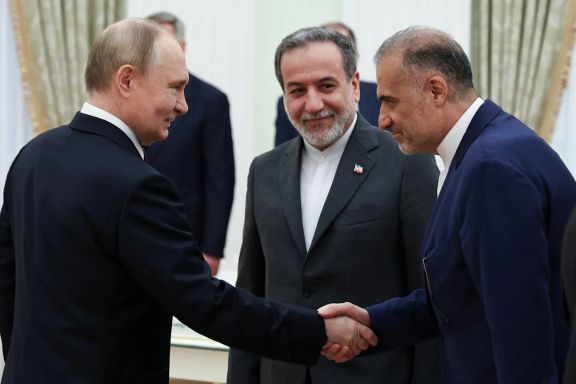
Russian President Vladimir Putin, Abbas Araghchi, Iran’s foreign minister, and Kazem Jalali, Tehran’s ambassador to Moscow

Iran has agreed a secret €500 million arms deal with Russia to acquire thousands of advanced shoulder-fired missiles in a major effort to rebuild air defenses damaged during last year’s war with Israel, the Financial Times reported on Sunday.

The agreement, signed in Moscow in December, commits Russia to deliver 500 man-portable Verba launch units and 2,500 9M336 missiles over three years, the FT reported, citing leaked Russian documents and several people familiar with the deal.

The Verba is described as one of Russia’s most modern shoulder-fired, infrared-guided air defense systems, capable of targeting cruise missiles, low-flying aircraft, and drones. Operated by small mobile teams, it allows forces to create dispersed defenses without relying on fixed radar installations, which are more vulnerable to strikes, the report said.

Under the €495 million contract, deliveries are scheduled in three tranches from 2027 through 2029, the FT said, adding that one person familiar with the transaction suggested a smaller number of systems could have been delivered earlier.

Tehran formally requested the systems last July, days after the end of a 12-day conflict in which the US briefly joined Israel in strikes on Iran’s three key nuclear facilities, according to a contract seen by the newspaper.

A former senior US official told the FT that Moscow likely viewed the agreement as a way to repair ties with Tehran after failing to come to its ally’s aid during the June conflict.

The deal was negotiated between Rosoboronexport, Russia’s state arms export agency, and the Moscow representative of Iran’s Ministry of Defense and Armed Forces Logistics (MODAFL), FT’s report said.

The contract was arranged by Ruhollah Katebi, a Moscow-based MODAFL official who previously helped broker Iran’s sale of hundreds of Fath-360 close-range ballistic missiles for use in Russia’s invasion of Ukraine.

One Russian Ilyushin Il-76TD cargo plane has made at least three runs from Mineralnye Vody in Russia’s northern Caucasus to the Iranian city of Karaj in the past eight days, FT’s report said. At least one more Il-76 flew the same route in late December.

Iran reportedly received up to six Russian Mi-28 attack helicopters in January and operated one of them in Tehran this month.

According to documents seen by the newspaper, Rosoboronexport is selling the 9M336 missiles at €170,000 per unit and the launch systems at €40,000 each.

The deal also includes 500 “Mowgli-2” night-vision sights designed to track aircraft and other targets in darkness, the report added.

Unlike larger Russian strategic air defense systems such as the S-300 and S-400, the Verba systems do not require extensive training or integration and can be deployed more quickly, FT’s report said.

The report added that Verbas have not played a significant role in Russia’s defenses against Ukrainian drone attacks, which could make Moscow more willing to part with them than other air defense systems.

Most Viewed

Film shot inside Iran breaks censorship ground with intimate scenes
1

Film shot inside Iran breaks censorship ground with intimate scenes

2

Iran agrees €500 mln arms deal with Russia to rebuild air defenses - FT

3

Iran students rally at major universities to honor slain protesters

4

Dancing for the dead: How protest massacre is rewriting Iran’s mourning rituals

5

Iran rules out interim deal in US talks, keeps military on alert during diplomacy

Banner
Banner

Spotlight

  • How Tehran whitewashes its crimes abroad
    SPECIAL REPORT

    How Tehran whitewashes its crimes abroad

  • Iranian students burn flag, signaling a new phase in state–society rupture
    ANALYSIS

    Iranian students burn flag, signaling a new phase in state–society rupture

  • Iran protester dies after torture in Guards’ custody, source says
    EXCLUSIVE

    Iran protester dies after torture in Guards’ custody, source says

  • Dancing for the dead: How protest massacre is rewriting Iran’s mourning rituals

    Dancing for the dead: How protest massacre is rewriting Iran’s mourning rituals

  • Film shot inside Iran breaks censorship ground with intimate scenes

    Film shot inside Iran breaks censorship ground with intimate scenes

  • Why war may no longer be the worst outcome for Tehran
    ANALYSIS

    Why war may no longer be the worst outcome for Tehran

•
•
•

More Stories

Bipartisan lawmakers say Congress should not tie Trump’s hands on Iran

Feb 20, 2026, 17:12 GMT

Two bipartisan lawmakers announced on Friday they oppose a congressional bid to limit the use of force against Iran, arguing the measure would constrain Washington’s ability to respond to what they described as an evolving threat from Tehran.

In a joint statement, Representatives Josh Gottheimer, a Democrat from New Jersey, and Mike Lawler, a Republican from New York, said they would oppose the bipartisan Massie-Khanna War Powers Resolution, which seeks to require explicit congressional authorization for military action against Iran.

The lawmakers framed their stance around security concerns, saying the United States must retain operational flexibility. “This resolution would restrict the flexibility needed to respond to real and evolving threats and risks signaling weakness at a dangerous moment.”

The pushback comes as Representatives Ro Khanna and Thomas Massie prepare to force a House vote on their 2025 War Powers Resolution, which would require explicit congressional authorization before President Donald Trump could launch military action against Iran.

Khanna said he plans to use a procedural move to bring the measure to the floor as the US military completes its buildup in preparation for a potential strike on Iran.

Supporters say the measure is intended to reassert Congress’s constitutional authority over decisions that could lead to war and to ensure lawmakers debate any move that could put US troops in harm’s way.

Gottheimer and Lawler said they respect congressional oversight but warned against tying the hands of the executive branch.

“We respect and defend Congress’s constitutional role in matters of war. Oversight and debate are absolutely vital,” they said, adding that lawmakers should be fully briefed on any planned military action under the War Powers Act.

In their statement, the two lawmakers also accused Tehran of continuing to pursue a nuclear weapon and rebuild ballistic missile capabilities following recent regional tensions. They described Iran as “the world’s leading state-sponsor of terror” and cited its support for armed groups across the Middle East.

The lawmakers further pointed to Iran’s domestic crackdown following nationwide protests in January when nearly 40,000 people were killed, saying they stand with Iranians “demanding basic rights and dignity.”

The debate is unfolding as the United States has surged military assets closer to Iran while simultaneously pursuing talks aimed at curbing Tehran’s nuclear program. Trump recently said that regime change in Iran “would be the best thing that could happen,” underscoring the heightened stakes surrounding the congressional effort.

Three Iranians in Silicon Valley face US trade secrets charges

Feb 20, 2026, 08:19 GMT

Three Iranians working as engineers in Silicon Valley were charged with stealing sensitive trade secrets from leading US technology firms and transferring confidential data to unauthorized locations, including Iran, US authorities said on Thursday.

A federal grand jury in the Northern District of California indicted Samaneh Ghandali, 41, Mohammadjavad Khosravi, 40, and Soroor Ghandali, 32, on counts including conspiracy to commit trade secret theft, theft and attempted theft of trade secrets, and obstruction of justice. The three, all residents of San Jose, were arrested and made initial court appearances on Thursday.

According to the indictment, the defendants gained employment at major technology companies involved in developing mobile computer processors. Samaneh Ghandali and her sister Soroor Ghandali worked at Google before moving to another firm identified as Company 3, while Khosravi, who is married to Samaneh Ghandali, worked at a separate company identified as Company 2.

Prosecutors allege the defendants used their positions to access confidential information, including trade secrets related to processor security and cryptography. The indictment says they transferred hundreds of sensitive files to unauthorized third-party platforms, personal devices, and work devices linked to each other’s employers, as well as to Iran.

“As alleged, the defendants exploited their positions to steal confidential trade secrets from their employers,” United States Attorney Craig H. Missakian said. “Our office will continue to lead the way in protecting American innovation and we will vigorously prosecute individuals who steal sensitive advanced technologies for improper gain or to benefit countries that wish us ill.”

FBI Special Agent in Charge Sanjay Virmani described the alleged conduct as a “calculated betrayal of trust,” saying the defendants took deliberate steps to evade detection, including submitting false affidavits and manually photographing computer screens to avoid digital tracking.

The indictment also details travel to Iran in December 2023, when prosecutors say some of the exfiltrated material was accessed from a personal device.

If convicted, each defendant faces up to 10 years in prison for each trade secret-related count and up to 20 years for obstruction of justice.

Trump signals Iran deal deadline as reports point to limited strike plans

Feb 20, 2026, 02:07 GMT

US President Donald Trump on Thursday warned Iran it must reach a meaningful nuclear agreement with the United States within two weeks or face consequences, as reports indicate Washington is considering limited strikes to force a deal.

Speaking at the inaugural meeting of his Board of Peace initiative in Washington, Trump hinted at a narrow timeframe for progress and reiterated US demands on Tehran’s nuclear program.

“It’s proven to be, over the years, not easy to make a meaningful deal with Iran. We have to make a meaningful deal; otherwise, bad things happen,” Trump said. “And you’re going to be finding out over the next probably 10 days.”

He added that Iran “cannot have a nuclear weapon” and must halt actions Washington views as threatening to regional stability, suggesting that military measures could follow if diplomacy fails.

The Wall Street Journal reported that Trump is weighing an initial, limited strike on Iran as leverage to compel Tehran to accept US conditions in nuclear talks.

The report said Trump is reviewing targeted military options that could be executed within days if Iran refuses to halt enrichment activity, with the aim of strengthening US negotiating leverage without immediately triggering a broader conflict.

Also on Thursday, US Ambassador to the United Nations Michael Waltz doubled down on Washington’s pressure campaign in media appearances, accusing Tehran of stalling negotiations and saying that economic sanctions have strained the Iranian leadership.

“Even in the face of world condemnation over the killing of somewhere between 18,000 and 40,000 of their own people — an industrial-sized massacre,” Waltz said in an interview with Fox News.

Waltz said sustained pressure would continue even as diplomatic engagement moves forward.

'Obvious gap remains'

The head of the UN nuclear watchdog, IAEA Director General Rafael Grossi, said on Thursday that an “obvious” gap remains between the United States and Iran over uranium enrichment after attending talks in Geneva on Tuesday.

“It is clear that there is, there is this gap which is, which is obvious, between the position of the United States, which is demanding… no enrichment at all, and what Iran would like to continue to be doing,” Grossi told CNN. He added that while the agency has been allowed back into Iran, inspectors have not been granted access to the nuclear sites targeted in US-Israeli airstrikes in June.

Grossi said he believes the 400 kg of enriched uranium remains “where it was” before the bombings and has not been moved.

Experts say Iran entering era of constant unrest

Feb 19, 2026, 16:56 GMT

Iran is entering a phase of persistent unrest, driven by decentralized “minor triggers” and deepening economic and legitimacy pressures that repression alone may no longer contain, senior analysts said at Iran International's townhall in Washington DC.

Iran experienced in January its most widespread and sustained unrest since the founding of the Islamic Republic, as protests spread across cities and provinces and authorities responded with an escalating crackdown that analysts say reflects a deepening crisis of legitimacy at the core of the state.

Speaking during a special Iran International Insight town hall on Wednesday, experts said the scale, persistence and decentralization of the unrest signal a structural rupture between state and society - one repression alone may no longer be able to contain.

In what participants described as one of the harshest security responses in recent years, tens of thousands have been killed, detained or interrogated. Rather than restoring order, panelists argued, the severity of the crackdown underscores mounting anxiety within the leadership about the durability of its authority.

A widening legitimacy gap

Political scientist Mohammad Ghaedi said each protest cycle deepens what he described as a structural legitimacy deficit.

“In democracies, when we ask why leaders should rule, the answer is because they are elected by the nation,” he said. “But if you ask that question of Iranians, there is no clear answer — because 47 years ago, Ayatollah Khomeini deceived the nation.”

According to Ghaedi, the leadership is fully aware of this vulnerability.

“They have to respond in a way that makes the nation unwilling to protest again. That explains the brutality of the repression,” he said.

From mega-triggers to permanent volatility

Bozorgmehr Sharafedin, a senior Iran analyst and Head of Digital at Iran International, said the protest landscape has fundamentally shifted.

“Iranian society has wisely moved from demonstrations triggered by mega-triggers to minor triggers,” he told the panel moderated by Gelareh Hon. “Minor triggers are very difficult for the government to contain because they're not centralized, they're unpredictable and they're emotionally charged.”

Instead of singular catalytic events driving nationwide mobilization, grievances now simmer across economic, social and political spheres — producing recurring, localized flare-ups that strain security forces and steadily erode the state’s ability to project control.

Sharafedin framed the crisis around three central actors: Ali Khamenei, Donald Trump and the Iranian public.

“The social contract between Khamenei and the people has expired,” he said. “Either the Supreme Leader reaches a deal with Trump at the expense of the people, or Trump sides with the people against the Islamic Republic. In both scenarios, Khamenei loses,”

Economic hardship and ideological erosion

Mohammad Machine-Chian, a senior journalist at Iran International and a former researcher at the University of Pittsburgh, argued that the unrest reflects both deep economic distress and mounting ideological rejection.

“Demanding a normal material life is in and of itself a rejection of Khomeinism — the whole ideology of the Islamic Republic, which prescribes abandonment of material life and demands sacrifice for the state” he said.

He cited soaring prices as a daily pressure reshaping public sentiment.

“Inflation is nearly 60%. Food inflation is about 72%. If we go deeper, it gets uglier — cooking oil around 200%, and red meat over 100%. This is the reality people are dealing with.”

Beyond inflation, he said, the regime’s traditional pillars are weakening. The Islamic Republic was historically sustained by an alliance between the bazaar and the mosques — institutions that once anchored its social legitimacy.

“The bazaar is finally breaking completely with the Islamic Republic,” he said. “Mosques now have detention centers. They no longer serve a social or civil purpose in Iranian society.”

Panelists also highlighted what they described as a significant psychological shift within society: foreign assistance, once politically taboo, is now openly debated.

Audience questions addressed policy trade-offs in the United States, concerns in Turkey over possible regional escalation, and the apparent weakening of Tehran’s regional proxy network.

The town hall concluded that the Islamic Republic faces converging pressures — eroded legitimacy, weakened institutions, economic deterioration and a society increasingly detached from the ideological foundations of the state. While repression may buy the leadership time, panelists said it no longer restores authority or rebuilds public consent.
Iran jail terms for Christians top 280 years as arrests nearly doubled

Feb 19, 2026, 13:50 GMT
•
Niloufar Goudarzi

Iranian courts sentenced Christians to more than 280 years in prison in 2025, according to a joint report by four rights groups, in what advocates describe as a widening use of national security laws to suppress religious dissent.

The findings reveal a sharp escalation in repression as authorities increasingly label those who leave Islam as "security threats" and "Mossad mercenaries" following regional conflicts.

The report, titled "Scapegoats" and released on Thursday, documents 254 arrests in 2025, nearly double the number recorded the previous year. Rights advocates say the surge reflects a strategic shift by the Islamic Republic to use national security frameworks to crush religious dissent.

"The Islamic Republic is a religious apartheid state where non-recognized minorities like Christian converts are not considered citizens but just 'ghosts' in the eyes of the regime," said Fred Petrossian, an Iranian-Armenian researcher and journalist specializing in religious minorities, based in Brussels, who collaborates with Article 18.

The study was a collaborative effort by Article 18, Open Doors, Middle East Concern (MEC), and Christian Solidarity Worldwide (CSW).

Regional tensions fuel domestic raids

The report describes the 12-day war with Israel in June 2025 as a "pivotal moment" for domestic targeting. In the single month following the June 24 ceasefire, at least 54 Christians were detained across 19 cities.

Petrossian told Iran International that the state has moved to "choke the freedoms" of converts by framing their faith as an extension of foreign hostility.

"A religious holiday becomes criminalized when it represents both faith and collective identity outside state-approved boundaries," Petrossian said.

He pointed specifically to Christmas, which in recent years has gained wide popularity among ordinary Iranians despite official disapproval from clerics.

Shops in major cities openly sell Christmas trees and decorations, cafés display festive themes, and large crowds, many of them Muslims, gather outside churches such as those in Tehran and Isfahan.

Authorities, however, often respond to private Christmas gatherings of converts with raids, arrests, and intimidation.

Petrossian added that the struggle for Christian freedom in Iran is inseparable from the broader fight for human rights and civil liberties for all citizens.

He said that at least 19 Christians have lost their lives in the recent violence and unrest, reflecting how deeply intertwined religious persecution is with the wider crackdown affecting the Iranian society.

Authorities have increasingly weaponized Article 500 bis of the penal code, which criminalizes "propaganda contrary to the holy religion of Islam". The report found that nearly 90% of all charges against Christians in 2025 were brought under this amended article, which carries sentences of up to 10 years.

Systematic mistreatment in detention

The report paints a horrifying picture of the conditions faced by converts in the Iranian prison system, including psychological torture and the deliberate denial of healthcare.

  • Narges Nasri: A pregnant convert sentenced to 16 years in prison on International Women’s Day for her faith and for supporting the "Woman, Life, Freedom" protest movement on social media.
  • Aida Najaflou: A convert who fractured her spine in a prison fall and only received surgery after fellow prisoners protested on her behalf. She was later returned to her cell prematurely despite being at risk of paralysis.
  • Nasser Navard Gol-Tapeh: A convert in his sixties who suffered a stroke while in solitary confinement and was returned to his cell after just two days of hospital treatment.
  • Christian convert broke spine, denied care in Iran prison - rights group

    Christian convert broke spine, denied care in Iran prison - rights group

  • Western charity scrutiny tests line between faith, foreign influence

    Western charity scrutiny tests line between faith, foreign influence

  • Iran's continued persecution of Christians raises alarm, says UN rapporteur

    Iran's continued persecution of Christians raises alarm, says UN rapporteur

The 'two-tier' propaganda machine

Petrossian pointed to a "two-tier" system where the state uses recognized ethnic Christians, such as those of Armenian or Assyrian descent, to project an image of tolerance while criminalizing the larger community of converts.

While ethnic Christians may worship in their own languages, they are strictly prohibited from preaching in Persian or welcoming converts.

"Recognition does not mean they have all rights," Petrossian said. "The moment members of these communities do not follow the state’s red line, they face repression similar to that experienced by converts."

The Islamic Revolutionary Guard Corps (IRGC) has taken an increasing role in these crackdowns, often acting with more brutality than traditional intelligence agencies.

In February, 20 plainclothes IRGC agents raided a gathering in Gatab – a town in Mazandaran province where they reportedly tore cross necklaces off several people and blocked emergency medical personnel from assisting the injured.

"IRGC agents go to homes without a legal warrant and arrest people. They say obscene and offensive things and insult and humiliate them," one convert testified in the report.

Petrossian added that the state’s efforts to control even personal life create a "dystopian system" where religious holidays like Christmas are criminalized because they represent a "collective identity outside state-approved boundaries".

The report concludes by calling on the international community to hold Iran accountable under Article 18 of the ICCPR, which guarantees the freedom to adopt and practice a faith of one's choosing.