400,000 Iranians abroad share internet access with users at home, Psiphon executive says
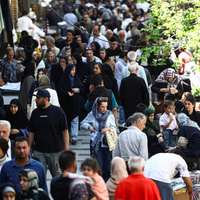
Psiphon's director of DC operations said that hundreds of thousands of Iranians living abroad are sharing their internet connections to help people inside Iran access the open internet.
Speaking to Iran International on the sidelines of a rally in Washington, Ali Tehrani said the effort relies on a tool known as the Conduit application.
“400,000 Iranians outside the country are sharing their internet by installing the Conduit app, so people inside Iran can access free internet,” he said.
(From left) Iranian diplomats Saeed Khatibzadeh, Esmail Baghaei, Abbas Araghchi during a foreign policy event in Tehran on February 8, 2026
Iran’s foreign minister said on Sunday that Tehran’s right to enrich uranium on its own soil must be recognized for nuclear talks with the United States to succeed, two days after the two sides held indirect discussions in Muscat aimed at testing whether diplomacy can be revived.
Foreign Minister Abbas Araghchi told reporters at a foreign policy conference in Tehran that Friday’s Muscat talks were limited to the nuclear file and that Iran would not negotiate on missiles or regional issues.
“Zero enrichment can never be accepted by us,” Araghchi said, adding that talks should focus on arrangements that allow enrichment in Iran.
“We need to focus on discussions that accept enrichment inside Iran while building trust that enrichment is and will remain for peaceful purposes.”
Araghchi said results of the Muscat round were being reviewed and that both sides were waiting for decisions in their capitals on whether to proceed, with any next round expected to remain indirect and potentially be held outside Oman.
“The results of the talks are under review,” Araghchi said. “The overall approach of both countries is to continue the talks, and we are waiting for decision-making in the capitals.”
He added that Iran would not negotiate its missile program or regional policies, pushing back against US calls to widen the agenda.
“The missile issue and regional issues have not been on the agenda and are not on the agenda,” Araghchi said.
Tehran’s top diplomat described the first Muscat meeting as a test of seriousness, adding that talks would continue only if Iran concluded the United States was acting in good faith.
“The first session was a trial of how much we can trust the other side.”
He also said Iran had increased consultations with regional states compared with past nuclear diplomacy, and that Tehran had kept Russia and China informed of the process.
A scene from a foreign policy event in Tehran on February 8, 2026
Speaking at the same event, Kamal Kharazi, head of Iran’s Strategic Council on Foreign Relations and a former foreign minister, said Tehran’s foreign policy should prioritize ties with neighboring countries while maintaining what he called resistance to coercive pressure from adversaries.
Ali Akbar Salehi, a former foreign minister and senior nuclear official, argued that Iran faced a broader governance challenge in translating its revolutionary ideals with practical policy tools, adding that strengthening the domestic economy and modern capabilities would make Iran’s foreign policy more sustainable.
Saeed Khatibzadeh, head of the Foreign Ministry’s political and international studies center, said the conference aimed to bridge academia, industry and the foreign policy establishment.
Araghchi framed enrichment as tied to sovereignty, saying no outside power could dictate what Iran may possess, and argued that diplomacy could work only if Iran’s rights were respected.
The Muscat talks came amid high regional tensions and an expanded US military posture in the region.
Iran’s President Masoud Pezeshkian said on Sunday that the talks were a “step forward,” adding that Tehran wanted its rights under the Nuclear Non-Proliferation Treaty to be respected.
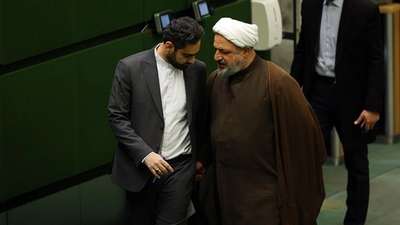
An Iranian lawmaker accused prominent reformist and opposition figures of promoting submission to the United States, using harsh religious language during a speech in parliament on Sunday.
Mohammad Seraj, a Tehran lawmaker, described the United States as “the embodiment of Satan” and said calls for engagement with Washington amounted to abandoning Iran’s independence and Islamic principles.
Seraj said those advocating what he called a “comprehensive agreement” with the United States were “friends of Satan,” naming former presidents Hassan Rouhani and Mohammad Khatami, as well as reformist opposition figures Mir-Hossein Mousavi and Mehdi Karroubi.
Head of Iran’s judiciary said on Sunday that Tehran has no hope or trust in the US and warned Washington against using negotiations to buy time while boosting military capabilities in the region.
“If the enemy wants, in the name of negotiations, to waste time and add to its military equipment and tools in the region, it is mistaken,” Gholamhossein Mohseni-Ejei said.
Mohseni-Ejei also said the enemy was seeking to tighten pressure on Iran through sanctions and economic isolation.
“We are in full readiness and will confront the enemy more firmly than in the 12-day war,” he added.
Iran’s army commander said on Sunday that the country’s armed forces are closely monitoring their adversaries and are ready to respond decisively to any hostile action.
Major General Amir Hatami, commander-in-chief of Iran’s army, made the remarks on the sidelines of a ceremony marking Air Force Day.
“The enemy’s movements are being carefully monitored, and we are prepared to respond firmly to any act of aggression,” Hatami said, adding that the presence of US naval forces in the region was not new.
Iran does not seek to start a regional war but would hold the United States responsible for the consequences of any such conflict, the country’s top military commander said on Sunday.
Major General Abdolrahim Mousavi, chief of staff of Iran’s armed forces, said Iran remained fully prepared for a prolonged conflict with the United States while also remaining open to what he described as logical and unconditional avenues for diplomacy.
“We are not interested in starting a regional war,” Mousavi said at a ceremony marking the anniversary of Iran’s air force. “But a regional war would push the region’s progress and development back by years, and its consequences would be the responsibility of the war instigators, meaning the United States and the Zionist regime.”
Mousavi said Iran possessed both the military capability and readiness for a long-term confrontation with Washington, while stressing that Tehran preferred to avoid escalation.