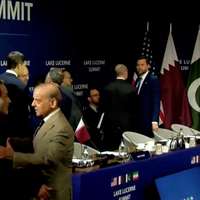
Oman’s foreign minister held separate meetings with Iranian and US delegations as Muscat hosted indirect talks on Iran’s nuclear file, Oman’s foreign ministry said.
Sayyid Badr Albusaidi met the Iranian delegation led by Abbas Araghchi and the US delegation headed by US special envoy Steve Witkoff, accompanied by Jared Kushner, the ministry said.
The consultations focused on creating conditions to resume diplomatic and technical negotiations and on supporting dialogue to promote security and stability, the ministry added, reaffirming Oman’s role as a mediator.


Australian Senator Raff Ciccone, Chair of the Parliamentary Joint Committee on Intelligence and Security and a co-sponsor of a bipartisan Senate motion condemning Iran’s crackdown on protests, said Australia was standing firmly with the people of Iran.
The Australian Senate on Thursday approved the motion, which cited killings, mass arrests and internet blackouts imposed on civilians during protests that began in late December. It also acknowledged the distress of Iranian-Australians unable to contact relatives in Iran.
In an interview with Iran International, Ciccone said the vote sent a clear message of unity across Australia’s political spectrum.
“Earlier today in the Australian Senate, myself and a number of other senators across the political spectrum came together in a sign of unity and national bipartisanship to send a very strong message that Australia and the Australian Senate stands very closely with the people of Iran,” he said.
The motion called on the Albanese government to work with international partners, including the United Nations, to support independent investigations into human rights violations, press for accountability, expand targeted sanctions and push for an end to violence and communications restrictions.
Ciccone’s comments followed new Australian sanctions imposed earlier this week on 20 individuals and three entities linked to Iran’s security apparatus.
“Since 28 December last year, the Iranian regime has responded to peaceful protests with extraordinary and horrifying violence against its own people,” Ciccone said, adding that authorities had tried to conceal the crackdown through internet and telecommunications blackouts.
He said his office had received hundreds of calls and emails from members of the Iranian-Australian community worried about family and friends.
“Members of the Australian Iranian community have watched these events unfold with profound anguish,” he said.
Ciccone urged Iranian authorities to halt attacks on civilians and said Australia would not stay silent.
“The attacks that are occurring on citizens has to stop, has to stop immediately,” he said. “Australia is very much by your side.”
Iran discussed its nuclear file with a senior Chinese foreign ministry official during a visit to China by an Iranian deputy foreign minister, state media reported.
Kazem Gharibabadi, Iran’s deputy foreign minister for legal and international affairs, met Chinese Assistant Foreign Minister Liu Bin, with talks focusing on Iran’s nuclear issue, the reports said.
Iranian state media quoted Liu as saying China supports Tehran’s right to the peaceful use of nuclear energy and favors resolving the nuclear file through political and diplomatic means.
An Iranian lawmaker said Iran views its missile industry as a legal and indigenous right and would respond forcefully if attacked, state media reported.
Esmail Kowsari, a member of parliament’s national security and foreign policy commission, said Iran would “defend itself with strength” in the event of military action, according to the report.
Kowsari also said talks between Iran and the United States would not produce results and that Tehran would not accept what he described as imposed negotiations.
Some oil tankers are increasing speed as they pass through the Strait of Hormuz amid rising tensions between the United States and Iran, Bloomberg reported on Friday.
Very large crude carriers were moving through the narrow waterway at speeds of up to 17 knots, compared with a typical top speed of about 13 knots for fully laden vessels, according to ship-tracking data cited by the outlet.
Roughly a quarter of the world’s seaborne oil trade passes through the strait, the report said.

A group of scholars in Iranian studies issued a public statement expressing solidarity with people in Iran, describing the protests as a defining historical moment and warning that silence or misplaced neutrality carries consequences.
“The current uprising marks a defining historical moment - one in which silence, equivocation, or misplaced neutrality carries consequences,” the scholars said in a collective statement released on Thursday.
The statement said academics who work on Iran benefit professionally from their research and therefore bear a responsibility to acknowledge the realities facing Iranians. It pointed to widespread state violence, including killings, imprisonment, torture, enforced disappearances and executions, alongside broader repression through surveillance, internet shutdowns, economic pressure and restricted access to medical care.
Universities have become central sites of repression, the statement said, with students, faculty members and researchers arrested, dismissed, forced into exile or killed for political expression. Campuses have been militarized and academic life hollowed out through intimidation and purges, it added.
The scholars rejected narratives portraying the protests as driven by foreign actors, calling such claims a core element of state propaganda that erases Iranian political agency.
“We further reject the repeated circulation - explicit or implicit - of narratives about foreign orchestration, outside agitators, or foreign boots on the ground for which the government has not provided any provable evidence,” the statement said.
The scholars also criticized what they described as an excessive focus on data disputes while documentation of events inside Iran is actively suppressed.
At the same time, they said they do not advocate war or external control over Iran’s future, emphasizing opposition to authoritarian violence without endorsing foreign intervention.
Calling for ethical clarity within their field, the signatories urged colleagues to stand publicly with protesters, avoid reproducing official narratives, center the voices of Iranians demanding change and prioritize documentation of lived experience. They also called for the immediate release of political prisoners and an end to executions.