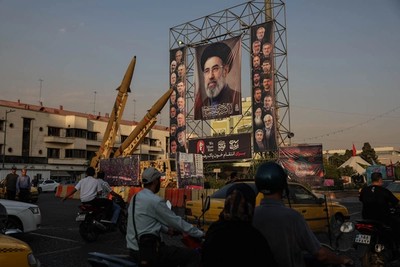
Supporters of the Islamic Republic hold Iranian flags and images of supreme leader Ali Khamenei, in a state-sponsored rally in Tehran, Iran, January 12, 2026
Tehran on Monday conducted large pro-government rallies in several cities intended to counter the nationwide protests challenging its rule, in a strategy it has deployed against previous bouts of mass unrest ultimately crushed by deadly force.
The aim is not necessarily to convince skeptics, but to project an image of control and popular backing at a moment of visible strain.
After days of sustained demonstrations calling for the overthrow of the system, authorities organized counter-rallies in several cities on Monday, presenting them as popular condemnations of the protests themselves.
State television depicted the gatherings as mass denunciations of unrest, echoing official claims that the uprising was driven by “armed terrorists” and foreign adversaries.
A familiar mobilization
The mechanics of the rallies followed a script many Iranians recognize. State bodies drew participants to central locations in Tehran and other major cities, relying on administrative pressure and access to public resources.
Coverage was then amplified by state television and media outlets affiliated with the Islamic Revolutionary Guards Corps.
In recent broadcasts, state outlets released a mix of ground-level footage and aerial images intended to convey scale. Some of the images show visible crowds, underscoring that the authorities retain a base of support.
It is difficult to determine precise numbers, the duration of the gatherings, or whether all images reflect live events from the same day. Similar visual techniques — including the reuse of footage or the circulation of undated aerial shots — have been employed during previous protest cycles.
Even taken at face value, the rallies appeared limited in duration and geographic spread.
By contrast, demonstrations opposing the government have persisted for weeks, erupting across hundreds of locations according to tallies compiled by activists and researchers, despite the risks involved.
The contrast is sharpened by the conditions under which each takes place: pro-government gatherings proceed under heavy security, while protesters have faced gunfire, mass arrests and lethal force.
Information control as context
This round of rallies unfolded amid unusually severe restrictions on communication. For several consecutive days, internet connectivity across much of Iran has been sharply curtailed, according to digital rights groups and user reports, leaving millions unable to communicate freely or share information.
State and Guards-linked outlets, by contrast, have continued to publish without interruption. Agencies such as Tasnim, Fars and Mehr have maintained full access, flooding television and online platforms with official narratives.
The result is a highly asymmetric information environment. While ordinary citizens struggle to document events or verify developments, state-aligned media dominate the public space with curated imagery.
Under such conditions, rallies are presented largely on the authorities’ terms, with limited independent means to corroborate scale, timing or participation.
A recurring sequence
Similar state-organized rallies followed major protest movements in 2009, 2019 and 2022, each time presented as demonstrations of enduring legitimacy. In each case, they coincided with intensified security measures and tighter controls on dissent.
Evidence of the human toll has continued to surface despite efforts to restrict documentation.
Videos circulating online in recent days, which could not be independently verified, appeared to show bodies in a morgue in Kahrizak, with grieving relatives gathered nearby—imagery that contrasted sharply with official broadcasts of unity and resolve.
In a message released Sunday night, Reza Pahlavi described the moment as a new phase in what he called a national uprising, urging supporters to challenge the state’s control over information and public space.
What the competing images ultimately underscore is a question that spectacle alone cannot answer: how Iranian cities would look if opposing sides were able to assemble under comparable conditions.
The return to this familiar choreography comes as protests continue despite severe limits on communication, widespread arrests and the high personal cost of participation.
The repeated staging of loyalty rallies suggests not confidence, but the absence of other tools for demonstrating consent. Carefully framed images may circulate for a time, but they cannot indefinitely substitute for credibility rooted in broad public trust.
In the end, theater may delay recognition of a crisis, but it does not resolve one.
An illustration showing an ancient Iranian soldier and a Revolutionary Guard member holding a weapon together, displayed during a November 7 ceremony in Tehran where a statue of pre-Islamic Persian King Shapur I was unveiled.
Tehran’s unveiling of a towering statue depicting the Roman Emperor Valerian kneeling before pre-Islamic Persian King Shapur I has renewed criticism of the Islamic Republic’s appeal to nationalist sentiment following the June war with Israel.
For over forty years, the theocracy purged ancient Persian history from schoolbooks, replacing it with post-Islamic narratives. But after the 12-day conflict with Israel, officials have turned to the distant pre-Islamic past to rally a divided society.
From murals of ancient kings and soldiers to patriotic songs added to Shi’ite mourning ceremonies performed before Supreme Leader Ali Khamenei, Tehran now embraces imagery once deemed heretical by its own revolutionary ethos.
The statue unveiled in Tehran's Revolution Square
'Kneel before Iran' campaign
Tehran’s Revolution (Enghelab) Square was the scene of an unusual spectacle on Friday as officials unveiled a massive bronze statue depicting Roman Emperor Valerian kneeling in submission before Sassanid King Shapur I, commemorating Iran’s victory at the Battle of Edessa (260 AD).
The event was held under the slogan “Kneel before Iran,” part of what authorities describe as a campaign to project “national unity and historical pride” following the June war with Israel.
Tehran Mayor Alireza Zakani, a staunch ultraconservative, said on X: “Enmity with Great Iran can only end in kneeling before this historic nation.”
Municipal official Davood Goodarzi said the installation would be accompanied by visual displays depicting “other victories of Iranians over foreign aggressors,” including the defeat of British forces by local commander Rais-Ali Delvari, Mirza Kuchak Khan’s resistance against Russian troops, and Surena’s triumph over Rome at the Battle of Carrhae in 53 BCE.
The goal, Goodarzi said, is “strengthening concepts such as national dignity, social unity, and Iranian identity.”
The statue, he said, would remain temporarily at Revolution Square before being moved to a city gateway “where it will stand as the first emblem of Iran before diplomats and foreign visitors.”
Unveiled women were allowed to attend the unveiling ceremony—an uncommon scene at events organized by Tehran’s ultra-hardline municipality.
The turn to the pre-Islamic past
The sharp reversal also recalls remarks once made by Khamenei. In a 2011 speech, he asserted that “all the great military victories of this nation came after Islam,” dismissing pre-Islamic accounts as “things that are not documented.”
In 1987, he had said that prophets triumphed over kings such as Cyrus and that “nothing remains of these monarchs in history but names remembered with derision.”
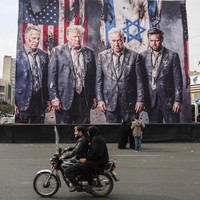
Nevertheless, pro-government social media accounts have now gone so far as to circulate posters equating Khamenei himself with Shapur, showing him standing with a staff as Benjamin Netanyahu and Donald Trump kneel before him. The caption reads: “You will kneel before Iran.”
Image circulating by hardliners on social media
'Hypocrisy'
Pro-government figures have hailed the move as a patriotic success. Conservative political reporter Hossein Saremi posted: “Today’s grand Iranian gathering showed that people and the state share one essence: Iran itself. Nothing can take our homeland away.”
Others, however, called the spectacle “hypocrisy.” Journalist Gholamhossein Pashaei wrote on X: “Every year you close Pasargadae to stop people from celebrating Cyrus Day, yet you unveil Shapur’s statue in Enghelab Square with drums and fireworks during Fatimiyya (mourning period)!”
Dissident commentator Hamid Asafi called the ceremony “a perfect snapshot of the Islamic Republic’s contradictions.”
On Telegram he wrote: “A week ago they closed Cyrus’s tomb out of fear of the crowds, and now they glorify Shapur in the same breath. The Islamic Republic fears living history but poses for selfies with its corpse.”
He added: “They know people no longer respond to rosaries and sermons. That’s why they’ve brought history back to the stage—in a controlled costume. If they can’t erase the past, they’ll try to own it.”
The irony deepened as UNESCO formally recognized Cyrus’s Charter as one of the earliest human-rights documents.
President Masoud Pezeshkian wrote on X: “Iran, the cradle of dialogue, justice, and coexistence, can still inspire peace today.”
Users swiftly replied, questioning how such pride could coexist with a government that blocks access to Cyrus’s tomb each year to those wishing to visit it on his birthday.