Deadly clashes mark seventh night of protests across Iran
A scene of a protests
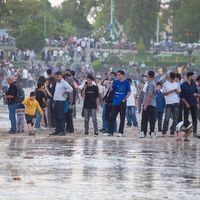
Protests continued across Iran for a seventh day and night on Saturday, with demonstrations reported in scores of cities and a sharp rise in fatalities marking one of the most violent phases of the unrest so far.
Videos and eyewitness accounts received by Iran International showed security forces opening fire on protesters in several locations, most notably in Malekshahi, a city in Ilam province, where state-linked media confirmed multiple deaths following clashes.
Based on information shared with Iran International, during protests in Malekshahi at least five protesters were killed by direct fire from security forces, and around 30 others were wounded.
Footage from the city showed wounded protesters and scenes of chaos after live ammunition was used.
Overall, at least 15 protesters and one member of the security forces have been reported killed during seven days of demonstrations, according to rights group HRANA.
Iran International was able to confirm that dozens more were wounded by live fire or pellet guns, while arrests were reported across several provinces.
The unrest, initially driven by economic grievances, has increasingly taken on a political character, with protesters chanting slogans against clerical rule and the Supreme Leader, as well as calling for a return of monarchy.
Demonstrations were reported in major cities as well as smaller provincial centers, despite heavy security deployments and warnings from authorities.
In his first public remarks since the protests began, Supreme Leader Ali Khamenei described participants as “rioters” and called for their suppression, signaling a hardening official stance as the unrest entered its second week.
Protests and street gatherings have been recorded in at least 174 locations across Iran over the past seven days, a rights group said, despite an intensified security crackdown aimed at curbing dissent.
The Human Rights Activists News Agency (HRANA) said demonstrations, labor strikes and street protests were reported in 60 cities across 25 provinces, indicating that unrest has extended beyond major urban centers into smaller cities and surrounding areas.
The group said protest activity had taken varied forms, including at least 18 student gatherings at 15 universities.
According to HRANA, at least 582 people were arrested during the past week, a figure it described as a minimum estimate, warning that the actual number is likely higher due to reporting restrictions and security pressure.
The data showed a significant number of those detained were minors. In the southwestern city of Yasouj alone, at least 81 people were arrested, including 70 under the age of 18, HRANA said.
Arrests of teenagers aged 15 to 17 were also reported in cities including Sabzevar, Izeh, Zahedan, Isfahan and Yasouj.
HRANA said it had confirmed at least 16 deaths linked to the protests during the seven-day period, including one member of Iran’s security forces. The remaining fatalities were civilians, it said.
At least 44 protesters were wounded by live ammunition or pellet fire, according to HRANA and separate reporting by Iran International. Dozens of others were injured by beatings, tear gas or during arrests, the reports said.
HRANA warned that the death toll could rise, citing conflicting official accounts, pressure on families and severe limits on information flow.
Iranian authorities have not issued comprehensive public figures on arrests or casualties.
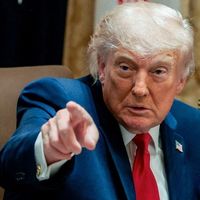
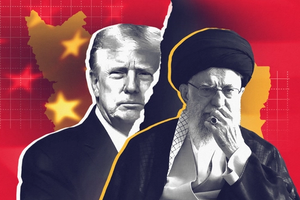
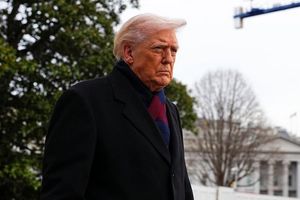
Within a week of the outbreak of protests in Iran against the Islamic Republic and its rulers, US President Donald Trump weighed in twice with direct comments.
On the second day of protests, he condemned the Iranian government for firing on demonstrators. On day six, he went further, warning that if the killing of protesters continued, US forces “will come to their rescue.”
This amounts to the fastest and most explicit reaction by an American president to a wave of unrest in Iran in the past 45 years. The question is whether this posture translates into concrete diplomatic steps or credible military pressure—or remains a largely symbolic deterrent message.
In 2009, former US president Barack Obama responded cautiously to Iran’s Green Movement protests. At the time, he had sent a second letter to Iran’s supreme leader, Ali Khamenei, and had yet to receive a reply. Obama feared that open support for protesters could undermine the secret backchannel he was attempting to establish with Khamenei to resolve the nuclear standoff.
At the same time, his advisers warned that overt US backing could backfire: protesters might be branded as “foreign agents,” giving the government a pretext to crack down even harder.
Those concerns are far less salient for Trump, at least for now. On one hand, there is currently no meaningful or active diplomatic channel between Tehran and Washington that a sharp US stance could weaken or shut down.
On the other hand, Iranian officials have for years accused protesters of being agents of hostile powers—a charge repeated by Khamenei himself in a recent speech on the unrest—rendering the label largely meaningless. There is little indication that demonstrators now fear either foreign support or accusations of outside ties.
Years later, Obama acknowledged that his cautious approach to the Green Movement had been a mistake, arguing that the United States should support popular, pro-freedom movements wherever they arise. Trump’s swift and blunt reaction suggests he has avoided a similar error.
The Obama administration’s experience also underscores another lesson: firm rhetoric is not enough. In 2012, Obama declared that the use of chemical weapons by the Syrian President Bashar al-Assad constituted a US “red line.”
Yet a year later, a sarin gas attack on Eastern Ghouta, a rebel-held suburb to the east of Damascus, killed hundreds of civilians, but the United States did not launch a military strike. Instead, Obama pursued a diplomatic route to remove Syria’s declared chemical weapons stockpiles.
That effort reduced—but did not end—the use of chemical weapons in Syria, and it significantly weakened Obama’s standing, and that of the United States, among Syrian opposition groups.
Trump, by contrast, appears keenly aware that unfulfilled threats erode both his personal authority and the projection of American power. He has acted on threats toward Iran twice: first, with the killing of Qassem Soleimani exactly six years ago, on January 3, 2020, and second, with a strike on Iranian nuclear facilities around 200 days ago.
On Saturday, Trump also followed through on recent threats against Venezuelan President Nicolas Maduro, announcing that the United States had carried out a major operation against Venezuela and detained Maduro and his wife, removing them from the country.
Tehran moved quickly to respond to Trump’s threat against the Islamic Republic’s repressive forces targeting protesters, suggesting that Khamenei is attentive to the speed and clarity of the message and the prospect of its implementation.
US President Donald Trump’s warning to Iran's rulers over violence against protesters has triggered divided reactions among Iran’s opposition and critics, with Tehran answering the remarks by issuing counter-threats against US interests in the region.
Hours after Trump posted his message on Truth Social, Ali Larijani, Secretary of Iran’s Supreme National Security Council, warned that US interference would be met with instability and the destruction of American interests across the region.
Iran’s Foreign Ministry also condemned Trump’s remarks as “interventionist,” warning that any reaction by the Islamic Republic could push “the entire region deeper into crisis and instability.”
A day later, Supreme Leader Ali Khamenei declared that Tehran would confront what he described as “riots,” while signaling limited openness to dialogue.
Exiled Prince Reza Pahlavi, whose name is being chanted by protesters as a future leader of Iran, welcomed Trump’s message. In a social media post, he thanked the US president and wrote:
“This warning you have issued to the criminal leaders of the Islamic Republic gives my people greater strength and hope—hope that, at last, a President of the United States is standing firmly by their side.”
He added: “I have the plan for stable transition for Iran and the support of my people to get it done. With your leadership of the free world, we can leave a legacy of lasting peace.”
In other messages, he urged Tehran residents to defy government efforts to prevent gatherings in the capital, calling mass street presence a vital complement to protests in smaller cities.
Amir Hossein Etemadi, an advisor to Prince Reza Pahlavi, warned Iranian officials that Trump’s message should be taken seriously, writing: “For every bullet fired at the people, they move faster toward their own death and that of their regime.”
Rejection of foreign intervention
At the same time, many reformists and government critics in Iran have strongly opposed foreign interference while urging authorities to refrain from violence.
Azar Mansouri, head of Iran’s Reformist Front, emphasized the right to protest but rejected outside interference, writing: “We stand with the protesters and do not see repression as a solution. But we explicitly and firmly condemn any foreign intervention; such interference harms non-violent protests.”
Prominent commentator Sadegh Zibakalam wrote that while he views Iran’s foreign, military, and nuclear policies as damaging to national interests, he cannot “stand alongside Trump and Netanyahu,” despite recognizing protest as a fundamental civil right.
Former vice president Mohammad-Ali Abtahi urged the government to prevent bloodshed to deny Washington any pretext.
Such statements have angered some social media users, who accuse reformist figures of aligning with the Islamic Republic against protesters.
A double-edged threat
Several analysts argue that Trump’s warning could have contradictory effects embolden some protesters and deter others.
Reformist journalist Ahmad Zeidabadi wrote that military intervention aimed at regime change is likely the last thing Trump seeks. Instead, he argued, Trump sees the protests as leverage for maximum pressure and potentially to undermine the Islamic Republic’s legitimacy.
According to Zeidabadi, such threats may push some protesters to withdraw while emboldening others.
Another commentator, Sahand Iranmehr, echoed this view, saying the message could foster “false hope” among some protesters while making others fear their movement could become “a battleground for US or Israeli geopolitical agendas.”
Journalist Bahman Amouee argued that Trump and Israeli Prime Minister Benjamin Netanyahu have effectively handed the Iranian government an excuse for harsher repression, aided by opportunists inside and outside the country.
Vali Nasr, a professor at Johns Hopkins University, summed up the concern in a post on X:
“Threatening to bomb Iran is not helping protesters… Iranians didn't revolt when Israel bombed and called on them to rise up; they are unlikely to do the same if US bombed Iran.”
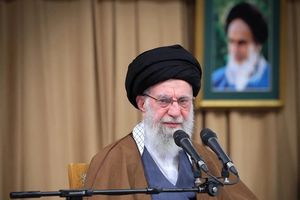
Iran’s supreme leader on Saturday called the nationwide protests the work of foreign-backed agitators and urged a harsher crackdown, in his first public speech since demonstrations began seven days ago
“A number of agitated people, enemy mercenaries, had positioned themselves behind bazaar merchants and chanted slogans against Islam, against Iran and against the Islamic Republic,” Ali Khamenei said, according to state media.
“Protest is legitimate, but protest is different from rioting,” Khamenei added. “Officials should speak with protesters. Speaking with a rioter is pointless. Rioters must be put in their place,” he said.
The comments marked Khamenei’s first public response to the latest wave of demonstrations, which have intensified amid economic strain and currency volatility.
Khamenei’s language echoed his stance during earlier nationwide protests, including the 2022 “Woman, Life, Freedom” uprising and demonstrations in November 2019, when security forces used lethal force to suppress unrest.
At least eight protesters have been killed so far after being shot by security forces during the current unrest, according to human rights groups. Independent organizations, including Iran Human Rights Organization, previously documented 551 deaths – among them 68 children – during the 2022 protests.
Currency crisis blamed on ‘the enemy’
Khamenei also attributed the protests to economic grievances while assigning responsibility for the currency crisis to foreign adversaries. “These gatherings were mainly by bazaar merchants,” he said, adding that sharp and unstable exchange-rate swings were “not natural” and were “the work of the enemy.”
He accused unnamed actors of exploiting merchants’ complaints to cause “damage and insecurity,” saying such actions were “unacceptable.”
The remarks came as protesters in several cities have chanted for the overthrow of the Islamic Republic and mainly voiced support for the exiled prince Reza Pahlavi.
Confrontation with ‘the enemy’
Khamenei closed by insisting the Islamic Republic would not retreat. “The enemy will not sit quietly and uses every opportunity,” he said, adding that authorities “were and will be present in the field.”
On Friday, US President Donald Trump warned that if Iranian authorities shoot peaceful protesters, the United States would act to help the people.
"If Iran shots and violently kills peaceful protesters, which is their custom, the United States of America will come to their rescue. We are locked and loaded and ready to go," Trump wrote in a message published on his Truth Social account.
Iranian officials responded with warnings toward the United States and Israel.
Tehran snapped back into protest mode following two nights of relative quiet, shortly after Donald Trump warned the United States was “locked and loaded” to intervene if Iran kills peaceful demonstrators.
In a message published on his Truth Social account, Trump warned that if Iran’s rulers kill peaceful protesters, the United States would act to save the Iranian people.
"If Iran shots and violently kills peaceful protesters, which is their custom, the United States of America will come to their rescue. We are locked and loaded and ready to go."
Iran’s leaders rejected Trump’s warning, accusing Washington of violating the UN Charter and “inciting violence and terrorism,” according to a Foreign Ministry statement.
Iran also warned in a letter to the UN that Tehran would “exercise its rights decisively” if attacked and hold the US fully responsible for any intervention.
Officials including Parliament Speaker Mobammad Bagher Ghalibaf and top security official Ali Larijani also threatened that US forces and bases in the region could become “legitimate targets” if Trump’s warning turned into military action.
Capital unrest
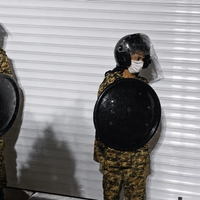
After a brief lull on Wednesday and Thursday, protests in the capital resumed in multiple districts, with crowds chanting against the ruling establishment as security forces deployed in large numbers and used tear gas and batons to disperse gatherings.
Protests were also held in dozens of other cities including the holy cities of Mashhad and Qom as well as Shiraz, Hamadan, and Zahedan, a city in Iran’s restive southeast which was n epicenter of protests in 2022.
The US-based Human Rights Activists News Agency (HRANA) says at least eight protesters have been killed nationwide since the latest wave of unrest began on Dec. 28.
Prince’s call
Exiled Prince Reza Pahlavi urged Iranians to “take control of the streets” in Tehran and other major cities through a simultaneous mass presence and road blockades, telling supporters to move in small, cohesive groups from neighborhood streets toward central arteries.
The prince said a “million-strong” wave would overwhelm security forces and could prompt some to retreat or even join the people, describing such a takeover of the capital’s streets as an essential step toward bringing down the Islamic Republic.
Prominent activists
Several prominent Iranian dissidents including renowned filmmaker Jafar Panahi and jailed Nobel Peace Prize laureate Narges Mohammadi issued a joint statement calling for a peaceful transition away from the Islamic Republic, saying that Iran is at a critical juncture amid mounting economic and political pressures.
“We stand with the people to reclaim the right to a dignified life, freedom, justice, human dignity, and sovereignty over our own destiny,” the statement said, published on Mohammadi's official account on X.
The signatories, including figures such as dissident filmmaker Mohammad Rasoulof, political prisoners Mostafa Tajzadeh and Rasoul Qadiyani, say a renewed wave of civil resistance “taking over the streets” reflects a national will to remove what they call the illegitimate regime and build a democratic order based on popular sovereignty, justice and normal relations with the world.