• العربية
  • فارسی
Brand
  • Iran Insight
  • Politics
  • Economy
  • Analysis
  • Special Report
  • Opinion
  • Podcast
  • Iran Insight
  • Politics
  • Economy
  • Analysis
  • Special Report
  • Opinion
  • Podcast
  • Theme
  • Language
    • العربية
    • فارسی
  • Iran Insight
  • Politics
  • Economy
  • Analysis
  • Special Report
  • Opinion
  • Podcast
All rights reserved for Volant Media UK Limited
volant media logo

Protesters chant slogans against Khamenei in nighttime gatherings

Dec 29, 2025, 15:25 GMT+0Updated: 16:27 GMT+0

Tehran protesters chanted 'death to the dictator' during sporadic nighttime demonstrations, videos obtained by Iran International show.

Similar chants were heard in Malard, a town in western Tehran province, on Monday evening.

Most Viewed

IRGC-linked media hints at threat to Persian Gulf undersea internet cables
1

IRGC-linked media hints at threat to Persian Gulf undersea internet cables

2

Iran Guards say two ships seized in Hormuz after ceasefire extension

3
EXCLUSIVE

Strikes on petrochemical hubs leave Iran short of plastics

4
INSIGHT

War or economic collapse: can Iran withstand the pressure?

5

Iran executes former atomic agency employee over alleged spying for Israel

Banner
Banner

Spotlight

  • Tehran stocks head for reopening, but it risks triggering a new crisis
    ANALYSIS

    Tehran stocks head for reopening, but it risks triggering a new crisis

  • Power vacuum in Tehran emboldens hardliners
    INSIGHT

    Power vacuum in Tehran emboldens hardliners

  • Inflation spikes, basic goods slip out of reach for Iranians, citizens say
    VOICES FROM IRAN

    Inflation spikes, basic goods slip out of reach for Iranians, citizens say

  • Iran turns to citizenship and assets as tools of pressure beyond its borders

    Iran turns to citizenship and assets as tools of pressure beyond its borders

  • Who backs war now? Tehran flips the script
    INSIGHT

    Who backs war now? Tehran flips the script

  • As Tehran digs in, ordinary Iranians pay the price
    INSIGHT

    As Tehran digs in, ordinary Iranians pay the price

•
•
•

More Stories

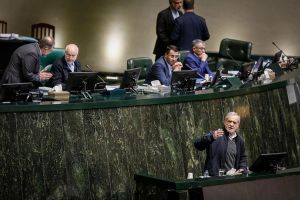
Iran lawmakers reject draft budget, flag revenue risks and inflation fears

Dec 29, 2025, 14:13 GMT+0

Iran’s parliamentary budget committee has rejected the overall framework of the government’s 1405 (2026–27) budget bill, dealing an early setback to President Masoud Pezeshkian’s economic agenda amid soaring inflation and currency turmoil.

The Majlis’ joint budget committee voted 32–9 against the bill’s general outlines on Monday, citing concerns that the proposal would fuel inflation, further erode household purchasing power and rely on revenue assumptions lawmakers fear will not be met.

The committee said its report rejecting the bill will now be sent to parliament’s leadership for debate in an open session, where lawmakers will decide whether to return the budget to the government for revision.

The budget had been formally submitted to parliament last week, as Iran grapples with mounting fiscal pressures, a sliding rial and rising public discontent over living costs.

  • Iran president says budget cannot match wages to inflation

    Iran president says budget cannot match wages to inflation

Iran replaces central bank chief as currency crisis deepens

Dec 29, 2025, 14:07 GMT+0

Iran’s president has appointed former economy minister Abdolnaser Hemmati as the new head of the central bank, state-linked media reported on Monday, confirming a leadership change amid turmoil in currency markets and mounting economic pressure.

Mehdi Tabatabaei, deputy head of communications at the president’s office, said on X that President Masoud Pezeshkian had decided to name Hemmati as central bank governor.

Read more...

Iran replaces central bank chief as currency crisis deepens

Dec 29, 2025, 13:57 GMT+0

Iran’s president has appointed former economy minister Abdolnaser Hemmati as the new head of the central bank, state-linked media reported on Monday, confirming a leadership change amid turmoil in currency markets.

Mehdi Tabatabaei, deputy head of communications at the president’s office, said on X that President Masoud Pezeshkian had decided to name Hemmati as central bank governor.

The move follows days of conflicting reports over the fate of Mohammad Reza Farzin, who had faced intensifying criticism as the rial slid to record lows and inflation accelerated.

Earlier on Monday, Iran’s judiciary denied reports that senior political leaders had agreed to retain Farzin, saying no such decision had been taken and that the matter fell solely within the president’s authority.

Later, the president’s office confirmed that Farzin had submitted his resignation earlier in December.

Hemmati, a former governor of the central bank and ex-economy minister, returns to the post as Iran grapples with severe currency instability.

On Monday, the dollar was trading at around 1.41 million rials on the open market, while gold prices also hit record highs, triggering protests and strikes by shopkeepers in parts of Tehran.


Protester stands ground as security forces move on Tehran market unrest

Dec 29, 2025, 13:41 GMT+0

Iranian security forces on motorcycles moved against protesting shopkeepers on Tehran’s Jomhouri Street on Monday, footage received by Iran International showed.

In the video, one protester sat down in the middle of the road and did not flee as the motorbike units advanced, in an apparent act of defiance.

Iran interior ministry blames currency volatility on ‘psychological warfare’

Dec 29, 2025, 13:03 GMT+0

Iran’s interior ministry on Monday blamed recent currency volatility on what it described as hostile psychological operations, as pressure on the rial intensifies amid public discontent.

Ali-Akbar Pourjamshidian, the security and law enforcement deputy to the interior minister, said fluctuations in foreign exchange markets were driven not by fundamentals but by “enemy inducements” and a manufactured psychological climate, urging the public not to be swayed by what he called external propaganda.

Pourjamshidian’s comments reflect a broader narrative within the government that links economic instability to national security, at a time when authorities face mounting pressure to stabilize markets and address rising living costs without signaling vulnerability.