Screen grab from a YouTube video by popular Iranian creators Kouman
Changes to how YouTube presents ads has dealt a sharp blow to Iranian content creator revenues while bringing mercifully fewer ads to ordinary viewers of the banned but wildly popular video app.
Despite being officially blocked in Iran, YouTube has in recent years grown into a major source of both entertainment and dollar-based income in a country where cultural censorship and economic malaise are deep.
Persian-language creators inside the country and in the diaspora built large audiences, while viewers relied on VPNs to access content largely unavailable on domestic platforms.
Aria Keoxer, a veteran YouTuber with more than 750k followers, said in a video this week that while some videos previously earned up to $11 per thousand views, that figure has now fallen to around $1.
“The game is over for Iranian YouTubers,” he said.
Users happy
For many ordinary users, however, the same shift has been met not with anger but with relief. Most viewers were never part of YouTube’s advertising economy.
Their concern is access and usability, not revenue, and many on social media describe the experience as unexpectedly positive.
“Not showing ads for us Iranians is basically free YouTube Premium,” one X user posted with a tinge of irony. “Looks like we’re seriously moving forward by going backward.”
In Iran, YouTube Premium exists largely in theory. Subscribing requires foreign payment methods, and even when technically possible, the dollar-priced monthly fee can be prohibitively expensive.
Even for those who could afford it, payment remains nearly impossible because of sanctions and Iran’s exclusion from international banking systems.
Lost opportunity
Despite the ad-free relief for viewers, YouTube’s role as a source of income remains central.
The platform had become a rare outlet for Generation Z creators, artists constrained by political and social restrictions, rural families sharing local culture and cooking, and entertainment and political producers sidelined by state television.
For many, it was one of the few ways to earn in hard currency.
YouTube’s tighter enforcement now appears to undercut earnings even for creators operating abroad. Some popular online shows, including the Eternal Love reality show, have attracted millions of viewers, but their revenue streams are increasingly fragile.
Domestic platforms such as Aparat offer revenue shares of around 50 to 70 percent, but payments are made in rials, leaving them unable to compete with YouTube’s dollar-denominated income.
Solution: politics
Experts have urged creators to adapt by producing English-language content, targeting diaspora audiences, or securing domestic and foreign sponsors. Some YouTubers say they plan to shift content to other platforms, including Kick.
The technology website Zoomit argued that the loss of profitability could remove “one of the last justifications policymakers had for maintaining the platform’s filtering—those who viewed it as a source of foreign currency revenue.”
The daily Ham-Mihan, however, argued that even lifting the filter would not resolve creators’ problems, as sanctions and economic restrictions would remain.
“Companies like Adidas or Nike, which have no official presence in Iran, are unaffected by whether YouTube is filtered or not, because Persian-language YouTube users do not have free access to these brands to make purchases,” the paper wrote.
“What could help YouTubers and users in the long term is the lifting of sanctions and the presence of reputable brands in Iran.”
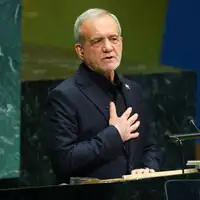
Some of Iranian President Masoud Pezeshkian’s supporters are now openly warning that Iran is headed toward crisis that could threaten the political system itself, with a growing number arguing that the president should resign.
Aside from lifting censorship of WhatsApp and resisting enforcement of compulsory hijab laws, most of Pezeshkian’s campaign pledges remain unrealized.
Even on the sensitive issue of the hijab, his refusal to formally implement a hardline law has not halted pressure from radical factions, which have been pushing to regain the lost ground in recent weeks.
Disillusionment is no longer confined to critics outside Pezeshkian’s original support base. Some of his former backers are now openly questioning whether he can continue in office at all.
Prominent sociologist Taghi Azad-Armaki, speaking to the website Khabar Online, stated bluntly that he hopes Pezeshkian will remain a one-term president.
“Mr. Pezeshkian is in unity with the heads of the three branches of government, all are aligned with the Supreme Leader, and power has effectively been consolidated to govern the country. However, this alignment has not resulted in broader national, social or regional cohesion,” he said.
“It would actually be a positive development for the ruling establishment … to finally put an end to the elections altogether—to abolish elections, and for the Leader and the ruling establishment to choose a president themselves, that there is a coup so that people could be freed from the current situation,” Azad-Armaki said.
Pezeshkian has one backer who's power is beyond match, however: Supreme Leader Ali Khamenei. The 86-year old theocrat who has ultimate power over all Iranian decisions foreign and domestic has praised him repeatedly in recent speeches.
The office of the presidency has historically provided Khamenei a heat shield from criticism and allows the supreme leader to avoid messy arguments over governance even as officials are constrained by his policies.
Among the most influential voices sounding the alarm on Pezeshkian is Abbas Abdi, a prominent reformist commentator.
Referring to persistent attacks on the government, along with fragmentation and passivity within it, Abdi said in an interview with Eco Iran earlier this month that only if the deadlock is acknowledged and “a decision is made somewhere (above) to change course” could the crisis be overcome.
Without such a shift, he suggested, the next year could be deeply destabilizing for the system. He reiterated similar concerns on the online program Strategic Dialogue, warning that the continuation of a suspended posture toward Israel, combined with the absence of meaningful internal reforms, could trigger a renewed wave of domestic protests.
Abdi’s remarks prompted a sharp response from the Revolutionary Guards-linked newspaper Javan, which accused him of implicitly shifting blame for the government’s failure to implement reforms onto the “system” itself, meaning the Supreme Leader Ali Khamenei.
Undeterred, Abdi doubled down last week in an op-ed published in Etemad, defending his prediction that “events outside the will of the system” would occur if the current trajectory continued.
Calls for resignation
Public frustration has increasingly spilled onto social media, particularly after the recent sharp fall in the value of the rial. Hardliners accuse Pezeshkian of incompetence, while disillusioned supporters argue that if structural constraints prevent him from acting, he should step aside.
A user named Saeed wrote on X: “Either you have been allowed to work, in which case you must be accountable for these crushing price increases, or you have not been allowed to work, in which case you must have the courage to tell the people and resign!”
“It’s best to resign before public anger reaches its peak and the people’s patience runs out. We have had enough; we are at our breaking point,” another user, Shirkoohi, posted on X.
“You may not understand the meaning of poverty, misery, and livelihood, but surely by now you should have understood the meaning of the 1979 revolution and the sound of an approaching revolution,” he added.
“I wish all officials would resign collectively and make the Iranian people happy… An entirely corrupt and flawed system needs fundamental change, not the replacement of one individual,” another user posting as Ali Shomali wrote.
Recent rains delivered Iran from a dangerous dry spell straight into to destructive floods because the land has been denuded by years of poor management, environmental expert Roozbeh Eskandari told Eye for Iran.
As heavy rainfall hits parts of the country, flooding has replaced drought as the most visible sign of Iran’s environmental crisis.
But instead of easing water shortages, the rain is accelerating destruction, washing through cities, villages and farmlands without replenishing groundwater or restoring depleted aquifers.
Decades of destructive urban expansion, dam building, interbasin water transfers and unchecked groundwater extraction have compacted the land, Eskandari said, chalking it up to "bad governance"
Trained in hydraulic structures and environmental research, Eskandari studies how dams, urban expansion, soil degradation and groundwater extraction affect flood behavior and water scarcity, placing him at the intersection of engineering, environment and policy.
Land that once drank in the rainfall no longer can: "The soil has lost the ability to absorb the water," Eskandari said.
A familiar pattern has emerged across Iran: rain arrives after prolonged drought, but instead of recharging groundwater, it turns into runoff. Water remains on the surface, rushing downhill, collecting mud and debris and producing floods.
Climate change has altered rainfall patterns, Eskandari adds, increasing intensity and shortening precipitation periods, which he calls "not a root cause, but can be considered as an intensifier."
Flooding offers little relief because Iran lacks the systems needed to manage water when it arrives. Watershed management, land-use planning and early warning mechanisms that could turn floods into a resource are largely absent.
"These floods could be used to feed the aquifers," Eskandari said. Instead, without preparation, they are simply not used."
Environmental injustice
Damage consistently concentrates in areas with weak infrastructure and limited political influence. These include villages, informal settlements and poorer urban districts.
Wealthier neighborhoods are better protected by drainage networks, reinforced construction and faster access to emergency services, turning flooding into an issue of environmental injustice.
The flooding now unfolding is also taking place against a deeper structural crisis.
When Dr. Kaveh Madani spoke to Eye for Iran earlier this year, he warned that Iran is no longer facing a typical drought but what he calls water bankruptcy, a condition in which consumption exceeds supply and reserves built over generations have already been exhausted.
“We have never seen such a thing,” Madani said. “The people of Tehran, the city that is the richest, most populous and strongest politically, is running out of water, is facing day zero.”
Madani’s warning reinforces Eskandari’s assessment that short bursts of rain or even seasonal floods will not reverse the crisis without systemic reform.
For Eskandari, the shift from drought to flooding is not an anomaly but a warning.
“We are one step closer to territorial collapse,” he said. “These policies have taken Iran into, as I call it, a point of no return,” Eskandari said, “for the land and for the people, both at the same time.”
You can watch the full episode of Eye for Iran on YouTube or listen on any podcast platform of your choosing.
China’s recent backing of the United Arab Emirates’ claims over three Iranian islands in the Persian Gulf has triggered unusually sharp public criticism of Beijing among Tehran’s hardline supporters.
Official reactions, however, were restrained. Iran’s Foreign Ministry called the claims “baseless,” directing its criticism at the UAE rather than China.
Even the state-run English-language broadcaster Press TV sought to soften Beijing’s position, saying China had merely supported a peaceful resolution “in accordance with the UN Charter and international law.”
No such diplomatic language was used by ultrahardliners.
“China must know that issuing a statement against Iran’s national sovereignty is a miscalculation in a strategic partnership,” conservative lawmaker Ahmad Naderi wrote on X.
He added that Tehran had so far contained its concerns over the treatment of Muslims in Xinjiang and “acted rationally,” but could reassess if its territorial red lines were crossed.
“Beijing cannot treat the One China principle and sovereignty over a rock in the South China Sea as a non-negotiable red line … and apply double standards when it comes to Iran’s territorial integrity,” he wrote.
‘No diplomatic slip’
Hossein Shariatmadari, the editor in chief of the hardline daily Kayhan, was even more direct. In a scathing editorial, he argued that by the same logic China’s sovereignty over Taiwan, Penghu, Kinmen and Matsu—administered by Taipei—could also be questioned.
Shariatmadari warned that Iran could respond by reviving claims over the islands of Ariana and Zarkuh, and even Bahrain, which remained under Iranian sovereignty until August 1971.
The semi-official Mehr News Agency struck a similar tone. “This is no longer an uninformed diplomatic slip, but a serious error—one that cannot be hidden behind words or justifications,” an editorial said, asking: “Is China itself willing to negotiate with other countries over islands under its sovereignty?”
Criticism also came from outside the hardline camp. The establishment daily Jomhouri-ye Eslami, funded by the office of the supreme leader but often skeptical of Iran’s ties with China and Russia, noted that Beijing had now, for the third time in two years, sided with the UAE.
“Even if one accepts such a hypothesis regarding the Chinese president the first time this mistake was made,” the paper wrote, “it cannot explain the second mistake or the foreign minister’s current action.”
It accused China of ignoring Iran’s ownership of Abu Musa and the Tunbs to “extract greater concessions from the UAE,” and faulted Iran’s Foreign Ministry for passivity in the face of similar positions taken by both China and Russia.
Self criticism
The online magazine Emrooz-o Farda described the episode as a test of Iran’s diplomacy and of its partners’ commitment to basic principles.
“From Beijing’s perspective, this may be economic and political balancing,” it wrote, “but from Tehran’s point of view, getting involved in the issue of territorial integrity crosses a clear red line.”
Former diplomat Kourosh Ahmadi, writing in Sazandegi in an article also published by the state news agency IRNA, called the trend deeply worrying. He linked China’s initial endorsement in December 2022 to similar statements by Russia in July 2023 and later European Union references to what they described as Iran’s “occupation” of the islands in October 2024 and October 2025.
“In the absence of negotiation and engagement with the West,” Ahmadi wrote, “Beijing and Moscow see no obligation to factor Iran’s sensitivities into their priorities.”
Journalist Ehsan Mansouri summed up the mood bluntly: “Unfortunately, we have become very weak—and Saudi Arabia and the UAE now matter more to China and Russia than we do.”
As Azerbaijan and other Caspian Sea states deepen partnerships with Western energy companies to extract more oil and gas from aging offshore fields, Iran stands apart as the only Caspian littoral country that produces no hydrocarbons from the sea at all.
Across the region, governments are racing to modernize reservoir management as competition for long-term gas supply intensifies.
Azerbaijan is pressing ahead with multibillion-dollar pressure-enhancement projects to sustain output from mature fields, while Kazakhstan and Turkmenistan are expanding offshore production with foreign capital and advanced technology.
Western majors, international service firms and even Persian Gulf state companies are reshaping the Caspian’s energy map—locking in production and export capacity for decades.
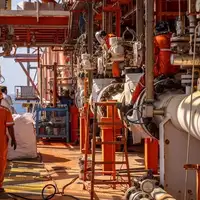
Iran, by contrast, lacks both the equipment and the partners to participate. Its only seismic survey vessel in the Caspian was decommissioned nearly two decades ago, and its sole offshore drilling platform has remained inactive for years.
The result is not simply underinvestment, but effective exclusion: while neighbors upgrade offshore infrastructure and extend field life, Iran has been left on the sidelines.
Contrast: Azerbaijan
Nowhere is the contrast clearer than in Azerbaijan’s flagship Shah Deniz gas field.
Operated by a consortium led by Britain’s BP, the field has attracted more than $30 billion in investment and supplies gas to Georgia, Turkey and much of Europe.
With production from its active phases expected to decline in the coming decade, Azerbaijan has moved early, signing contracts worth nearly $3 billion for large-scale pressure-enhancement facilities designed to sustain output, cut emissions and unlock additional reserves.
“Eliminating pressure decline is now the central priority,” Elham Shaban, director of the Caspian Oil Studies Center in Azerbaijan, told Iran International, noting that further contracts with Western and domestic firms are expected to be finalized in the coming months.
Iran’s handicap
Iran faces a parallel challenge at home—without comparable tools to address it. South Pars, the giant gas field it shares with Qatar and which supplies roughly 70 percent of Iran’s domestic consumption, has begun to experience pressure decline.
While Qatar installed modern pressure-enhancement systems years ago with Western support and has since signed contracts worth nearly $30 billion to expand production and liquefaction capacity, Iran has turned to local contractors, signing agreements worth $17 billion for smaller platforms and less powerful compressors.
Funding for those projects, however, has yet to materialize. Iranian oil officials have warned that gas shortages this winter could reach a record 300 million cubic meters per day, underscoring the gap between technical need and execution.
The same pattern extends to Iran’s oil sector. Roughly 80 percent of Iran’s producing oil fields are in the second half of their lifespan, with annual decline rates estimated at 8 to 12 percent.
Limited access to advanced recovery technologies has left Iran with a recovery rate of about 24 percent—only marginally above its natural baseline.
Not even China
By comparison, Saudi Arabia has raised recovery rates above 50 percent through decades of cooperation with Western firms, while Azerbaijan extended the life of its Azeri-Chirag-Gunashli fields by signing a long-term redevelopment agreement with BP and its partners.
Elsewhere around the Caspian, foreign capital continues to flow. Kazakhstan has attracted tens of billions of dollars to develop the Kashagan field, the region’s largest, while Turkmenistan’s offshore sector is operated almost entirely by the UAE’s Dragon Oil.
Iran’s Arab neighbours Arab have also expanded into gas development and transport infrastructure, reinforcing a regional energy network from which Tehran remains largely absent, despite its close political ties with Moscow and Beijing.
China, Iran’s largest trading partner, made no direct investment in Iranian or Russian energy projects in the first half of this year, while channeling more than $20 billion into Kazakhstan and the Middle East under its Belt and Road Initiative.
For Iran, sanctions and technological isolation have turned the Caspian from a shared resource into a widening strategic divide.
Faced with economic crisis, social defiance and regional strain, Iran’s supreme leader Ali Khamenei continues to invoke earlier moments of “glory,” treating defeat and mismanagement as moral triumphs rather than political failures.
This approach has been a defining feature of his 36-year rule: confronting challenges not by reassessing the past but by recasting it.
That pattern was again on display in a December 15 speech, in which Khamenei returned to the state narrative forged after the 1980s war with Iraq—known officially as the “Sacred Defense.”
The Iran–Iraq war, which ended in 1988 without a clear winner, inflicted enormous human and financial losses on both countries, leaving hundreds of thousands dead.
In its immediate aftermath, Iran’s theocratic rulers embedded their interpretation of the conflict into public space. Murals across the country depicted blood-stained bodies of “martyrs” alongside grieving children.
Khamenei delivered his latest speech in an event commemorating the martyrs of that war in Karaj, Iran’s fourth-largest city, just west of Tehran. He called for a “transfer of the values and motivations of the Sacred Defense era to the new generation through artistic effort and persistent follow-up.”
Rather than grappling with present-day realities, he looked backward, framing sacrifice and “martyrdom” as enduring virtues for a new generation.
No mistakes
In his speech, Khamenei acknowledged Iran’s dire condition but sought to project optimism.
“Despite all the hardships and difficulties, there exist numerous positive points and considerable readiness within the country to move toward Islam and the Revolution,” he said, adding that “these must be strengthened.”
Political analyst Jamshid Barzegar told Iran International TV that the remarks reflected a leadership unwilling to accept responsibility.
“Not only does Khamenei fail to alleviate the poverty and other problems he has imposed on the nation, he does not seem to have a plan to correct his mistakes,” Barzegar said.
He also questioned Khamenei’s assertion that society is moving “toward revolution and Islam,” noting that the supreme leader himself abandoned revolutionary and Islamic rhetoric after the 12-day war with Israel, shifting instead toward nationalist themes that emphasized Persian identity over religious ideology.
No course correction
Khamenei’s retreat into past narratives—coming shortly after the unveiling of a replica statue depicting a Roman emperor prostrating before a Persian king—has projected an image of uncertainty rather than authority.
That impression was reinforced by the handling of the Karaj speech itself. Its broadcast was delayed until the following day, apparently for security reasons, suggesting the establishment has not forgotten the shock—if not the humiliation—of the June assault and its personal aftermath for Khamenei.
The unusually brief version posted on his website also hinted at heavy editing, possibly to avoid missteps.
Economic analyst Mohammad Machinchian criticized Khamenei’s reference to “numerous positive points,” arguing that it bore little resemblance to everyday reality.
“Only in recent days nearly all Iranians suffered heavy financial losses due to unusual price hikes,” Machinchian said. “But Khamenei is captivated by the distant past and seeks to follow the same path that has led to the current impasse.”