• العربية
  • فارسی
Brand
  • Iran Insight
  • Politics
  • Economy
  • Analysis
  • Special Report
  • Opinion
  • Podcast
  • Iran Insight
  • Politics
  • Economy
  • Analysis
  • Special Report
  • Opinion
  • Podcast
  • Theme
  • Language
    • العربية
    • فارسی
  • Iran Insight
  • Politics
  • Economy
  • Analysis
  • Special Report
  • Opinion
  • Podcast
All rights reserved for Volant Media UK Limited
volant media logo

Iran condemns US ‘bullying’ of Venezuela

Nov 26, 2025, 16:11 GMT+0Updated: 23:50 GMT+0
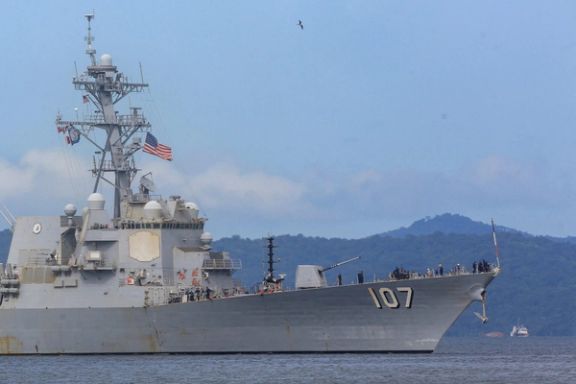
The US Navy destroyer USS Gravely (DDG-107) approaches Port of Spain for joint training with the Trinidad and Tobago Defence Force to strengthen regional security and military cooperation, as seen from Port of Spain, Trinidad and Tobago, October 26, 2025.

Iranian foreign minister Abbas Araghchi on Wednesday accused the United States of bullying and aggression in its treatment of Tehran's Latin America ally Venezuela, as US military forces have gathered in the region.

In a phone call with his Venezuelan counterpart, Araghchi condemned what he called "the United States' bullying approach toward Venezuela and other independent developing countries in the Western Hemisphere," according to state media.

Washington’s "threat to use force against Venezuela is a clear example of a gross violation of the fundamental principles of the UN Charter and the peremptory norms of international law," he added.

The administration of US President Donald Trump has been amassing forces in the Caribbean in the biggest military buildup in the region for decades.

Washington accuses Venezuelan President Nicolas Maduro of narco-terrorism and has offered a $50 million dollar reward for information leading to his arrest. The US strategy remains unclear but appears aimed at unseating the leftist populist.

Ties between Iran and Venezuela flourished under Maduro's predecessor Hugo Chavez and the countries continue to find common ground over objections to US policy.

Araghchi on Wednesday urged UN member states to rally against "America’s aggressive unilateralism" and accused its Mideast foe Israel of being a menace to Latin America, calling it "a major threat to the region’s peace, stability and security."

US news outlets citing US and Israeli officials reported this month that Iran's Islamic Revolutionary Guard Corps sought to kill the Israeli ambassador to Mexico but the plot was thwarted over the summer by Mexican security forces. Iran denied the allegations.

Most Viewed

Ghalibaf defends Iran-US talks amid hardline backlash
1
INSIGHT

Ghalibaf defends Iran-US talks amid hardline backlash

2
INSIGHT

Iran diplomacy wobbles as factions compete to avoid looking soft on US

3
VOICES FROM IRAN

Bread shortages, soaring prices strain households in Iran, residents say

4
ANALYSIS

The politics of pink: how Iran uses cuteness to rebrand violence

5

War-hit homeowners feel abandoned as Iran’s reconstruction aid fades

Banner
Banner

Spotlight

  • The future has been switched off here
    TEHRAN INSIDER

    The future has been switched off here

  • Lights out, then gunfire: Witnesses recount Mashhad protest crackdown
    VOICES FROM IRAN

    Lights out, then gunfire: Witnesses recount Mashhad protest crackdown

  • Family told missing teen was alive, then received his body 60 days later
    EXCLUSIVE

    Family told missing teen was alive, then received his body 60 days later

  • Is Iran entering its Gorbachev moment?
    INSIGHT

    Is Iran entering its Gorbachev moment?

  • Iran crackdown reaches cemeteries as graves of slain protesters defaced
    EXCLUSIVE

    Iran crackdown reaches cemeteries as graves of slain protesters defaced

  • Iran diplomacy wobbles as factions compete to avoid looking soft on US
    INSIGHT

    Iran diplomacy wobbles as factions compete to avoid looking soft on US

•
•
•

More Stories

With city smog and forest fires, even breathing is a political act in Iran

Nov 26, 2025, 15:47 GMT+0
•
Kambiz Hosseini

At eleven o’clock each night, Tehran time, my studio, half a world away, seems to inherit the city’s fatigue. The callers gather like silhouettes behind a scrim of static.

As the lines open, I picture Tehran under its nocturnal dome, a sky not dark but dimmed, as if a giant thumb has pressed the horizon into a bruise.

The city breathes shallowly now. Pollution maps pulse in colors that feel less like data than diagnosis: orange, red, a purple so deep it suggests something beyond neglect, something closer to abandonment.

To the north, the Hyrcanian forests, once described by an old ranger as “green witnesses from before language,” have been burning for weeks. Flames move through those ancient stands with a slow, deliberate patience, as if obeying an unseen logic.

From a distance, these may appear as separate misfortunes, poisoned air in the cities, burning lungs in the mountains.

But the longer I listen to callers, the more the crises merge into a single story. In Iran today, even breathing has become contested terrain. Breathing itself is political.

Neither dawn nor dusk

Tehran, a metropolis of more than thirteen million, has offered its residents only a handful of clean-air days this year.

In Karaj, Ahvaz, Mashhad, Tabriz and Isfahan, air-quality readings have climbed into ranges Americans might remember from the rare weeks when wildfires smothered the West Coast.

In Iran, though, the crisis is not a season, it is a condition. Schools close. Emergency rooms fill. Children learn to recognize, by color alone, the days when they must stay indoors. The city moves under a half-light that resembles neither dawn nor dusk.

The voices that reach me on “The Program,” my nightly show, arrive with a clarity that often anticipates scientific explanation.

A mother whose children wake coughing. A factory worker whose exhaustion seems to begin in the mind, not the muscles. A man who runs a short errand and ends the day bedridden.

Later, experts explain these stories in clinical language: microscopic particles slipping through the lungs into the bloodstream, crossing the blood-brain barrier, raising the risk of heart disease, cognitive decline and dementia.

By the government’s own admission, roughly sixty thousand Iranians die each year from air pollution, or nearly 160 people every day.

Hyrcanian forest

Far from the capital, the forests fight their own losing battle for air. The Hyrcanian woodlands, recognized by UNESCO for their botanical uniqueness, have burned across the hills of Chalus and Dizmar.

Each morning, new smoke rises behind press briefings that insist the fires are “contained.” Despite years of warnings, Iran lacks any aerial firefighting ability.

These fires are not anomalies. They are symptoms of deforestation, unrestrained development and a bureaucracy that mistakes denial for strategy.

Nearly half the forests have already been lost. What should be a coordinated national response has instead become a volunteer effort carried out by the people least equipped to shoulder the burden.

Meanwhile a state capable of constructing an enormous surveillance apparatus remains unable to protect the most basic conditions of life: water that sustains, forests that stand, air that does no harm.

For years, Iranians have described political repression as a form of suffocation.

Now the metaphor has become literal. Cities are not simply policed, they are choking. Forests that once served as the country’s lungs burn in pale columns visible for miles.

The distance between living politically and living biologically narrows by the day.

Each night, as the program winds down, I repeat a simple invitation: send a message, and we will send you a link that connects you directly to our studio.

The microphone will pass from my hand to yours. It remains, against the scale of the crisis, a fragile gesture. But in a country where breathing grows harder each year, refusing silence is no longer only a political act, it is an act of survival.

My last caller tells me invokes rock band Nine Inch Nails in a proud, defiant voice: “I got my fist, I got my plan. I got my survivalism.”

I smile. She hangs up, and that is our show for tonight, I say. Take care of the person sitting next to you. I will see you tomorrow night at eleven p.m., Tehran time.

“We are off air,” my director tells me. I lower my forehead to the microphone, close my eyes, and take a long breath.
Tehran presses Berlin on 1980s Iran-Iraq war chemical weapons supplies

Nov 26, 2025, 15:24 GMT+0

Iran's foreign minister on Wednesday pressed Germany to release any findings into German companies suspected of supplying materials for chemical weapons deployed by Saddam Hussein during the 1980s Iran-Iraq war.

Hussein, Iraq’s former president, used chemical weapons extensively against Iranian forces and Iraqi Kurds during the conflict.

“The truth must prevail, and those who supported Saddam’s chemical weapons program must be held responsible,” Araghchi told the 30th annual Conference of the States Parties to the Chemical Weapons Convention (CWC) in The Hague on Tuesday.

In December 2002, Berlin daily Die Tageszeitung reported that Germany was the country whose companies contributed most to Baghdad’s efforts to acquire weapons of mass destruction, citing documents Iraq submitted to the United Nations.

“We urge Germany to release the results of its past investigations and commit to full and transparent investigations about the involvement of its companies and nationals in enabling Saddam’s atrocities,” he said.

Relations between Berlin and Tehran are at a low ebb after Germany joined France and Britain in September in reimposing international sanctions on Iran for what the European powers see as defiance of UN nuclear inspections.

Tehran had also bristled at comments by German Chancellor Friedrich Merz during a surprise military campaign on Iran in June in which he described the attacks as "dirty work Israel is doing for all of us."

Araghchi said Iran’s unanimous election to the Chemical Weapons Convention Executive Council — the 41-member policy-making body of the Organisation for the Prohibition of Chemical Weapons — was “a meaningful step for all who believe in a world free of chemical weapons.”

“As a nation that has suffered deeply from Saddam’s chemical attacks during the 1980–1988 war on our people, Iran carries enduring wounds that still affect tens of thousands of victims and their families,” he said.

Araghchi attended the conference with Kamal Hoseinpur, a lawmaker from Sardasht, a city in Iran’s northwest near the border with Iraq that was hit by Iraqi chemical attacks in 1987.

Araghchi described Sardasht as “a global symbol of resistance, suffering and the call for justice.”

“The people of Sardasht endured chemical attacks whose consequences continue even today, made worse by unjust US sanctions that restrict access to vital medicines and medical care,” Araghchi said.

Araghchi contrasted Germany with the Netherlands, where Dutch businessman Frans van Anraat was convicted in 2005 for supplying Iraq with chemicals used to produce mustard gas during the 1980s.

“The judicial investigations by Dutch authorities which led to the prosecution and conviction of one Dutch individual is appreciated,” he said. “However, we all know that it was the very minimum and showed only the tip of the iceberg.”

“Justice for the victims is overdue, and their calls for justice must never be forgotten,” he added.

Araghchi's comments come as Iran's own government came under scrutiny after security forces used an unidentified "green gas" against protestors during the nationwide protests in 2022 after a young woman, Mahsa Amini, died in morality police custody.

In November 2022, videos were posted on social media that showed thick green smoke wafting through the streets in Javanrud in Western Iran as security forces there confronted protesters.

The German newspaper Bild reported in 2018 that Berlin had approved a license for a company to sell technology with potential military applications to Iranian firms which were ultimately used by the Syria in domestic chemical weapons attacks.

Iranian-American mother detained for two months in Tehran, US confirms

Nov 26, 2025, 00:35 GMT+0
•
Azadeh Akbari

A 70-year-old American-Iranian mother has been detained in Iran for two months, the State Department confirmed to Iran International, with her political dissident son saying the move aimed to silence him.

Afarin (Masoumeh) Mohajer was detained on September 29 by security forces at Tehran's Khomeini International Airport, her son Reza Zarrabi told Iran International.

Human rights organizations had previously reported her arrest but said she was detained upon arrival in Tehran. His son, however, said she was arrested as she attempted to fly back to the United States.

Zarrabi, who is based in Frankfurt, said authorities detained his mother to pressure him into ending his political activism against Tehran’s Islamic theocracy. He calls himself a Republican and Liberal Democrat.

“We are aware of the detention of a US citizen in Iran and are closely tracking reports of this case,” the State Department spokesperson said in an email response when asked if Washington is aware of Mohajer’s detention.

"The Department of State has long warned Americans not to travel to Iran and that is particularly true now," the spokesperson added.

Zarrabi described his mother as warm and attached to him after he lost two siblings to suicide. She belonged to no political groups, he said.

Mohajer had travelled to Iran to attend to matters relating to an inheritance, Zarrabi added. She now faces charges he called false, including "membership in hostile groups, propaganda against the Islamic Republic on social media, insulting the Supreme Leader and insulting the religion (of Islam)."

Zarrabi said he has been a political activist for 14 years and a member of Iranian opposition think thanks, but that his mother had no role in his activities.

Mohajer is being held in the women’s section of Ward 209 of Evin Prison in Tehran, Zarrabi added, saying she called last week to plead with him to stop his dissident activities and believes Iranian intelligence agents coerced her.

Reza Zarrabi and his mother Afarin (Masoumeh) Mohajer.
100%
Reza Zarrabi and his mother Afarin (Masoumeh) Mohajer.

Zarrabi expressed worries for her health in prison as she suffers from brain cancer and is certain that she is not receiving medical treatment.

“I have no doubt that she is a hostage and a victim of the Iranian government’s hostage-taking toward the United States,” he said.

Relations between Tehran and Washington are at a low ebb after the United States joined a surprise Israeli military campaign on the country in June, attacking three Iranian nuclear facilities.

Iran has long detained foreign and dual nationals whom it eventually releases in exchange for political or financial concessions.

"Anyone with a US connection, including dual US-Iranian nationals, is at significant risk of questioning, arrest, and detention in Iran," the State Department told Iran International in its statement.

"Iranian authorities routinely delay consular access to detained US nationals. In particular, Iranian authorities consistently deny consular access to dual US-Iranian nationals."

Iran vows to boycott US World Cup draw over rejected visas

Nov 25, 2025, 20:27 GMT+0

Iran's football authorities said on Tuesday they would boycott a draw for the US-hosted 2026 World Cup in Washington DC next week after visas for two top officials were rejected.

Visa requests sent to the US Embassy in Dubai for Iran Football Federation president Mehdi Taj and national team executive director Mehdi Kharati were rejected in October, state media reported.

Tehran-based sports outlet Varzesh 3 reported on Tuesday that at least four other officials who had submitted their petition in the same group request had had their visas approved, including head coach Amir Ghalenoei.

But Iran Football Federation spokesperson Amir Mahdi Alavi said that the country would shun the ceremony if its whole delegation was not cleared to attend.

FIFA and the US State Department did not immediately respond to Iran International requests for comment.

The draw for the 2026 World Cup is scheduled for December 5.

Iran's Tasnim news agency had reported in October that Taj, Ghalenoei and seven other officials were denied US visas to attend the ceremony. Iran's foreign minister Abbas Araghchi said his ministry was following up on the matter.

Varzesh 3 added that Taj, who serves on FIFA’s Executive Committee, is likely to obtain a visa through FIFA via a separate channel.

US President Donald Trump has presented the World Cup as a "once in a lifetime opportunity" to showcase what he has described as an American golden age under his leadership.

The Trump administration last Monday introduced a new expedited visa process for the millions of visitors expected to travel to the United States for the 2026 World Cup, while noting that even those with match tickets could still be refused entry.

The system, announced at the White House and designed to prioritize visa appointments for FIFA ticket-holders, will move applicants with confirmed seats to the front of the interview queue. Still, Secretary of State Marco Rubio stressed that faster processing does not guarantee admission to the country.

Football fandom is endemic in Iran despite only lukewarm endorsement by the ruling Islamic theocracy and its team regularly qualifies for the World Cup.

ICE releases Iranian professor at University of Oklahoma

Nov 25, 2025, 19:24 GMT+0

US immigration authorities have released Vahid Abedini, a former reformist activist in Iran and a professor of Iranian studies at the University of Oklahoma.

In a post on his LinkedIn account, Abedini said he was released from custody on Monday night after several days in detention by US immigration authorities.

“I’m relieved to share that I was released from custody tonight. It was a deeply distressing experience, especially seeing those without the support I had,” he wrote on LinkedIn, thanking colleagues and academic associations for their help.

Abedini “was detained for standard questioning and was released," The New York Times reported on Tuesday citing Tricia McLaughlin, assistant secretary for public affairs at the Department of Homeland Security.

Joshua Landis, the director of Middle East studies at the university, said on X that Abedini was detained by US Immigration and Customs Enforcement (ICE) while boarding a flight to Washington DC to attend the Middle East Studies Association conference and was taken to jail on November 22.

"He has been wrongfully detained because he has a valid H-1B visa —a non-immigrant work visa granted to individuals in 'specialty occupations,' including higher education faculty. We are praying for his swift release," Landis wrote.

According to the University of Oklahoma’s website, Abedini is an Iranian studies professor whose work focuses on elite politics, technology and foreign policy.

The University of Oklahoma declined to discuss the matter and ICE did not respond to an Iran International request for comment.

A search of the ICE detainee database shows a record for Vahid Abedini, listing his country of birth as Iran and his status as “in ICE custody.”

According to Iranian media, Abedini has long been active in Iran’s reformist political circles and was a member of student Islamic associations at Tehran University.

Abedini was a signatory to a statement issued by reformists during Iran’s 2024 election supporting Masoud Pezeshkian.

100%

Abedini received his master’s and PhD in political science from Florida International University, where he also taught as an adjunct professor before joining the University of Arkansas as a visiting assistant professor.

Iranian scholar and former State Department adviser Vali Nasr described Abedini's arrest as "wrongful detention."

"He is a respected scholar and teacher, and according to his employer, the University of Oklahoma, his visa is valid. I and all his is friends, colleagues and students call for his immediate release and to his work at the university," Nasr said on X.