• العربية
  • فارسی
Brand
  • Iran Insight
  • Politics
  • Economy
  • Analysis
  • Special Report
  • Opinion
  • Podcast
  • Iran Insight
  • Politics
  • Economy
  • Analysis
  • Special Report
  • Opinion
  • Podcast
  • Theme
  • Language
    • العربية
    • فارسی
  • Iran Insight
  • Politics
  • Economy
  • Analysis
  • Special Report
  • Opinion
  • Podcast
All rights reserved for Volant Media UK Limited
volant media logo
OPINION

With city smog and forest fires, even breathing is a political act in Iran

Kambiz Hosseini
Kambiz Hosseini

Host of nightly show The Program

Nov 26, 2025, 15:47 GMT+0Updated: 23:50 GMT+0
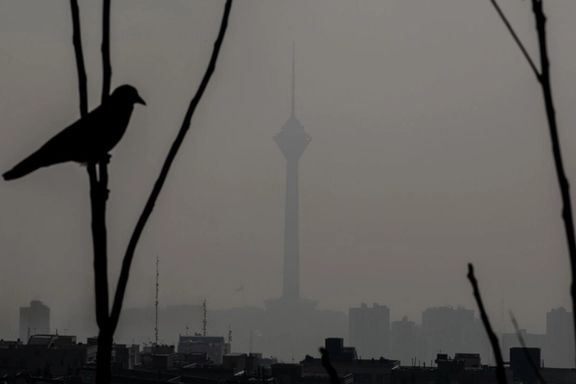
A bird perches on a branch as heavy smog shrouds Tehran, leaving its iconic Milad Tower barely visible through the pollution, November 25, 2025

At eleven o’clock each night, Tehran time, my studio, half a world away, seems to inherit the city’s fatigue. The callers gather like silhouettes behind a scrim of static.

As the lines open, I picture Tehran under its nocturnal dome, a sky not dark but dimmed, as if a giant thumb has pressed the horizon into a bruise.

The city breathes shallowly now. Pollution maps pulse in colors that feel less like data than diagnosis: orange, red, a purple so deep it suggests something beyond neglect, something closer to abandonment.

To the north, the Hyrcanian forests, once described by an old ranger as “green witnesses from before language,” have been burning for weeks. Flames move through those ancient stands with a slow, deliberate patience, as if obeying an unseen logic.

From a distance, these may appear as separate misfortunes, poisoned air in the cities, burning lungs in the mountains.

But the longer I listen to callers, the more the crises merge into a single story. In Iran today, even breathing has become contested terrain. Breathing itself is political.

Neither dawn nor dusk

Tehran, a metropolis of more than thirteen million, has offered its residents only a handful of clean-air days this year.

In Karaj, Ahvaz, Mashhad, Tabriz and Isfahan, air-quality readings have climbed into ranges Americans might remember from the rare weeks when wildfires smothered the West Coast.

In Iran, though, the crisis is not a season, it is a condition. Schools close. Emergency rooms fill. Children learn to recognize, by color alone, the days when they must stay indoors. The city moves under a half-light that resembles neither dawn nor dusk.

The voices that reach me on “The Program,” my nightly show, arrive with a clarity that often anticipates scientific explanation.

A mother whose children wake coughing. A factory worker whose exhaustion seems to begin in the mind, not the muscles. A man who runs a short errand and ends the day bedridden.

Later, experts explain these stories in clinical language: microscopic particles slipping through the lungs into the bloodstream, crossing the blood-brain barrier, raising the risk of heart disease, cognitive decline and dementia.

By the government’s own admission, roughly sixty thousand Iranians die each year from air pollution, or nearly 160 people every day.

Hyrcanian forest

Far from the capital, the forests fight their own losing battle for air. The Hyrcanian woodlands, recognized by UNESCO for their botanical uniqueness, have burned across the hills of Chalus and Dizmar.

Each morning, new smoke rises behind press briefings that insist the fires are “contained.” Despite years of warnings, Iran lacks any aerial firefighting ability.

These fires are not anomalies. They are symptoms of deforestation, unrestrained development and a bureaucracy that mistakes denial for strategy.

Nearly half the forests have already been lost. What should be a coordinated national response has instead become a volunteer effort carried out by the people least equipped to shoulder the burden.

Meanwhile a state capable of constructing an enormous surveillance apparatus remains unable to protect the most basic conditions of life: water that sustains, forests that stand, air that does no harm.

For years, Iranians have described political repression as a form of suffocation.

Now the metaphor has become literal. Cities are not simply policed, they are choking. Forests that once served as the country’s lungs burn in pale columns visible for miles.

The distance between living politically and living biologically narrows by the day.

Each night, as the program winds down, I repeat a simple invitation: send a message, and we will send you a link that connects you directly to our studio.

The microphone will pass from my hand to yours. It remains, against the scale of the crisis, a fragile gesture. But in a country where breathing grows harder each year, refusing silence is no longer only a political act, it is an act of survival.

My last caller tells me invokes rock band Nine Inch Nails in a proud, defiant voice: “I got my fist, I got my plan. I got my survivalism.”

I smile. She hangs up, and that is our show for tonight, I say. Take care of the person sitting next to you. I will see you tomorrow night at eleven p.m., Tehran time.

“We are off air,” my director tells me. I lower my forehead to the microphone, close my eyes, and take a long breath.

Most Viewed

Ghalibaf defends Iran-US talks amid hardline backlash
1
INSIGHT

Ghalibaf defends Iran-US talks amid hardline backlash

2
INSIGHT

Iran diplomacy wobbles as factions compete to avoid looking soft on US

3
VOICES FROM IRAN

Bread shortages, soaring prices strain households in Iran, residents say

4
ANALYSIS

The politics of pink: how Iran uses cuteness to rebrand violence

5

War-hit homeowners feel abandoned as Iran’s reconstruction aid fades

Banner
Banner

Spotlight

  • The future has been switched off here
    TEHRAN INSIDER

    The future has been switched off here

  • Lights out, then gunfire: Witnesses recount Mashhad protest crackdown
    VOICES FROM IRAN

    Lights out, then gunfire: Witnesses recount Mashhad protest crackdown

  • Family told missing teen was alive, then received his body 60 days later
    EXCLUSIVE

    Family told missing teen was alive, then received his body 60 days later

  • Is Iran entering its Gorbachev moment?
    INSIGHT

    Is Iran entering its Gorbachev moment?

  • Iran crackdown reaches cemeteries as graves of slain protesters defaced
    EXCLUSIVE

    Iran crackdown reaches cemeteries as graves of slain protesters defaced

  • Iran diplomacy wobbles as factions compete to avoid looking soft on US
    INSIGHT

    Iran diplomacy wobbles as factions compete to avoid looking soft on US

•
•
•

More Stories

Tehran presses Berlin on 1980s Iran-Iraq war chemical weapons supplies

Nov 26, 2025, 15:24 GMT+0

Iran's foreign minister on Wednesday pressed Germany to release any findings into German companies suspected of supplying materials for chemical weapons deployed by Saddam Hussein during the 1980s Iran-Iraq war.

Hussein, Iraq’s former president, used chemical weapons extensively against Iranian forces and Iraqi Kurds during the conflict.

“The truth must prevail, and those who supported Saddam’s chemical weapons program must be held responsible,” Araghchi told the 30th annual Conference of the States Parties to the Chemical Weapons Convention (CWC) in The Hague on Tuesday.

In December 2002, Berlin daily Die Tageszeitung reported that Germany was the country whose companies contributed most to Baghdad’s efforts to acquire weapons of mass destruction, citing documents Iraq submitted to the United Nations.

“We urge Germany to release the results of its past investigations and commit to full and transparent investigations about the involvement of its companies and nationals in enabling Saddam’s atrocities,” he said.

Relations between Berlin and Tehran are at a low ebb after Germany joined France and Britain in September in reimposing international sanctions on Iran for what the European powers see as defiance of UN nuclear inspections.

Tehran had also bristled at comments by German Chancellor Friedrich Merz during a surprise military campaign on Iran in June in which he described the attacks as "dirty work Israel is doing for all of us."

Araghchi said Iran’s unanimous election to the Chemical Weapons Convention Executive Council — the 41-member policy-making body of the Organisation for the Prohibition of Chemical Weapons — was “a meaningful step for all who believe in a world free of chemical weapons.”

“As a nation that has suffered deeply from Saddam’s chemical attacks during the 1980–1988 war on our people, Iran carries enduring wounds that still affect tens of thousands of victims and their families,” he said.

Araghchi attended the conference with Kamal Hoseinpur, a lawmaker from Sardasht, a city in Iran’s northwest near the border with Iraq that was hit by Iraqi chemical attacks in 1987.

Araghchi described Sardasht as “a global symbol of resistance, suffering and the call for justice.”

“The people of Sardasht endured chemical attacks whose consequences continue even today, made worse by unjust US sanctions that restrict access to vital medicines and medical care,” Araghchi said.

Araghchi contrasted Germany with the Netherlands, where Dutch businessman Frans van Anraat was convicted in 2005 for supplying Iraq with chemicals used to produce mustard gas during the 1980s.

“The judicial investigations by Dutch authorities which led to the prosecution and conviction of one Dutch individual is appreciated,” he said. “However, we all know that it was the very minimum and showed only the tip of the iceberg.”

“Justice for the victims is overdue, and their calls for justice must never be forgotten,” he added.

Araghchi's comments come as Iran's own government came under scrutiny after security forces used an unidentified "green gas" against protestors during the nationwide protests in 2022 after a young woman, Mahsa Amini, died in morality police custody.

In November 2022, videos were posted on social media that showed thick green smoke wafting through the streets in Javanrud in Western Iran as security forces there confronted protesters.

The German newspaper Bild reported in 2018 that Berlin had approved a license for a company to sell technology with potential military applications to Iranian firms which were ultimately used by the Syria in domestic chemical weapons attacks.

Water tariffs fill budget gaps, not depleted wells, Iranian lawmaker says

Nov 26, 2025, 14:23 GMT+0
•
Arash Sohrabi

An Iranian lawmaker said price-based water policies risk serving as fiscal stopgaps rather than tackling the country’s chronic shortages, urging non-price reforms and stricter controls on water-intensive industry placement before any tariff overhaul.

“In practice, administrations use pricing policies merely to cover budget deficits and may claim they want to develop renewable resources, while this has appeared in six development plans and has not been implemented,” Reza Sepahvand, a senior member of parliament’s energy committee, said in a roundtable discussion carried by Iranian media.

Sepahvand said political and commercial interference has pushed water policy off approved tracks, channeling investment into ill-suited mega-projects and heavy industry in arid regions and aggravating tensions between provinces and farmers. “What forces have pushed the country off the proper path of water management?” he questioned.

He cited the clustering of steel pellet plants around Ardakan in Yazd – a central desert region – and long-running fights over piping water from one region to another as choices that worsen shortages.

The debate comes as experts blame decades of over-extraction, unchecked urban growth and placing water-hungry industries in the desert – alongside drier weather – for pushing groundwater sources and lakes to the brink.

They say lasting fixes require enforcing ecological limits, curbing groundwater pumping, and shifting money from large dams and pipelines to watershed restoration and reuse.

Tariffs miss the real drain

Investigative journalist Amirhadi Anvari told Iran International that raising prices would make little difference and will be marginal at best.

“Iran uses more than 90% of its water in agriculture. The share of municipal drinking water is estimated at 6% to 8%, and industry at 2% to 3%. In these circumstances, changing the price of urban and industrial water will not make much difference.”

He said the core problem is not household behavior but the policy model guiding farms, arguing that the agriculture model is driven by ideology, not resource limits.

“The important point about the agriculture sector is that it is ideological. All top-level policy documents, laws and development plans under both leaders of the Islamic Republic – Khomeini and Khamenei – have been built on self-sufficiency.”

Anvari links self-sufficiency to expansion of irrigated farming despite dwindling supplies.

“To achieve food self-sufficiency, you must expand the cultivated area. Many of Iran’s rain-fed fields... have now been turned into irrigated lands. This was not the choice of farmers; it was an ideological program of the Islamic Republic’s leaders.”

  • Mismanagement, not drought, pushes Iran toward water bankruptcy

    Mismanagement, not drought, pushes Iran toward water bankruptcy

  • Iran’s deepening water crisis nears critical levels in major cities

    Iran’s deepening water crisis nears critical levels in major cities

  • Iran's real crisis: environmental decay wrought by official neglect

    Iran's real crisis: environmental decay wrought by official neglect

Profiteering derails reforms

Mehdi Zare, a scientist who has studied environmental risk and infrastructure, said during the same roundtable that short-term interests across the system have repeatedly overridden sound planning.

“All of this has beneficiaries – from users to those who influence studies and decisions,” he said. “Unless we establish an order that can restrain short-term gains, stakeholders can bend trajectories and prevent the situation from reaching equilibrium.”

Zare warned that bias can creep in even at high-level policy meetings, shaping outcomes on issues such as securing Lake Urmia’s water rights, limiting new wells around Tehran, or managing migration to the capital region.

“Advisers may be top experts, but if they have a bias, they can guide decisions so that, for example, the priority is not the lake’s environmental flow or reducing extra abstraction,” he said.

Other specialists in the event echoed calls to sequence reforms. They argued that real-world pricing only works alongside non-price measures such as clearer water rights, enforcement, modern irrigation and industrial recycling, particularly calling for transparency on where revenue goes.

They also questioned utilities’ reliance on water sales to fund operations, saying the model creates pressure to sell more rather than conserve.

Sepahvand said policy should curb politically driven megaprojects and re-orient investment toward groundwater recharge and watershed management, adding that any tariff rises should follow – not replace – structural fixes.

The experts in the event, however, cautioned that without governance changes to insulate water decisions from narrow interests, higher bills alone will neither restore depleted aquifers nor ease tensions between regions competing for dwindling supplies.

Iran bans public entry to forest zones as wildfire threat persists

Nov 26, 2025, 09:55 GMT+0

Iranian authorities have imposed temporary bans on entering forest regions across the north and west of the country after wildfires damaged vast areas of woodland and pasture that officials now say are largely under control.

The commander of Iran’s Forest Protection Unit, Colonel Majid Zakariaei, said fires this year have scorched about 46,000 hectares of national land, forest and rangeland.

He told state media that from March to November more than 2,300 fires were recorded nationwide – a 12-percent rise in the number of incidents compared with the same period last year, though the total burned area was about two percent smaller.

Zakariaei said around 95 percent of fires were linked to human activity, including careless visitors and campers, compounded by drought and rising temperatures.

“Climate change, reduced rainfall, and dryness have turned natural areas into tinder,” he said, calling for better public awareness and faster local response systems.

While the largest recent fires in the Hyrcanian Forests – the ancient, UNESCO-listed woodlands along the Caspian Sea – have been extinguished, authorities warned that dry conditions persist and that access will remain restricted until effective autumn rains arrive.

“The situation is still fragile. Until we have sufficient rainfall, unnecessary entry to the forests is prohibited,” Zakariaei said, announcing that bans now cover the Hyrcanian, Zagros and Arasbaran forest zones.

The measure, which includes parts of Mazandaran, Golestan, Ardabil and North Khorasan provinces, is aimed at preventing new flare-ups.

Firefighting teams remain on full alert and village councils near the forests have been told to prepare local emergency stations.

  • Mismanagement, not drought, pushes Iran toward water bankruptcy

    Mismanagement, not drought, pushes Iran toward water bankruptcy

  • Public criticism mounts over Iran government’s forest fire response

    Public criticism mounts over Iran government’s forest fire response

Political and media reactions

The government’s handling of the fires has triggered debate in Iranian media and on social networks.

The newspaper Farhikhtegan said in an article on Wednesday that several of the northern fires may have been intentionally set, describing them as “organized acts” rather than the result of drought or accident.

The paper cited unnamed officials who said about 20 suspects had been detained.

The article suggested that such incidents were meant to “undermine confidence in the state’s crisis management,” framing the destruction as part of broader attempts to disrupt the country.

Environmental officials have not endorsed those claims and maintain that negligence remains the dominant cause. They say most of the recent fires began near roads, farms or picnic areas rather than in inaccessible terrain.

Iran’s environmental community has urged a focus on prevention with experts saying that weak firefighting infrastructure, limited aerial equipment and late detection continue to leave forests vulnerable.

The Hyrcanian Forests, believed to be among the world’s oldest surviving temperate forests, are home to hundreds of endemic plant and animal species. Prolonged drought and land encroachment have already reduced much of their natural resilience.

Zakariaei said Iran plans to expand its firefighting bases and training programs, with 21 stations now designated nationwide and more in development. “With better readiness and local participation, we hope to reduce next year’s figures,” he said.

Iran’s troubled energy sector gets an untested tsar

Nov 26, 2025, 07:11 GMT+0
•
Umud Shokri

President Masoud Pezeshkian has drawn fire over his decision to hand leadership over a crucial new energy body tasked with confronting an acute power crisis to a bureaucrat with no background in the sector.

The newly formed Energy Optimization and Strategic Management Organization (EOMSO) was hailed as a technocratic command center for a sector in crisis.

With Esmaeil Saghab Esfahani at its helm, tens of millions of Iranians could soon feel through the consequences of having untested hands manage a key aspect of their daily lives.

Iran’s energy system is under historic strain. Chronic blackouts, aging grids, water scarcity and soaring demand have eroded reliability, while subsidies distort consumption and drain national revenue.

Esfahani held a senior position in the administration of Pezeshkian's hardline predecessor Ebrahim Raisi and his appointment has been attributed by some critics as a potential sop to to the government's conservative opponents.

Lacking expertise

The EOMSO was created in early 2025 to confront these pressures by streamlining policy and coordinating investment across electricity, oil, gas and renewables. Its mandate runs from grid modeling and demand-side management to long-term transition planning.

But Esfahani's previous work centered on administrative reform, social equity programs and government transformation initiatives—useful skills, but far removed from the thermodynamics, market design, regulatory engineering and infrastructure planning that define modern energy governance.

There is no record of experience in electricity economics, energy markets, renewable-integration planning or the operational challenges of Iran’s grid and gas systems.

This gap represents more than a resume mismatch. It signals strategic misalignment at a moment when Iran needs precision and domain-specific leadership most.

Task at hand

The stakes are high because EOMSO is tasked to reduce Iran’s estimated $53 billion in annual energy waste, guiding renewable-energy investment with the National Development Fund, supervising subsidy reform and steering the transition toward cleaner and more resilient energy systems.

Integrating the cultures and functions of multiple legacy institutions into a single strategic entity is itself a formidable challenge.

Doing so under intensifying demand pressures, geopolitical volatility, and deteriorating infrastructure requires leadership that understands both the technical architecture and the political economy of Iran’s energy sector.

Without deep technical grounding, the organization risks drifting toward procedural audits rather than reform. Key initiatives could stall. Policies can be misjudged, wasting limited capital and prolonging Iran’s vulnerability to outages.

Administrative instincts alone are no substitute for practical knowledge.

Political cost

Beyond the technical implications, the appointment carries political and institutional consequences that reach into Pezeshkian’s broader reform agenda.

The moderate president campaigned on professionalizing governance and empowering specialists. Choosing Esfahani undercuts that promise and risks reducing EOMSO to another venue where political balancing supersedes competence.

Public trust, already strained by blackouts and stalled projects, is unlikely to withstand another round of unmet expectations. Energy policy touches households and industries daily; missteps are felt immediately.

The danger is not personal failure on the part of Saghab Esfahani. It is the systemic vulnerability created when a critical institution is led without the technical authority needed to manage its portfolio.

Iran’s energy crisis is too severe, and the EOMSO’s mandate too demanding, for improvisation. The body’s creation could be a step toward coherent energy governance if the administration compensates for the expertise gap.

Without corrective measures—and fast—the appointment risks becoming an energy turning point for all the wrong reasons.

Iranian-American mother detained for two months in Tehran, US confirms

Nov 26, 2025, 00:35 GMT+0
•
Azadeh Akbari

A 70-year-old American-Iranian mother has been detained in Iran for two months, the State Department confirmed to Iran International, with her political dissident son saying the move aimed to silence him.

Afarin (Masoumeh) Mohajer was detained on September 29 by security forces at Tehran's Khomeini International Airport, her son Reza Zarrabi told Iran International.

Human rights organizations had previously reported her arrest but said she was detained upon arrival in Tehran. His son, however, said she was arrested as she attempted to fly back to the United States.

Zarrabi, who is based in Frankfurt, said authorities detained his mother to pressure him into ending his political activism against Tehran’s Islamic theocracy. He calls himself a Republican and Liberal Democrat.

“We are aware of the detention of a US citizen in Iran and are closely tracking reports of this case,” the State Department spokesperson said in an email response when asked if Washington is aware of Mohajer’s detention.

"The Department of State has long warned Americans not to travel to Iran and that is particularly true now," the spokesperson added.

Zarrabi described his mother as warm and attached to him after he lost two siblings to suicide. She belonged to no political groups, he said.

Mohajer had travelled to Iran to attend to matters relating to an inheritance, Zarrabi added. She now faces charges he called false, including "membership in hostile groups, propaganda against the Islamic Republic on social media, insulting the Supreme Leader and insulting the religion (of Islam)."

Zarrabi said he has been a political activist for 14 years and a member of Iranian opposition think thanks, but that his mother had no role in his activities.

Mohajer is being held in the women’s section of Ward 209 of Evin Prison in Tehran, Zarrabi added, saying she called last week to plead with him to stop his dissident activities and believes Iranian intelligence agents coerced her.

Reza Zarrabi and his mother Afarin (Masoumeh) Mohajer.
100%
Reza Zarrabi and his mother Afarin (Masoumeh) Mohajer.

Zarrabi expressed worries for her health in prison as she suffers from brain cancer and is certain that she is not receiving medical treatment.

“I have no doubt that she is a hostage and a victim of the Iranian government’s hostage-taking toward the United States,” he said.

Relations between Tehran and Washington are at a low ebb after the United States joined a surprise Israeli military campaign on the country in June, attacking three Iranian nuclear facilities.

Iran has long detained foreign and dual nationals whom it eventually releases in exchange for political or financial concessions.

"Anyone with a US connection, including dual US-Iranian nationals, is at significant risk of questioning, arrest, and detention in Iran," the State Department told Iran International in its statement.

"Iranian authorities routinely delay consular access to detained US nationals. In particular, Iranian authorities consistently deny consular access to dual US-Iranian nationals."