• العربية
  • فارسی
Brand
  • Iran Insight
  • Politics
  • Economy
  • Analysis
  • Special Report
  • Opinion
  • Podcast
  • Iran Insight
  • Politics
  • Economy
  • Analysis
  • Special Report
  • Opinion
  • Podcast
  • Theme
  • Language
    • العربية
    • فارسی
  • Iran Insight
  • Politics
  • Economy
  • Analysis
  • Special Report
  • Opinion
  • Podcast
All rights reserved for Volant Media UK Limited
volant media logo

Iran’s nuclear standoff deepens as oversight lapses - NYT

Nov 10, 2025, 12:03 GMT+0
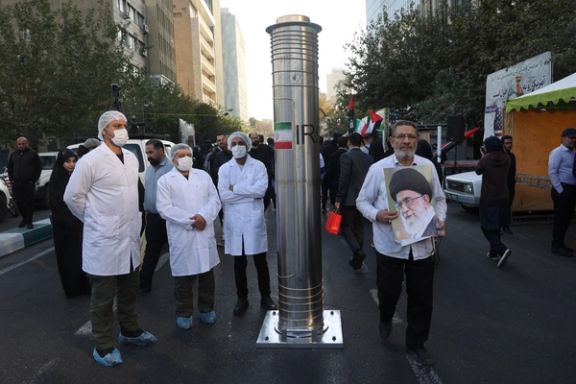
A model of a centrifuge is displayed during the 46th anniversary of the US embassy takeover in Tehran, November 4, 2025.

Iran’s nuclear program has reached a dangerous stalemate after the 2015 deal’s expiry, collapsed talks, and lack of oversight – raising regional fears of a renewed clash with Israel, New York Times reported. 

According to the Times, US strikes earlier this year failed to eliminate Iran’s enrichment capacity, and uncertainty remains over the location and scale of Tehran’s stockpile of highly enriched uranium. 

Analysts cited in the report warned that the lack of diplomacy or inspection access leaves both sides on alert, with Israel signaling readiness to act again if Iran moves closer to a weapon capability.

The Times said Iran has refused inspectors access to new underground enrichment sites such as “Pickaxe Mountain” near Natanz nuclear site and continues to face renewed United Nations sanctions and severe economic pressure. 

Regional powers are urging restraint and fresh negotiations but acknowledge little progress as Tehran and Washington exchange blame over the failure of talks.

The International Atomic Energy Agency told the Financial Times last week that most of Iran’s enriched uranium stockpile appears to have survived the conflict but cannot be verified without access. 

Most Viewed

Ghalibaf defends Iran-US talks amid hardline backlash
1
INSIGHT

Ghalibaf defends Iran-US talks amid hardline backlash

2
INSIGHT

Iran diplomacy wobbles as factions compete to avoid looking soft on US

3
VOICES FROM IRAN

Bread shortages, soaring prices strain households in Iran, residents say

4
ANALYSIS

The politics of pink: how Iran uses cuteness to rebrand violence

5

War-hit homeowners feel abandoned as Iran’s reconstruction aid fades

Banner
Banner

Spotlight

  • The future has been switched off here
    TEHRAN INSIDER

    The future has been switched off here

  • Lights out, then gunfire: Witnesses recount Mashhad protest crackdown
    VOICES FROM IRAN

    Lights out, then gunfire: Witnesses recount Mashhad protest crackdown

  • Family told missing teen was alive, then received his body 60 days later
    EXCLUSIVE

    Family told missing teen was alive, then received his body 60 days later

  • Is Iran entering its Gorbachev moment?
    INSIGHT

    Is Iran entering its Gorbachev moment?

  • Iran crackdown reaches cemeteries as graves of slain protesters defaced
    EXCLUSIVE

    Iran crackdown reaches cemeteries as graves of slain protesters defaced

  • Iran diplomacy wobbles as factions compete to avoid looking soft on US
    INSIGHT

    Iran diplomacy wobbles as factions compete to avoid looking soft on US

•
•
•

More Stories

Iran passive defense chief says underground missile sites largely intact

Nov 9, 2025, 11:12 GMT+0

Iran’s underground missile and ammunition facilities withstood the 12-day conflict and US strikes thanks to two decades of hardening and design, said Iran’s passive defense chief in an interview with the Story of the War podcast on Saturday.

“Almost all underground and under-mountain missile infrastructure remains intact and has no serious problems,” Gholamreza Jalali said, crediting long-running operational measures and engineering choices.

The priority given to aerospace and missile assets, Jalali said, guided 20 years of planning for missile cities and depots built into mountains and deep underground. Only minor repairable damage occurred at some access points, he added.

Underground networks and nuclear sites

Sensitive nuclear centers, Jalali said, were placed in safe spaces after early threat assessments, adding that he personally proposed the protected design concept years ago.

“The shadow of war was present from the very beginning of our activities, and based on the threat scenarios, it was decided that sensitive nuclear sites should be designed in secure underground locations beneath mountains.”

During the 12-day war and the US attacks on nuclear facilities, added Jalali, some foreign reports highlighted the confrontation between “bunker buster bombs” and Iranian concrete engineering. “It was an oversimplified interpretation of designs."

“Regarding the US claim of destroying nuclear facilities, it must be said that further details remain classified and confidential,” he added.

Banks cyber security not addressed yet

Jalali pointed to cyber-attacks on Iranian banks, saying two major banks shared a core platform with unresolved weaknesses. “For banking security, we designed a regional secure model and obtained funding, but execution rests with the relevant bodies,” he said.

During the June conflict, Iran’s Bank Sepah and Bank Pasargad were hit by major cyberattacks that disrupted online banking and ATM services.

Jalali also addressed the use of foreign messaging platforms by military figures, saying none of Iran’s commanders, living or dead, had ever used WhatsApp, while reports suggested some Hamas leaders had relied on it.

Advanced surveillance and data-analysis systems – spanning artificial intelligence, satellites, and signal tracking – are fully controlled by Israel and the United States, he said, adding that using such platforms exposes communications to monitoring and targeting.

“When we are in confrontation with such adversaries, we must assume total visibility across digital space.”

Former communications minister Mohammad Javad Azari Jahromi said in August that Iranian officials with sensitive information on their phones were easy targets for Israeli cyber operations during June's 12-day war, adding that Israel exploited platforms such as WhatsApp to track them.

“In the recent war, those who had information and were of interest to Israel were easy prey for hacking,” Azari Jahromi said, but did not identify those targeted.

Shelters kept confidential

Tehran has multiple shelter options, including metro stations, car parks, and basements, but officials avoided announcing them publicly to prevent panic, he added.

Local authorities received training to guide people in emergencies, while Tehran Municipality was working to upgrade facilities and warning systems for possible use as public shelters, according to him.

Iranian President Masoud Pezeshkian visits the Iranian Atomic Energy Organization in Tehran, Iran, November 2, 2025.
100%
Iranian President Masoud Pezeshkian visits the Iranian Atomic Energy Organization in Tehran, Iran, November 2, 2025.

Iran had fully expected attacks on its nuclear facilities and launched a plan to prepare, he added.

Limited drills in Kashan and broader exercises at Fordow, Natanz, and Isfahan helped minimize risks, Jalali said, adding that chemical storage was cleared and activities scaled back before strikes, and post-attack tests confirmed no radioactive contamination.

Iran will not reveal new missile details for now, Guards official says

Nov 9, 2025, 10:36 GMT+0

Iran’s Revolutionary Guards said the country’s missile program has advanced significantly since the 12-day war with Israel, describing the gains as a major leap in capability while declining to disclose new details about its weapons development.

“We do not intend to publicize new details about our missiles for now,” said Ali Naderi, deputy head of public relations for Iran’s Revolutionary Guards Aerospace Force, adding that Iran’s missile program had advanced “by several years” after the recent 12-day war with Israel.

Naderi said the conflict had strengthened Iran’s capabilities rather than set them back, as claimed by Israel. “They thought they could push our missile power two years behind, but by God’s grace we moved several years ahead,” he told reporters in Tehran.

He said the Aerospace Force now has “more than 30 types of missile and defense systems” and described the country’s arsenal as “full.” 

Naderi praised the leadership of the late commander Amir Ali Hajizadeh, saying “his presence is still felt” and that assassinations of commanders had only “accelerated Iran’s progress.”

He added that while the Guards’ new systems remain classified, “what we can show is displayed at the National Aerospace Park,” adding that the program’s expansion has drawn “rage from enemies hit hardest by Iran’s missile command.”

US sees chance to strip Hezbollah of arms by choking Iran’s cash flow

Nov 9, 2025, 08:16 GMT+0

The United States is seeking to exploit what it sees as a rare opportunity in Lebanon to choke off Iranian funding to Hezbollah and press the group to disarm, a senior Treasury official said, as Washington steps up efforts to contain Tehran’s regional influence.

John Hurley, undersecretary for terrorism and financial intelligence, said Iran has managed to channel about $1 billion to Hezbollah this year despite Western sanctions that have crippled its economy. 

“There’s a moment in Lebanon now. If we could get Hezbollah to disarm, the Lebanese people could get their country back,” he told Reuters in an interview published on Sunday. 

Hurley said the key to curbing Hezbollah’s power was to “drive out the Iranian influence and control that starts with all the money they are pumping into Hezbollah.” 

He spoke in Istanbul as part of a regional tour to Turkey, Lebanon, the UAE and Israel aimed at tightening financial and diplomatic pressure on Tehran.

John K Hurley, the Under Secretary for Terrorism and Financial Crimes at Department of the Treasury
100%
John K Hurley, the Under Secretary for Terrorism and Financial Crimes at Department of the Treasury

Pressure campaign on Iran

The remarks come as the US intensifies its so-called maximum pressure campaign on Iran, whose economy is reeling under renewed UN snapback sanctions imposed after talks to limit its nuclear and missile activities collapsed in September. 

Western governments accuse Tehran of pursuing nuclear weapons capability, a charge Iran denies, insisting its program is for civilian energy.

Washington last week sanctioned two individuals accused of funneling Iranian funds to Hezbollah through money exchanges, in a bid to sever the group’s financial channels. The Treasury said the network had helped move tens of millions of dollars to rebuild Hezbollah’s military infrastructure in Lebanon.

Founded by Iran’s Revolutionary Guards in 1982, Hezbollah has grown into Lebanon’s most powerful military and political force. It has fought multiple wars with Israel and is a key member of Tehran’s “Axis of Resistance” alliance. 

The group remains designated as a terrorist organization by the US and several Western states.

  • US sanctions Hezbollah's Iran-linked 'cash network'

    US sanctions Hezbollah's Iran-linked 'cash network'

  • Iran helped Hezbollah rebuild command structure in Lebanon - Le Figaro

    Iran helped Hezbollah rebuild command structure in Lebanon - Le Figaro

An investigation by Le Figaro in October found that Iran’s Quds Force had helped Hezbollah reorganize after the 2024 war with Israel and the assassinations of its longtime leaders Hassan Nasrallah and Hashem Safieddine. 

Lebanon’s fragile government has pledged to disarm all non-state groups, including Hezbollah, under a US-backed truce with Israel. But the group continues to wield significant political influence and has resisted full demobilization, arguing that its weapons are essential to defend the country.

US officials say Iran’s financial and military backing remains central to Hezbollah’s survival. “Even with everything Iran has been through, even with the economy not in great shape, they’re still pumping a lot of money to their terrorist proxies,” Hurley said.

From guns to votes: Iran-backed Iraqi militias may be about to transform

Nov 7, 2025, 21:48 GMT+0
•
Negar Mojtahedi

Iran-backed militias in Iraq are looking to consolidate the grip they won by force of arms on the fragile country's politics with gains in parliamentary elections next month, experts told Eye for Iran podcast.

After a series of military and diplomatic setbacks, Tehran may hope their allies next door can preserve its influence via the ballotbox and protect a decades-old Iranian political investment in its neighbor.

Confident that US attacks "obliterated" Iranian nuclear sites in June amidst an Israeli military campaign, US President Donald Trump may be ignoring the potential threat Iran poses in Iraq according to historian Dr Shahram Kholdi.

“Iraq may become, in a very odd way, the Achilles heel of the Trump administration,” he told Eye for Iran.

Kholdi warned Tehran’s reconfigured influence could quietly undermine US gains against Iran in the region, adding that steering its militias into politics risks “recreating the Islamic Republic light version in Iraq, 2.0, that operates through bureaucracy rather than arms.”

The shift comes as Washington issues one of its strongest warnings yet, saying it will not recognize Iraq’s next government if any ministries are handed to armed factions linked to the Islamic Republic, a source in Iraq’s Kurdistan region told Iran International on Friday.

In a recent call with Iraq’s defense minister reported by Saudi daily Al-Sharq al-Awsat, US Secretary of War Pete Hegseth cautioned any interference by armed factions to unspecified future US military operations would provoke a sharp American response.

The minister, according to the report, described it as “a final notice,” reflecting US concern that Iran’s allies could use Iraq’s elections to entrench themselves in state institutions.

For Tehran, encouraging its proxies to enter politics provides a way to adapt without relinquishing its arms.

The Popular Mobilization Forces, an umbrella of Shi'ite militias funded through Iraq’s state budget, command vast patronage networks that already blur the line between governance and coercion. Bringing those networks formally into Iraq’s political system could allow Iran to project stability while maintaining influence behind the scenes.

“Iran has been severely weakened in the wake of the 12-day war,” said Jay Solomon, a journalist and author of The Iran Wars.

“What we see is an effort to maintain their proxies and stay below the radar but rebuild.” The approach, described by Solomon, reflects a shift from confrontation to consolidation, using political channels to preserve influence while avoiding direct conflict with the United States.

That calculation, according to Alex Vatanka, Director of the Iran Program at the Middle East Institute, shows how Iran’s leadership has learned to work within new limits.

“They want to rebuild as much as they can within limits. They probably have a much better sense of their limitations today than they did before this summer. But again, they do not want to have that open fight, certainly not on Iraqi soil.”

Two decades after the US invasion of Iraq, Washington faces a familiar dilemma: whether to tolerate a fragile partner shaped by Tehran’s influence or confront a more sophisticated phase of Iranian power consolidation.

Iran’s recalibration in Iraq, analysts on Eye for Iran said, is less a retreat than a pause for recovery, a reminder that even under pressure its power lies not in confrontation but in adaptation.

You can watch the full episode of Eye for Iran on YouTube or listen on a podcast platform of your choosing.

Former top US officials on Mideast doubt imminent Iran-Israel war

Nov 7, 2025, 19:13 GMT+0

Two former senior US Mideast policy officials said a renewed conflict between Israel and Iran appeared remote after the arch-foes clashed in June, but described Tehran in a roundtable discussion hosted by Iran International TV as a lingering threat.

Iran envoy for President Donald Trump from 2020 to 2021 Elliott Abrams and Ambassador Dennis Ross, a former Middle East adviser to Republican and Democratic administrations, are veterans of decades of US diplomacy with long records in the fraught region.

Both see the Islamic Republic as threat to US national security, the country's military presence in the Middle East and the security of its Arab partners and Israel.

The first direct blows between Israel and Iran last year transformed their fight from one in the shadows and via Iran's armed allies like Hezbollah, they said, into a face-to-face showdown culminating in a June war which dealt Tehran punishing blows.

A ceasefire enforced by Trump after US strikes hit three key Iranian nuclear sites is likely to hold for the foreseeable future, they predicted.

In a panel moderated by Bozorgmehr Sharafedin, Iran International's head of Digital, they said a weakened Tehran is salving its wounds and focusing on its internal grip while Israel relishes calm after a Gaza ceasefire mediated by President Trump.

"Lacking air defenses, (the Iranians) know that a great deal more damage can be done by Israel, and I don't think the Israelis are looking for it right now either," Abrams said. "They've having gotten the hostages back from Gaza. They need to let their military rest, rebuild, rearm."

Israeli strikes likely damaged Iran's air defense infrastructure. Iran's foreign minister Abbas Araghchi said this week Tehran had rebuilt its missile power beyond pre-war levels and that it seeks peace through diplomacy, but Iranians must not fear war.

"I would be quite surprised actually to see war with one exception, Abrams added. "If the regime in Tehran decides we must quickly, as quickly as possible, rebuild the nuclear program, then they're going to get hit again."

Iran denies seeking nuclear weapons but Israel and Western countries doubt its intentions. Trump seeks to resume talks halted by the June conflict but Tehran rejects US demands it negotiate over its missiles or support for armed regional allies.

"The fact is, Iran has no air defense today," Ross said. "If they were to rush for a nuclear weapon right now, that would invite either an Israeli response or an American one, and I'm quite certain that the Iranian leadership knows better than that."

Ross served as director of the policy planning staff of the US State Department under President George H.W. Bush, helping guide diplomacy as perennial US adversary the Soviet Union unraveled and toward Saddam Hussein's Iraq in the 1991 Gulf War.

"Right now where we are with the regime, talk tough, talk bravely, but recognize the reality is," he added. "The last thing you need is another fight with the Israelis, and you need even less of one with the United States."

Obliterated, exaggerated

US attacks on June 22 hit the Fordow, Natanz and Esfahan nuclear sites in raids Trump has repeatedly said "obliterated" Iran's nuclear program.

While he asserted Tehran is now focused on survival and not resuming its activities, Trump has pledged to attack again if it does.

Iranian officials this week vowed to build the program back stronger than before.

The head of UN nuclear watchdog Rafael Grossi said on Friday that Tehran still possesses enriched uranium sufficient, should Iran choose and be able to enrich it further, to make several nuclear weapons.

Both former senior officials said that while the US and Israelis strikes had dealt Iran significant setbacks, Trump was dealing in hyperbole.

"It's premature. It's exaggerated," Abrams said. "Meaning, there is something there. He's just making too much of it."

"It's a real change. And I think Trump is right to draw attention to that," Abrams said. "To go further and say, you know, it's the end of conflict and peace in our time, no that goes too far. The regime is still there. Their military is still powerful. They have a dangerous ballistic missile program."

Abrams, a fellow for Middle Eastern studies at the Council on Foreign Relations (CFR) in Washington, supports robust US engagement in the region and the encouragement of democratic transitions.

A neoconservative, he was a prominent advocate of preemptive military action against Iraq during George W. Bush’s presidency.

Ross said Trump's military intervention marked an important paradigm shift, transmitting to the region that the United States would check Iranian influence.

"What he did is he signaled, 'you don't have impunity any longer.' Now that was really important for the region, because it said, okay, we really don't have to be so afraid of the Iranians anymore."

Ross is fellow at Washington DC thinktank the Washington Institute and served as a presidential aide in unsuccessful bids by Barack Obama to resolve the Israeli-Palestinian conflict.

He has advocated an active and multi-pronged US engagement in the Mideast and the world not limited to ideological or military approaches and co-founded the advocacy group United Against a Nuclear Iran in 2008.

"This is a regime that is focused on survival," Ross asserted. "It always has been, but that's the first priority. It feels it can manage and sustain control, which is another reason why they're not looking for trouble on the outside right now, because that could actually endanger them more on the inside."