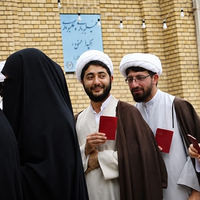
Harakat Hezbollah al Nujaba, an Iraqi militia trained by Iran's Revolutionary Guards
Iran-backed militias in Iraq are looking to consolidate the grip they won by force of arms on the fragile country's politics with gains in parliamentary elections next month, experts told Eye for Iran podcast.
After a series of military and diplomatic setbacks, Tehran may hope their allies next door can preserve its influence via the ballotbox and protect a decades-old Iranian political investment in its neighbor.
Confident that US attacks "obliterated" Iranian nuclear sites in June amidst an Israeli military campaign, US President Donald Trump may be ignoring the potential threat Iran poses in Iraq according to historian Dr Shahram Kholdi.
“Iraq may become, in a very odd way, the Achilles heel of the Trump administration,” he told Eye for Iran.
Kholdi warned Tehran’s reconfigured influence could quietly undermine US gains against Iran in the region, adding that steering its militias into politics risks “recreating the Islamic Republic light version in Iraq, 2.0, that operates through bureaucracy rather than arms.”
In a recent call with Iraq’s defense minister reported by Saudi daily Al-Sharq al-Awsat, US Secretary of War Pete Hegseth cautioned any interference by armed factions to unspecified future US military operations would provoke a sharp American response.
The minister, according to the report, described it as “a final notice,” reflecting US concern that Iran’s allies could use Iraq’s elections to entrench themselves in state institutions.
For Tehran, encouraging its proxies to enter politics provides a way to adapt without relinquishing its arms.
The Popular Mobilization Forces, an umbrella of Shi'ite militias funded through Iraq’s state budget, command vast patronage networks that already blur the line between governance and coercion. Bringing those networks formally into Iraq’s political system could allow Iran to project stability while maintaining influence behind the scenes.
“Iran has been severely weakened in the wake of the 12-day war,” said Jay Solomon, a journalist and author of The Iran Wars.
“What we see is an effort to maintain their proxies and stay below the radar but rebuild.” The approach, described by Solomon, reflects a shift from confrontation to consolidation, using political channels to preserve influence while avoiding direct conflict with the United States.
That calculation, according to Alex Vatanka, Director of the Iran Program at the Middle East Institute, shows how Iran’s leadership has learned to work within new limits.
“They want to rebuild as much as they can within limits. They probably have a much better sense of their limitations today than they did before this summer. But again, they do not want to have that open fight, certainly not on Iraqi soil.”
Two decades after the US invasion of Iraq, Washington faces a familiar dilemma: whether to tolerate a fragile partner shaped by Tehran’s influence or confront a more sophisticated phase of Iranian power consolidation.
Iran’s recalibration in Iraq, analysts on Eye for Iran said, is less a retreat than a pause for recovery, a reminder that even under pressure its power lies not in confrontation but in adaptation.
You can watch the full episode of Eye for Iran on YouTube or listen on a podcast platform of your choosing.
Outside the building of the General Directorate of Prisons of Semnan Province
A Swiss citizen Iran says died by suicide in prison was a 64-year-old tourist, a Swiss foreign ministry spokesman told Iran International, adding that Switzerland is seeking more details on his arrest and death from Tehran.
The foreign ministry added on Friday that the individual had been living in South Africa for the past 20 years and was traveling in Iran as a tourist.
The email response from the ministry said that the Swiss embassy in Iran was earlier denied access to the prisoner and now wants Tehran to provide full information about his arrest and death.
"Since Switzerland was informed of the arrest, the Swiss Embassy in Tehran has been in daily contact with the Iranian authorities to obtain more information about the circumstances of the arrest and to gain access to the detained Swiss citizen," the foreign ministry said.
"However, due to the accusations (espionage – national security), the requested consular access was not granted," it added. "Switzerland is demanding that the Iranian authorities provide detailed information."
The Swiss citizen who allegedly committed suicide in Semnan Prison on Thursday had been arrested while collecting soil samples in Iran’s central desert during an Israeli airstrike, media affiliated with Islamic Revolutionary Guard Corps reported.
Meanwhile, local media quoted unnamed Iranian official as saying that person was conducting espionage when he was arrested. The name of the Swiss citizen and the circumstances of his arrest and death remain unclear.
“This individual used prior intelligence training to take their own life during a specific opportunity,” Mashregh News, a publication affiliated with the Islamic Revolutionary Guard Corps (IRGC), reported late Thursday, citing an unnamed security official.
"Switzerland is demanding that the Iranian authorities provide detailed information on the reasons for his arrest and a full investigation into the circumstances of his death," the Swiss foreign ministry said.
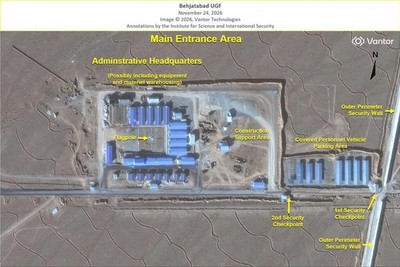
The individual, detained by the IRGC Intelligence Organization, was accused of gathering information in a sensitive area during Israel's October air attack. The media report specifically said that this occurred during the Shahroud attack, which targeted an IRGC missile facility. Satellite imagery from Planet Labs later revealed significant damage to the site, known for building ballistic missiles and launching rockets as part of Iran’s space program.
After their arrest, the person was transferred to Semnan Prison, where they allegedly revealed information about their network and communication links, according to the outlet.
A local judiciary official confirmed the death on Thursday, saying that the Swiss national, facing espionage charges, had committed suicide in their cell.
Switzerland has also confirmed the death. "The FDFA confirms the death of a Swiss citizen in Iran," spokesperson Pierre-Alain Eltschinger told Iran International. "The Swiss Embassy in Tehran is in contact with the local authorities to clarify the circumstances of the death in an Iranian prison," he added.
According to Mizan, Iran's judiciary news website, the detainee asked their cellmate on Thursday morning to purchase food from the prison canteen. While alone in the suite, the detainee reportedly took their own life. "Prison officials immediately intervened to save the individual, but their efforts were unsuccessful," Mohammad Sadegh Akbari, a local judiciary official, was quoted as saying. “Suicide has been definitively confirmed.”
Iran has arrested dozens of dual nationals and foreigners in recent years, often on charges of espionage or security-related offenses. Some of these detainees have been released in exchange for deals involving Iranians held in foreign prisons.