• العربية
  • فارسی
Brand
  • Iran Insight
  • Politics
  • Economy
  • Analysis
  • Special Report
  • Opinion
  • Podcast
  • Iran Insight
  • Politics
  • Economy
  • Analysis
  • Special Report
  • Opinion
  • Podcast
  • Theme
  • Language
    • العربية
    • فارسی
  • Iran Insight
  • Politics
  • Economy
  • Analysis
  • Special Report
  • Opinion
  • Podcast
All rights reserved for Volant Media UK Limited
volant media logo
ANALYSIS

No regrets: Khamenei ramps up defiance of US with hostage crisis praise

Behrouz Turani
Behrouz Turani

Iran International

Nov 5, 2025, 07:17 GMT+0Updated: 00:01 GMT+0
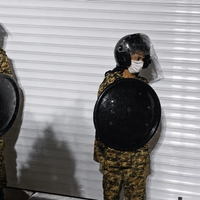
Police stand guard at a demonstration during the Iran hostage crisis, in Washington, D.C., November 1979.

Almost half a century after young revolutionaries stormed the US embassy in Tehran, Iran’s Supreme Leader Ali Khamenei once again defended the move, leaning into the original break between the arch-foes and all but ruling out rapprochement.

Speaking Monday on the anniversary of the November 4, 1979 seizure of the embassy, Khamenei described Iran’s enmity toward the United States as “existential rather than tactical,” a confrontation that cannot be resolved.

“The inherently arrogant nature of the US accepts nothing but submission,” he said. “Every US president desired this. Some concealed it, others expressed it openly. The current president has made it explicit, revealing the US’s true nature.”

For Khamenei, the threat lies not in sanctions or military pressure but in ideological erosion. America’s demands—whether over nuclear activities, missiles, or regional policy—are, to him, attempts to take away what defines the system that has become synonymous with his name.

'Victory day’

Khamenei tried to illustrate this point with both history and scripture.

“Our problem with the United States began on August 19, 1953, not November 4, 1979,” he said, invoking the CIA-backed coup against Prime Minister Mohammad Mossadegh seventy-odd years ago.

On the latter date, he echoed his mentor and predecessor Ruhollah Khomeini in calling it “a day of honor and victory,” doubling down on a bet many insiders now publicly regret.

Even senior conservatives like Ali Akbar Nateq Nouri, once chief inspector of the Supreme Leader’s office, have called the storming of the US embassy “a big mistake,” admitting that the ensuing hostage crisis was “the starting point” of many of Iran’s troubles.

But Khamenei is adamant that repentance equals betrayal. History, as he tells it, shows that every concession to the United States only invites more demands—a conviction hardened through experience.

Impossible conditions

When Donald Trump first took office, he declared that all he wanted from Tehran was a pledge not to pursue nuclear weapons, signaling he had no quarrel with Iran’s theocratic order.

But midway through indirect negotiations in the spring of 2025, his stance shifted toward a more conventional hardline: curbs on missiles, abandonment of regional allies, and most recently, recognition of Israel.

Khamenei’s Monday speech contained a direct reply: “If they stop supporting the Zionist regime, remove military bases from the region and cease interfering in regional affairs, these matters could potentially be reviewed,” he said, referring to calls for engagement with the United States.

The conditions were impossible by design—a reminder that what Washington calls diplomacy, he sees as ideological surrender.

‘Unconditional surrender’

Even when hinting at pragmatic concessions such as curbing enrichment, he was dismissive: “This isn’t something foreseeable for now, nor for the near future.”

Trump’s post on Truth Social in mid-October, calling for Iran’s “unconditional surrender” just days into Israel’s war on Iran, may have been the epitome of what Khamenei always asserted: that America seeks capitulation, not coexistence.

His answer was unambiguous: “Expecting the Iranian nation to submit, given its level of capabilities, wealth, intellectual and spiritual background and its vigilant and motivated youth, is meaningless.”

Khamenei shows no sign of repentance or retreat. To him, the struggle with the United States is not about sanctions or missiles but about identity. In his twilight, he seems as convinced as ever that the system must endure as it is, or not at all.

Most Viewed

Ghalibaf defends Iran-US talks amid hardline backlash
1
INSIGHT

Ghalibaf defends Iran-US talks amid hardline backlash

2
INSIGHT

Iran diplomacy wobbles as factions compete to avoid looking soft on US

3
VOICES FROM IRAN

Bread shortages, soaring prices strain households in Iran, residents say

4
ANALYSIS

The politics of pink: how Iran uses cuteness to rebrand violence

5

War-hit homeowners feel abandoned as Iran’s reconstruction aid fades

Banner
Banner

Spotlight

  • The future has been switched off here
    TEHRAN INSIDER

    The future has been switched off here

  • Lights out, then gunfire: Witnesses recount Mashhad protest crackdown
    VOICES FROM IRAN

    Lights out, then gunfire: Witnesses recount Mashhad protest crackdown

  • Family told missing teen was alive, then received his body 60 days later
    EXCLUSIVE

    Family told missing teen was alive, then received his body 60 days later

  • Is Iran entering its Gorbachev moment?
    INSIGHT

    Is Iran entering its Gorbachev moment?

  • Iran crackdown reaches cemeteries as graves of slain protesters defaced
    EXCLUSIVE

    Iran crackdown reaches cemeteries as graves of slain protesters defaced

  • Iran diplomacy wobbles as factions compete to avoid looking soft on US
    INSIGHT

    Iran diplomacy wobbles as factions compete to avoid looking soft on US

•
•
•

More Stories

Washington rebukes Iran on anniversary of 1979 embassy takeover

Nov 4, 2025, 22:03 GMT+0

The United States on Tuesday condemned Iran’s record on international law and human rights on the 46th anniversary of the 1979 takeover of its embassy in Tehran.

“The attack and seizure of the United States Embassy in Tehran marked the beginning of countless violations of international law and the Iranian regime’s refusal to accept diplomacy,” the State Department’s Persian-language account said in a post on X.

On November 4, 1979, pro-Islamic Republic students stormed the US embassy in Tehran and took 52 American diplomats and staff hostage for 444 days, leading to the rupture of diplomatic ties between Tehran and Washington that have never been restored.

The State Department’s post said the embassy takeover began “a long pattern of ignoring the rights of other nations and interfering in their affairs,” reflecting “the same disregard for fundamental rights and freedoms that today defines this regime’s behavior toward its own people.”

It added that the United States “remains determined to promote diplomacy, accountability, and the aspirations of the Iranian people for a brighter future.”

The statement comes as Iran marked the anniversary with state-organized rallies across the country earlier in the day.

Iranian Supreme Leader Ali Khamenei doubled down on his hard line backing the takeover in a speech on Monday.

"The people took to the streets, and part of these demonstrations and popular movements, with student participation, led to the seizure of the US embassy,” he said. "The US embassy was the center of conspiracies and plotting to destroy the Islamic Revolution.”

Crowds gathered across the country waving national flags and portraits of Iran’s leaders to observe what officials call the National Day of Fighting Global Arrogance.

In Tehran, effigies of US President Donald Trump and Israeli Prime Minister Benjamin Netanyahu being hanged were displayed during the state sponsored rally.

Iranian diaspora critics voice doubts over Mamdani as New York mayor

Nov 4, 2025, 20:55 GMT+0

Some critics in Iran's diaspora are expressing skepticism about Zohran Mamdani, the Muslim and self-described Democratic socialist frontrunner in elections for New York City mayor on Tuesday, even likening his populist vision to Ayatollah Khomeini's 1979 Islamic Revolution.

Mamdani, a 34-year-old state assemblyman, won the Democratic primary in June, edging out former New York governor Andrew Cuomo.

Born in Uganda to parents of Indian descent, he was raised in New York and has championed affordability in a campaign which has belatedly earned the praise of some Democratic leaders. If elected he would be New York's first Muslim mayor.

His platform emphasizes affordable housing, police reform and Palestinian rights, earning him strong backing from progressives and Muslim organizations.

But his left-leaning and pro-Palestine positions have unsettled some Iranian exiles who see echoes of populist and millenarian promises they say marred their homeland in the 1979 Islamic Revolution.

"Modern Iranian history flashes a bright caution sign as America’s far left and Islamist movements converge in our cities and universities," Andrew Ghalili, senior analyst at advocacy group the National Union for Democracy in Iran, wrote in The New York Sun.

"Iranians have seen this movie before, and the American left are playing their role perfectly. It’s only a matter of time until the tragic third act," he added.

Mamdani was criticized for using the phrase "globalize the intifada" during the mayoral primary, a phrase referring to a Palestinian uprising years after campus protests against Israel's incursion into Gaza beginning at Columbia University in New York spread nationwide and inflamed debates about free speech and anti-Semitism.

He has since distanced himself from the slogan and has campaigned with representatives of many faiths, including Jewish and Muslim leaders.

Many first and second-generation immigrants from Iran are conservative and skeptical of the role of Islam in public life, holding up the nearly 50-year-old Islamic theocracy in their homeland as a cautionary tale.

Mamdani has hit out at what he has called Islamophobia in the wake of the 9/11 attacks but has not cited Islam as a basis of his political outlook.

University of Illinois at Chicago PhD candidate and commentator Sana Ebrahimi criticized Mamdani’s promises of free services on X, comparing them to Ayatollah Khomeini’s unfulfilled pledges.

“Every time I see those curated photos of Zohran Mamdani, I am reminded of Khomeini as a ‘humble servant of the people,'" she wrote. "Four and a half decades later, Iran is destroyed and its currency has been gutted. Grand promises are easy and that is Zohran’s game plan."

On the campaign trail, Mamdani said his aunt feared riding the New York subway in the wake of the 9/11 of attack for fear of being persecuted for her Islamic veil.

Iranian dissident Masih Alinejad, who resides in New York City, urged Mamdani to protect the rights of all citizens, including those who reject the hijab.

She was speaking after a US court in Manhattan last month convicted two men of attempting to kill her in a plot backed by Tehran.

“(Mamdani) said his aunt removed her hijab in New York because she didn’t feel safe. Well, I don’t feel safe in New York because the real killers, backed by Iran - the top sponsor of Hamas - came after me twice here simply for saying no to hijab. So yes, Mayor, step up and protect this city from terrorist organizations,” she posted on X.

In a podcast appearance with conservative New York Times columnist Bret Stephens, Alinejad appeared to suggest Mamdani was a "radical" whose rise coincided with more public displays of Islamic and pro-Iranian activity in America.

"Let's talk about my concern in the West, in America, in New York City, the rise of radicals," she said. "There are more than 300 mosques in New York. What is it about this fantasizing with the radicals, saying we want to pray in the streets. So let's just talk about Mamdani."

Polls show Mamdani leading rivals Andrew Cuomo and Curtis Sliwa as voters weigh issues such as housing and crime.

French think tank says Iran purveying influence via Paris embassy

Nov 4, 2025, 20:40 GMT+0

Iran’s embassy in Paris coordinated a decades-long campaign to influence French political, academic and media spheres, according to a new report by French think tank France2050.

The organization's inaugural 120-page report said Iran has maintained a “structured system of infiltration” in France for decades through its diplomats and cultural institutions.

The report compiled by journalists, historians and former intelligence officials, said Tehran had maintained a “structured system of infiltration” in France for decades through diplomats and cultural institutions.

France2050 is led by Gilles Platret, a former mayor and vice president of a center right party. The report's editorial directors, Emmanuel Razavi and Jean-Marie Montali, are authors of books on Iranian influence abroad.

The document was submitted to the Interior Ministry, the Senate and the National Assembly to inform policymakers about foreign influence operations in France, according to its authors.

“In France, the number two of the Iranian embassy, Ali Reza Khalili, was responsible for establishing an influence network: recruiting and directing ‘agents,’ whether they were aware of being manipulated or not,” the report said.

It described Khalili as chief of staff to the Iranian ambassador and president of the Franco-Iranian Center, an association created in 2016 that regularly hosted conferences, cultural events and training sessions.

These activities, the authors wrote, enabled Tehran to “identify and recruit potential interlocutors in academia, civil society and the media.”

Embassy accused of coordinating propaganda

The report called the Iranian embassy in Paris “the European anchor of the Revolutionary Guards’ influence operations.”

Citing European counter-espionage sources, it said the mission served simultaneously as “a cultural center, a propaganda unit and a coordination office for the surveillance of the diaspora and the repression of opponents abroad.”

Several embassy staff members officially registered as diplomats were identified by European services as belonging to Iran’s Ministry of Intelligence (MOIS) or the Quds Force, according to the document.

The embassy allegedly supervised cultural and religious institutions such as the Centre Culturel Islamique d’Iran in Paris, which the report called “a discreet but effective relay for Tehran’s propaganda.”

The France2050 authors also cited links between the embassy and regional Shiite associations in Lyon and Villeurbanne, describing joint events attended by Iranian diplomats “often without public mention of their participation.”

Recruitment in universities and civil society

According to the document, the embassy and the Franco-Iranian Center offered scholarships, internships and trips to Iran to “students or researchers demonstrating open-mindedness toward Iranian culture,” which it characterised as a form of recruitment for influence operations.

Targets included “young intellectuals, journalists in training, or NGO activists susceptible to anti-Western or anti-imperialist rhetoric,” the report said.

The embassy also allegedly directed a digital influence campaign using social-media accounts tied to Iranian state outlets such as Press TV, Al-Alam and Hispan TV.

Cyber-monitoring referenced in the report found recurring links between these French-language networks and the embassy’s communications unit, with some account administrators participating in events run by Ali Reza Khalili’s center.

The campaigns, the report added, aimed to “create ideological confusion, erode trust in democratic institutions and normalize the Iranian regime’s positions in the French political and media landscape.”

It warned that the absence of an EU terrorist designation for the Revolutionary Guards allowed operatives “to travel, fundraise and coordinate freely across Schengen countries.”

Iran releases French couple after three years, Macron says

Nov 4, 2025, 18:45 GMT+0

Iran has released French prisoners Cecile Kohler and Jacques Paris who had been detained since 2022, President Emmanuel Macron announced on Tuesday, nearly two weeks after Paris freed an Iranian citizen charged with promoting terrorism.

The two French prisoners "are out of the Evin jail and en route to the French embassy in Teheran," Macron said on X. "I welcome this first step, the dialogue continues."

Foreign Minister Jean-Noel Barrot said later on X that the two French nationals were now "safe" at the French Embassy "ahead of their final release".

Iran's foreign ministry spokesman said the two French nationals "have been released on bail and will remain under supervision until the next stage of judicial proceedings."

Kohler and Paris were arrested in May 2022 during a tourist trip to Iran. Both were charged with spying for Israel, charges they denied.

The pair were also charged with "conspiracy to overthrow the Islamic Republic and corruption on earth."

In May, France filed a case against Iran at the International Court of Justice (ICJ), accusing Tehran of unlawfully detaining the two French citizens for three years and violating international law.

In September, Paris withdrew its case against Iran after a meeting between Macron and Iranian President Masoud Pezeshkian in New York, which was seen as a possible gesture toward reviving prisoner-exchange talks.

Iranian foreign minister Abbas Araghchi suggested at the time that Iran might free the French pair in exchange for Iranian national Mahdieh Esfandiari, who was due to face trial in January for promoting acts of terrorism.

Esfandiari, an Iranian student living in the French city of Lyon, was arrested in February allegedly over her social media posts against Israel.

On October 23, Iran's foreign ministry confirmed Esfandiari had been conditionally released after 235 days of detention.

Survival mode: how Tehran adapts through crisis, endures decay

Nov 4, 2025, 17:20 GMT+0
•
Ata Mohamed Tabriz

Tehran is in a tougher position after the 12-day war and the return of UN sanctions but may not be as close to collapse as some Iranians might like.

Over the years, the Islamic Republic has learned through crises how to avoid breakdown by adjusting pressure and tension.

This does not mean the system is stable. But the way political actors interpret a state steadily losing ground can, paradoxically, prolong its life and dull the will to resist.

When everything is framed as “imminent collapse,” the mechanisms through which the power structure renews itself go unseen.

The Islamic Republic, precisely when it appears weak, is rebuilding itself. The rulers in Tehran are shifting from rigidity to hybridity—from total control to a contradictory mix of freedom and repression.

A new logic of survival

One sign of this shift is visible in the hijab issue. In much of Tehran and other major cities, the state has largely pulled back from strict dress enforcement, though verbal warnings have returned.

The sight of unveiled women and the freer—if still risky—operation of cafés are widely seen as retreats from the theocracy’s ideological ground.

But that retreat tells only half the story. While scaling back the morality police, the government has intensified executions and political arrests. The security apparatus advances elsewhere with renewed vigor.

In this survival logic, Tehran knows total control is neither possible nor necessary. It loosens its grip in some areas to vent pressure while consolidating power in others. This could be called controlled liberalization: limited freedoms to absorb discontent, paired with harsh repression to enforce discipline.

Even these freedoms are narrow and uneven—visible mostly in affluent parts of Tehran. In other cities, tolerance around hijab or social life is largely confined to wealthier districts. Only a small segment benefits, while the threat of arrest still hangs over all.

This display of flexibility is part of the survival mechanism—meant to defuse unrest and repair eroded legitimacy.

Redefining freedom

The Islamic Republic is trying to redefine freedom itself. Freedom becomes not a universal right but a class-based privilege without legal protection, shadowed by laws ready to repress. What is limited and controlled is sold as freedom.

This divide is not only social but psychological. Images of these narrow freedoms circulate online, creating a sense of normalcy—as if society were breathing again and the control had softened.

Yet this circulation is itself a tool of control. Power now operates not only through coercion but through the display of freedom—showing it to blunt the desire for it.

Repression, however, has not changed.

In the post-war period, mechanisms of elimination have not disappeared—they have become more complex and severe. Arrests and executions have multiplied even as scenes of openness are displayed.

These images of easing mask the reconstruction of the same machinery of fear. What has occurred bears little relation to freedom.

(Not) understanding power

The Islamic Republic has changed its governing logic, while many analysts—ignoring the full scope of that shift—still read every retreat as weakness or collapse.

Yet within those very weaknesses, the Islamic Republic has forged new methods of survival, oscillating between coercion and tolerance.

Today’s government no longer rules through rigid discipline but through fluid, contradictory behavior in which retreat and advance reinforce each other. This marks a kind of institutional learning: endurance now depends less on absolute control than on calibrating the limits of freedom and repression.

To treat weakness or non-enforcement of law as proof of collapse is to miss Tehran’s new logic. The Islamic Republic has built alternative strategies to mask fragility—ways to rebuild legitimacy and manage society amid crisis.

In today’s Iran, the system finds its strength not in closing doors but in keeping them half-open. Apparent openings and simultaneous crackdowns are two sides of the same political logic.

Understanding that logic is essential—because “weakness” is not always a prelude to “collapse.” Sometimes, it is the state’s latest strategy for survival.