Iran marks anniversary of US embassy takeover with nationwide rallies
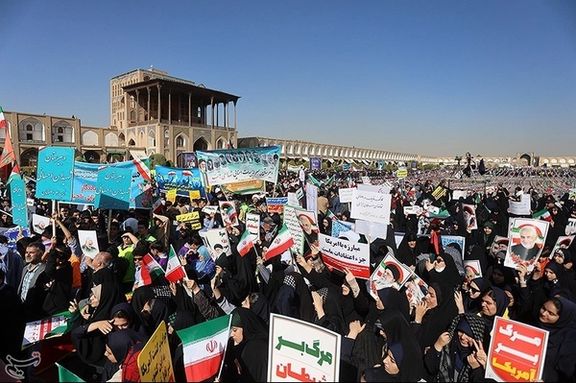
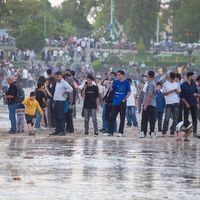
Participants attend a rally in the central city of Isfahan to mark the anniversary of the 1979 US embassy takeover, waving Iranian flags and chanting slogans against the United States and Israel. (November 4, 2025)
Iran on Tuesday marked the anniversary of the 1979 seizure of the US embassy in Tehran with state-organized rallies across the country, the first such commemorations since the United States and Israel carried out air strikes on Iranian targets earlier this year.
Crowds gathered across the country waving national flags and portraits of Iran’s leaders to observe what officials call the National Day of Fighting Global Arrogance.
The annual event, organized by state institutions, commemorates the November 4, 1979 takeover of the US embassy by militant students who held 52 Americans hostage for 444 days, leading to the rupture of diplomatic ties between Tehran and Washington.
Marchers, including students, public employees and members of the military, chanted slogans against the United States and Israel in Tehran and major cities.
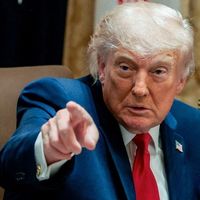
Effigies of US President Donald Trump and Israeli Prime Minister Benjamin Netanyahu being hanged are displayed during the 46th anniversary of the US expulsion from Iran, in Tehran, November 4, 2025. A scene from a rally in Tehran to mark the anniversary of the 1979 US embassy takeover (November 4, 2025)
State television showed large gatherings in Tehran, Mashhad, Isfahan and Shiraz, describing the turnout as a show of national unity and defiance following the recent confrontation.
In Tehran, organizers also showcased models of Iran’s ballistic missiles and nuclear centrifuges, which state media said symbolized the country’s technological progress and deterrent capability.
In the capital, demonstrators moved from Palestine Square to the site of the former US embassy, where the ceremony concluded with speeches, patriotic songs and the reading of a closing resolution denouncing Western sanctions and reaffirming support for Palestinians.
Models of Iranian ballistic missiles and nuclear centrifuges are displayed near the site of the former US embassy in Tehran during rallies marking the anniversary of the 1979 embassy takeover. (November 4, 2025)
Officials stress independence and unity
Parliament Speaker Mohammad-Bagher Ghalibaf, who joined the rally and delivered the main speech, said the anniversary symbolized Iran’s resolve to remain independent and resist what he called domination by foreign powers.
He said the country’s independence could not be “traded for any concession” and that “Death to America” was a rejection of hegemony, not hostility toward a nation.
Symbolic coffins draped in Israeli flags are carried during a rally in Tehran marking the anniversary of the 1979 US embassy takeover (November 4, 2025)
Ghalibaf cited the 1953 coup against Prime Minister Mohammad Mossadegh and the 1964 exile of Ayatollah Ruhollah Khomeini as examples of past interference, arguing that Iran’s self-reliance in defense, science and technology was its safeguard against renewed pressure.
Former Revolutionary Guards commander Mohsen Rezaei told reporters that Iran’s message to adversaries was one of “resistance and readiness,” saying the nation would respond firmly to any renewed threat.
Resolution reaffirms resistance policy
At the close of the Tehran rally, a statement read aloud by organizers reaffirmed Iran’s commitment to what it called “rational resistance” against Western powers and support for Palestinians in Gaza.
The text rejected any compromise with the United States or Israel, urging national cohesion and stronger economic management at home.
The declaration also stressed that Iran’s defense and nuclear program were integral to national sovereignty and called on government institutions to curb inflation and address public grievances.
A model of a centrifuge is displayed during the rallies in Tehran, November 4, 2025.
Iranian lawmakers chanted “Death to America” and “Death to Israel” in parliament on Tuesday as they marked the anniversary of the 1979 seizure of the US Embassy in Tehran, state media reported.
Deputy speaker Ali Nikzad, who presided over the session, said Iran would not yield to foreign pressure. “The hostility and plots of the criminal America against the Iranian nation did not begin on November 4 and will not be solved through negotiations with the United States,” he said. “This conflict is rooted in principles, and the main issue is the effort to make the Iranian nation surrender.”
Nikzad said the takeover of the US Embassy was not a rash or emotional act but a reaction to years of US interference. He said the United States did not tolerate an independent power in West Asia and that disputes such as the nuclear issue were “only excuses.”
After his remarks, lawmakers shouted anti-US and anti-Israel slogans, according to state television.
Khamenei defends anti-US slogan
The chants came a day after Supreme Leader Ali Khamenei defended the slogan and reaffirmed Iran’s anti-US stance in a speech to students in Tehran. Khamenei said that Iran’s dispute with Washington was “essential, not tactical,” rejecting the notion that the chant itself created enmity between the two countries.
“The slogan ‘Death to America’ is not what causes hostility — the enmity is rooted in the nature of America’s imperialist system,” he said.
Khamenei added that the United States would have to end its military presence in the Middle East and withdraw support for Israel before any future cooperation with Iran could even be considered.
Israeli Prime Minister Benjamin Netanyahu, in an interview last month, cited such chants as proof that Iran remains a global threat. He said Tehran is developing intercontinental ballistic missiles that could reach American cities and warned that “you don’t want to be under the nuclear gun of these people who chant ‘death to America.’”
The anniversary marks the start of the Iran Hostage Crisis, when followers of Ruhollah Khomeini stormed the US Embassy in Tehran on November 4, 1979, and held 52 American diplomats and staff hostage for 444 days, an episode that triggered more than four decades of confrontation between Tehran and Washington.
A US federal judge has found Iran liable and awarded $841 million in damages to 36 plaintiffs whose family members had been wounded or killed in attacks by militant groups in Iraq’s Anbar province, their co-counsel said on Monday.
Iran provided significant material support for “terrorists” who carried out attacks in Iraq between 2003 and 2017, District Judge Randolph Moss of the District of Columbia said in a 12-page memorandum opinion.
The United States invaded Iraq in 2003 and promptly faced a deadly insurgency.
Moss awarded about $420.7 million in compensatory damages and $420.7 million in punitive damages to the plaintiffs.
Plaintiffs generally rely on the US Victims of State Sponsored Terrorism Fund for compensation as it is “very difficult” to collect judgments from Iran, their co-counsel Nicholas Reddick said.
“Pretty much all of Iran’s assets have already been seized by the government or prior litigants, so there isn’t just money sitting around in a bank account that we can go seize.”
Foreign governments are generally considered beyond the jurisdiction of US courts, but the terrorism exception to the Foreign Sovereign Immunities Act (FSIA) allows the courts to hold these countries accountable, where immunity is not absolute.
In 2016, Iran filed a lawsuit against the United States before the International Court of Justice (ICJ), also known as the World Court, for allegedly breaching a 1955 friendship treaty by allowing US courts to freeze assets of Iranian companies. The money was to be given in compensation to victims of terrorist attacks.
In 2023, the ICJ judges ruled Washington had illegally allowed courts to freeze assets of some Iranian companies and ordered the United States to pay compensation but left the amount to be determined later.
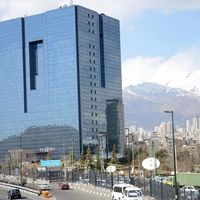
However, in a blow for Tehran, the world court said it did not have jurisdiction over $1.75 billion in frozen assets from Iran's central bank.
Iran's Wrestling chief Alireza Dabir with a picture of slain IRGC Quds Force commander Qassem Soleimani
The United States has revoked the permanent residency of Alireza Dabir, the president of Iran’s Wrestling Federation and a staunch loyalist of Iran's Supreme Leader, a US government official told Iran International.
It was not immediately clear when the revocation took effect.
Dabir told Iran International in a telephone interview in October that he had “given back” his green card but declined to respond to requests for comment.
Wrestling is an ancient and widely celebrated sport in Iran.
The male-dominated theocracy has backed wrestling programs with generous state funding in support that has helped Iranian athletes secure numerous international titles and championships.
A gold medalist in freestyle wrestling at the 2000 Sydney Olympics and a former Tehran city council member, he has been a vocal supporter of Iran’s ruling establishment and its anti-Western rhetoric.
“We always chant ‘Death to America,’ but the important thing is showing it in action,” Dabir said in a 2022 interview with Iran’s state media. “Some people talk a lot but don’t do much. We need to prove it with action.”
Following the comments, the Biden administration denied entry to Dabir and several Iranian wrestlers who were due to compete in Texas.
'Enforcing gender apartheid'
Iran’s state-run Press TV quoted Dabir in January 2022 as saying he obtained the Green Card during the Sydney Olympics, “just like many other athletes,” believing he might study in the United States, but “never used it.”
Iranian-American activists have long opposed Dabir’s entry into the United States, citing his political loyalties and role in enforcing restrictions on women’s participation in sport.
“(Dabir) is not only enforcing gender apartheid in sport, banning women from most wrestling disciplines and forcing mandatory hijab in the few allowed formats like Alysh, but also stands accused of deep corruption and political cronyism,” said Lawdan Bazargan, director of advocacy group the Alliance Against Islamic Regime of Iran Apologists (AAIRIA).
Iran bans women from competing in wrestling, even as neighboring Muslim countries such as Turkey permit female participation.
Sardar Pashaei, a former Greco-Roman world champion and once head coach of Iran’s youth national team, wrote to the USA Wrestling’s executive director in 2022 urging US sports bodies to shun Iranian government-sponsored athletes.
“Refrain from inviting officials and athletes who are government propaganda tools that are anti-women and anti-American,” he wrote.
Mohammad Javad Zarif, Iran’s former vice president for strategic affairs and foreign minister
Former Iranian foreign minister Javad Zarif said on Monday that the United States failed to humiliate Iran in a June war and that only earnest negotiations could resolve the impasse between the two adversaries.
Speaking at a conference in Hiroshima in Japan on Monday, Zarif said Iran’s resilience in the face of military and economic pressure had shown that “the era of hit and run is over.”
“A superpower that spends over $800 billion a year on its military could not humiliate Iran, which allocates less than $10 billion to defense,” Zarif said.
“In fact, that superpower was compelled to evacuate all personnel from its military bases surrounding Iran before daring to launch reckless bombings against Iran’s safeguarded facilities.”
US talks with Tehran over its disputed nuclear program began earlier this year with a 60-day ultimatum. On the 61st day, June 13, Israel launched a surprise military campaign which was capped with US strikes on June 22 targeting key nuclear sites in Esfahan, Natanz and Fordow.
Iran denies seeking nuclear weapons and has called the attacks illegal.
Zarif said decades of sanctions, cyberattacks, and assassinations had failed to force Iran to capitulate, arguing that the country’s nuclear program was rooted in “dignity, not deterrence.”
He said Supreme Leader Ali Khamenei’s insistence on continuing the program stemmed from “resistance to submission."
“For him (Khamenei), it has always been about something far more profound and enduring: dignity,” Zarif said.
Iran's 86-year-old ruler appeared to double down on his hard line against a rapprochement with Washington on Monday, saying the United States must quit military bases in the region and sever ties with Israel to mend fences with Iran.
The former Iranian chief negotiator urged the United States to “set aside the illusion of demanding Iran’s unconditional surrender” and instead engage in “genuine negotiations” to ensure the program remains peaceful.
Zarif called for reviving diplomacy through initiatives he said he had proposed to promote peaceful nuclear cooperation and rebuild trust with the West.
“One practical step that I proposed in a recent Foreign Policy essay could be a US–Iran non-aggression pact,” Zarif said. “Another initiative that a colleague and I proposed in The Guardian a couple of months ago is the Middle East Network for Atomic Research and Advancement, or MENARA — a collaborative regional network dedicated to non-proliferation while harnessing peaceful nuclear cooperation.”
The United States has demanded Iran renounce domestic uranium enrichment while Tehran maintains its nuclear program is an international right.
Zarif said the network would include “an enrichment consortium bringing together existing capabilities into a collective peaceful and transparent effort,” adding that it would be open to all Middle Eastern countries willing to renounce nuclear weapons and accept strict safeguards.
Kataib Hezbollah Iraqi militia gather ahead of the funeral of the Iraqi militia commander Abu Mahdi al-Muhandis, who was killed in an air strike at Baghdad airport, in Baghdad, Iraq, January 4, 2020
Israeli-Russian academic Elizabeth Tsurkov who was freed by an Iran-backed Iraqi militia in September offered some of her first insights yet on her captors on Monday, decrying Iran and its regional allies as "brutal ignoramuses".
"I am confident that so many of the successes Israel has had vs. the Iranian axis is not due to Israeli genius but due to the stupidity of the men who make up the rank-and-file and commanders of these militias & Iranian regime," Tsurkov wrote on X.
"Having spent 903 days in the captivity of an Iraqi militia servicing Iran, I can tell you that I've never met more ignorant people in my life," the Princeton PhD candidate added.
Tsurkov was abducted by Iran-backed Shi'ite militia Kata’ib Hezbollah and was released after a Trump administration hostage envoy traveled to Iraq in February to push for her release.
She is a prolific analyst on social media and announced her return to X last month with an animation of rapper Dr. Dre with the caption "Guess who's back." Her posts are frequently critical of Israeli policy.
"Commanders who think tracking devices can be planted in teeth, but don't know white [non-silver] fillings exist. Commanders who think Masons rule the world," Tsurkov said of her captors. "Senior commanders who are literally illiterate. An Iranian commander who thinks there is such a thing as spoken vs. written Hebrew."
"What a travesty that Iraqis, Yemenis, Gazans, Iranians, and Lebanese are subject to the rule of these brutal ignoramuses," she added.
Kata’ib Hezbollah denied responsibility, but Israel’s Channel 11 cited an Iraqi official as saying that Tsurkov was initially detained by Iraq’s intelligence service—or by individuals posing as its officers—before being transferred to Kata’ib Hezbollah.
The group is one of several Tehran -backed and funded armed groups which took part in Iraq's conflict against Islamic State militants but amassed power and influence by maintaining their arms after fighting largely winded down.