Tehran dam runs dry, Lake Urmia collapse displaces residents
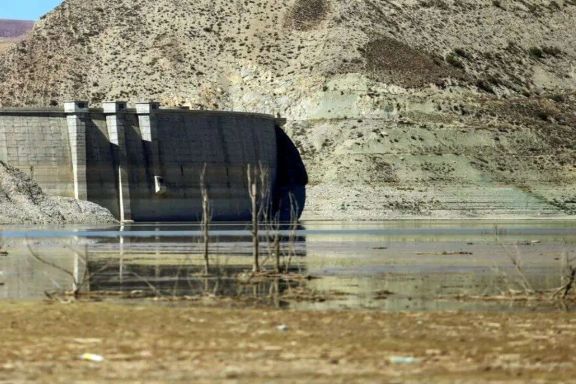
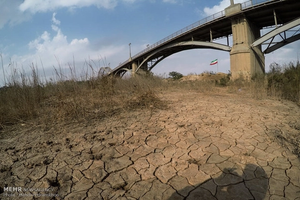
A view from Mamlou dam (undated)
Iran’s deepening water emergency is straining both cities and rural communities, with one of Tehran’s key reservoirs taken offline and the once-vast Lake Urmia reduced to a salt desert, forcing migration and sparking deadly disputes over dwindling supplies.
Authorities confirmed this week that the MamlouDam, one of five major reservoirs supplying the capital, has fallen below usable levels.
Only 8% of its 250 million cubic meter capacity remains, with storage at 19 million cubic meters -- below the “dead volume” threshold of 28 million.
The facility, built in 2007 east of Tehran, is officially out of operation for the first time, leaving the capital more reliant on other reservoirs already at historic lows.
The crisis extends far beyond Tehran. In northwestern Iran, Lake Urmia, once the Middle East’s largest saltwater lake, has lost more than 90% of its volume and surface area.
Environmental experts warned on Wednesday that “salt storms” from the dried lakebed are beginning to hit surrounding provinces, damaging crops, raising health risks, and prompting what officials describe as the early stages of forced relocations from nearby towns and villages.
People walk across the dried basin of Lake Urmia.
Lawmakers acknowledge that years of mismanaged agriculture, unchecked groundwater pumping and weak enforcement of water-use reforms have accelerated the decline.
“The lake is like a critical patient in intensive care,” said Reza Hajikarim, head of Iran’s Water Industry Federation, warning that existing plans were not implemented to save the lake. He urged rapid cuts in water-intensive farming and enforcement of ecological water rights, saying “we do not need new solutions, only execution of the old ones.”
“Salt storms from Lake Urmia have now begun, and evacuations are starting in provinces surrounding the lake. The salt storms and rising temperatures caused by the sun’s reflection are among the consequences of Urmia’s desiccation, undermining life and habitability in the region. This is only the beginning,” he added.
Social strains are mounting. In recent weeks, a violent clash over irrigation rights near Urmia left one dead and 13 injured, highlighting how scarcity is fueling local disputes.
Similar unrest erupted earlier this year in central Iran, where farmers damaged a pipeline transferring water from Isfahan to Yazd. Rights groups say protests over blackouts and dry taps in cities such as Sabzevar were also met with arrests and tear gas.
Experts stress the problems are largely man-made. Climatologist Nasser Karami has described the situation as an “engineered drought,” arguing that mismanagement, subsidies for water-intensive crops, and expansion of militarized agriculture -- not climate alone -- lie at the root.
Agriculture consumes over 85% of Iran’s water while contributing less than 12% of GDP, and exports such as pistachios and melons remain state priorities despite groundwater depletion.
Other ecosystems are also under threat. Officials warn that Anzali Wetland on the Caspian coast faces collapse without $300 million in restoration funds, after decades of sewage, sediment and pollution inflows.
Iran’s Meteorological Organization says the country has endured two decades of near-continuous drought, but specialists argue that structural reforms -- diverting water from agriculture to households, modernizing irrigation, reducing waste, and enforcing groundwater limits -- could stabilize supplies.
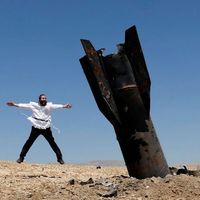
Airmen inspect a Massive Ordnance Penetrator bomb at Whiteman Air Base in Missouri in a photo released by the US Air Force.
Boeing is set to receive a contract worth up to $123 million to replace the 14 massive bunker-buster bombs expended during June’s US strikes on Iran’s nuclear facilities, Bloomberg reported on Tuesday,citing a Pentagon budget document and three people familiar with the matter.
The weapon, known as the GBU-57 Massive Ordnance Penetrator (MOP), weighs 30,000 pounds (13,600 kg), measures six meters (20 feet) in length, and is considered the world’s largest precision-guided conventional bomb. It can penetrate up to 200 feet underground before detonating, according to the US Air Force.
The Pentagon disclosed in an August budget document that it had reallocated $123 million from operations and maintenance accounts to Air Force munitions procurement, saying the funds were needed to replace munitions used in “Operation Midnight Hammer,” the code name for the strikes.
The document described the operation as being conducted “in support of Israel.”
During the June raid, US B-2 bombers deployed 12 of the MOPs against the Fordow nuclear enrichment facility, with President Donald Trump telling a gathering of military leaders outside Washington that the weapons achieved “total obliteration,” and that “every single one of them hit its target.”
On June 22, Trump ordered airstrikes on nuclear sites at Isfahan, Natanz, and Fordow two days before brokering a ceasefire to a 12-day war in June between Iran and Israel.
The bombs are manufactured with components from several facilities. The bomb bodies are forged at the McAlester Army Ammunition Plant in Oklahoma, where the Army has been expanding production capacity to triple monthly output.
Personnel there fill casings with explosives and assemble the warhead and fuse. Boeing supplies the tail kit, which provides navigation and guidance systems, and has integrated the bomb for use with the B-2 stealth bomber.
The Air Force has disclosed few details about the program but acknowledged in 2015 that it had contracted 20 units with Boeing.
The new replacement contract is separate from an agreement the service awarded in late August to Applied Research Associates Inc. and Boeing to design and prototype the next generation of the weapon.
Iran’s pharmaceutical sector is facing delays of four to six months in the allocation of foreign currency for importing raw materials, industry officials said, warning the hold-ups risk disrupting the drug supply chain.
Health Ministry officials have repeatedly pledged to secure strategic medicines, but suppliers say the central bank’s slow allocation of funds, coupled with sanctions-related banking hurdles, has left companies months behind in receiving payments, Tasnim reported on Wednesday.
From $3.5 billion in promised annual funds for pharmaceuticals and medical equipment, only about $3 billion is expected to materialize this year, according to the Food and Drug Administration.
“We may face shortages in coming months, and even need to seek antibiotics in winter,” said its drug chief, Akbar Abdollahi-Asl.
Industry representatives added that while Iran produces about 72% of its active pharmaceutical ingredients domestically, just $100 million in timely foreign currency allocations could cover most raw material needs. Importers urged urgent state support to prevent shortages, warning that patients could bear the brunt of the delays.
The United States on Wednesday accused Iran of gross human rights violations following the deaths of three women in prison, the deteriorating condition of an imprisoned activist on hunger strike, and the looming execution of a Kurdish political prisoner.
The State Department’s Persian-language account on X said three women -- Somayeh Rashidi, Jamileh Azizi and Soudabeh Asadi -- died in recent days at Qarchak prison near Tehran after being denied medical care, adding their deaths followed that of Farzaneh Bijanpour in January.
It cited a statement by 45 women prisoners who condemned “inhumane treatment” of fellow inmates.
Washington also highlighted the case of Hossein Ronaghi, a well-known dissident jailed for criticizing the authorities, who is on hunger strike in protest at what it called “horrific prison conditions.”
The US said his health had sharply worsened due to denial of medication for chronic illness and demanded his immediate release.
Separately, it condemned what it described as the arbitrary detention and torture of Kurdish activist Pakshan Azizi, arrested with relatives in August 2023 and sentenced to death after what it called a sham trial.
“We call on the regime to halt her execution, free her and all political prisoners, and end its campaign of terror against its own people,” the statement said, adding more than 1,000 executions in Iran so far in 2025.
An Iranian remake of Love Island has exploded online, sparking fierce debate about taboos, personal freedom and the responsibilities of new media.
Marketed as Eternal Love, the show gathers young contestants in a luxury villa, reshuffles their romantic ties and pits them in staged challenges—following a formula that has proved commercially irresistible from Britain to Netflix.
But in Iran’s fraught cultural landscape, its rise is about more than entertainment: it reflects social shifts, strained relationships and the clash between audience demand and media censorship.
Global lessons
Reality shows worldwide have long faced serious criticism.
In the 2025 season of Love Island alone, Ofcom—the UK’s media regulator—received over 14,000 complaints.
Social pressure led to protective protocols: restricting contestants’ social-media use during broadcast, offering psychological support before and after filming and mandating training for television appearances.
In the US, lawsuits against Love Is Blind producers raised the question of whether contestants were mere “entertainment tools” or employees entitled to rights. The outcome was costly settlements and the entry of labor organizations into the fray.
The message is clear: reality TV is never “just entertainment”—mental health, labor rights and human dignity are at stake.
Added sensitivities
Eternal Love reproduces the same criticisms: commodifying emotions, privileging appearance over character, crafting heroes and villains and fueling collective judgment.
The main difference lies in its platform.
YouTube, unlike television, lacks a regulatory body and binding standards. That absence can intensify psychological and social pressure on participants—especially when their intimate relationships are laid bare to millions of viewers, including teenagers.
Supporters counter that a weary, anxious Iranian society deserves entertainment. They argue taboos must be broken and media should serve as a “mirror” to new realities of relationships.
There is some truth to this. Yet global experience shows that a mirror that sells also carries responsibility—for participants’ well-being and for the younger audiences exposed to such content.
Need for standards
This responsibility raises urgent questions for the makers of Eternal Love: is there a public care protocol, do contestants have access to counseling, are contracts fair and allow withdrawal without penalty, and has an age rating been defined?
Most of all, where is the line between reality and scripted drama, and don’t audiences have the right to know?
Eternal Love embodies two realities at once: society’s right to entertainment and taboo-breaking, and the dangers of crossing into unregulated territory.
If this genre is to persist in Persian-language media—and it likely will—clear standards are essential: transparent care protocols, contractual protections for participants, anti-harassment policies, social-media management during broadcast, age guidance and stronger media literacy.
Global precedents exist. It only takes the will to adopt and enforce them.
The Islamic Republic’s police beating a protester in Iran
A new investigation has revealed how Iranian security forces relied on global supply chains and intermediary companies to obtain weapons later turned on protesters during the 2022 Woman, Life, Freedom uprising.
The joint report by the Iran Human Rights Documentation Center and independent news outlet IranWire describes how Turkish, European and North American firms, often through shadowy networks and front companies, supplied or enabled the transfer of shotguns, ammunition and paintball guns used to quell street unrest.
“Shooting protesters in the eyes is a deliberate form of torture meant to instill fear. Hundreds of cases involving teenagers and adults reveal a state-sanctioned pattern, with weapons supplied and repurposed through state-linked channels," it said.
"Targeting eyes and faces reflects a calculated effort to incapacitate protesters and create cautionary examples. These acts violate ICCPR Article 7, constitute crimes against humanity under the Rome Statute and breach domestic firearms laws."
The report argues that while the Iranian government has long imported arms despite sanctions, the 2022 protests marked a shift.
Security forces deliberately deployed so-called less-lethal weapons not as a means of crowd control but as tools of intimidation and punishment. Shotguns, pellet rounds, paintball guns and tear gas canisters were routinely fired at eyes, leaving many protesters permanently blinded or disfigured.
Doctors in Tehran and Kurdistan reported hundreds of eye injuries, suggesting the practice was widespread and state sanctioned.
Investigators documented 134 victims across 24 provinces, with an average age of 29. At least 114 were struck by pellets, nine by paintball rounds, and nine by direct hits from tear gas canisters.
The report said that these numbers represent only a fraction of the total, with many victims avoiding hospitals for fear of arrest.
'Complicity'
The companies named include Turkish shotgun makers Hatsan, Akkar and Sarsilmaz, whose Escort, Karatay and SAR-branded models were traced inside Iran.
European firm Cheddite was linked to ammunition identified by headstamps recovered from protest scenes. Paintball markers produced by Tippmann in the United States and DYE Precision in Canada were also diverted into the hands of police and Basij forces.
These products reached Iran through Turkish intermediaries such as Yavascalar YAF, as well as front companies tied to the FARAJA Cooperative Foundation and the Defense Industries Organization.
Some procurement was disguised under the cover of sports, with the Iran Paintball Association and other federations providing channels to skirt restrictions.
The report warns that such transfers may constitute corporate complicity in human rights abuses under international law. It highlights potential breaches of export control rules and exposure to secondary sanctions, particularly where companies made sales despite Iran’s documented record of violent crackdowns.
The authors call for urgent action, including classifying shotguns and paintball markers as dual-use products subject to strict end-user verification, closer scrutiny of financial intermediaries including crypto platforms and new pathways for victims to seek justice.
They argue that without accountability, foreign firms and evasive intermediaries will continue to arm Iran’s security forces with tools of repression.