• العربية
  • فارسی
Brand
  • Iran Insight
  • Politics
  • Economy
  • Analysis
  • Special Report
  • Opinion
  • Podcast
  • Iran Insight
  • Politics
  • Economy
  • Analysis
  • Special Report
  • Opinion
  • Podcast
  • Theme
  • Language
    • العربية
    • فارسی
  • Iran Insight
  • Politics
  • Economy
  • Analysis
  • Special Report
  • Opinion
  • Podcast
All rights reserved for Volant Media UK Limited
volant media logo

How an Iranian dissident's kindness to a US prisoner earned him a new life

Ardavan Roozbeh
Ardavan Roozbeh

Iran International

Jul 26, 2025, 20:35 GMT+1Updated: 05:56 GMT+0
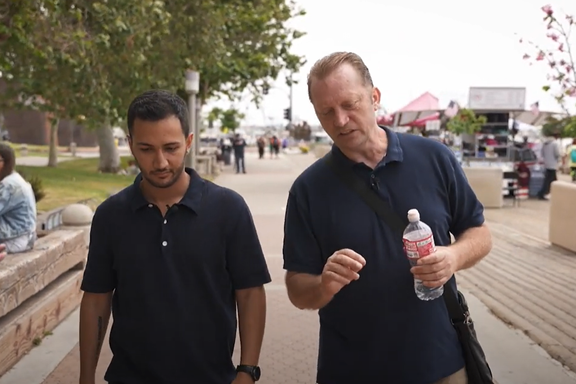
Michael White (right) and Mehdi Vatankhah in San Diego

US Navy veteran Michael White's pursuit of love in Iran instead landed him in a Mashhad jail, where he looked destined to languish as a political bargaining chip.

But the kindness of an Iranian cellmate allowed him to contact his loved ones, and Mehdi Vatankhah's risking of his own life ultimately earned him a new one in the United States.

I traveled to San Diego to chronicle the unlikely bond forged between two unfairly imprisoned men born a world apart but now forever united by solidarity and friendship.

At the border crossing between the United States and Mexico, a man with a tired face but a warm smile greeted me. Michael White, a former hostage in Iran, broke the ice with Iranian-style jokes and a few Farsi words. One of the first things he said was, “The Iranian regime is not like its people. Iranians are amazing. I love their culture. They deserve a better life.”

That sentence marked the beginning of the documentary I wrote and produced—one that follows the intertwined lives of two men: Michael White, an American hostage freed from Iranian prisons, and Mehdi Vatankhah, a young Iranian political activist. It’s a journey from solitary confinement cells in Mashhad to the open skies above California.

Michael, a Los Angeles native and a US Navy veteran, traveled to Iran in 2018 to meet a woman named Samaneh Abbasi, whom he had met in online chat rooms. But what began as a romantic trip soon turned into a nightmare.

A photo on Michael White's Instagram page purportedly shows him and his Iranian girlfriend Samaneh
100%
A photo on Michael White's Instagram page purportedly shows him and his Iranian girlfriend Samaneh

On his third trip, he was arrested in Mashhad and sentenced to 10 years in prison on charges of “insulting the Supreme Leader” and “publishing private photos.”

He was taken to a secret detention facility run by the Ministry of Intelligence, where he endured harsh interrogations and torture aimed at forcing him to confess to espionage for the US and Israel. The pressure was so intense that he once attempted suicide.

After weeks in solitary confinement, he was transferred to Vakilabad Prison in Mashhad, where he shared a cell with Mehdi Vatankhah. Within those cold, gray prison walls began a bond that would alter both of their destinies.

Michael recalls that before his arrest, he had fallen deeply for Samaneh. He had first met her in Kish Island and was captivated by the kindness of the Iranian people and their culture. After returning to the US, his feelings only deepened. Determined to meet her family in Mashhad, he even converted to Islam in San Diego to remove any religious barriers.

But by the time of his third visit, Samaneh had told him she no longer wanted a relationship. Still, he hoped to meet her over lunch and propose formally. Instead, on his way to the meeting, three black vehicles intercepted him. His eyes were blindfolded, his head pushed down, and he was taken to an unknown location.

He was held in a surveillance-monitored room and only allowed out for interrogations—interrogations marked by shouting, threats, physical abuse, and sleep deprivation. His captors wanted him to confess which intelligence agency he worked for. At one point, the case prosecutor told him: “Six Iranian operatives are imprisoned in the U.S. You're the only American we can use for an exchange.”

Eventually, he was transferred to Vakilabad Prison, where he shared a cell with Vatankhah. Mehdi, a political prisoner with strong English skills, gradually gained Michael’s trust.

“The first time I saw him,” Mehdi recalls, “I could tell from the way he walked that he was seriously ill. He was wary of everyone. Later I learned that even his mother didn’t know where he was.”

100%

In 2020, Mehdi was temporarily released. Using the information Michael had given him, he contacted Michael’s family and the US State Department. Until that point, US officials didn’t even know Michael was being held in Iran. Thanks to those efforts, Michael was able to meet with representatives of the Swiss Embassy in Tehran, which protects the US interests in Iran.

During the COVID-19 pandemic, Michael became ill. Iranian authorities, fearing the political fallout of his potential death in custody, transferred him to a safe house in Tehran.

On June 4, 2020 (15 Khordad 1399), Michael was exchanged for Majid Taheri, an Iranian American physician who had been jailed in the US for violating sanctions. Notably, Taheri chose not to return to Iran after his release and remained in the United States.

Then-President Donald Trump tweeted, “I will never stop working to secure the release of Americans held hostage overseas.” He thanked both the Swiss government and Iran for facilitating the exchange, saying it proved “a deal is possible.”

But Iran’s history of hostage-taking goes far beyond Michael’s case. From Nizar Zakka and Jason Rezaian to Siamak Namazi—and today, the French couple Cécile Kohler and Jacques Paris, now in their third year of detention—the pattern remains: arrests used as political leverage. In reality, Iran has proven that negotiating with it is far from easy.

Michael’s mother released a statement after his freedom: “During the 683 days my son was held hostage by Iran’s security forces, I lived in a nightmare.”

Yet the story didn’t end there. In prison, Michael had promised Mehdi that if he were ever freed, he would help him achieve his dream of becoming a pilot. With Michael’s legal support, Mehdi was granted entry into the United States through a humanitarian parole program. Today, he lives and flies in San Diego.

On one of his first flights, I sat beside him in the tiny cockpit of his light aircraft. When I asked how he felt looking back, he simply said, “It all feels like a nightmare… a nightmare I’ll never forget.”

But the scars Michael carried from Iran went beyond prison and torture: “Betrayal, heartbreak, unanswered questions. “He still drifts into silence whenever he hears Samaneh’s name, staring off and murmuring, “I don’t know why it happened. I was just in love with her.”

When I asked if he believed Samaneh was an agent, he didn’t answer directly. He only said, “Samaneh was like many Iranians. Outside, she wore a hijab, but inside her home, she and her family were just like Americans—like so many Iranians.”

Michael still insists: “The Iranian people don’t deserve this regime. They’re good people who deserve freedom and a better life.”

Perhaps Michael’s story has ended. But what the Islamic Republic has been targeting for years goes far beyond one man or one nation. It is humanity itself: human connection, freedom of speech, the right to live. And not just for Iranians—for anyone who dares to step onto its soil.

Most Viewed

Ghalibaf defends Iran-US talks amid hardline backlash
1
INSIGHT

Ghalibaf defends Iran-US talks amid hardline backlash

2
INSIGHT

Iran diplomacy wobbles as factions compete to avoid looking soft on US

3
VOICES FROM IRAN

Bread shortages, soaring prices strain households in Iran, residents say

4
ANALYSIS

The politics of pink: how Iran uses cuteness to rebrand violence

5

Scam messages seek crypto for ships’ safe passage through Hormuz, firm warns

Banner
Banner

Spotlight

  • Tehran moderates see ‘no deal–no war’ limbo as worst outcome
    INSIGHT

    Tehran moderates see ‘no deal–no war’ limbo as worst outcome

  • The future has been switched off here
    TEHRAN INSIDER

    The future has been switched off here

  • Lights out, then gunfire: Witnesses recount Mashhad protest crackdown
    VOICES FROM IRAN

    Lights out, then gunfire: Witnesses recount Mashhad protest crackdown

  • Family told missing teen was alive, then received his body 60 days later
    EXCLUSIVE

    Family told missing teen was alive, then received his body 60 days later

  • Is Iran entering its Gorbachev moment?
    INSIGHT

    Is Iran entering its Gorbachev moment?

  • Iran crackdown reaches cemeteries as graves of slain protesters defaced
    EXCLUSIVE

    Iran crackdown reaches cemeteries as graves of slain protesters defaced

•
•
•

More Stories

Sacred fire still burns as many Zoroastrians quit Iran for America

Jul 26, 2025, 17:10 GMT+1
•
Niloufar Rostami

A small fire is lit at dawn and quenched at dusk at the Zoroastrian center in Orange County, California in imitation of sacred fires in worshippers' home temples of Yazd and Tehran which have burned uninterrupted for centuries.

In recent years, Iran’s Zoroastrian community has been leaving in greater numbers, with the United States becoming the primary destination.

The latest census in 2016 indicated nearly 20,000 Zoroastrians, despite legal restrictions, strive to keep the tradition of the “sacred fire” alive in their homeland.

The tradition faces new challenges in the United States. Maintaining an eternal flame is no easy task. A shortage of mobads or Zoroastrian clerics, combined with the high cost of building fire temples, has led many to settle for small, gas-lit flames.

“We only light the fire during hours when we’re present at the center. There’s no other choice. We adapt to time and place,” said mobad Ashkan Bastani, grandson of Iran’s last High Mobad, who has lived in Orange County for over 20 years.

Iran’s Zoroastrian community, a small minority, faces profound challenges after migration, not only the loss of homeland but also of roots and rituals.

Migration was not our choice

Following the 1979 revolution in Iran, the confiscation of Zoroastrian-owned property and businesses, along with the imposition of Islamic laws governing all aspects of public life, triggered a wave of migration.

“My grandfather would look over his shoulder every few steps in Yazd. He was afraid of shadows,” recalled one Zoroastrian. “At age ten, he accidentally stepped onto a Muslim neighbor’s farmland and was punished by having his feet tied to stocks.”

Later in his 40s, he was attacked from behind at a pistachio market because, according to some Muslims, the presence of a gabr (a pejorative term for Zoroastrians) would bring bad luck to the bazaar.

Since the Islamic Republic’s founding, officially declaring one’s religion became mandatory, not just in the census but for routine processes like banking, school enrollment, insurance and job applications.

The consequences of this requirement have gone far beyond statistics; a single answer could either open doors or close them entirely, curbing the ambitions of minorities.

Until the late 1990s, Zoroastrian migration was largely individual or family-based. Since then, with help from NGOs like the Hebrew Immigrant Aid Society (HIAS), migration became more organized.

By 2017, in the early days of President Donald Trump's first term, hundreds of Iranian Zoroastrians had emigrated to the United States

In 2024, amid fears which soon materialized of Trump again barring travel from Iran, various minorities in partnership with HIAS saw another wave of Zoroastrians managing to migrate to the United States.

Population decline, low birthrates

According to Iran’s 1996 census, the Zoroastrian population stood at nearly 28,000. By 2006, it had dropped to 19,823. The 2016 census recorded 23,109 Zoroastrians in Iran.

“Many Muslims interested in Zoroastrianism claim to be Zoroastrians during the national census,” said a former member of the Tehran Zoroastrian Association on condition of anonymity.

“Meanwhile, official Zoroastrian leaders avoid stating the real numbers out of fear of government backlash. They want to appear large perhaps as a show of strength but we know our true numbers are far fewer,” he said.

“Zoroastrian families in Iran are reluctant to have children, which is common with the rest of population in Iran due to economic hardship and destitute. But our migrants abroad aren’t facing such issues and are willing to grow their families,” he added.

The Didban news website cited Kourosh Niknam, a mobad and former lawmaker, as saying Iran's Zoroastrian population had halved over the past three decades amid migration and low birth rates.

Zoroastrians in the United States

There are no official numbers for the Zoroastrian population in the US. The World Zoroastrian Federation estimates the number between 10,000 and 15,000, while the North American Zoroastrian Association puts it closer to 20,000, including both Iranian Zoroastrians and Indian Parsis.

Parsis, or Parsees, are descendants of Zoroastrians who fled Iran after the Islamic conquest and found refuge in India.

The largest communities in the United States are in California particularly Los Angeles, Orange County, and San Diego with smaller populations in New York and Texas.

Wealthy Zoroastrians have helped establish community centers and temples in these cities, and Parsis have built a fully traditional fire temple in Houston, Texas.

Islands of solitude

Depending on location and population size, many Zoroastrians in the United States may feel isolated from religious and social life. Their faith may only be expressed through ceremonial Nowruz tables or private wedding and funeral rituals.

“Since I arrived here, I haven’t attended a single Zoroastrian ceremony. I don’t think there’s another Zoroastrian in this state. I miss our small gatherings in Iran,” said Anahita, a Zoroastrian living in Nebraska.

But mobad Ashkan Bastani in California strives to keep the faith alive.

“At the Orange County Zoroastrian Center, we hold religious education classes for children and celebrate all the festivals and traditions. Everyone is welcome, regardless of religion,” he said.

“At some of our well-known festivals like Mehregan and Sadeh, many Muslims also attend, enjoy our food, and dance with us,” Bastani added.

The shadows

While there have been improvements in how Zoroastrians are perceived in Iran, many still struggle to move past the fear and marginalization.

“Public attitudes have improved. Terms like ‘unclean’ and ‘fire-worshipper’ are rarely heard now,” said one community leader in Iran. “But we’re still stunned by remarks from some officials. We can’t tell if they truly believe what they say or are just asserting control. Some things have changed—but some haven’t.”

The Zoroastrian migration story is not just about relocation. It is a narrative of perseverance, of holding onto identity, tradition, and a sacred flame that has symbolized life and light for centuries, whether in Yazd, California, or the quiet solitude of Nebraska.

Israel was planning regime change in Iran when Trump declared truce – WaPo

Jul 26, 2025, 16:50 GMT+1

Israel was preparing a final wave of attacks aimed at toppling Iran’s ruling system when US President Donald Trump announced a ceasefire, The Washington Post reported, citing Israeli and American officials involved in the operation.

“When Trump declared a ceasefire, Israel was moving into a final phase of attacks intended to topple the regime,” said David Ignatius in an opinion piece published by The Washington Post on Friday evening.

The final phase, which Israeli planners believed could bring down the Islamic Republic, was halted when Trump intervened.

The ceasefire announced by Trump on June 23 ended a 12-day conflict between Israel and Iran that was capped off by US strikes on Iranian nuclear sites.

The United States had signaled it would join only if the campaign was going well, officials were quoted by the Post as saying.

At the height of the conflict, both Israeli Prime Minister Benjamin Netanyahu and Trump hinted at favoring Iranian regime change.

"It’s not politically correct to use the term, 'Regime Change,' but if the current Iranian Regime is unable to MAKE IRAN GREAT AGAIN, why wouldn’t there be a Regime change??? MIGA!!!" Trump said in a post on Truth Social in late June.

According to the Washington Post, Israel’s 12-day assault dealt such severe damage to Iran’s nuclear and military infrastructure that it set Tehran’s weapons program back by at least one to two years.

“Iran is no longer a threshold nuclear state,” one Israeli source told the paper. The official said the campaign eliminated nearly all of Iran’s first- and second-tier nuclear scientists and crippled both enrichment and weaponization capabilities.

Strikes on facilities at Natanz, Fordow, Isfahan and hidden uranium caches were paired with targeting of electromagnetic pulse and nuclear fusion research. The Israeli source said the intent was to dismantle not only Iran’s hardware but also the human and logistical backbone of its nuclear efforts.

The Post described the operation as combining aerial bombing, intelligence penetration and algorithm war.

After the first two days, Israel achieved total air superiority and destroyed around half of Iran’s ballistic missiles and 80 percent of its launchers, according to the report.

Israel's surprise campaign of airstrikes and drone attacks killed hundreds of Iranians including civilians, military personnel and nuclear scientists. Iran's retaliatory missile strikes killed 27 Israeli civilians.

Tehran installs loudspeakers in city squares for when internet access is cut

Jul 26, 2025, 10:43 GMT+1

Tehran has begun installing loudspeakers in major city squares to help inform the public during emergencies when authorities cut internet access, a city council member said on Saturday.

“With internet outages during crises, we must use loudspeakers for public alerts,” said Mehdi Babaei, a member of Tehran’s City Council. “A number of these loudspeakers have been installed in main squares and the work is still ongoing.”

Babaei said the system is designed to function both in normal and emergency conditions. “These systems will play the call to prayer during routine times,” he said. “In crises, we need to decide how to use them for public announcements.”

He said mobile networks could also be disrupted during wartime. “In the 12-day war, the communications ministry had to limit internet access at times,” he said. “We may even have to temporarily block mobile phones. So we need different ways to alert people.”

“These systems can play both sirens and voice messages,” he said. “It depends on what city managers or crisis teams decide during emergencies.”

During last month's 12-day war, the Iranian government imposed a widespread internet blackout across the country, cutting off mobile networks and home internet services for millions.

The shutdown left people unable to access information, contact family members, or carry out basic tasks such as banking and navigation.

Monitoring group NetBlocks said it was the most severe connectivity crisis since the November 2019 protests.

Exiled prince says 50,000 insiders back Iran regime change - Politico

Jul 26, 2025, 08:41 GMT+1

Reza Pahlavi, the exiled son of Iran’s last shah, told Politico that at least 50,000 government and military insiders have registered with his defection platform to help topple the Islamic Republic.

“There’s tens of thousands — the last estimate is over 50,000 at least, maybe more,” Politico quoted Pahlavi as saying in an interview published on Saturday, adding that his office is giving priority to those within key state institutions.

He said his team is working to verify identities and assess the credibility of registrants. A second site for civilian supporters is expected to go live in the coming weeks.

Pahlavi to convene opposition conference in Munich

The Convention of National Cooperation, scheduled for Saturday in Munich, is expected to bring together around 500 regime opponents from inside and outside the country. Pahlavi said it will be “perhaps the largest gathering ever” of anti-regime voices since the 1979 revolution, aiming to project unity among opposition groups and reach audiences inside Iran via smuggled internet services, such as Starlink.

He said all participants back three core principles: preserving Iran’s territorial integrity, defending individual freedoms and equality, and separating religion from the state.

Nine killed in armed attack on courthouse in southeast Iran

Jul 26, 2025, 07:06 GMT+1

Nine people, including three assailants, were killed and 20 others wounded in an armed attack on a courthouse in the southeastern Iranian city of Zahedan on Saturday, Iranian state media reported.

Fars News Agency, affiliated with the Islamic Revolutionary Guard Corps, said gunmen stormed the judiciary building in the restive Sistan and Baluchestan province and opened fire, first targeting court offices and then shooting at civilians outside.

Security personnel helped court staff and visitors leave the area as gunfire and an explosion were heard from inside the building, Fars said. The cause of the explosion has not been announced. Local speculation pointed to a possible suicide bomber, though this remains unverified.

According to the rights group Haalvsh, the attackers entered through Azadi Street and directly targeted the judges’ offices. Eyewitnesses said several judiciary employees and security forces were hit. The area remains under tight lockdown.

Jaish al-Adl, a Sunni armed group rooted in Iran’s Baluch minority, claimed responsibility for the attack. The group had recently threatened retaliation over the execution of Baluch prisoners in Iran.

The province has seen a sharp rise in executions this year. Iran Human Rights (IHR) NGO recorded at least 343 executions in the first four months of 2025, a 75-percent increase compared to the same period last year.

Baluch prisoners accounted for nearly one-third of all executions in April, including four men hanged on April 30. Rights groups have warned of the possible execution of 85 Baluch inmates in Zahedan Central Prison.

Jaish al-Adl, which has claimed a series of past attacks on military positions including those of the IRGC, is designated as a terrorist organization by both the Islamic Republic and the United States.

Sistan and Baluchestan has long been a center of unrest, frequently targeted by armed factions like Jaish al-Adl, known for ambushes, bombings, and raids that have killed both civilians and security personnel.