More than 40 years after the 1979 revolution and despite persistent tensions between Tehran and Washington, American cars remain a prized symbol of prestige and nostalgia in Iran.
Classic American cars, often spotted cruising the streets of Iranian cities, serve as moving relics of a bygone era. For many Iranians, these cars are more than just a means of transportation; they represent cultural heritage, status and a deep-rooted admiration for American engineering.
Even Ayatollah Khomeini, Iran’s first supreme leader - the man who led the 1979 revolution and coined the term Great Satan for the United States - was driven in an American car upon his return to Iran from exile.
The 1977 Chevy Blazer disappeared soon after that momentous day and was found and restored only in 2025.
Iran's revolutionary leader Ayatollah Khomeini upon his return from exile, Tehran, Iran, Feb. 1979
Other prominent figures of the Islamic Republic have also been spotted riding American cars. Gholamali Haddad Adel, a former parliament speaker and a close relative of current leader Ali Khamenei, was often seen behind the wheel of a Chevrolet Caprice Classic in the 1990s.
Saeed Jalili, former chief nuclear negotiator and a hardline contender in the 2024 presidential election known for his staunch anti-US rhetoric frequently drove an Oldsmobile during his tenure at the Foreign Ministry’s watchdog bureau.
While Iran’s domestic auto industry spearheaded by Iran Khodro since the late 1950s has made strides in assembling European and Korean vehicles, American cars remain synonymous with distinction and exclusivity.
In a country where foreign imports are tightly restricted, owning a US-made vehicle is a luxury—an emblem of prestige often reserved for the elite.
'Good old days'
The appeal of American cars predates the 1979 revolution.
Three years previously the Iranian government launched the "Cadillac Iran" assembly line, producing nearly 2,500 Cadillac Seville luxury sedans. This venture blended local manufacturing with American craftsmanship, solidifying the place of US vehicles in Iranian automotive culture.
Screenshot of an Instagram page showing a young Iranian posing next to a Buick
Popular Iranian car vlogger and enthusiast Alireza jokingly claims that being a true driver in Iran requires either a German luxury car or an American gas-guzzler.
“If you can’t afford a Mercedes, you can’t call yourself a driver unless you’re behind the wheel of an American V8,” he quips. He also shares a favorite saying among Iranian classic car lovers: “A man must drive a Chevy for work, a Buick for leisure and only a Cadillac for a rendezvous.”
The admiration for American cars, particularly those from the 1960s and 1970s, is rooted in their durability, reliability, and timeless design. While the revolution led to a strict ban on American imports, the restriction only intensified their appeal and elevated them to the status of coveted classics.
Much like Cuba where vintage car restoration has become a national pastime Iran has seen a growing demand for mechanics skilled in repairing and maintaining American cars.
A mechanic in southern Iran promoting his work on old cars on Instagram
29-year-old Tehran mechanic Farhad Keshavarz inherited his shop from his father, who specialized in these vehicles long before the revolution.
“These cars demand the highest level of care, and their owners can’t wait to show off their roaring engines,” says Farhad, who receives daily requests for full overhauls and engine restorations.
For over four decades, American V8s in Iran have transcended political divides, symbolizing status, power and a golden age of automotive excellence.
While many Americans now associate reliability with Japanese brands like Honda and Toyota, in Iran, "Made in America" still carries a mystique.
Here, an American car is not just a machine—it is a statement, a status symbol, and a cherished link to an era when luxury and power ruled the open road.
Iran's Supreme Leader Ali Khamenei leading a Tehran Firday prayers, January 18, 1980
Many middle-aged and older Iranians associate Friday prayers with the iconic image of a cleric delivering a sermon four decades ago while holding a 1970s G3 assault rifle—once a symbol of revolutionary power and defiance.
In the 1980s, following Ayatollah Khomeini’s Islamic revolution and during the Iran-Iraq war, Friday prayers drew large crowds and held significant public appeal. Over time, however, attendance declined as the lineup of Friday prayer imams changed, and growing dissatisfaction with the Islamic Republic’s social restrictions and worsening economic conditions further eroded their popularity.
Today, Friday prayers resemble weekly political briefings, often attended by local military and civilian officials. Policy directives are routinely sent from Tehran to guide the content of the sermons, turning them into orchestrated political messaging platforms.
Since assuming power, Supreme Leader Ali Khamenei has restructured the Friday prayer apparatus, moving its coordinating headquarters from the religious center of Qom to Tehran. He also systematically removed the imams appointed by his predecessor, Ruhollah Khomeini, replacing them with younger clerics more aligned with his vision.
Facts and figures According to an investigation by the Iran International website:
- There are currently 850 Friday prayer imams across Iran.
- Around 85% of them were appointed after 2017.
- Most cities have two Friday prayer imams.
- The seven-member Friday Prayer Headquarters under Khamenei’s control appoints imams even in small towns with populations as low as 500.
- About 70% of the imams appointed since 2017 have served with Iran’s military forces or were embedded with military units in Syria.
- Only one imam appointed by Khomeini remains in his position today.
Leading the Friday prayers is only one of the responsibilities of the Imams. They also lead the local councils in charge of imposing Islamic social and cultural control. They also supervise Islamic tax organizations, they are jury members at the Press Courts, they are member of the trustees of the Islamic Azad University, member of the Educational Council and local security councils among many other responsibilities. Some have their own bureaucratic empire.
Khamenei introduces changes
When Ali Khamenei became Supreme Leader, he replaced four of the seven members of the headquarters overseeing Friday prayer imams. Ten months later, he renamed the body the Policy-Making Headquarters for Friday Prayers. Significant changes followed the 2018 nationwide protests, when Khamenei appointed a younger cleric, Mohammad Haji Ali Akbari, as its head. Haji Ali Akbari also serves as one of Tehran’s Friday prayer imams.
Unlike most cities, Tehran does not have a permanent Friday prayer leader. In each of Iran’s 31 provinces, the Friday prayer imam also serves as Khamenei’s official representative.
Kazem Nour Mofidi, the Friday prayer imam of Golestan province, is currently the only one still in office from Khamenei’s earlier appointments. Historically, many provincial imams were members of the Assembly of Experts—the body responsible for selecting the Supreme Leader’s successor. Of those appointed after 2017, however, only six hold seats in the Assembly. Most of the older imams were replaced due to political misalignment with Khamenei’s views.
The province of Isfahan has the largest number of Friday prayers imams (86) while two provinces, Qom and Kordestan have 8 imams each.
The imams, who enjoy Khamenei’s backing, in many cases wield a lot of political power in their city, adjudicating differences among officials, overseeing local government decisions and in times of civil unrest rally government forces and supporters against protesters.
What is Friday Prayer?
Muslims face Mecca five times a day every day to say their prayers. Muslims may do their mid-day prayers in congregations of at least five individuals as "Friday prayers." The imams deliver two speeches called sermons before the prayers. Friday prayers are compulsory in Sunni populated areas which the Shiites may or may not turn up for the congregation.
Khomeini never led Friday prayers while Khamenei used to lead the prayers regularly in his early years as Supreme Leader. However, he has been only occasionally taking part in Friday prayers in recent years.
Pro-hijab vigilantes protesting outside the Iranian Parliament. March 2025
An unprecedented police crackdown on pro-hijab protesters in Iran suggests a shift in priorities, signaling that defiance of higher authorities even by supporters will no longer be tolerated.
On Friday evening, hundreds of male and female police officers raided a makeshift vigilante camp outside the Iranian parliament, dispersing around two dozen protesters—mostly women—who had been stationed there for over 45 days. They were protesting the delay in enforcing a controversial hijab law.
While no arrests were reported, religious vigilante groups claim that police used excessive force. They called on their supporters to rally outside the parliament on Saturday afternoon. A spokesman, Hossein Allahkaram, announced later that the rally would be postponed until after the Nowruz holidays.
In the past, security forces have even protected radical supporters during high-profile actions, such as the storming of the British embassy in 2011 and the Saudi embassy in 2016—both of which triggered major diplomatic crises.
A defiance of the Supreme Leader and his policy shift?
In mid-September, Iran's Supreme National Security Council (SNSC) suspended the implementation of the hijab legislation, which imposes harsh penalties—including heavy fines and prison sentences—on women who violate strict dress codes and businesses that fail to enforce them. The decision was reportedly driven by concerns over public backlash and the risk of triggering anti-government protests.
Since the decision could not have been made without the approval of Supreme Leader Ali Khamenei, who has avoided discussing the issue in his speeches for months, criticism of the delay could be viewed as defiance of what appears to be a strategic shift in Khamenei’s approach.
Vigilantes continue to refer to Khamenei’s April 2023 speech, in which he took a firm stance. Khamenei declared in the speech that disregarding hijab was “religiously and politically haram (forbidden).” In the same speech, he accused foreign intelligence agencies of encouraging Iranian women to defy the mandatory hijab. However, he has conspicuously avoided addressing the hijab issue in recent months, including during his December 17 address to an all-female audience.
Rather than blaming Khamenei, vigilantes hold Mohammad-Bagher Ghalibaf responsible for the delay in enforcing the legislation and argue that he should be accountable for Friday’s crackdown. Hours before the crackdown, they chanted against Ghalibaf during his speech at Friday prayers in Tehran.
The Friday crackdown could also be seen as a warning to ultra-hardliners that opposition to Khamenei’s potential policy shifts— possibly including allowing engagement in direct talks with the Trump administration—will not be tolerated.
“Consider the recent actions against [pro-] hijab protesters as marking a shift in Iran’s political landscape,” a former aide to ex-President Mahmoud Ahmadinejad, Abdolreza Davari, posted on X, suggesting that authorities are now seeking to mend their relationship with the hugely disillusioned middle classes.
Debate over freedom of assembly
The police action has sparked debate over the right to assembly in Iran. Some opposition figures have criticized the crackdown.
Ali-Asghar Shafeian, chief editor of the reformist Ensaf News, argued in a tweet that the police response was unnecessary and contradicted President Masoud Pezeshkian’s stance on freedom of expression.
Others, including prominent Islamic law expert Mohsen Borhani, pointed out that the vigilantes—who had no permit for their sit-in—have consistently rejected the right of other political groups to protest, despite Article 27 of the Iranian Constitution protecting peaceful assembly.
Mahmoud Nabavian, a senior Paydari member who played a key role in drafting the hijab law, recently argued that the preservation of the Islamic Republic must take precedence over enforcing the law, given the multiple domestic and international crises that it is facing—implicitly acknowledging the risk of unrest.
Heshmatollah Falahatpisheh, former head of the Iranian parliament’s Foreign Relations and National Security Committee.
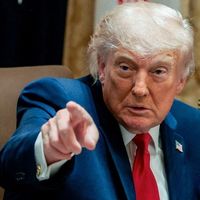
While Iran’s Foreign Minister Abbas Araghchi has repeatedly emphasized that Tehran is committed to holding indirect talks with Washington, a prominent politician in Tehran argues that President Donald Trump is unlikely to accept such negotiations.
Araghchi, widely seen as representing Supreme Leader Ali Khamenei’s position, has stated in multiple interviews and statements that Iran’s current strategy is to engage with the US through intermediaries.
However, Heshmatollah Falahatpisheh, former head of the Iranian parliament’s Foreign Relations and National Security Committee, told the conservative Nameh News website: “Trump will not accept negotiations through intermediaries.”
He also criticized President Massoud Pezeshkian for “lacking a clear foreign policy strategy,” arguing that while Trump appears to have a plan for every possible scenario, Iran’s president has yet to outline a vision for Tehran’s future relations with Washington.
Since Pezeshkian is widely known to have limited authority over foreign policy, the criticism may have been aimed at Khamenei, though the politician would not have dared to address him directly.
“Currently, Trump's plan is to force Iran to the negotiating table through maximum pressure,” Falahatpisheh said, adding that “diplomacy will have a chance if Trump moderates his stance.” He also made it clear that Trump seeks direct talks with Iran.
Falahatpisheh further noted that apart from some Persian Gulf states, most international players are focused on their own interests rather than easing tensions between Iran and the US. He pointed to the recent trilateral meeting between Iran, China, and Russia in Beijing, saying that both China and Russia were primarily advancing their own agendas rather than working to resolve Iran’s standoff with Washington.
Earlier this week, Khamenei's senior adviser Ali Larijani, as well as prominent economists in Tehran said that Iran needs to address its problems with the United States urgently in a bid to lift or reduce US sanctions and give the ailing economy a chance to grow after many years of crises and stagnation.
Iranian economist Mehdi Pazouki, an academic in Tehran told the press that Iran's economy is hostage to the country's failing foreign policy and Iran's inability to have amicable relations with the world.
Ali Ghanbari, another Iranian economist, told Iranian media that the country’s economy is under strain due to its foreign policy, which is not controlled by the Pezeshkian administration. Without explicitly stating that Khamenei, rather than Pezeshkian, oversees Iran’s foreign policy—particularly Tehran’s relations with Washington—Ghanbari described it as “a structural problem beyond the control of Pezeshkian’s government.”
Given this reality, Falahatpisheh outlined two possible scenarios for the future of Iran-US dynamics: “Either a war breaks out between Iran and Israel, with the United States carrying out precision strikes on targets in Iran—an escalation that would not stop there but spread across the region—or there will be no war, but additional countries will join the United States in its maximum pressure campaign against Iran.”
He noted that even China and Russia will cautiously support the United States in this case if Washington guarantees their interests.
Falahatpisheh noted that “Iran has not identified its opportunities in this situation or considered the consequences of what might unfold.” He blamed Pezeshkian’s passivity and inaction for the current state of affairs, suggesting that the president should begin the new year with concrete operational plans. Meanwhile, Pezeshkian’s stated approach has been to push forward Khamenei’s impractical vision of domestic investment as a path to economic recovery—without explaining how it would be implemented.
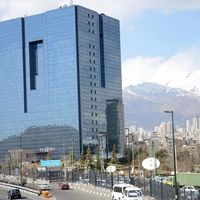
As inaction continues and unrealistic economic projections persist, the exchange rate for the US dollar in Tehran’s markets has surpassed one million rials. According to former Central Bank governor Mohammad Hossein Adeli, every Iranian household is effectively paying 180 million rials ($180) per month as a hidden cost of US sanctions. He warned that with each Iranian losing money to the sanctions’ impact on non-oil trade, the situation could become a serious security issue for the country before 2029.
Two Iranian fans holding a jersey in memory of Mahsa Amini at 2022 Qatar World Cup
The absence of the usual jubilation after Iran secured a spot in the 2026 FIFA World Cup earlier this week reflects deep societal and political divisions that extend far beyond the football pitch.
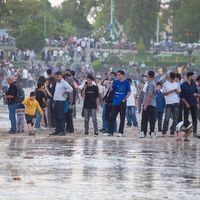
Iran's national football (soccer) team, Team Melli, secured a World Cup spot with a draw against Uzbekistan on Tuesday. In the past, such a victory would have brought millions to the streets in celebration, but this time, the public response was largely indifferent.
Media outlets in Tehran, such as Rouydad24, and numerous social media users noted this apathy. "The national football team qualified for the World Cup, but there was no enthusiasm in the public sphere or on social media. The event seemed so insignificant that people behaved as if they had no connection to the team," journalist Mohammad Parsi wrote on X.
In stark contrast, when Iran qualified for the 1998 World Cup by defeating Australia, millions celebrated in the streets nationwide. The euphoria of that moment, when people danced in public without fear of morality police intervention, remains a historic memory.
Football has long been Iran's most popular sport, but many Iranians say they no longer take pride in their national team. This shift is largely political, rooted in the 2022-2023 "Woman, Life, Freedom" protests, sparked by the death of 22-year-old Mahsa Amini in September 2022 while in morality police custody for allegedly violating hijab laws.
During the nationwide protests, Team Melli initially showed solidarity with the demonstrators. Some players, including forward Sardar Azmoun, openly condemned the brutal crackdown. Many others wore black armbands and refused to sing Islamic Republic's anthem before their World Cup match against England in November 2022, as a gesture of support.
However, under apparent pressure from security forces, the team’s public support for the protesters waned. This led to widespread disillusionment among fans, who began referring to the squad as the government’s or "mullahs' team."
The team's meeting with then-president Ebrahim Raisi before leaving for Qatar angered many supporters who did not expect the players to ignore the continued crackdown on protesters. Legendary striker Ali Daei and outspoken star Ali Karimi, charged in absentia for supporting the protests, said they rejected FIFA and Qatar’s invitation to watch the matches in Doha. The unpopularity of Team Melli reached a peak in February 2024 when thousands celebrated its defeat to Qatar in the Asian Cup tournament.
Inter Milan striker Mehdi Taremi, who scored both goals in Tuesday’s match, has also faced backlash. Taremi, known for his pro-government stance, was criticized for distancing himself from political issues and denying allegations that the team had been coerced into singing the national anthem.
The declining support has also been evident in dwindling stadium attendance—despite the match attended by President Masoud Pezeshkian falling during the New Year holidays, only one-third of Azadi Stadium’s 100,000 seats were occupied.
Ordinary Iranians are bearing unprecedented economic pain as their Islamic government's row with its hated enemies Israel and the United States ramps up and Tehran prioritizes military spending to shore up defense and its regional clout.
“It is a real tragedy,” said Mohamad Machine Chian, a senior researcher at the Center of Governance and Markets at Pittsburgh University on the Eye for Iran podcast. “Their quality of life has been steadily dropping for the past couple of years. But especially the past year, it has been a disaster.”
Chian told Eye for Iran that the Iranian government has continued to prioritize funding the Islamic Revolutionary Guard Corps (IRGC) and military ventures over investing in the wellbeing of its citizens.
Since President Masoud Pezeshkian took office, the Iranian currency has halved in value.
With unemployment surging above 70 percent, millions are struggling to afford basic necessities as crippling inflation and poverty grip the nation.
The sharp depreciation has driven inflation above 40 percent, with food prices soaring by as much as 100 percent in some cases. As the crisis deepens, the economic strain on ordinary Iranians is only expected to worsen in the coming months.
Machine Chian said President Pezeshkian missed numerous opportunities to address the deepening crisis and has failed to include a welfare plan in the budget to alleviate citizens' suffering.
“One such opportunity was that President Pezeshkian could have put together next year's budget in a way that convinced the Islamic Republic’s powers to at least, for a year, halt increases in military spending. That could have deescalated the situation,” said Machine Chian.
"This is during a crisis. He (Pezeshkian) should have prioritized the budget for basic necessities. But he prioritized the IRGC," said Machine Chian.
Iran implemented a 200 percent increase in military spending for the Persian year beginning this month and will aim to boost revenue through higher taxes despite a big deficit and a moribund currency besetting the economy.
It's bad...but just how bad?
The economic crisis is the worst Iran has experienced since the inception of the Islamic Republic, according to Mahdi Ghodsi, an economist at the Vienna Institute for International Economic Studies. Remarkably, Ghodsi says that the economy was better even during the eight-year war between Iran and Iraq.
“It's the worst situation, it's the worst condition, the direst condition that Iran has ever experienced,” said Ghodsi.
Ghodsi added that the reasons for this collapse are multifaceted, including Iran's militant stance in the region as a means of preserving the ruling system.
“It’s a dark comedy,” Ghodsi told Eye for Iran. “Leaders of Iran are mingling in a situation of lack of policy because their only objective is to survive. And to survive, they feel the need to initiate wars and increase tensions with other countries.”
Oil revenue: how much does it matter?
The looming uncertainty over a potential war with the United States or a new nuclear deal is also deepening the economic crisis.
Since President Trump took office, the rial has plummeted by 80,000. The administration has imposed new sanctions targeting Iran’s oil industry, including Chinese “teapot refineries” processing Iranian crude.
The Iranian state relies heavily on oil exports. However, at the current rate of oil exports, the revenue generated is insufficient to cover even basic pension funds, according to Machine Chian.
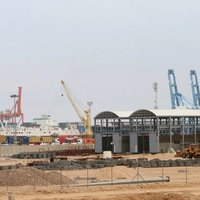
Iran's oil exports totaled $54 billion in 2024, up slightly from $53 billion in 2023, with volumes averaging 1.5 million barrels per day, according to the US Energy Information Administration.
However, President Trump signed an executive order vowing to reduce Iran’s oil exports to zero. Both Ghodsi and Machine Chian say that while the world markets can endure such a move, the impact on Iran’s economy would be crushing.
Iran currently attempts to stabilize the prices of basic goods and services by injecting US dollars into the economy. But if oil exports fall to zero, the state will lack sufficient foreign currency reserves, leading to further spikes in inflation and continued depreciation of the rial.
This also means Iran would no longer be able to subsidize the price of gasoline.
If the government can't subsidize gasoline prices, then there will likely be an increase in prices this summer, both economists warn.
Ghodsi and Machine Chian said that could lead to nationwide protests similar to the November 2019 protests, which erupted after a sudden increase in fuel prices and quickly spread as a broader expression to fight the establishment. Hundreds were killed and more than 7,000 were arrested.
But according to both economists, any meaningful change in Iran’s leadership through maximum pressure cannot happen without maximum support for the Iranian people.
With the shadow of war looming or a potential nuclear deal, the rial may continue to spiral. Rising inflation and economic hardship will likely fuel further public discontent, while tensions keep diplomatic and military risks high.