Iran media sound alarm over worsening economic crisis
Days after the 46th anniversary of the 1979 Islamic Revolution, media in Tehran are sounding the alarm over deep flaws in the governing system and a worsening economic crisis, warning that the Islamic Republic's survival is increasingly at risk.
A leading article in the Jomhouri Eslami newspaper, a conservative outlet owned by Supreme Leader Khamenei's office, noted last week that 46 years after its establishment, the Islamic Republic has yet to restore justice in Iranian society. "The people are still suffering from injustice and discrimination," the daily wrote.
The article also criticized the governing system for undermining the independence and freedom it has long promoted. Highlighting "the divide between the people and the ruling clerics," the newspaper stressed that "the people should be the driving force and focal point in the Islamic Republic" and posed a pointed question: "What is the people's role and status in the government?"
Although Iran holds regular elections, political parties and the media face severe restrictions, and only approved candidates are allowed to run.
Jomhouri Eslami also criticized the stark contrast between officials leading lavish lifestyles—driving luxury cars under tight security to pay respects at the mausoleum of the Islamic Republic's founder—and ordinary people who struggle to reach them to voice their concerns.
The daily criticized the disparity between officials and the public, noting that officials earn several times more than ordinary citizens and enjoy government-funded travel and luxury while advocating austerity. The daily warned that such a lifestyle and governance approach could undermine the political system's stability.
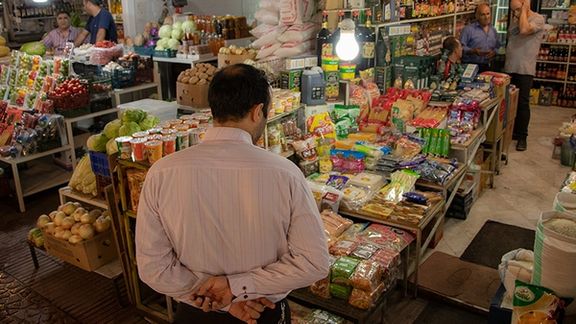
Meanwhile, the pro-reform website Fararu warned, "A catastrophe is on its way as half of the population in Iran is getting poorer on a day-to-day basis."
It cautioned that the situation is becoming increasingly dire, particularly for low-income groups, due to rising inflation, soaring exchange rates, price fluctuations, and ongoing economic crises. The website argued that many Iranians are struggling to make ends meet amid the financial turmoil.
"At the same time, all initiatives aimed at improving the situation have failed and remained futile. This has caused a general dissatisfaction among the public and has led to serious questions about the government's ability to tackle the current crisis," the website wrote.
Fararu cited market expert Hamid Haj Esmaili, who attributed the worsening economic situation over the past two decades not only to sanctions but also to government inefficiency in resource distribution, which has exacerbated the crisis.
Haj Esmaili noted that nearly half of Iran's population relies on government support to survive, while the government must take stronger action against corruption. He emphasized that these challenges are all linked, in some way, to the impact of sanctions and urged authorities to engage with other countries to address the crisis.
Meanwhile, the pro-reform daily Setareh Sobh published a commentary last week by former lawmaker Yadollah Eslami, who highlighted "the wide gap between the people and the government." He argued that "the officials' indifference to people's increasing problems has made many people distance themselves from the government."
Eslami also criticized officials "for the arrogance in their rhetoric when they address the nation," describing their tone as "a mixture of insult and violence." He warned that "unfortunately, some Iranian officials believe that insults and violence are a virtue for them; and in this situation, what is being sacrificed is truth, justice, and freedom."
An official adjusts flags during the G7 summit at the European Council building in Brussels June 5, 2014.
Iran rejected the latest G7 statement that criticized Tehran's ongoing nuclear activities and support of regional militant groups.
“The G7 members unequivocally condemned Iran’s destabilizing actions, including its rapid advancement of uranium enrichment without credible civil justification, its facilitation of terrorism organizations and armed groups across the Middle East and Red Sea, its proliferation of ballistic missiles and drones, and its transnational repression and violation of fundamental human rights,” read the statement issued on Saturday.
The G7 ministers held a meeting on the sideline of the Munich Security Conference.
Foreign Ministry Spokesman Esmail Baghaei on Monday and during his weekly briefing rejected the statement as politically motivated, arguing that Western powers themselves were responsible for fueling instability.
“The return of stability and security to West Asia requires these countries to stop their interventionist policies in regional affairs,” he said, referring to the United States, Canada, and three European members of the G7.
Iran pushes back on military, nuclear criticism
In response to criticism concerning the military capabilities of Iran, Baghaei said that Iran’s defense facilities follow all prevailing international laws.
“Iran’s military and defense advancements are necessary for national security and contribute to stability in West Asia,” he added.
Over the nuclear issue he dismissed concerns raised over enrichment of uranium as being politically driven.
“Our peaceful nuclear activities are fully in line with the Non-Proliferation Treaty and international safeguards,” he said, adding that Iran would continue its program based on its technical and industrial needs.
Baghaei accused the G7 of ignoring Israel’s nuclear capabilities. “The biggest obstacle to a nuclear-free Middle East is the Zionist regime, which has stockpiled weapons of mass destruction while enjoying full support from the same G7 countries,” he said.
Diplomatic outreach continues despite tensions
Despite Western pressure, Baghaei highlighted Iran’s ongoing diplomatic efforts, pointing to high-level meetings in Oman by Foreign Minister Abbas Araghchi. “These engagements are part of a broader strategy to enhance economic and political cooperation,” he noted.
On restrictions faced by Iranian flights to Beirut, he said discussions are underway with Lebanese officials. “We will not allow external forces to disrupt the strong historical ties between Iran and Lebanon,” he said.
Last week two flights from Tehran were banned from landing in Lebanon's only international airport.
On Friday, the second flight banned from taking off from Iran triggered protests in Lebanon from supporters of the Iran-backed group who blocked the road to the airport. The Lebanese army fired tear gas at protesters.
Responding to Israeli threats, Hezbollah funeral plans
Baghaei also addressed Israeli Prime Minister Benjamin Netanyahu's recent comments on a possible attack on Iran.
“Such statements are a blatant violation of international law, and those who issue these threats should be held accountable,” he said.
Israel's Prime Minister Benjamin Netanyahu expressed his intention on Sunday "to finish the job against Iran" with the support of US President Donald Trump.
Regarding Iran’s involvement in the funeral of the assassinated Hezbollah Secretary-General Hassan Nasrallah, killed by Israel last year, Baghaei said Tehran will be participating at a high level.
The emir of Qatar Tamim bin Hamad Al-Thani will visit Tehran in coming days, the Hezbollah-affilaited Al-Mayadeen News reported, a couple of weeks after Doha expressed preparedness to mediate talks between Iran and the United States.
Iran's former ambassador to Doha Hamid Dehghani on Sunday described the emir's visit as "very important".
"The visit of Sheikh Tamim bin Hamad Al Thani to Tehran at this stage, and his discussions with our country's officials regarding bilateral relations, regional and global developments, especially consultations on the issue of Palestine, are considered highly significant," Dehghani said in a post on his X account.
On February 5, the Qatari foreign ministry spokesman told Fox News the Arab country was prepared to serve as a mediator between Tehran and Washington in settling the crisis over Iran's disputed nuclear program, as it did in the past.
“It is through mediation and through the negotiations that we have done this in the past,” Majed Al-Ansari said. “And we had been even during the first Trump administration working with the administration over getting an arrangement with Iran."
“We are hopeful that we can be instrumental for the United States with this,” the diplomat added.
On Sunday, US National Security Advisor Mike Waltz said President Donald Trump is willing to engage in talks with Iran only on condition that Tehran fully abandon its nuclear program.
"The President has also expressed a willingness to take whatever action is necessary. All options are on the table," Waltz told Fox News on Sunday, leaving the option of diplomatic channels open.
Trump's state secretary Marco Rubio told CBS later in the day that the US administration does not "have any outreach from Iran."
"Ideally, yeah, I would love to wake up one day and hear the news that Iran has decided not to pursue a nuclear weapon, not to sponsor terrorism, and re-engage in the world as a normal government. We've had no indication of any of that, not just now, but for 30 years," he said.
Iranian activist and journalist Masih Alinejad warned that the Islamic Republic and its allied groups, including Hamas and Hezbollah, are spreading their ideology in Europe during a speech on Sunday at the Munich Security Conference.
"Here in Germany, they have 51 Islamic centers...You think Islamic centers here are trying to educate you about peace, security? No," she said.
"All the Islamic centers here are appointed by Ali Khamenei, the dictator from my country, they're trying to expand Islamic laws, Sharia laws to Germany," she added.
Alinejad said that Iran-backed networks in Europe are indoctrinating youth, warning that they are "brainwashing your children to say that they are Hamas, they are Hezbollah."
She expressed concern that radical ideologies are being spread online, citing TikTok videos where users glorify Osama Bin Laden and extremist groups like the Taliban and ISIS.
She also criticized European governments for suppressing voices that speak out against Islamist extremism, arguing that this enables the spread of radical ideologies.
In spite of her attendance, organizers of the conference confirmed to Iran International that the informal invitation to Iran's exiled Prince Reza Pahlavi had been withdrawn after discussions with the German government.
The German Foreign Ministry acknowledged communication with the MSC but said that decisions on invitations were made independently. A source familiar with the matter told Iran International that Berlin feared Pahlavi’s attendance might jeopardize German dual-national prisoners in Iran.
"At the Munich Security Conference, I warned that freedom of speech is under threat. Silencing voices in the name of political correctness or islamophobia won’t stop terrorism, it will only empower it," Alinejad wrote a in a post on X Sunday, addressing the retraction.
Alinejad also called attention to human rights abuses in Iran, mentioning women on death row and the mother of Pouya Bakhtiari, a protester killed by security forces during Iran's 2019 protests who recently attempted suicide in prison. "Stand on the right side of history," she urged.
Iran's exiled Crown Prince Reza Pahlavi speaking at a meeting in Munich on February 16, 2025.
Exiled Iranian prince Reza Pahlavi called for unity and democratic engagement among opposition forces during a meeting in Munich on Sunday.
“Our goal today is solely to save Iran, and in the future, our mission is to enable free elections,” Pahlavi said, emphasizing pluralism and the rejection of divisive behavior.
“Escalation, radicalization, and reactionary leadership will not help this movement—in fact, they could even contribute to its polarization.”
His remarks followed the cancellation of his planned speech at the Munich Security Conference, a decision confirmed by conference organizers after consultations with the German government.
The German Foreign Ministry said it had communicated with the MSC but maintained that the decision was made independently.
A source told Iran International that Berlin feared Pahlavi’s presence could jeopardize German dual-national prisoners held in Iran.
The cancellation sparked protests outside the conference venue on Saturday. Demonstrators chanted slogans in support of Pahlavi and condemned the MSC’s decision.
Addressing his supporters, Pahlavi called for calm. “We must disavow divisive elements. Profanity, threats, and any form of undemocratic behavior have no place in this struggle,” he said.
“Chanting the slogan King Reza Pahlavi contradicts the idea of having the right to choose the type of government in the future."
Nissan pickup trucks in Iran being loaded with gasoline for smuggling
Iran says it has dismantled 130 fuel smuggling depots and arrested 41 key suspects in Tehran province, the capital’s judiciary chief announced on Sunday.
Ali Alghasimehr said authorities have seized over 600,000 liters of smuggled fuel, describing the network as highly organized and large-scale.
He said intelligence and security services played a crucial role in the crackdown which targeted illegal fuel storage sites mainly in southern and western Tehran.
Last December, Iran's President Masoud Pezeshkian said that 20 to 30 million liters of fuel are smuggled out of the country daily, calling it a catastrophe amid the country's energy crisis.
Pezeshkian did not specify the destinations but fuel smuggling in Iran often involves routes to neighboring countries where fuel prices are significantly higher.
In December, Reuters reported that a sophisticated oil smuggling network generating at least $1 billion a year for Iran and its proxies has flourished in Iraq since Prime Minister Mohammed Shia al-Sudani took office in 2022.