Emir of Qatar to visit Tehran in coming days - Al-Mayadeen
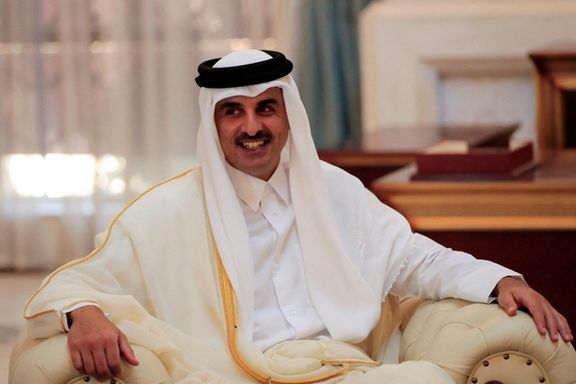
The emir of Qatar Tamim bin Hamad Al-Thani will visit Tehran in coming days, the Hezbollah-affilaited Al-Mayadeen News reported, a couple of weeks after Doha expressed preparedness to mediate talks between Iran and the United States.
Iran's former ambassador to Doha Hamid Dehghani on Sunday described the emir's visit as "very important".
"The visit of Sheikh Tamim bin Hamad Al Thani to Tehran at this stage, and his discussions with our country's officials regarding bilateral relations, regional and global developments, especially consultations on the issue of Palestine, are considered highly significant," Dehghani said in a post on his X account.
On February 5, the Qatari foreign ministry spokesman told Fox News the Arab country was prepared to serve as a mediator between Tehran and Washington in settling the crisis over Iran's disputed nuclear program, as it did in the past.
“It is through mediation and through the negotiations that we have done this in the past,” Majed Al-Ansari said. “And we had been even during the first Trump administration working with the administration over getting an arrangement with Iran."
“We are hopeful that we can be instrumental for the United States with this,” the diplomat added.
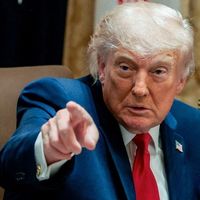
On Sunday, US National Security Advisor Mike Waltz said President Donald Trump is willing to engage in talks with Iran only on condition that Tehran fully abandon its nuclear program.
"The President has also expressed a willingness to take whatever action is necessary. All options are on the table," Waltz told Fox News on Sunday, leaving the option of diplomatic channels open.
Trump's state secretary Marco Rubio told CBS later in the day that the US administration does not "have any outreach from Iran."
"Ideally, yeah, I would love to wake up one day and hear the news that Iran has decided not to pursue a nuclear weapon, not to sponsor terrorism, and re-engage in the world as a normal government. We've had no indication of any of that, not just now, but for 30 years," he said.
Iranian activist and journalist Masih Alinejad warned that the Islamic Republic and its allied groups, including Hamas and Hezbollah, are spreading their ideology in Europe during a speech on Sunday at the Munich Security Conference.
"Here in Germany, they have 51 Islamic centers...You think Islamic centers here are trying to educate you about peace, security? No," she said.
"All the Islamic centers here are appointed by Ali Khamenei, the dictator from my country, they're trying to expand Islamic laws, Sharia laws to Germany," she added.
Alinejad said that Iran-backed networks in Europe are indoctrinating youth, warning that they are "brainwashing your children to say that they are Hamas, they are Hezbollah."
She expressed concern that radical ideologies are being spread online, citing TikTok videos where users glorify Osama Bin Laden and extremist groups like the Taliban and ISIS.
She also criticized European governments for suppressing voices that speak out against Islamist extremism, arguing that this enables the spread of radical ideologies.
In spite of her attendance, organizers of the conference confirmed to Iran International that the informal invitation to Iran's exiled Prince Reza Pahlavi had been withdrawn after discussions with the German government.
The German Foreign Ministry acknowledged communication with the MSC but said that decisions on invitations were made independently. A source familiar with the matter told Iran International that Berlin feared Pahlavi’s attendance might jeopardize German dual-national prisoners in Iran.
"At the Munich Security Conference, I warned that freedom of speech is under threat. Silencing voices in the name of political correctness or islamophobia won’t stop terrorism, it will only empower it," Alinejad wrote a in a post on X Sunday, addressing the retraction.
Alinejad also called attention to human rights abuses in Iran, mentioning women on death row and the mother of Pouya Bakhtiari, a protester killed by security forces during Iran's 2019 protests who recently attempted suicide in prison. "Stand on the right side of history," she urged.
Iran's exiled Crown Prince Reza Pahlavi speaking at a meeting in Munich on February 16, 2025.
Exiled Iranian prince Reza Pahlavi called for unity and democratic engagement among opposition forces during a meeting in Munich on Sunday.
“Our goal today is solely to save Iran, and in the future, our mission is to enable free elections,” Pahlavi said, emphasizing pluralism and the rejection of divisive behavior.
“Escalation, radicalization, and reactionary leadership will not help this movement—in fact, they could even contribute to its polarization.”
His remarks followed the cancellation of his planned speech at the Munich Security Conference, a decision confirmed by conference organizers after consultations with the German government.
The German Foreign Ministry said it had communicated with the MSC but maintained that the decision was made independently.
A source told Iran International that Berlin feared Pahlavi’s presence could jeopardize German dual-national prisoners held in Iran.
The cancellation sparked protests outside the conference venue on Saturday. Demonstrators chanted slogans in support of Pahlavi and condemned the MSC’s decision.
Addressing his supporters, Pahlavi called for calm. “We must disavow divisive elements. Profanity, threats, and any form of undemocratic behavior have no place in this struggle,” he said.
“Chanting the slogan King Reza Pahlavi contradicts the idea of having the right to choose the type of government in the future."
People walk near a poster depicting Syria's President Bashar al-Assad in Damascus, Syria May 19, 2023.
Hardline Iranian newspaper Farhikhtegan has criticized the country's foreign policy establishment for being left behind in Syria as regional rivals gain power in Tehran's former outpost.
The paper argued in an article on Sunday that Iran's "clichéd diplomacy" has left it weak as Turkey and Saudi Arabia gain ground.
"If our country doesn't take immediate action to disrupt Turkey's plan in Syria, Iran's name will be removed from the list of influential actors in Syria's developments, and Saudi Arabia will turn itself into another Turkey in this arena," the newspaper wrote.
The paper lambasted the Foreign Ministry's approach, describing it as disappointing and lacking any urgent action plan to secure Iran's national interests.
"In the midst of this heavy diplomatic battle...the approach that the Iranian diplomatic apparatus has taken seems disappointing," the article stated.
Farhikhtegan pointed to what it sees as a key miscalculation. "Iran is waiting to see how the new Syrian side will behave," the paper said, referring to an earlier statement from a government official.
The article further highlighted Turkey's proactive engagement with the new Syrian government, contrasting it with what it called Iran's passivity. It also highlighted the growing influence of Saudi Arabia and the UAE in the region, suggesting they are capitalizing on Iran's inaction.
The paper concluded with a stark warning: "It seems that the procrastination of Iranian diplomacy...is closing this window [of opportunity]."
It urged a strategic shift, including engagement with Saudi Arabia and the UAE, to counter Turkish influence and reclaim Iran's stake in Syria's future after years of building itself in the country alongside ousted President Bashar Al Assad.
On Saturday, a foreign ministry official said Tehran was in indirect talks with Syria’s new government. “We are monitoring the developments in Syria with deliberation and patience and will make our specific decision when the time is right,” Mohammadreza Raouf Sheibani, Iran’s special representative for West Asia, said in an interview.
He confirmed recent remarks of Syrian Foreign Minister Asaad Hassan al-Shibani about an exchange of positive messages between Tehran and Damascus following the overthrow of Assad’s government in December.
Iran and Russia, Assad’s main backers during the brutal conflict that began in 2011, played key roles in maintaining his grip on power until a rapid rebel offensive last December forced him into exile in Moscow. Since then, both countries have sought to maintain influence in Syria while navigating the new political landscape.
Iran, which invested heavily in Assad’s survival—reportedly spending at least $30-$50 billion—now faces the challenge of recalibrating its strategy. Supreme Leader Ali Khamenei has vowed on multiple occasions to reclaim Iran’s influence in Syria.
Nissan pickup trucks in Iran being loaded with gasoline for smuggling
Iran says it has dismantled 130 fuel smuggling depots and arrested 41 key suspects in Tehran province, the capital’s judiciary chief announced on Sunday.
Ali Alghasimehr said authorities have seized over 600,000 liters of smuggled fuel, describing the network as highly organized and large-scale.
He said intelligence and security services played a crucial role in the crackdown which targeted illegal fuel storage sites mainly in southern and western Tehran.
Last December, Iran's President Masoud Pezeshkian said that 20 to 30 million liters of fuel are smuggled out of the country daily, calling it a catastrophe amid the country's energy crisis.
Pezeshkian did not specify the destinations but fuel smuggling in Iran often involves routes to neighboring countries where fuel prices are significantly higher.
In December, Reuters reported that a sophisticated oil smuggling network generating at least $1 billion a year for Iran and its proxies has flourished in Iraq since Prime Minister Mohammed Shia al-Sudani took office in 2022.
US Secretary of State Marco Rubio and Israeli Prime Minister Benjamin Netanyahu make a joint statement to the media at the Prime Minister's office in Jerusalem on February 16, 2025.
US Secretary of State Marco Rubio said that Iran is the single greatest threat to the Middle East in a joint press conference with Israeli Prime Minister Benjamin Netanyahu in Jerusalem.
Rubio said: "Behind every terrorist group, behind every act of violence, behind every destabilizing activity, behind everything that threatens peace and stability for the millions of people that call this region home is Iran.
"And by Iran I mean the ayatollahs, by Iran I mean its regime, a regime who by the way, its people don’t support. The people of Iran are victims of that regime."
Netanyahu, who has long campaigned for harsher policies on Iran from global powers, warning of the threat the country's nuclear program poses to the region, welcomed the comments which echo his own years-long campaign against Tehran.
“Israel and America stand shoulder to shoulder in countering the threat of Iran," he said. "We agree that the ayatollahs must not be allowed to have nuclear weapons. We also agreed that Iran’s aggression in the region has to be rolled back.”
Addressing the Gaza war against Iran-backed militants, Hamas, Netanyahu said Israel had dealt a significant blow to Tehran over the past 16 months, adding that with the support of Trump, "I have no doubt we can and will finish the job".
He also said Israel had weakened the Iranian-backed Hezbollah movement in southern Lebanon and had hit hundreds of targets in Syria to prevent a new Iranian-backed front opening up against Israel.
"Now, if any other force believes that Israel will permit other hostile forces to use Syria as a base of operations against us, they are gravely mistaken," Netanyahu said.
US Secretary of State Marco Rubio meets with Israeli president Isaac Herzog at the president's residence in Jerusalem, Israel February 16, 2025.