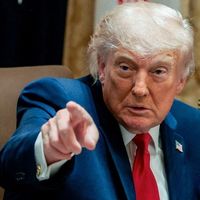
Iranian President Masoud Pezeshkian and US President Donald Trump
The Ham-Mihan newspaper in Tehran has cautioned President Masoud Pezeshkian that delaying a response to US President Donald Trump for direct talks would be more detrimental than making a poor decision.
Pezeshkian has downplayed the importance of the memorandum that Trump signed on Tuesday to intensify sanctions enforcement by reducing Tehran's oil exports to zero. However, Trump also expressed a wish to hold direct talks with his Iranian counterpart and preferably reach an agreement rather than activate maximum pressure measures.
The Iranian president argued that sanctioning a country which has many neighbors and friends would not be easy and expressed confidence that "Iran could overcome its difficulties with everyone’s help and the wisdom of the Leader of the Revolution.”
"They believe our economy depends entirely on oil and aim to block our exports, but there are many ways to counter their efforts," Pezeshkian said Wednesday. However, he has previously acknowledged on multiple occasions that Iran's economy would suffer significantly if sanctions remain in place.
On Thursday, he also reiterated that proving that Iran's nuclear program is peaceful would be an easy task.
“These statements will not solve any problems,” Ham-Mihan wrote in an editorial titled “Delayed Decision Worse Than Making a Bad Decision. ” The paper urged Pezeshkian to clearly announce Iran’s position by Friday, after securing the Supreme Leader’s agreement and approval.
“Otherwise, we will be paying the costs of a ‘delayed decision’ which would be higher than the cost of making a ‘bad decision’," the editorial stated, arguing that the future of Iran-US relations could only be evaluated once Iran announces a final and official decision.
Several other reformist media outlets on Thursday similarly stressed the importance of seizing the opportunity to avoid further economic strain and escalating tensions. The moderate-conservative news website Asr-e Iran also echoed the need for decisive action in an editorial titled “Mr. Pezeshkian, Call Trump.”
The piece argued that the best response to Trump’s overtures would be for Pezeshkian to initiate a direct phone call to discuss a potential deal, focusing solely on the nuclear issue. The editorial emphasized that Trump likely expects a prompt response.
Hardline media such as Kayhan and the Revolutionary Guards-linked Javan, however, have staunchly rejected any direct talks with the Trump administration as before.
Trump’s approach and US Policy
Trump has extended multiple overtures to Iran, including dismissing rumors of a joint US-Israel military strike as “greatly exaggerated.” He expressed his preference for a "Verified Nuclear Peace Agreement," which he claims would allow Iran to grow and prosper peacefully.
However, a White House fact sheet released Tuesday, after Trump signed a National Security Presidential Memorandum (NSPM) reinstating maximum pressure on Iran, outlined a stringent policy. The NSPM mandates that Iran must be denied nuclear weapons and intercontinental ballistic missiles, its terrorist networks neutralized, and its development of missiles and other weaponry curbed.
Trump has also said he does not care who takes the first step to begin negotiations despite other people’s advice to let Iranians be the ones who reach out to the US.
Criticism of vague messages
Ham-Mihan also criticized government officials for sending vague messages including the government spokeswoman, Fatemeh Mohajerani’s vague statement that Iran's position would be decided based on the principles of “dignity, wisdom, and expediency”.
Vice-President Mohammad-Reza Aref also said on Wednesday that engaging in talks with Trump is not currently on Iran's agenda although a meeting between “two human beings” is not impossible.
Experts’ opinions
Speaking to the reformist Shargh daily, Kourosh Ahmadi, a former Iranian diplomat to the UN, noted that Trump’s decision to sign a memorandum rather than issuing a new executive order reflects an effort to pressure Iran into negotiations. Ahmadi described this as a small window of opportunity for Iran to reach an agreement before the full effects of maximum pressure measures take hold.
Abolghasem Delphi, Iran’s former ambassador to Serbia, also urged the government to act swiftly. He advocated for practical steps to initiate talks with both Europe and the United States. Delphi observed that while Trump’s current focus is on the nuclear issue, he may adopt a similar framework to address other contentious topics in the future.
Ali Khamenei is saluted by air force personnel on Friday, February 7, 2025
Iran's Supreme Leader Ali Khamenei firmly rejected the idea of negotiations with the United States on Friday, appearing to pour cold water on optimism by US President Donald Trump and his own government for a nuclear deal.
Trump on Tuesday reinstated the so-called maximum pressure policy on Iran from his first term but said he preferred a deal. Relative moderate President Masoud Pezeshkian has publicly expressed openness to US talks.
“Negotiating with such a government should not be done; it is neither wise, intelligent nor honorable,” the the 85-year-old veteran theocrat who has the ultimate say over Iranian policy told a group of air force personnel in Tehran.
Khamenei accused Washington of perfidy over the last international nuclear deal in 2015, from which Trump withdrew the United States in 2018.
The comments were his strongest since Trump returned to office and come after the hawkish US president appeared to offer Tehran an olive branch this week, saying, "I really want to see peace ... (but) they cannot have a nuclear weapon".
"It's very simple. I'm not putting restrictions. They cannot have one thing," Trump said.
Iranian officials including Pezeshkian quickly said proving the peaceful aims of Iran's nuclear program to Trump could be easily done. US ally and Iran's arch-foe Israel says Tehran is aiming for a bomb, which it views as an existential threat.
Trump this week shocked the region by mooting the takeover of Gaza by US troops and its redevelopment into the "Riviera of the Middle East" - an idea Khamenei pilloried.
“The Americans sit and redraw the world map on paper—but it’s only on paper, with no basis in reality. They make statements about us, express opinions and issue threats."
"If they threaten us, we will threaten them. If they act on those threats, we will do the same. If they undermine our nation's security, we will undoubtedly respond in kind,” he added.
Trump's harsh sanctions directive was followed by a statement from President Trump on his social media platform Truth Social saying any reports of a devastating US-Israeli attack on Iran were "greatly exaggerated".
This sparked debate within Iran's political establishment and prompted some to urge President Masoud Pezeshkian to engage in talks to avoid further economic sanctions.
Khamenei's latest statement comes in direct contrast to those calls, offering a vague warning of retaliation against the US without clarifying whether he was referring to military action or other forms of pressure.
Iran's leader also rejected the notion that talks could ease Iran's economic hardships.
“Negotiations with the United States have no impact on solving the country's problems. We must understand this correctly and not be misled into thinking that sitting at the negotiation table with that government will resolve certain issues. No, negotiations with the United States will not solve any problems,” Khamenei said.
Iran’s economy has deteriorated significantly since 2018, when Trump imposed new oil export and banking sanctions, a decline compounded by decades of mismanagement, corruption, and prioritizing funding for terrorism over domestic welfare.
The national currency has lost 95% of its value, plummeting 22-fold, while inflation has remained around 40% for the past five years. Some official estimates indicate that more than a third of the population now lives below the poverty line.
A former official and a public intellectual in Tehran called on Iran's government to seize the opportunity for negotiations with the United States following US President Donald Trump’s offer to speak with his Iranian counterpart.
Hamid Aboutalebi, a political adviser to Iran’s former President Hassan Rouhani urged President Masoud Pezeshkian and Foreign Minister Abbas Araghchi to seize the opportunity for comprehensive negotiations with the Trump administration.
Amid the usual rhetoric and slogans repeated by various Iranian politicians following Trump's remarks, Aboutalebi’s comments stood out as more novel and pragmatic.
Referring to Trump's mooted openness to talks with his political counterpart, Aboutalebi suggested in a post on X that the Iranian president should call Trump to ease tensions between Tehran and Washington.
Trump offered to speak his Iranian counterpart after issuing a memorandum this week ramping up sanctions under a “maximum pressure” policy against Tehran.
Iran's president on Wednesday played down the memorandum aimed at reducing Tehran's oil exports to zero but offered no reaction after Trump said he was willing to speak with his Iranian counterpart.
Aboutalebi warned Araghchi that potentially renewed United Nations sanctions could devastate an already struggling economy and accused the foreign minister of sapping the government's will for talks with intransigent statements.
"Despite claims to the contrary, Pezeshkian's lack of urgency suggests he has sidelined foreign policy and the issue of lifting sanctions," he wrote.
"At the same time, your opposition to negotiations, your warnings to officials who support diplomacy, and your dismissive attitude toward President Trump have only contributed to Pezeshkian's indifference."
Araghchi’s recent public comments have been interpreted by some media outlets in Tehran as unhelpful and dismissive toward opening talks with President Trump.
Former Iranian presidential advisor, Hamid Aboutalebi
Aboutalebi was appointed as Iran's ambassador to the UN delegation in New York in 2013, but the United States denied him a visa, citing his alleged involvement in the 1979 takeover of the US Embassy in Tehran.
Despite his alleged role in the embassy seizure, Aboutalebi later emerged as a moderate politician by the theocracy's standards and served as the political deputy to Rouhani's chief of staff.
Aboutalebi praised the approach taken by Mexican and Canadian officials in responding to Trump's executive order on tariffs, noting that "while Trump took a hardline approach by issuing executive orders against America's allies in Canada and Mexico, he opted for a much softer measure with Iran by issuing an executive memorandum."
He suggested Iran could adopt a similar strategy to ease tensions with the United States, which may worsen once the US government steps up sanctions.
Sadegh Zibakalam, a public intellectual and vocal critic of Tehran hardliners, published an essay asking what Iran has gained with 46 years of confrontation with the United States.
Tehran analyst and commentator Sadegh Zibakalam
“No one is suggesting, nor does anyone even consider, that we should become subservient to the United States, blindly accepting whatever they dictate and becoming dependent on them," Zibakalam argued.
"This is a completely incorrect interpretation. Rather, the goal is to ease tensions and conflicts and move toward an environment of engagement.”
Still, government officials appeared in no rush to bless the idea of talks.
Vice President Mohammad Aref said Wednesday, "Talks between Pezeshkian and Trump are not on the agenda of the Islamic Republic."
Meanwhile, government spokesperson Fatemeh Mohajerani offered little more than a reiteration of the Islamic Republic’s foreign policy principles: dignity, wisdom, and prudence—whatever those may entail.
Rouzbeh Parsi, head of the Middle East and North Africa program at the Swedish Institute of International Affairs, in an undated photo.
Sweden has launched an inquiry into allegations that Rouzbeh Parsi, an Iranian-Swedish Middle East scholar at a prominent thinktank, was involved in a Tehran-led influence network aimed at shaping Western policy.
Foreign minister Maria Malmer Stenergard said on Thursday that the government has contacted the Swedish Institute of International Affairs for more information, calling the allegations “very serious.”
She warned that Iran, along with Russia and China, is conducting extensive intelligence operations in Sweden.
Parsi has denied collaborating with Tehran.
Swedish TV channel, TV4 Nyheterna, reported on January 29 that Parsi communicated with authorities in Tehran who actively sought to amplify official Iranian foreign policy talking points in Western policy circles.
The discussions, TV4 reported, aimed to shape Western perceptions of Iran during critical nuclear negotiations.
TV4 said Parsi had held meetings with Iranian diplomats, including former Foreign Minister Javad Zarif, and worked alongside senior figures who were closely affiliated with the IRGC.
In 2023, a joint investigative report by Iran International and Semafor combed through thousands of emails from Iranian diplomats, revealing a network of academics and think tank analysts cultivated by Iran's foreign ministry to extend Tehran's soft power.
Members of the grouping, called the Iran Experts Initiative (IEI), were guided by Iran's Foreign Ministry in their public writing and media appearances. They were key voices in Western thinktanks and policy institutions helping promote Iran's stances.
Parsi, listed in the leaked emails as an IEI member, attended its inaugural meeting in May 2014 at Vienna’s Palais Coburg hotel, coinciding with international nuclear talks. Documents indicate that Iran’s foreign ministry covered the event’s costs.
While Parsi acknowledges his participation, he denies collaborating with Tehran.
“My purpose was to observe how Iranian officials reason and act in real-time,” he told TV4.
The Swedish Institute of International Affairs defended Parsi, saying it has “full confidence” in his work.
Iranian Exiled Crown Prince Reza Pahlavi, speaking on January 28 at a National Press Club Newsmakers event on the need for freedom, democracy and human rights for the Iranian people.
Iran’s exiled Prince Reza Pahlavi accused Germany of barring him from the upcoming Munich Security Conference, calling the decision an effort to silence the Iranian people and appease the Islamic Republic.
“I was pleased to be invited to take part in this year’s @MunSecConf. However, my participation in this conference has been blocked by @GermanyDiplo [German Foreign Office]," Pahlavi wrote in an X post.
A German foreign ministry spokesperson offered an implicit denial that government had any role in banning Prince Pahlavi's participation. The spokesperson told Iran International that 'The Munich Security Conference decides independently on its invitations," without offering any further details.
Prince Pahlavi also wrote, “This decision was not about silencing me. This was about silencing the Iranian people. It was about silencing all those who stand for freedom, justice, and dignity. And that we will not stand for."
The conference, which is scheduled to begin later this month, has previously welcomed speakers that have criticized the Iranian government. Last year, it also banned Iranian government officials from attending.
From his X post, Pahlavi has, however, suggested the German government has been influenced by Tehran in its decision.
“So while the German government caves to the Islamic Republic, I urge the German people to stand with Iranians fighting for human rights and democracy— not only for Iranians’ sake, but for their own,” he wrote.
Pahlavi, the heir of Iran’s last monarch, has been calling on Western nations to sever links with the Islamic Republic and provide support for Iran’s protest movement.
He vowed to travel to Munich despite the exclusion, saying that Iran’s liberation “will never be determined by foreign governments.”
Germany’s Foreign Office has not publicly commented on Pahlavi’s exclusion.
Social media posts and readers’ comments on reports published by some media outlets reveal divergent views about the possibility of a meeting between the US and Iranian presidents.
President Donald Trump on Wednesday expressed hope for a nuclear agreement with Iran, stating his willingness to engage in talks with his Iranian counterpart. He added that he did not care who initiated the contact.
Some social media users noted that while Masoud Pezeshkian may be Iran’s president, unlike Trump, he is not the country’s highest authority. They emphasized that Pezeshkian would need approval from Supreme Leader Ali Khamenei for all significant decisions, including matters of foreign policy.
“Trump has absolute authority in the US for everything. Does Pezeshkian also have absolute authority?” one commenter questioned, pointing out that Pezeshkian lacks the power to fulfill even smaller promises, such as removing social media platform filters.
“Hold an urgent meeting with political, economic, cultural, and diplomatic experts, go to the Leader after summarizing [the situation], and invite Trump to Iran after his approval! Trump is ready for a deal,” Amin Asgari, a political economy researcher, told Pezeshkian in an X post.
Like many others, former Deputy to President Hassan Rouhani, Hamid Aboutalebi, advocated for diplomacy over hostility in a detailed post addressed to Pezeshkian. He urged Pezeshkian to call Trump and signal Iran’s readiness for talks, citing the need to reach a preliminary agreement to “prevent further tensions, mitigate risks, and avoid the potential activation of the snapback mechanism or escalation into conflict and war.”
Economic concerns
Many Iranians expressed economic concerns in response to media reports and social media discussions on the possibility of resuming maximum pressure sanctions.
Refusal to engage in talks with Trump, they argued, could lead to severe economic consequences as evidenced by the fast response of the foreign exchange market to the announcement and the depreciation of the rial.
“Forget about [the possibility of] negotiations. What will happen is maximum pressure and a halt in Iran's oil sales. This means more wretchedness and misery for us all,” lamented one user on X.
Another anonymous reader urged comprehensive talks, writing, “Think of the lifting of sanctions instead of squandering opportunities and spouting empty slogans.” This comment, posted on the conservative Tabnak news website under the headline “Trump’s Return to Maximum Pressure against Iran: Re-Taking an Unviable Path” received 125 upvotes and only nine downvotes.
Other comments on the same article echoed similar sentiments, predicting difficult times for Iran if hostilities with the US persist. However, not everyone agreed. One reader argued, “The Revolutionary Guards must give the Americans a new lesson,” though 297 users opposed the comment, while only 36 supported it.
Opposition to talks
Radical elements opposed to negotiations with the US reiterated in their posts that no Iranian official should meet with Trump. They cited his role in the assassination of Quds Force Commander Qasem Soleimani in January 2021. “We demand retribution for General Soleimani’s killers,” one user wrote on X.
Ehsan, an ultra-hardliner social media activist with over 3,700 followers, criticized reformist media outlets for selectively highlighting Trump’s remarks. “Trump’s threats to destroy Iran, impose maximum pressure, and prevent oil sales have been ignored by reformists, who instead focus on his willingness to meet Pezeshkian,” he wrote.
Interestingly, even some hardliner outlets, including Hamshahri, ran headlines such as “Trump: I’m Ready to Talk to Pezeshkian.”