Netanyahu’s office denies report he seeks Trump’s backing for Iran strike
Israel has denied a Channel 12 report claiming the Prime Minister is seeking US President Donald Trump’s support for a military strike on Iran’s nuclear sites and normalization with Saudi Arabia before advancing the second phase of the Gaza ceasefire.
Netanyahu’s office dismissed the claims as “a total lie that harms the families of the hostages,” Times of Israel reported.
The report alleged that Netanyahu’s plan included delaying negotiations with Hamas for several months while Trump approves an attack on Iran and seals a deal with Saudi Arabia, like those done with countries such as the United Arab Emirates under Trump in 2020.
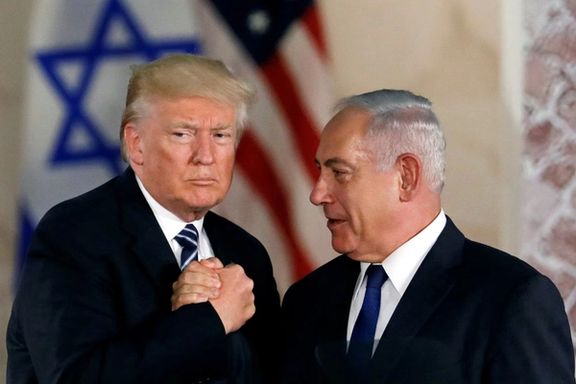
Netanyahu is set to meet Trump on Tuesday, the first foreign premier to do so since his taking office, in an effort to reset ties after often strained relations with the Biden administration amid the war in Gaza.
The two leaders are expected to discuss the Gaza ceasefire and strategies to counter Iran, according to a statement released by Netanyahu's office.
A screengrab of the video of the underground missile base aired by Iran's state TV
Iran’s Islamic Revolutionary Guard Corps (IRGC) commander-in-chief said that the force’s missile systems "can hit any enemy target in the region and overcome enemy anti-missiles" as the country rebuilds its defences after Israel's October aerial barrage.
Hossein Salami told Tasnim News Agency Monday: “The IRGC today is much more advanced in the field of weapons and much more experienced in skills.”
He described Iran’s military strength as a key factor in deterring adversaries, pointing to past missile strikes as proof of the IRGC’s capabilities.
The comments come just months after an aerial attack from Israel severely damaged Iranian military infrastructure.
The Institute for the Study of War said of the October strike: "The IDF [Israeli military" conducted precision strikes targeting around 20 locations across Iran, including facilities tied to the Iranian drone and missile programs and air defense network."
Mohammad Reza Naqdi, a deputy commander of the IRGC
In a separate interview, Mohammad Reza Naqdi, a deputy commander of the IRGC, told state television Sunday: “Whenever we want, we can put any point in the world under the missile range."
The statements come as Israeli Prime Minister Benjamin Netanyahu announced on Sunday that his Monday meeting with US President Donald Trump will include talks on the ongoing threat from Iran.
Reza Naqdi added: “Any range, in any point in the world, that the system and the Supreme Leader wants, is not beyond the technological reach of the Islamic Republic’s military forces.”
Salami highlighted the importance of the IRGC's navy in Iran's defense systems after the IRGC Navy unveiled another underground missile base in the coastal areas of southern Iran on Saturday.
The IRGC also unveiled a new cruise missile, named Ghadr-380, which has "anti-jamming capabilities" and a range of more than 1,000 km (more than 600 miles), according to IRGC Navy Commander Alireza Tangsiri.
“We have worked to continuously strengthen our defense capabilities with the efforts of dedicated, innovative young scientists,” he said at a military exhibition.
“This development will continue, and dear Iran will join the ranks of countries conducting extraterrestrial flights, showcasing our nation's scientific strength.”
Iran has developed an estimated arsenal of 3,000 ballistic missiles, according to US intelligence assessments.
Iran launched hundreds of drones, rockets and ballistic missiles at Israel last year, demonstrating its ability to strike its archenemy despite extensive missile defenses.
Iranian hardliners have warned that a return to diplomatic negotiations under Donald Trump could include renewed efforts to curb Iran’s missile program.
Tehran has repeatedly ruled out missile-related talks, maintaining that its military strategy is non-negotiable.
Iran has dispatched four vessels from its IRGC and army navies to the UAE for a meeting with Emirati naval forces.
"We have repeatedly said that regional countries can ensure the region's security and that there is no need for foreign presence," IRGC navy chief Alireza Tangsiri was quoted as saying by state media.
In addition to Persian Gulf forces, coalition forces including the US, Iran's archenemy, have a strong presence around the Strait of Hormuz.
The UAE and Iran repaired diplomatic ties in 2022, abou six years after Abu Dhabi cut diplomatic relations in allegiance with Saudi Arabia after the 2016 looting of the Saudi embassy in Tehran. Saudi followed one year later.
The IRGC navy chief announced there will be ongoing drills with other countries neighboring Iran such as Oman, which was one of the mediators involved in the repairing of ties between Iran and Saudi Arabia.
"We have had engagements with Oman's navy in this regard and have participated in joint drills with Oman," he said.
A multi-purpose drone carrier will also be integrated into the IRGC navy, he said.
Iran FM Abbas Araghchi (right) during an interview with Aljazeera that was aired on January 31, 20204.
Iran would retaliate if its nuclear facilities were targeted, Foreign Minister Abbas Araghchi said, warning that such an attack would lead to a war in the region.
In an interview aired on Al Jazeera, Araghchi called military action against Iran’s nuclear sites “one of the greatest historical mistakes the US could make.”
His comments follow growing concerns in Tehran that a second Trump administration could green light an Israeli attack on Iran.
On January 23, Donald Trump said that he hoped a deal over Iran's nuclear program would make it so that the United States did not have to support an Israeli attack on Iran.
Asked by a reporter in the Oval Office whether he would support Israel striking Iran's nuclear facilities, Trump said: "Obviously, I'm not going to answer that question."
"It would really be nice if that could be worked out without having to go that further step ... Iran hopefully will make a deal, and if they don't make a deal, I guess that's okay too."
In his interview with Al Jazeera, Araghchi suggested that unfreezing Iranian assets could serve as a confidence-building measure facilitating a deal between the two sides.
“The US has frozen Iran’s assets in various locations and has not fulfilled its commitments to release them. This move could be the first step toward establishing trust between us,” he said.
Trump withdrew from the 2015 nuclear deal in 2018, reinstating sanctions as part of his maximum pressure strategy. Iran responded by expanding its nuclear activities beyond the agreement’s limits.
During his campaign, Trump has indicated he would restore his previous policies, aiming to secure a broader deal that includes Iran’s missile program and regional influence.
A spokesperson for Israeli Prime Minister said on Thursday that Israel is closely monitoring Iran’s actions.
“War is one way to achieve our objectives… Even if Iran claims to comply, we must remain skeptical – it could be a deception. Trump’s previous policy of ‘maximum pressure’ worked, and Israel expects to collaborate with him to restore it,” he told the Jerusalem Post.
“If a deal is possible, he will try to make a deal. But in the end, there’s a limit to how much diplomacy can achieve. We’ll give it a chance, but the clock is ticking. If necessary, we will act – with or without American approval.”
An Iranian ballistic missile shot down over Israel in October 2024.
Iran's ballistic missile and space launch technologies serve a deterrent purpose, not an offensive one, President Masoud Pezeshkian said Sunday after visiting an exhibition showcasing the latest military advancements.
"We have worked to continuously strengthen our defense capabilities with the efforts of dedicated, innovative young scientists. This development will continue, and dear Iran will join the ranks of countries conducting extraterrestrial flights, showcasing our nation's scientific strength," Pezeshkian told officials and media.
Defense Minister General Aziz Nasirzadeh framed Iran’s ballistic missile program as an extension of its space launch efforts.
“Iran began its space activities by developing satellites. When challenges arose in satellite launches, the country shifted to building satellite carriers, a field in which it has now reached maturity. He added that there are promising plans, including the possibility of providing services to friendly nations,” the minister said.
Iran has launched a few satellites into low orbit, but its ballistic missile technology is viewed as a serious threat to regional countries and even most of Europe if its range extends beyond 2,000 kilometers. Last year, Iran launched two missile attacks on Israel, firing hundreds of medium-range ballistic missiles. While Israeli, American, and allied air defenses limited the damage, the attacks underscored Tehran’s ability to threaten regional countries with an estimated arsenal of 3,000 missiles.
President Pezeshkian also highlighted Iran’s space program as a driving force behind its missile development. "Our enemies constantly try to prevent us from standing on our own feet, but this has driven us to achieve scientific and technological advancements."
Iranian media have voiced concerns that President Donald Trump may push for limits on Iran’s ballistic missile program, as he did in 2018 when he withdrew from the JCPOA nuclear deal during his first term. Largely state-controlled and often reflecting official views, the media has repeatedly emphasized that Iran will not negotiate on any issue beyond its nuclear program.
A photo of the new IRGC Navy underground missile base which was unveiled on February 1, 2025
The Islamic Revolutionary Guard Corps (IRGC) Navy on Saturday unveiled another underground missile base in the coastal areas of southern Iran, state TV reported.
"We are preparing ourselves to confront any enemy, at any scale, in any manner, and in any geography," said IRGC Navy Chief Alireza Tangsiri after unveiling the new underground missile city.
The missile bases are unveiled as a message to Iran's enemies, IRGC Chief Commander Hossein Salami said, calling on them to "make more precise calculations and to ensure they do not make mistakes that would put both themselves and others in trouble."
Should they make any mistake, "all these systems you see will be activated," he warned.
The IRGC also unveiled a new cruise missile, named Ghadr-380, which has "anti-jamming capabilities" and a range of more than 1,000 km (more than 600 miles), according to IRGC Navy Commander Alireza Tangsiri.
"Cruise missiles with the capability of countering enemy destroyers' electronic warfare are stationed in the IRGC's new underground missile city," the IRGC-affiliated Sabereen News reported.
"These missiles, with significant upgrades to their weapon systems and electronic warfare countermeasures, are ready for deployment in the shortest possible time," the report added.
This is the third underground missile base being unveiled by the Revolutionary Guard over the past month.
On January 18, the IRGC Navy unveiled an underground naval missile base at an undisclosed Persian Gulf location, two days before Trump's return to the White House.
The base is one of several built underground for vessels capable of launching long-range missiles and carry out distant warfare, IRGC Chief Commander Hossein Salami said after visiting the secret base during war games.
Footage released by IRGC-affiliated media and the state TV showed tunnels with long rows of "a new version of Taregh-class radar-evading speedboats which can launch cruise missiles."
Also on January 10, the IRGC's Aerospace Force unveiled what state TV called an underground missile city.
The base was used in the Iranian missile attacks against Israel in what the Islamic Republic codenamed operations True Promise 1 and 2 in April and October 2024, the IRGC-affiliated Tasnim said.
"The volcano lying under these mountains can erupt in the shortest time possible," state TV's report said.
Iran has been conducting multiple military exercises in the past few weeks, including air defense drills near nuclear sites like Natanz and a 110,000-strong Basij mobilization in Tehran, to showcase its capabilities and project a message of strength in the region, following consecutive defeats for its allies since September.
IRGC commander-in-chief Hossein Salami said earlier this month that the ongoing military exercises aim to make the enemies refine their assessments of Iran’s defense capabilities and demonstrate that the country’s deterrence is unaffected by external events, a tacit reference to the fall of Tehran’s longtime ally Bashar al-Assad in Syria.