A day after Iran’s Supreme Leader urged officials to dismiss US demands, a conservative newspaper in Tehran advocated for negotiations, describing them as the only viable path to addressing the country’s economic crisis.
Jomhuriyeh Eslami (Islamic Republic) daily wrote on Thursday, “Officials must acknowledge that negotiation is the most effective solution for addressing the country’s challenges, a path that enjoys strong public support. Any hesitation in pursuing this approach would be unwarranted.”
Following the consecutive defeats of Iran’s proxies and allies in the region last year, coupled with a severe economic crisis exacerbated by a 33% drop in the value of the rial, many Iranian officials and media outlets have been urging for negotiations with the incoming Trump administration to ease sanctions.
However, Supreme Leader Ali Khamenei and his staunchest supporters, primarily within the military and hardline factions, have downplayed the setbacks, maintaining that the Islamic Republic remains strong and capable of overcoming all challenges.
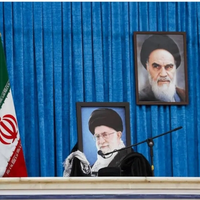
In his speech on Wednesday, Khamenei warned officials against heeding any American demands, claiming that Washington is still bitter over losing Iran as an ally 46 years ago. "The United States has failed in Iran and is now seeking to compensate for this defeat," he said in a meeting with a group of his supporters from the city of Qom.
“The people have voted for officials to serve their interests, not those of the United States. Therefore, decision-makers…must focus solely on the interests of the Iranian nation and the Islamic Republic. They should not, under any circumstances, consider the interests of the United States or Zionists, as they are fundamentally hostile to our nation and the Islamic Republic, with their ultimate goal being the destruction of Iran,” Khamenei said.
Jomhuriyeh Eslami daily, however, made the opposite argument on Thursday, saying there should be no hesitation about negotiations, “nor should attention be given to the propaganda of extremist elements seeking to reject negotiations for their own specific agendas. Iran needs to resolve its economic crisis, which can only be achieved through reforms, and negotiations to lift sanctions remain the best path to reach this goal.”
As Khamenei called for steadfast opposition to the United States, three Revolutionary Guard officials said publicly that Tehran cannot respond to Israel’s October airstrike at this time.
Current member of parliament and IRGC General Esmail Kowsari, addressing why Iran has not retaliated against Israel, said this week that "If we were in a better financial position, we would have launched Operation True Promise-3 and even Operation 4." Highlighting the $921 billion US military budget, Kowsari acknowledged Iran’s financial and military limitations.
An Iranian activist based in the US, with 23,000 followers on X, responded to Kowsari’s remarks in a tweet, questioning why it took 45 years for the Islamic Republic to realize it is not capable of confronting the United States.
"After driving Iran into bankruptcy across economic, military, diplomatic, and geopolitical dimensions, leaving people without access to water, electricity, and gas, is it only now that you realize the importance of a strong military budget and economic capability? Have you just figured out that two plus two equals four and that taking on superpowers alone is not feasible?"
Iran’s Islamic Revolutionary Guard Corps (IRGC) has unveiled its latest loitering munition drone, the Rezvan, during the ongoing military drills codenamed Great Prophet 19.
The drone, with a range of 20 kilometers and an operating time of 20 minutes, is designed for rapid deployment and targeted attacks, particularly in complex terrain, according to the IRGC.
"Our drones carried out several rounds of firing and drone operations, and in our scenario, we successfully destroyed hypothetical enemies and terrorists attacking Iranian bases," said Mohammad Pakpour, the commander of the IRGC Ground Forces, on the sidelines of the exercise in the Azgeleh region in the western Kermanshah province.
The suicide drone is fired from a cylindrical launcher and transmits live video to the operator, allowing for precise target selection and engagement, IRGC media Tasnim reported.
Also on Thursday, the Iranian Army announced that it will incorporate 1,000 new drones into its combat forces in the coming days. These drones were designed and manufactured jointly by the Iranian Army and the Ministry of Defense.
Commander of the the Army's Ground Force Brigadier General Kioumars Heidari said that the new military equipment joining the Army has capabilities like maneuverability, precision, and smartness, but he did not elaborate on details.
IRGC commander-in-chief Hossein Salami said Thursday that the ongoing military exercises aim to make the enemies refine their assessments of Iran’s defense capabilities and demonstrate that the country’s deterrence is unaffected by external events, a tacit reference to the fall of Tehran’s longtime ally Bashar al-Assad in Syria.
"The goal of the exercises is to adjust and refine the enemy's calculations regarding Iran's defense power so that they do not make decisions based on incorrect calculations," Salami said. "Foreign developments do not affect our deterrence."
He discussed what he characterized as enemy attempts to depict Iran's defense capabilities as diminished, particularly in the wake of developments in Syria. "The enemy has invested heavily in psychological and media operations, especially after recent events in Syria, to foster the perception that the defensive and deterrent power of the Islamic Republic of Iran has weakened and that Iran has lost its regional deterrent assets," he said.
The Great Prophet 19 exercise is the latest in a series of drills conducted by Iran's military to showcase its capabilities and project a message of strength in the region, following consecutive defeats for its allies since September.
Gunmen killed a border guard on Thursday in Mirjaveh County, located in Iran's restive southeastern province of Sistan-Baluchestan, state-run media reported.
The province, which borders Afghanistan and Pakistan, has been a hotspot for sporadic deadly clashes involving militant groups, armed drug traffickers, and Iranian security forces.
Among the groups active in the region is Jaish al-Adl, known for ambushes, bombings, and other violent operations that have claimed the lives of civilians and security personnel.
Jaish al-Adl advocates for an independent Baluchestan, encompassing Baluch populations on both sides of the Iran-Pakistan border, and has carried out numerous attacks in southeastern Iran.
Sistan-Baluchestan is one of Iran’s least developed regions, with strained relations between its predominantly Sunni Muslim population and the country’s Shiite-led establishment.
Two senior IRGC commanders said this week that the Islamic Republic is currently unable to retaliate against Israel's October air strikes due to financial constraints and the loss of key regional ally Syria.
Iranian political and military officials have repeatedly threatened to launch a large-scale retaliation against Israel, referring to the operation as “True Promise 3.” The codename refers to two earlier missile and drone strikes carried out against Israel in 2024.
An IRGC general who until recently was stationed in Syria told Iranian media that such an operation should have been launched earlier, and now Iran is not in a position to ignite a large-scale conflict with Israel.
"I do not know why the operation was not launched or who decided against responding to Israel," General Behrouz Esbati who heads the Iranian armed forces Cyberspace Headquarters, told the conservative Tabnak news website.
"However, as someone who was on the ground in Syria, I can say that we would be in a much better position today if Iran had retaliated against Israel's attack."
Iranian troops quit Syria last month in the face of a surprise rebel offensive which toppled the ruling Assad dynasty, Iran's faithful ally for decades.
The loss was among the heaviest to Iran's so-called Axis of Resistance in 15 months of war with Israel. Tehran describes the armed front as legitimate resistance against Israel and has been keen to avoid all-out conflict with its better armed fow.
"I believe the current situation makes it impossible to carry out Operation True Promise-3," Estate added. "Under the present circumstances, it is not in the interest of the Resistance to drag the region into a war. If we initiate a new operation, the enemy will respond with renewed attacks."
Addressing the reasons behind Assad's fall, Esbati remarked, "Assad lacked the motivation to fight. Despite Khamenei’s assurance that Iran would support him if he resisted, Assad was unwilling to engage in battle."
He also criticized Assad's military leadership, saying, "His army commanders were corrupt and accepted bribes from everyone." Esbati further accused Russia of betrayal, saying, "Russia betrayed both Assad and Iran." He added that "after Iran's first retaliation against Israeli attacks, Russia was aligned with Israel."
The Didban Iran news website in Tehran quoted also General Esmail Kowsari, an IRGC officer and member of the Iranian parliament's National Security Committee, as saying, "The Islamic Republic's hands are tied; otherwise, we would have responded to Israel and carried out Operation True Promise-3."
Highlighting the United States' $921 billion military budget, Kowsari remarked, "If we were in a better financial position, we would have launched Operation True Promise-3 and even Operation 4."
Meanwhile, Etemad newspaper cited Foreign Minister Abbas Araghchi, who stated, "Iran must learn a lesson from Assad's fall in Syria." He added, "The Syrian army was defeated before it even considered fighting or resisting." The foreign minister warned, "Syria's defeat should serve as a lesson for us, and we must not allow the enemies to spread despair within Iran."
Palestinian gunmen take part in a memorial service, in Jenin refugee camp the Israeli-occupied West Bank, March 3, 2023.
Iran is pivoting toward arming Palestinian militants in the occupied West Bank following the downfall of Tehran’s ally Bashar al-Assad in Syria, Israel’s Defense Minister said on Tuesday.
"Judea and Samaria has become a central arena in the map of threats to Israel and we are preparing to respond accordingly," Katz said, using the Biblical names for lands on the west bank of Jordan River which Israel seized in a 1967 war.
"We are seeing increasing efforts to promote Palestinian terrorism in Israel through the smuggling of advanced weapons, funding and guidance both on the part of the Iranian axis and on the part of the radical Sunni Islamic axis that is strengthening its grip on the region after the events in Syria,” he added.
Violence in the West Bank has spiked in recent weeks as Iran copes with military losses dealt by Israel to its armed allies in the region, especially in Syria, which had provided a key strategic and military base for Tehran.
In Lebanon, Iran's most powerful ally Hezbollah suffered a huge blow after Israeli bombardment of critical infrastructure and the group’s leadership since September, while Hamas in Gaza has been weakened since its attack on Israel on October 7, 2023, led to the longest Gaza war since the group took control of the enclave in 2007.
The series of setbacks to Iran's network of military allies has, according to Israel, led to a renewed focus on the West Bank as part of Tehran's war against its archenemy.
“Iran-backed terrorist groups, including Islamic Jihad, al-Aqsa Martyrs' Brigades, and Hamas, have proliferated in number and strengthened their presence in the West Bank in recent years," Joe Truzman, an expert on Palestinian militants wrote in The Long War Journal.
“Iranian arms and funding have primarily fueled this violent escalation,” he added, saying the groups have established armed cadres in the West Bank cities of Nablus, Jenin, Tulkarm and beyond.
”Iran has established itself in our sector and over half a million citizens of the State of Israel are sitting on a ticking time bomb," Israel Ganz, a top leader of Israeli settlers in the occupied West Bank, said on Tuesday.
"We must not continue to live here with the same concept that existed on the sixth of October.”
The announcement comes on the back of a deadly attack which saw three Israelis killed in a shooting on a car and bus near the settlement of Kedumim this week.
In the latest 2024 statistics, Israel’s internal security agency the Shin Bet said it had thwarted 1,040 significant attacks in the West Bank and Jerusalem during 2024.
These included 689 shooting attacks, 326 bomb attacks, 13 stabbing attacks, nine rammings and a kidnapping. It was a 40 percent increase in 2023, it said.
Since the Oct. 7 attack, dozens of Israelis and hundreds of Palestinians have been killed in the West Bank.
Iran's ambassador to the United Nations on Wednesday urged the Security Council to hold Israel accountable for what he described as its destabilization of Syria.
Addressing a Security Council meeting on the situation of Syria, Amir-Saeid Iravani called Israel "the greatest threat to the present and future of Syria.”
“Israel continues to violate Syria’s sovereignty and territorial integrity, and the Security Council must take decisive action to stop and hold Israel accountable for its destabilizing actions," he said.
Since the beginning of Syria's civil war in 2011, Israel has carried out hundreds of strikes in Syria to quash Iran’s influence and interrupt supply routes to Hezbollah in Lebanon, its most powerful armed ally in the region.
In December, the Bashar al-Assad government - a key pillar of Iran’s influence in the region - fell despite 13 years of Iranian military support.
Iravani said Iran's presence in Syria "has been legal, in accordance with international law and at the request of the Syrian government at the time."
Iran's military withdrawal, he added, was "carried out responsibly, taking into account the potential impacts on the Syrian people."
Iranian forces have largely quit Syria following Assad's fall, the Wall Street Journal reported on Tuesday, citing US, European, and Arab officials.
Members of Iran’s Quds Force have now relocated to Iran and pro-Assad militia groups have disbanded, the report added, citing a senior US official.
According to Western and Arab officials cited, most forces in eastern Syria—including Iranian Revolutionary Guards officers and Afghan, Iraqi, Lebanese and Syrian fighters—retreated to al-Qaim, a border town on the Iraqi side.
Some Iranian personnel based in Damascus flew to Tehran, while Hezbollah fighters in western Syria fled overland to Lebanon, they added.