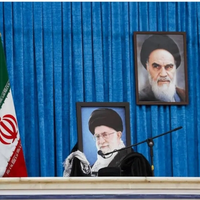
(From left) Iran’s Supreme Leader Ali Khamenei, President Masoud Pezeshkian, Parliament Speaker Mohammad Bagher Ghalibaf, Justice Cheif Gholam-Hossein Mohseni Ejei during the inauguration of Pezeshkian in July 2024
As President-elect Donald Trump’s inauguration nears, more establishment figures and experts in Iran are urging authorities to engage in negotiations with the United States to alleviate the Islamic Republic’s severe economic pressures.
Former Reformist Interior Minister Abdolvahed Mousavi-Lari, one of the growing voices advocating for dialogue, told the Iranian press that "President Masoud Pezeshkian should break the taboo surrounding negotiations with the United States."
Mousavi-Lari stated that "Supreme Leader Ali Khamenei will accept the idea of negotiations with the United States if Pezeshkian explains the country's [dire economic] situation to him." This comes despite Khamenei's reputation as a staunchly anti-US political figure. In a 2019 meeting with former Japanese Prime Minister Shinzo Abe, Khamenei expressed his belief that Trump was not worthy of engaging in talks.
Mousavi-Lari emphasized the interconnected fate of Pezeshkian and Iran’s Reformist movement, stating, "Those who voted for Pezeshkian voted for change. If he refuses to negotiate with the United States, many voters may come to regret their decision."
He argued, "Pezeshkian neither wants nor is capable of pursuing negotiations with the United States without Khamenei's support. Pezeshkian must stand by his promise to the people to address the country's economic problems." Mousavi-Lari reiterated that Pezeshkian should seek the leader's backing, adding, "Khamenei certainly wants the government to succeed and will support efforts to ensure its success."
However, the politician’s optimism about Khamenei’s intentions is not necessarily aligned with recent history. The Supreme Leader has consistently voiced staunch anti-US and anti-West sentiments, advocating for defiance and a strategy centered on regional dominance.
The prospect of further economic turmoil and unpredictable popular protests looms heavily over all levels of Iran's ruling establishment.
A senior expert on the United States told local media that Trump is eager to capitalize on potential unrest in Iran to pressure Tehran into entering negotiations with Washington. Meanwhile, a former Interior Minister has called on Pezeshkian to seek Khamenei's backing for talks with the United States.
In an interview with the Tehran-based Khabar Online website, Hadi Alami Fariman also cautioned that "any shift in Iran's nuclear doctrine will bring hardship for Iranians and provoke extensive military attacks on the country."
Fariman added that "Iran's nuclear dossier is likely to be the most significant issue Trump will address in dealing with Iran. His plans are expected to include maximum pressure tactics, intensifying sanctions, and pressuring China to halt oil purchases from Iran," he said.
He also suggested that "the Trump administration will aim to incite protests in Iran as a means to pressure the government into negotiations. Simultaneously, Trump is likely to leave a narrow window for diplomacy open to Tehran."
Meanwhile, Fariman proposed that "Iran should launch an extensive lobbying effort in the United States to establish connections with those close to the Trump administration and members of Congress." He also recommended the establishment of a direct hotline between Tehran and Washington to facilitate communication.
Fariman warned that "Trump's initial challenge for the Islamic Republic is likely to be the creation of major economic crises." He further emphasized that "Iran must adapt to the world's new order and pursue a fresh agenda."
Summing up Iran’s potential path forward, Fariman stated, "We should embrace a strategy of competition rooted in negotiations rather than threats. It is time to decide whether we want to align ourselves with this new global order or resist it."
He also suggested that Iran should consider cooperation with emerging states, including Syria, based on their de facto recognition. "We must acknowledge that Syria has shifted from a pro-Russian and pro-China orientation to one that supports the United States. At least for now, it harbors no hostility toward Israel and has established good relations with Arab states," he explained.
French Foreign Minister Jean-Noel Barrot looks on as he leaves on the second day of the G7 foreign ministers' meeting in Fiuggi, Italy, November 26, 2024.
France says Iran's future ties and sanctions relief depend on the release of three French citizens detained in the country, with some held in conditions resembling torture.
"The situation of our compatriots held hostage in Iran is simply unacceptable; they have been unjustly detained for several years, in undignified conditions that, for some, fall within the definition of torture under international law," French Foreign Minister Jean-Noel Barrot said Tuesday.
He added, "I say to the Iranian authorities: our hostages must be released. Our bilateral relations and the future of sanctions depend on it."
Rights groups say three French citizens—Cécile Kohler, Jacques Paris, and Louis Arnaud—have been arbitrarily imprisoned without due process, with Kohler and Paris held for over two years.
Iraq’s prime minister is set to visit Tehran on Wednesday to discuss regional issues following the tumultuous events of 2024, including the overthrow of Syria’s Bashar al-Assad and the decline of Iran’s regional influence.
On Monday, Iran’s Foreign Ministry spokesperson, Esmail Baghaei, told reporters that Prime Minister Mohammed Shia al-Sudani will focus on discussing the situation with Syria’s new government. Both Iraq and Iran are navigating cautiously amid the radically changed dynamics in the region.
Arab media reported on Sunday that the commander of the Quds Force of Iran's Islamic Revolutionary Guard Corps (IRGC) was visiting Baghdad to meet the leaders of Tehran-backed Shia groups as well as the Iraqi prime minister, Arab media reported Sunday.
Esmail Ghaani (Qaani) and several of his advisers in the Quds Force arrived in Baghdad on Sunday morning to meet with the leaders of the Shia factions and the head of the Popular Mobilization Units (PMU), Falih al-Fayyadh, Erem News reported citing an Iranian source.
There have been recurrent reports and analysis about Iraqi government plans to restrict the Iran-backed Shia militia groups. In fact, as opposition forces were moving toward Damascus last month to depose Assad, the Iraqi militia did not cross the border to defend him.
A pro-Hezbollah newspaper in Lebanon reported last month that the Iraqi militias reached a deal with the government not to attack Israel. The move reflected concerns about escalating conflicts in the region and fears of Iraqi security being endangered after insurgents took control in neighboring Syria.
Some regional and Iranian media outlets speculate that al-Sudani’s visit to Tehran may aim to persuade the Islamic Republic to halt its support for Shiite militias. While it remains unclear whether the prime minister’s agenda is that bold, the role of these militias in Iraqi politics is likely to be a key topic of discussion.
The Iranian Rouydad24 website, citing Arab media, said that al-Sudani’s agenda is securing guarantees from Tehran to cease its support for militias and Iran-aligned groups in Iraq, urging Iran to respect the decisions of the Iraqi government, and ensuring Iraq's immunity from any military operations by the US or Israel launched from Iraqi territory are expected to be key demands.
It is believed that Israeli, and possibly US, warplanes could launch missiles at Iran using Iraqi airspace. Reportedly, Israel employed this tactic during its October airstrike on Iran.
Alaeddin Boroujerdi, an influential Iranian lawmaker, told local media last week that the Iraqi Prime Minister might be delivering a message to Iran, though he did not specify its source. The Tehran-based Etemad Online suggested that the message likely originates from Washington, urging Baghdad to curb Iranian-backed militias and Shiite groups.
An Iraqi journalist in Baghdad, speaking on condition of anonymity, told Iran International that significant developments are expected in January and February as President-elect Donald Trump takes office.
French President Emmanuel Macron warned on Monday that Iran's nuclear program is nearing the point of no return, stressing the need for Paris to engage in strategic discussions with US President Donald Trump's administration about Tehran.
Macron urged the European parties to the lapsed 2015 nuclear deal with Tehran to consider reimposing sanctions, he told an annual conference with French ambassadors to outline foreign policy objectives in 2025,
"The acceleration of the nuclear program leads us nearly to the point of no return,” he said, describing Iran as the main strategic and security challenge for France and Europe.
Iran says its uranium enrichment program is for peaceful purposes but has accelerated activity since US President-elect Donald Trump withdrew from the 2015 nuclear deal - officially known as the Joint Comprehensive Plan of Action (JCPOA) - during his first term and reimposed sanctions on Tehran.
“Remember, when the United States decided to denounce the JCPOA, which they themselves had promoted, France had a simple view: we must move towards a broader agreement. This is our strategy today,” Macron added.
Last month, European powers France, Germany, and Britain warned that Iran’s actions had further eroded the agreement, noting that Tehran’s stockpile of highly enriched uranium has no credible civilian justification.
In December, the head of the UN nuclear watchdog reported that Iran was dramatically advancing enrichment close to the 90% purity needed only for weapons-grade material.
The three European nations, co-signatories of the 2015 accord, had brokered the deal under which Iran agreed to limit enrichment in exchange for the lifting sanctions. With the sanctions reimposed, Iran saw little to no incentive to keep its part of the bargain.
French, German, and British diplomats are scheduled to meet with Iranian counterparts on January 13 for a follow-up to last month’s talks, aimed at exploring serious negotiations in the coming months to ease tensions with Tehran as Trump prepares to return to the White House on January 20.
"In the coming months we will have to ask ourselves whether to use ... the mechanism to restore sanctions," Macron said, referring to October 2025 when the JCPOA formally expires.
Macron also mentioned Iran's ballistic missiles and support for Russia, labeling them threats to Europe and calling for diplomacy with Trump after he took office.
“Its (Iran’s) ballistic missile program threatens European soil and our interests. Iran is already involved in Russia's war against Ukraine through clear and fully identified military support.”
Warning that Iran’s use of terrorism continues throughout the world, he said, “Tehran’s support for dangerous groups across all conflict zones in the Middle East and its attempts to establish a presence in Africa amplify this danger through its so-called proxies.”
Iran has denied any connection between the detention of Italian journalist Cecilia Sala and the arrest of Iranian national Mohammad Abedini Najafabadi in Milan, describing reports of a reciprocal exchange as false.
“These two matters are entirely unrelated,” foreign ministry spokesman Esmail Baghaei said during a press briefing on Monday. “The Italian journalist was detained for violating Iranian laws, while the Iranian individual was arrested for circumventing US sanctions.”
Baghaei also criticized what he described as the US targeting Iranian citizens abroad.
“Several Iranian nationals are pursued and extradited in certain countries at the request of the US, which we consider a form of hostage-taking,” he said.
However, a source familiar with discussions between Sala's family and the Italian government told Iran International that Tehran made clear to Rome that Sala's freedom depends on Italy's release of Mohammad Abedini Najafabadi, an Iranian arrested at Washington's behest.
Dariush Forouhar and his wife Parvaneh Forouhar (Eskandari)
The "chain murders" of the 1990s—a series of assassinations targeting Iranian dissidents and intellectuals—claimed at least 80 lives and stand as a dark chapter in the Islamic Republic's history of extrajudicial killings.
Carried out by the Ministry of Intelligence under President Akbar Hashemi Rafsanjani, these killings sought to silence critics deemed threats to the state, continuing into the presidency of Mohammad Khatami.
In 1999, the Ministry of Intelligence officially—but only partially—admitted responsibility for four of the murders.
Q: Who were the dissidents killed by intelligence ministry agents?
Five individuals whose murders in November and December 1998 drew national and international attention were:
Majid Sharif: A translator and journalist.
Dariush Forouhar: Leader of the Pan-Iranist Nation Party of Iran.
Parvaneh Forouhar (Eskandari): Activist and wife of Dariush Forouhar.
Mohammad-Jafar Pouyandeh: Member of the banned Iranian Writers Association.
Mohammad Mokhtari: Member of the banned Iranian Writers Association.
The Ministry officially acknowledged responsibility for the killings of Dariush and Parvaneh Forouhar, Mohammad Mokhtari, and Mohammad-Ja’far Pouyandeh, but denied involvement in other cases, including Pirouz Davani’s death.
Q. How were the victims killed and where were their bodies found?
Majid Sharif’s body was found on the side of a road in Tehran on November 19, 1998, six days after he disappeared. Authorities claimed heart failure as the official cause of his death.
Dariush and Parvaneh Forouhar were stabbed to death in their Tehran home on November 22. Both sustained multiple stab wounds, suggesting the attack was both deliberate and exceptionally violent.
Mokhtari’s body was discovered on December 3 near a cement factory on a road south of Tehran, several days after he went missing.
Pouyandeh’s body was found in a field in Shahriyar, also south of Tehran, on December 8, a day after he left his office in the capital to return home.
Both bodies showed signs of strangulation, though the authorities never officially confirmed the cause of death.
Q: Were the killings limited to those in November and December 1998?
No. At the time, political groups and media outlets suspected the intelligence ministry of involvement in numerous other assassinations, often disguised as overdoses, car accidents, or unexplained stabbings.
The suspected victims of these systematic assassinations were primarily opponents of the Islamic Republic, including dissident politicians, literary figures, and translators. Others reportedly targeted included an Armenian, three Protestant priests, followers of the banned Bahá'í faith, a prominent university professor with no known political affiliations, and civilians allegedly linked to the intelligence ministry’s covert operations.
Q: When did government-linked murders begin and end?
Many believe the "Chain Murders" began with the killing of Dr. Kazem Sami, who served as minister of health in the first post-revolution cabinet in 1979.
Dr. Kazem Sami was stabbed to death in his medical practice in 1988. The individual accused of his murder reportedly died by suicide in prison. Years later, former President Akbar Rafsanjani, in his memoirs, referenced the alleged killer’s death, fueling further questions about the case.
Some activists and advocates argue that the "Chain Murders" never truly ceased, with allegations of systematic killings resurfacing in recent years.
Prominent filmmaker Kioumars Pourahmad, whose body was found without a suicide note in April 2023, andDariush Mehrjui and his wife, who were fatally stabbed in their Karaj home in October 2023, have been cited as possible victims of a renewed wave of targeted killings.
Q: Who did the authorities blame for the murders?
Supreme Leader Ali Khamenei and his supporters initially blamed “foreign enemies,” including Israel, for the murders of the Forouhars and the two writers.
Public outcry over these particular killings, however, put pressure on the so-called reformist government of President Mohammad Khatami.
At Khatami's insistence, a three-member independent team was established to investigate the killings. The committee ultimately confirmed suspicions of the intelligence ministry’s direct involvement.
On January 4, 1999, the ministry issued an unprecedented statement partially acknowledging responsibility by blaming “rogue” agents for four of the murders and describing the killings as “despicable and abhorrent.”
This limited admission prompted further scrutiny, as the intelligence ministry operates under the authority of Khamenei, raising questions about how such "rogue" actions could occur without his knowledge.
Q: What happened to the “rogue agents”?
Three top officials of the ministry—Saeed Emami, Mostafa Kazemi, and Mehrdad Alikhani—along with several agents, were charged with ordering and carrying out the assassinations.
Emami, widely regarded as the mastermind behind the killings, allegedly died by suicide in prison before his trial.
The remaining defendants were tried in Tehran's military court. Sentences ranged from qisas (death penalty) to life imprisonment, with some receiving as little as two and a half years.
Q: Were the death sentences carried out?
No. Judiciary authorities stated that the victims’ families had waived their Sharia-based right to qisas for the killers. This act of pardon spared the defendants from execution.
Q: Did the revelation of the ministry’s role in the killings affect the minister?
Ghorban-Ali Dorri-Najafabadi, a minister favored by Khamenei, who at the time had not yet fully consolidated his power as Supreme Leader, was forced to resign. He was replaced by the relatively moderate Ali Younesi.
Najafabadi has consistently denied any knowledge of the assassinations. However, some defendants in the case rejected this claim, stating that the "physical elimination" of targets identified by higher authorities was part of their job description.
In his 1999 trial, prominent reformist cleric and politician Abdollah Nouri accused Najafabadi of being aware of the killings.