Popular Iranian football commentator Adel Ferdosipour
Iran's media watchdog banned a popular football commentator’s live program mid-stream, the CEO of Iran's top video-sharing platform Aparat said, in an apparent attempt to muzzle a figure known for outspoken political criticism.
Mohammad-Javad Shakouri tweeted the audio file of a phone call from the monitoring department of SATRA, the media regulatory authority, which informed him that the platform needed to urgently drop Adel Ferdosipour’s reporting of a UEFA Champions League match between Liverpool and Real Madrid.
Aparat is a video-sharing platform similar to YouTube.
“Streaming the matches commentated by Adel Ferdosipour is against streaming regulations. Please remove the match being streamed now as soon as possible,” the man heard in the audio file who did not introduce himself said.
Ferdosipour produced and hosted Navad (90), a popular weekly live football show, for Channel 3 of the state television (IRIB) for nearly two decades. The program was among the state television’s most viewed shows and its audience sometimes topped 30 million.
Channel 3 dismissed Ferdosipour from the program in March 2019 for his occasional criticism of the government meddling in football clubs, including in the appointment of their managers and challenging the channel’s director, but he continued to produce another program, Football 120, for the Sports Channel of state television.
In December 2020, a year after Navad was dropped, over two million Iranians followed the Persian-language Instagram account of the Asian Football Confederation (AFC) in 48 hours when it was announced that Ferdosipour would be commentating on the Champions Asian League final live on AFC’s Instagram page.
In 2022, Ferdosipour rejected state television’s offer to do the commentaries on FIFA World Cup in solidarity with the Woman, Life, Freedom protesters and “bereaved Iranians," after hundreds of protesters were killed by security forces. He has since completely cut all ties with the state broadcaster.
He currently produces and presents a podcast, Football 360. The podcast can be watched on Aparat, as well as through the Football 360 mobile application.
In his post, Shakouri who is also the co-founder and chief executive officer of Filimo, a subscription video-on-demand platform similar to Netflix, threatened to “tweet every bizarre demand or bullying action of SATRA and the IRIB.”
Aparat and Filimo, like all other video-sharing and subscription video-on-demand platforms, are regulated by SATRA which can censor all online audiovisual media platforms. The organization has the exclusive right of media licensing.
Netflix, YouTube, all major social media networks, and messaging apps such as WhatsApp, Telegram, and Viber are blocked in Iran. These platforms can only be accessed through anti-filtering software.
SATRA is affiliated to the IRIB. It was formed in 2016 to ensure that non-state online platforms do not infringe on the IRIB's broadcasting monopoly.
The public relations office of SATRA told the Revolutionary Guards (IRGC) linked Tasnim news agency on Thursday that the program was banned because the IRIB has exclusive right to licensing and monitoring of all “live” online programs and Aparat had failed to acquire a license for the program.
On Wednesday SATRA also banned “Now”, a talk show hosted by the award-winning film director, writer, and actor Soroush Sehat after the release of only one episode. The explanation offered by SATRA, according to the CEO of Aparat, was that the host of the show had mentioned “Open Book”, a popular book review show he had hosted on IRIB during the program.
The IRIB, a rival of the online platforms, considers a mention of its own programs as infringement of its property rights because it is also the “referee and regulator”, the CEO of Aparat and Filimo wrote in another tweet about the ban of the talk show.
An Iranian teacher's union has sounded the alarm over a rise in student suicides, blaming it in part on religious morality enforcement and neglect of youth mental health issues.
The latest suicide of a female student is part of a "harrowing cycle deeply rooted in flawed policies, systemic pressures within the education sector, ideological impositions, and the disregard of authorities for the growing mental health crisis in schools," the Coordinating Council of the Iranian Teachers’ Trade Associations (CCITTA) said in a statement on Thursday.
The union was referring to the death of 16-year-old Sogand Zamanpour, who died by suicide in Masjed Soleiman in southwestern Iran. No further details about her case publicly known.
Her death follows that of Aynaz Karimi in Kazeroon, Fars province, earlier this month. Aynaz faced pressure from her school principal for minor infractions, including wearing nail polish and dyeing her hair, according to the Coordination Council of Iranian Educators' Trade Associations. This led to her eventual expulsion, after which she ended her life—a case that CCITTA said highlights the psychological toll of a repressive educational environment.
A week earlier, Arezou, a 16-year-old Afghan-Iranian girl in Tehran, ended her life after a confrontation with her school principal over wearing jeans instead of the required uniform. Her father explained that she left the school upset and later jumped from a sixth-floor apartment. He has held the school accountable for her death and filed a formal complaint.
Arezou’s case sparked comparisons on social media between Afghan and Iranian girls, with some pointing out the irony of escaping Taliban oppression only to face similar restrictions in Iran.
The teacher's union said the grim phenomenon is linked to official neglect of students' mental health. The council condemned the practice of using schools to instill ideological beliefs, warning that such policies strip students of their identity and future.
Established in 2001, CCITTA serves as the coordinating body for around 20 provincial chapters of the Iranian Teachers’ Trade Association (ITTA). The council further criticized the government’s education policies for imposing strict ideological frameworks that undermine students' individuality and motivation.
Reflecting on the initial cases, Zahra Behrouz Azar, Deputy for Women’s Affairs in Masoud Pezeshkian’s administration, addressed the suicides of two female students in an interview with Ham-Mihan Online earlier this month.
"While it may not be accurate to suggest an upward trend, even these two cases are far too many and deeply unacceptable," she said.
The strict enforcement of hijab rules in Iran continues to place significant pressure on women and girls and triggered months-long protests in 2022 following the death of a 22-year-old woman in police custody for allegedly wearing her hijab improperly.
Nevertheless, Iran’s parliament is set to unveil its Hijab and Chastity Law next month, which introduces new fines for violations of mandatory hijab regulations, Speaker Mohammad Bagher Ghalibaf announced on Wednesday.
Ghalibaf acknowledged the delay in finalizing the law was due to security concerns stemming from the 2022 protests.
British and French intelligence chiefs have warned of the threat posed by Iran potentially developing nuclear weapons. At the same time, European and Iranian diplomats met in Geneva on Friday for uneventful talks.
"Our services are working side by side to face what is undoubtedly one of the threats, if not to say the most critical threat, in the coming months - the possible atomic proliferation in Iran," Nicolas Lerner, who heads France’s DGSE, said at the British embassy in Paris alongside his British counterpart Richard Moore.
“The intelligence will be crucial to enable our authorities to make the right decisions and define the right strategies,” Lerner said in rare public comments.
The head of Britain's Secret Intelligence Service known as MI6, echoed those comments. "The regime's nuclear ambitions continue to threaten all of us, especially friends of France and the UK in the Gulf region," Moore said.
“Iran’s allied militias across the Middle East have suffered serious blows,” he added. “But the regime’s nuclear ambitions continue to threaten all of us.”
The comments by the intelligence chiefs and Iran’s meeting with the United Kingdom, France and Germany came after the International Atomic Energy Agency (IAEA) Board of Governors passed a resolution, proposed by the UK, France, and Germany, criticizing Tehran's lack of cooperation with the UN nuclear watchdog.
The resolution emphasized the urgent need for Tehran to cooperate with the IAEA and called on IAEA Director General Rafael Grossi to prepare a comprehensive report on the status of Iran's nuclear program.
The censure resolution has set the stage for a new phase in the dispute over Iran's activities which could lead toward more sanctions through the activation of so-called "snapback mechanism".
The purpose of the Geneva meeting, the first such talks since Trump's election victory, was to assess the feasibility of engaging in serious negotiations before the official inauguration of the new US president on January 20, Reuters reported. The United States had previously announced it would not participate in the Geneva meeting.
Iranian President Masoud Pezeshkian, who campaigned on a platform of reform and meritocracy, is facing criticism following nepotistic appointments within his administration.
Yousef Pezeshkian, the President's son, was appointed on Wednesday as the Media Advisor and Assistant to the Presidential Chief of Staff, Mohsen Haji-Mirzaei.
Despite publicly decrying preferential hiring practices, the president’s son, son-in-law, and other family members have secured government positions so far, echoing controversies that marred previous administrations led by Hassan Rouhani and Mahmoud Ahmadinejad.
Ironically, during a recent meeting with members of the medical community, Pezeshkian called for the inclusion of academics and experts in addressing national challenges.
“Unfortunately, problems are often entrusted to individuals who lack the necessary expertise,” he said, criticizing the influence of personal connections in staffing decisions. However, his remarks were overshadowed by media reports a day earlier that his son, Yousef Pezeshkian, had been appointed as media advisor and assistant to the chief of staff in his father’s administration.
Hassan Majidi, the president’s son-in-law, was previously named special assistant to the chief of staff. Meanwhile, Shahram Dabiri, the president’s parliamentary deputy, reportedly facilitated appointments for his own relatives, including his brother-in-law and brother, to key positions.
Hassan Majidi, Iranian president’s son-in-law, was previously named special assistant to the chief of staff.
The revelations are a sharp contrast to Pezeshkian’s campaign rhetoric. In addition to pledging a transparent and merit-based government, he promised to end internet restrictions, consult citizens before price hikes, and enact broad reforms.
However, internet access remains heavily restricted, and price increases have continued, fueling frustration among citizens who expected a reduction of the annual 40% inflation rate.
The move by Pezeshikian is not new in Iran’s political arena. Former president Hassan Rouhani faced backlash for appointing his brother, Hossein Fereydoun, as a special aide involved in nuclear negotiations. Fereydoun was later arrested on corruption charges.
Mahmoud Ahmadinejad’s tenure also saw the appointment of several family members, including his late brother Davoud as head of the Presidential Inspection Organization and his son’s father-in-law Esfandiar Rahim Mashaei to influential advisory roles. These appointments sparked controversy and accusations of consolidating power through personal networks.
The controversies surrounding family appointments in Pezeshkian’s administration come at a critical time for Iran, as economic challenges and public dissatisfaction grow.
Iran raised the stakes ahead of nuclear talks with European powers on Friday, unveiling plans to expand uranium enrichment capabilities and hinting at a potential shift in policy toward weaponization.
The talks –set to take place in Geneva between Iran and the E3 (France, Britain and Germany)– aim to restore dialogue and foster cooperation, while both sides remain poised for confrontation.
Speaking in Lisbon ahead of the negotiations, Iran’s foreign minister Abbas Araghchi suggested that any move by Western powers to reimpose UN sanctions could push Tehran over the edge.
“There is this debate going on in Iran, and mostly among the elites – even among the ordinary people – whether we should change our nuclear doctrine…because it has proved insufficient in practice,” Araghchi said in an interview carried by the Guardian on Thursday.
“This is the result after 10 to 12 years of negotiation, and after 10 years of implementation and homework and all these things, now, Iran is back under chapter seven [of the UN charter], what for,” he said, adding that UN sanctions would convince everybody in Iran that cooperation has been wrong.
This is not the first time Iranian officials hint at a possible revision of the country’s defense doctrine. It follows months of direct confrontation with Israel, including Israeli airstrikes on Iran's nuclear sites, and long-held frustration with what Tehran views as European failures to deliver on their commitments under the 2015 nuclear deal.
The nuclear deal, formally known as the Joint Comprehensive Plan of Action (JCPoA), was intended to limit Iran’s nuclear activities in exchange for sanctions relief. The deal unraveled in all but name when Donald Trump withdrew the United States from it in 2018.
A confidential report by the UN's nuclear watchdog revealed Iran’s plans to significantly enhance its uranium enrichment infrastructure. The report, shared with member states and seen by Reuters on Thursday, detailed Tehran’s intention to install 32 new cascades of centrifuges, including an array of 1,152 advanced IR-6 machines, at its Fordow and Natanz sites.
"Iran has informed the IAEA that it intends to feed uranium feedstock into the eight IR-6 centrifuge cascades recently installed at Fordow to enrich to up to 5% purity," Reuters reported citing the IAEA report.
The report said Tehran informed the IAEA that it intends to test intermediate and full cascades of up to 174 IR-4, IR-6, or IR-2M centrifuges in 15 R&D production lines at its above-ground pilot fuel enrichment plant (PFEP) at Natanz.
Iran already has more than 10,000 centrifuges operating across its underground and above-ground sites. The new move is part of Iran's response to a recent censure resolution passed by the IAEA Board of Governors, urging Tehran's cooperation with the UN nuclear watchdog.
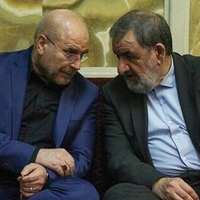
Iran's Parliament Speaker has come under fire from Reformists and other supporters of Masoud Pezeshkian for joining ultra-hardliners in demanding Mohammad-Javad Zarif’s withdrawal from the government.
Mohammad-Bagher Ghalibaf on Wednesday surprised many who believed he supported Pezeshkian, who has insisted on keeping Zarif in his 'national unity' cabinet as his strategic deputy, despite controversies over his son’s American citizenship.
In a Thursday editorial titled “Repetition of Political Self-Harm,” the 'reformist' Ham-Mihan newspaper criticized Ghalibaf for two decades of political inconsistency, accusing him of shifting allegiance between political factions.
The editorial further alleged that Ghalibaf's shift in stance on Zarif was prompted by the recent dismissal of Mehdi Maskani, the chief executive of the National Retirement Fund and one of Ghalibaf’s closest allies, by Pezeshkian’s Minister of Labor, Ahmad Meydari.
“Every incompetent person is not supposed to remain in their jobs because of your support or affiliation to you. You’d better stop political self-harm and employ trustworthy and qualified advisors,” the editorial told Ghalibaf.
Led by the Paydari (Steadfastness) Party faction, ultra-hardliners in Parliament last week rejected to amend a 2020 law that prohibits appointing dual nationals or individuals whose spouses or children hold dual nationality to "sensitive positions" in the government. Hardliners argue the restriction applies to Zarif.
In Wednesday’s session, Ghalibaf said he, too, believed that Zarif’s appointment to the post was illegal and urged him to resign voluntarily.
Only three days before his so-called “U-turn”, Ghalibaf had said that he, too, knew about Khamenei’s position as expressed by Fazaeli.
A commentary on the moderate-conservative Asr-e Iran news website suggested that Ghalibaf's sudden U-turn may reflect a sense of betrayal, believing that Pezeshkian has failed to reciprocate the support he provided.
Pezeshkian, who refers to his administration as the "National Unity Government," appointed Eskandar Momeni, a close ally of Ghalibaf, as interior minister—a key cabinet position—and retained several ministers from hardliner Ebrahim Raisi’s administration, despite strong objections from Reformist politicians.
Ghalibaf and his supporters in Parliament played a pivotal role in securing a vote of confidence for Pezeshkian’s entire cabinet, including several prominent Reformists, despite the conservative-dominated makeup of the legislature.
Ghalibaf was one of the four hardliners and ultra-hardliners who ran against Pezeshkian in the presidential elections. He withdrew from the race in the runoff elections, very reluctantly and after much behind the scenes disputes and power struggle, to allow ultra-hardliner Saeed Jalili to compete with Pezeshkian. However, many of his campaign groups reneged and joined Pezeshkian’s campaign against Jalili.
Some Reformist politicians and activists, including Mostafa Kavakebian, the secretary general of the Reformist Mardomsalari Party, have also criticized Ghalibaf for siding with ultra-hardliners in demanding Zarif’s exclusion from the government.
"The country needs fresh decision-making and a strategic focus on resolving the people's problems. Unfortunately, however, the priority for some lawmakers, from the Paydari Party to His Excellency Ghalibaf, seems to be eliminating the country's diplomatic asset—Zarif—from Pezeshkian’s government," Kavakebian tweeted on Wednesday.
Ghalibaf’s supporters have taken to social media too to defend him against such criticisms.
“Ghalibaf became a symbol of development, transformation, and harmony yesterday when he played a central role in the [Parliament’s] approval of cabinet ministers but today he has become a hypocrite and a reactionary to you because he is demanding Zarif not to be in the cabinet, based on the law, to avoid the law from being violated. Doesn’t so much contradiction jolt you?” Hamed Akbari, a pro-Ghalibaf sociologist and journalist protested in an X post Wednesday.