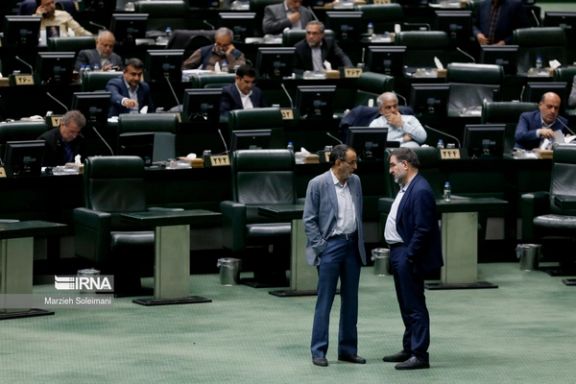
A session of the Iranian parliament on November 13, 2023
Concerns over a breach of Iranians’ privacy are growing as hardliners in the government defend a recent legislation to monitor peoples’ lifestyles online.
The controversial legislation, a clause of Article 75 of the Seventh Development Plan, mandates the Ministry of Islamic Guidance to launch a database consisting of information collected from online activities of individuals for "continuous monitoring and evaluation of cultural indicators, people’s lifestyles, media influence, and communications."
The legislation also requires government agencies and all domestic websites and platforms, including online businesses, to continuously feed their user information to the database.
Media and individuals on social media have extensively criticized the legislation that the parliament approved on November 8 but has yet to be endorsed by the constitutional watchdog, the Guardian Council.
Detractors, including legal experts, express concerns over the lack of assurance regarding the safety of individuals' sensitive personal information, despite a reference to Article 25 of the Iranian Constitution in the legislation. Article 25 explicitly prohibits the government from engaging in spying on citizens' private communications, “unless when required by law.”
Critics argue that this provision would empower any judge to override individuals' right to privacy whenever authorities, including security forces, decide to obtain private information and data derived from an individual's online activities across various platforms. This encompasses information related to travel and transportation, as well as online searches and downloads.
An earlier version of the proposed legislation explicitly outlined that the collected data would be utilized by authorities to "consolidate the Islamic-Iranian lifestyle," aiming to ensure that people's lifestyles align with the perceived Islamic standards of the regime.
In an interview with Ham-Mihan newspaper, Ali Yazdikhah, the deputy chairman of the parliament’s cultural committee, insisted that only "macro-data" would be stored in the database, emphasizing that it would not include information on individual citizens' lives and lifestyles. However, he acknowledged that data inputted into the system, such as individuals' interests or participation in religious ceremonies like Ashura, could be utilized to assess the general interest "in [Islamic] values and sanctities."
Several critics, including lawmaker Moeeneddin Saeedi, who opposes the bill, argue that the more the state engages in cultural engineering, the greater resistance it will encounter from the public. Saeedi stated, "Experience has proven that we have failed to advance indicators of culture with these [engineering] methods," he said during the debate on the parliament floor.
As an example, Saeedi pointed out that the current year's budget law stipulates that mosques conducting prayer congregations twice daily should receive financial incentives. However, he contended that the effectiveness of such measures in encouraging regular prayer is questionable, as over 75 percent of mosques in the country remain inactive due to insufficient attendance, despite the authorities' efforts to revitalize them.
Renowned journalist and social researcher Abbas Abdi told Ham-Mihan newspaper that the gathering of data for social research, if indeed the intended purpose of launching a database, is not inherently new or objectionable. However, he argued that government agencies lack the competence to carry out reliable research projects, and they are neither genuinely interested in nor adequately prepared to discover people's preferences or to publish research results to public.
He highlighted that authorities routinely withhold statistics on sensitive topics, including relationships between men and women, alcohol consumption, addiction, birth rates, age of marriage, and suicide.
“Suppose that they conduct research [based on the data available in the database] about dress code [=hijab], … They can’t publish the results because they are afraid people’s views and beliefs [will be known],” he said.
“However, if they intend to monitor people’s private lives and gather personal information, this would only be for the purpose of controlling and intimidating the public,” he added.
Ahmad Tavakoli, the head of the Civil Coordination in Mazandaran Province, has warned about a significant decline in the Caspian Sea water level, dropping by about four meters since the 1970s.
Tavakoli attributed the change in the world's largest lake to “substantial precipitation and the annual water flow", Iran recently blaming Russia for the crisis, emphasizing the closure of vital entrances, especially the Volga River.
Ali Salajegheh, the head of the Iranian Department of Environment, said the ecological challenge posed by the situation reveals a reduction of approximately one meter over the past 4-5 years, with an average annual recession of 20 centimeters.
His rare criticism against Russia, one of Iran's strongest allies, raised concerns about the ecological impact of dams constructed on the Volga River and the potential damage to delicate ecosystems relying on the Caspian Sea's waters
According to the Central Asia-Caucasus Analyst, it says: "This will have significant and serious implications, including a decline of the sea water level, a considerable retreat of the sea and increase of the land and coastal area especially in upstream countries (Russia and Kazakhstan), challenges to the operation of ports and shipping, as well as environmental consequences, particularly the drying of protected areas and wetlands."
It warned that the water level of the Caspian Sea has decreased by one meter in recent years and could drop by 9 to 18 meters by the end of the 21st century.
US President Joe Biden gives thumbs-up as he walks with Chinese President Xi Jinping at Filoli estate on the sidelines of the Asia-Pacific Economic Cooperation (APEC) summit, in Woodside, California, November 15, 2023.
The United States wants to convey to Iran through China that it does not wish to see an escalation of the Middle East conflict, the White House said Thursday.
US President Joe Biden met China's President Xi Jinping on Wednesday and according to Reuters Washington urged Beijing to use its influence to discourage Iran from taking actions that might aggravate the Israeli-Hamas conflict.
China is Iran's main oil customer despite US sanctions, and lends political support to the Islamic Republic. Tehran has a clear policy of maintaining strong ties to Beijing and Moscow as a counterweight to the United States after four decades of anti-American posturing.
John Kirby, the White House's Coordinator for Strategic Communications at the National Security Council, was questioned after Biden’s meeting with Xi about whether China had given the US assurances about the discussions regarding Iran.
"We certainly would encourage them to use those lines to reiterate to the Iranians that we don't want to see a deepening or an escalation of the conflict in the region," Kirby told Reuters.
Meanwhile, Iranian Foreign Minister Hossein Amir-Abdollahian, during an interview with CBS on Wednesday concerning the ongoing conflict between Israel and Hamas, stated: "We did not want this crisis to escalate."
He also denied Tehran’s involvement in an alleged Houthi drone attack in the Red Sea on Wednesday.
In a similar vein, Reuters also reported that the Iranian regime claims it was unaware of Hamas' invasion of Israel on October 7. Hamas leaders later denied the report on their official Telegram channel and in an interview with Iranian State Iranian state news agency IRNA.
Experts are warning about dire consequences of emigration of skilled workforce, but Iran’s vice-president claims there is no cause for worry.
In an interview with a publication affiliated with Sharif University of Technology, where he serves as a professor, Vice-President for Science, Technology, and Knowledge-Based Economy, Rouhollah Dehghani-Firouzabadi, attributed the apparent increase in the emigration of entrepreneurs and the workforce to the protests of the past year and the disruptions caused by the two-year-long Covid-19 pandemic, which impacted the usual procedures for immigrant acceptance.
He justified his assertion by stating, "If, in previous years, 100 people left, the current figure is 200 people. How many experts do we have? Let’s say 2,000.”
Vice-President for Science, Technology, and Knowledge-Based Economy, Rouhollah Dehghani-Firouzabadi
For those who have lost hope of prospects of positive change in the country, especially among the younger generation representing various backgrounds, emigration appears as the sole avenue toward a more promising life. A recent telephone poll by the US-based Statis Consulting revealed that nearly half of Iranian youth aspire to leave the country, driven by a prevailing sense of pessimism regarding their future in the homeland.
In an article last week, EcoIran, an economic news website, highlighted that the emigration of the workforce is no longer confined to physical relocation.The surge in virtual citizenship and remote work, particularly during and after the pandemic, has contributed to a substantial increase in digital emigration among Iranians. This shift has led to the migration of the activities of creative and expert workforce to international businesses,” the article said while warning that the growing desire to emigrate serves as an 'alarm bell' that has been ringing for several years, yet remains largely unheeded.”
“I’m warning that Iranian entrepreneurs and investors are redirecting their production towards neighboring countries that offer stability," Pedram Soltani, an entrepreneur and former deputy chairman of Iran's Chamber of Commerce, said in October in a tweet on the occasion of the National Export Day while also warning that factories either face the challenges of aging infrastructure and deterioration or continue to operate due to monopolistic control over the domestic market.
"Instability, uncertainties across political and social realms, a lack of a promising outlook for the future, high production risks, ad hoc legislation, and a complex and challenging business environment are cited by experts as some of the primary factors driving the migration of skilled labor from the country," Mahmood Olyaiy (Olyaei), an official of Iran's Chamber of Commerce, told the reformist Ham-Mihan newspaper.
Mahmood Olyaiy (Olyaei), an official of Iran's Chamber of Commerce
He emphasized that warnings to the government regarding the issues stemming from the emigration of skilled workforce have been ignored and there is a lack of clear policies to avert the potential consequences in the coming years.
Olyaiy added that “self-sanctioning and lack of transparency” cause reluctance in the business environment.
In a speech in September, former President Hassan Rouhani criticized the harsh treatment of the intellectual elite, alleging that some within the government are content that they were leaving the country. “They say let them go so others [who support the hardline government] can take their place,” he said.
In its 2022 report published ten months ago, Iran Migration Observatory (IMO) stated that Iran ranked 17th among countries with the highest number of individuals seeking education abroad and 54th among those with the highest emigration rates."
The IMO, a research institute established during Rouhani’s second presidential term at Sharif University of Technology, tracks data and generates analyses on emigration, with a particular focus on informing policymakers. The IMO released the inaugural edition of the Iran Migration Outlook, providing comprehensive data on Iranian migrants globally, international students, and those seeking asylum.
Iranian Foreign Minister Hossein Amir-Abdollahian has denied responsibility for a drone attack that was intercepted by the US Navy in the Red Sea on Wednesday.
According to the Pentagon, a US Navy warship shot down a drone early Wednesday morning that “originated from Yemen and was heading in the direction of the ship.”
Although the Pentagon did not specify who was behind the attack, the incident occurred after Iranian-backed Houthi forces in Yemen earlier this week vowed to target Israeli ships in the Red Sea.
As part of an interview with CBS on Wednesday regarding the ongoing war between Israel and Hamas, Amir-Abdollahian said: "We did not want this crisis to escalate."
The terrorist group Hamas launched a surprise terror attack on Israel on October 7, killing at least 1,200 civilians and taking at least 240 hostages, after which Israel started a massive retaliation against Gaza.
The alleged Houthi attack comes after calls by Iran’s leader Ali Khamenei to ban shipment of oil and food to Israel. His call was repeated by his ultra-hardliner loyalists such as Hossein Shariatmadari, who runs the Kayhan Daily newspaper in Tehran.
The firebrand Hossein Shariatmadari called for blocking "maritime traffic in the Persian Gulf, Bab-el-Mandeb Strait, the Oman Sea, the Red Sea and the Suez Canal,” in a Kayhan Daily editorial, which is funded by the Supreme Leader.
Prior to this, an Iranian ultraconservative lawmaker also claimed on Wednesday that Houthis had targeted Israeli ships after Ali Khamenei had made public statements against Israel.
Mahmoud Abbaszadeh-Meshkini, who sits on the Parliament’s National Security and Foreign Policy Committee, has criticized Amir-Abdollahian for what he called the government’s soft stance towards Israel.
Cut trees at Tehran's historical Sa'dabad Cultural-Historical Complex (November 2023)
The felling of ancient trees in Tehran's historical Sa'dabad Cultural-Historical Complex, home to the Shah's palace, has sparked controversy from environmental activists.
The historical complex constructed by the Qajar and Pahlavi monarchs, sprawling over 110 hectares in northern Tehran, encompasses natural forests, canals, gardens and museums, one of the capital's most famed destinations.
Recent public outrage ensued as images circulated depicting the removal of at least four aged trees on Italy Street in Tehran. Despite claims by eyewitnesses that one tree was “alive”, the municipality asserted that two were entirely “dry”, justifying the action as a precautionary measure to “eliminate the danger.”
Several years ago, a similar incident occurred when trees in the Sa'dabad complex were cut to construct a restaurant. Cultural heritage authorities defended the action, citing the trees as “annoying, obstructive, and pest-infested.”
Despite stringent penalties, including imprisonment, outlined in the Islamic Republic's laws for arbitrary tree cutting, little evidence has shown enforcement. Moreover, there is no reported information on whether municipal authorities have undertaken tree planting initiatives to compensate for the loss of aged and dry trees in Sa'dabad or elsewhere.
Urbanization has long posed a threat to Tehran's historical natural landscapes. The ancient trees that line Tehran's longest boulevard, Vali Asr, have over recent years also fallen victim to redevelopment projects - and even merchants who want better visibility for their shops.
Two years ago, the regime also came under fire for selling its Palm trees to countries including Qatar and Kuwait, the uprooting having devastating effects on the local ecosystem.