An Iranian flag flies above Tehran's sprawling skyline, shrouded in haze, November 9, 2026
Four Iranian reformist intellectuals have urged Tehran to seize an opportunity for diplomacy following Donald Trump's midterm election defeat, while warning that the US president could respond to his political setback by escalating rather than ending the war.
Writing in three articles published in the reformist newspaper Etemad on Sunday, November 8, Mohammad-Javad Haghshenas, sociologist Mahmoud Sadri, international relations analyst Alireza Ghandriz and political analyst Alireza Rajaei offered differing assessments of what Democratic control of Congress could mean for negotiations.
Their shared premise is that the elections have raised the domestic cost of the war for Trump without removing his authority to wage it. Trump himself acknowledged that “part of it was Iran,” while defending his decision to attack.
Haghshenas, a former leader of the National Trust Party, offered the most optimistic assessment, arguing that Tehran should move quickly rather than wait for uncertain political developments in Washington.
Citing reports of a purported letter from Vice President JD Vance proposing direct talks, Haghshenas argued that Vance, a potential contender for the 2028 Republican presidential nomination, had a political interest in ending a war that has damaged his party.
Echoing Qatar's prime minister, he urged both sides to accept a workable agreement rather than hold out for an ideal one.
Making a deal politically possible
Sadri and Ghandriz, writing jointly, argued that any agreement must be politically defensible in both Tehran and Washington.
They warned that Democratic opposition to Trump's handling of the war should not be mistaken for opposition to pressure on Iran.
President George W. Bush, they wrote, responded to the Republican defeat in the 2006 midterm elections by ordering a military surge in Iraq rather than withdrawing.
Citing the gradual normalisation of US-Vietnam relations in 1995 as a model, they proposed starting with limited humanitarian and maritime cooperation before expanding civil, academic and business ties.
Above all, they warned that presenting an agreement in Iran as an American surrender would undermine the very figures in Washington whose support would be needed to sustain it.
The danger of a wounded Trump
Rajaei offered the most guarded assessment, comparing Trump to a political gambler who might raise the stakes rather than accept a visible defeat. He stressed that he was describing political behaviour, not making a psychological judgment.
He outlined three possible scenarios: a limited agreement, continued pressure through sanctions and military threats, or renewed escalation triggered by failed negotiations, Israeli pressure or miscalculation.
Rather than trying to predict Trump's next move, Rajaei urged Tehran to strengthen crisis management, civilian resilience and transparent public communication.
His warning comes as Washington continues to combine diplomatic signals with military and economic pressure.
On the eve of the midterms, Trump said a deal with Iran “could happen,” and Tehran has since conveyed proposals through Qatari mediators. Meanwhile, the US naval blockade and sanctions remain in place.
Reports of preparations for a larger US offensive and the expected arrival of an aircraft carrier group in the region have added to uncertainty.
The conflicting signals make it difficult for Tehran to distinguish genuine negotiating opportunities from attempts to extract concessions under pressure.
Trump's record of abrupt changes in negotiating positions, including his public rejection of Iran's account of the Islamabad memorandum in June, adds to the risks of relying on a sweeping agreement rather than limited, reciprocal steps.
Each reversal could also strengthen Iranian hardliners who argue that Washington cannot be trusted, echoing Supreme Leader Mojtaba Khamenei's November 4 warning against expecting changes in US policy simply because political control shifts between parties.
The three articles offer a snapshot of reformist thinking at a moment when Tehran faces competing pressures to negotiate and maintain its confrontational posture.
Haghshenas sees an opportunity that should be seized quickly. Sadri and Ghandriz argue that any agreement must withstand political opposition on both sides. Rajaei warns that Trump's electoral defeat could encourage escalation rather than compromise.
What unites them is a warning that Trump's electoral defeat is neither an Iranian victory nor a guarantee of American restraint.
FILE PHOTO: U.S. President Donald Trump speaks with Qatar's Prime Minister Sheikh Mohammed bin Abdulrahman bin Jassim Al-Thani during a meeting onboard Air Force One during its refuelling stop at Al Udeid Air Base near Doha, Qatar, October 25, 2025.
Qatar's prime minister held a 45-minute meeting with US President Donald Trump in Washington on Monday amid regional efforts to end the Iran war, following an Iraqi prime ministerial visit to Tehran and a Turkish announcement of planned high-level US-Iran talks in Doha.
Sheikh Mohammed bin Abdulrahman Al Thani, who also serves as Qatar's foreign minister, met Vice President JD Vance separately before his talks with Trump, following a visit to Tehran last week.
The Qatari leader sought to persuade Trump to give diplomacy more time, Axios reported, citing sources familiar with the mediation. Vance has been personally involved in indirect negotiations with Iran over the past two weeks, speaking with Al Thani almost daily.
Qatar has been mediating a proposed agreement under which Washington would ease its naval blockade and release frozen Iranian funds, while Tehran would allow international nuclear inspections and reopen the Strait of Hormuz.
Ibrahim Kalin, head of Turkey’s National Intelligence Organization, said in a conference in Ankara on Monday that Qatar would host Vance and Iran’s Supreme National Security Council secretary Mohsen Rezaei next week, Türkiye newspaper reported.
Kalin said the planned Doha meeting could help advance negotiations between Washington and Tehran. He warned that failure to reach an agreement could lead to another US attack on Iran.
IRGC-affiliated Tasnim news agency subsequently cited an unnamed senior security official in Tehran as denying that such a meeting was planned.
“Iran’s policy and plans regarding negotiations have not changed, and until the American side takes practical action within the framework of the seven conditions, no plans for negotiations with the American side will be considered,” the official said.
The diplomatic activity followed talks in Tehran on Friday between Iraqi Prime Minister Ali Falih al-Zaidi and Iran’s chief negotiator Mohammad Bagher Ghalibaf, according to IRGC-affiliated Fars news agency.
Citing an informed source, Fars said Zaidi’s visit lasted several hours and focused exclusively on Iraq’s efforts to end the war between Iran and the United States.
Ghalibaf outlined Iran’s “two-day plan” and said Washington needed to respect Iran’s rights within that framework for negotiations to advance, the source said.
Iran’s proposal would halt US bombing, ease sanctions and end the US blockade of Iranian ports in exchange for reopening Hormuz, with nuclear negotiations to follow, Reuters reported.
US Secretary of State Marco Rubio said on Sunday that a breakthrough was not imminent, describing Iranian conditions as “outrageous and ridiculous and really not realistic.”
The diplomatic push comes after President Donald Trump played down the prospect of escalating the war in a “60 Minutes” interview aired on Sunday.
“Well I’m not looking to. I don’t think there’s any reason to,” Trump said when asked whether he would escalate the conflict following the US midterm elections.
‘Seven-point agreement’
Speaking at “The Search for a New Regional Social Contract in the Middle East” conference in Ankara, Kalin said Turkey and other regional mediators were working on a seven-point agreement, with the main disagreement concerning which side should act first.
The proposed plan envisages lifting sanctions against Iran and releasing frozen Iranian assets. In return, Tehran would commit not to develop nuclear weapons, begin negotiations with the International Atomic Energy Agency and lift its blockade of the Strait of Hormuz, according to Türkiye newspaper.
Kalin urged Tehran to show greater flexibility and warned that the next few days could be decisive.
A severely damaged car following a collision with a truck on a road in Iran, with an ambulance at the scene.
More than 78,500 people have died in road accidents in Iran over four years, yet the government is seeking to delay new vehicle safety standards despite repeated warnings about the quality of domestically manufactured cars.
Road accidents killed 10,357 people in the first six months of the current Iranian calendar year, ILNA news agency reported on Sunday, November 8, citing figures released a day earlier by Iran's Forensic Medicine Organization.
The figure was down just 0.4 percent from 10,401 deaths during the same period last year.
Another 224,220 people injured in road accidents were referred to forensic medical centers during the six-month period, an increase of 10.8 percent from a year earlier.
Industry minister seeks delay in safety standards
Poor-quality vehicles, unsafe roads and ineffective public education are among the main causes of Iran's road safety crisis, according to critics who say authorities have failed to address the underlying problems.
Traffic police chief Teymour Hosseini has previously urged the Ministry of Industry and the National Standards Organization to improve vehicle safety, arguing that higher traffic fines alone cannot reduce fatalities without safer roads, better-equipped cars and stronger enforcement.
However, Industry Minister Mohammad Atabak asked First Vice President Mohammad Reza Aref in a letter dated November 6 to postpone the implementation of new vehicle safety standards by at least one year.
Atabak cited foreign currency shortages, the country's emergency conditions and automakers' inability to invest in developing and redesigning vehicle platforms as reasons for the request.
If approved, the postponement would allow manufacturers to continue production under existing regulations, delaying an increase in mandatory vehicle standards from 85 to 122 requirements, along with new fuel consumption rules.
The proposed delay comes despite repeated warnings about vehicle safety and the country's persistently high road death toll.
"People die in road accidents because of their poor driving, and it has nothing to do with the quality of domestically manufactured cars," Mostafa Mirsalim, a member of Iran's Expediency Council, said on November 8.
Emergency responders attend the scene of a road accident involving a damaged car on a highway in Iran at night.
Mirsalim also described criticism linking domestic vehicle quality to road fatalities as unfair accusations against automakers.
Road accidents kill 78,510 in four years
Annual figures from Iran's Forensic Medicine Organization show that road deaths rose from 16,778 in the year ending March 2022 to 19,490 in the year ending March 2023.
Fatalities reached 20,045 in the year ending March 2024, the highest figure in the five-year period, before falling to 19,435 in the year ending March 2025 and rising again to 19,540 in the year ending March 2026.
Together, road accidents killed 78,510 people between March 2022 and March 2026, with annual deaths exceeding 19,000 throughout the four-year period.
Iran launched a national "No to Accidents" campaign in 2025 to reduce traffic fatalities, but ILNA questioned whether short-term initiatives could address the scale of the problem.
"It is unrealistic to expect that short-term campaigns and general recommendations can contain a crisis rooted in a combination of human, technical, infrastructural and managerial factors," ILNA wrote.
The news agency called for measurable targets and deadlines for the institutions responsible for road safety, including the Ministry of Roads, the Road Maintenance and Transportation Organization, municipalities and emergency medical services.
Young adults account for largest share of deaths
People aged 18 to 24 accounted for the largest share of road fatalities during the first six months of the current Iranian year, with 1,868 deaths, representing 18 percent of the total.
Another 1,555 victims were aged 30 to 39, while 1,514 were between 40 and 49 years old.
The fatalities also included 455 children aged 10 or younger.
Health Minister Mohammad Reza Zafarghandi described the roughly 20,000 annual road deaths as one of Iran's demographic challenges on June 16. Zafarghandi had previously said that 26 percent of road accident deaths were preventable.
The high number of young victims also raises questions about the government's population policies, which emphasize increasing birth rates and supporting infertility treatment.
"Population growth policies cannot be limited to encouraging childbirth and supporting infertility treatment. Preserving the lives of people already living in the country is equally important," ILNA wrote.
Hardliners wearing symbolic burial shrouds rally outside the IRGC headquarters in Tehran on Nov. 5, 2026, demanding military action over threats against Supreme Leader Mojtaba Khamenei, in a screengrab from video published by Tabnak.
A group of hardline women wearing white burial shrouds rallied outside the Revolutionary Guards headquarters in Tehran, accusing the armed forces of defying Supreme Leader Mojtaba Khamenei amid demands for retaliation over threats against him.
The protest drew a sharp rebuke from Tabnak, a news website linked to Secretary of Iran’s Supreme National Security Council Mohsen Rezaei, which published commentary accusing the demonstrators of turning against state institutions and warning that action against their movement had begun.
Protesters carried placards warning of threats to Khamenei’s life. “The Imam’s life is in danger. Act now. Tomorrow will be too late,” read one handwritten sign.
A yellow banner addressed military commanders, saying Khamenei’s October 31 order for an “immediate, effective strike without geographical limits” in response to threats remained unfulfilled. “They have threatened the Imam again!” it declared. “Obey before it is too late.”
A speaker over a loudspeaker cited Khamenei’s statement before protesters chanted: “Beware, O armed forces, of defying the leader! Shame on us [if we stand by]!”
An IRGC representative came out to address the protesters, delivering what he said was a message from the Guards commander. He said conditions prevented commanders from meeting them in person and urged them to leave: “This area is not safe. The enemy could exploit the situation at any moment. Please clear the area.”
A woman leading the protest then issued an ultimatum: “If the threat against the Imam’s life is not avenged within 24 hours, we sisters will turn this place into Fatima’s House of Sorrows,” invoking a Shiite symbol of mourning associated with the Prophet Muhammad’s daughter.
The hardliners previously held a similar rally outside the headquarters of Iran’s Armed Forces General Staff, where they described their sit-in protest as an “affectionate reprimand.”
They said they were tired of “empty boasts.” Their statement also equated calls for sustainable development and lasting peace with disarmament, arguing that such ideas were preventing military retaliation against the enemy, according to Ensaf News.
Journalist Masoud Kazemi told Iran International the group, known as Toueh, viewed itself as representing Mojtaba Khamenei’s positions and demanded full implementation of statements attributed to him.
Its demands included dissolving the Supreme National Security Council, and returning its powers to the supreme leader, Kazemi said. The protesters opposed negotiations and regarded those conducting them as traitors, he added.
The rally held on November 5 follows months of pressure from hardliners demanding revenge for Ali Khamenei’s killing in a February 28 airstrike. His son and successor pledged in July that retaliation would be carried out, intensifying pressure on officials pursuing diplomacy with Washington.
Tabnak quoted Hossein Soleimani, editor-in-chief of the IRGC-affiliated Mashregh News, identifying the protesters as the same group that previously occupied Ravagh-e Keshvardoust, a Tehran mourning site near where the former leader was killed.
In June, the site closed after the shroud-wearing hardliners staged a three-day sit-in demanding vengeance. The protesters had also called for the execution of officials involved in negotiations with the United States.
Soleimani accused the group’s leaders of convincing followers that virtually the entire establishment had betrayed the leader, nation and country. Their confrontation, he wrote, targeted state institutions rather than Israel or the United States.
He said the group had been monitored and repeatedly warned but had mistaken the Islamic Republic’s tolerance for permission to continue. Describing the movement as a worsening “cancerous tumor” requiring “surgery,” he added: “That surgery has already begun.”
The conservative newspaper Khorasan also criticized the rally, suggesting the women had either come to believe repeated accusations of betrayal against officials or were being deliberately fed selective information by a political faction exploiting their emotions to pressure commanders.
The hardliners’ ability to rally outside military headquarters stands in stark contrast to the treatment of anti-government protesters. Security forces have repeatedly used lethal force to suppress demonstrations across Iran, including during January’s protests and earlier waves of unrest, while loyalist demonstrators have been able to gather outside some of the country’s most sensitive military sites.
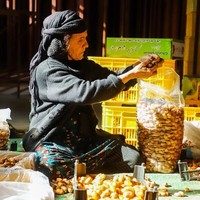
A worker packs dates in Ghasr-e Shirin, western Iran, November 5, 2026
While Tehran celebrates Donald Trump's midterm defeat and the economic pain the Iran war has inflicted on Americans, soaring prices and stagnant wages are pushing ordinary Iranians deeper into a cost-of-living crisis at home.
Senior Iranian officials have come close to claiming credit for the Democrats' sweeping election victory, frequently pointing to US officials' acknowledgment that the war contributed to Republican losses.
Many Iranian newspapers have followed suit, dwelling on America's economic and political troubles while portraying Iran as a country growing stronger despite the war.
"Ever-Stronger Iran on the Road to Progress," one economic daily declared on its front page on Thursday. Another proclaimed "American Humiliation Continues," alongside a photograph of a seemingly dejected Trump.
The hardline daily Kayhan highlighted what it described as €127 billion in European losses resulting from the closure of the Strait of Hormuz, presenting the economic damage as a measure of Tehran's success.
Largely absent from those triumphant headlines was the economic crisis that matters most to ordinary Iranians: the soaring cost of living.
The labour-focused news agency ILNA offered a starkly different picture, reporting that the estimated cost of basic household necessities had nearly doubled in seven months to 85 million tomans a month, almost six times the monthly earnings of an ordinary worker.
Labour expert Hamid Haji-Esmaeili told ILNA that inflation had become "normalised" in the thinking of Iranian officials, criticising the government's inadequate response and calling for wages to be revised midway through the year.
Pay levels set at the beginning of the Iranian calendar year no longer reflected economic realities, he argued, warning that the crisis was no longer confined to low-income workers but also affected civil servants and large sections of the middle class.
Economist Ali Ghanbari, also quoted by ILNA, described Iran as facing a "livelihood crisis", warning of a severe decline in the purchasing power of lower-income households.
Another ILNA report highlighted delayed wage payments for contract workers in Iran's southern oil-producing regions, adding to the uncertainty facing employees already struggling with inflation.
Growing calls to expand food-support programmes suggest that wages alone are no longer sufficient to protect many households from the rising cost of essential goods.
Years of inflation, currency depreciation, sanctions and inadequate investment had already eroded living standards. Two rounds of war in 2025 and 2026, and the subsequent US blockade of Iran's maritime trade, have compounded those pressures.
The government's response has come under increasing criticism, particularly over its failure to adjust wages and pensions to reflect the rapidly rising cost of living.
Pensioners have been among the most vocal groups demanding action. ILNA reported calls for authorities to restore their purchasing power immediately, as housing, healthcare and other essential expenses consumed an increasing share of their incomes.
In another report, a representative of military pensioners' organisations criticised repeated discussions about wage increases that had produced no concrete results.
He warned against creating "false hope" among pensioners frustrated by promises of financial relief that have yet to translate into higher payments.
Pensioners are among Iran's more organised social groups and have staged repeated demonstrations in recent years over inadequate incomes and rising prices.
Yet the emphasis in hardline political rhetoric remains on the costs Iran has imposed on its adversaries.
The closure of the Strait of Hormuz and its impact on international energy markets have been presented as evidence of Tehran's leverage over Western economies.
Such claims of success sit uneasily alongside accounts of hardship emerging from Iran's own media, where journalists operate under restrictions on reporting deemed damaging to the Islamic Republic's image.
For workers awaiting overdue wages and pensioners demanding relief, the economic pain inflicted on Iran's adversaries offers little consolation. Their immediate concern is whether they can pay next month's rent and put food on the table.
Iranian commentators are divided over JD Vance's remarks on the political costs of the war with Iran, with some seeing evidence of tensions within the Trump administration and others warning that he may be trying to lure Tehran into a disadvantageous deal.
In a post on X on Wednesday, Vance identified ending the war and reassessing relations with Israel among the priorities of voters who supported Donald Trump in 2024 but switched to Democrats in Tuesday's midterm elections.
Iran's parliament speaker and chief negotiator, Mohammad-Bagher Ghalibaf, quoted Vance's post to challenge the Trump administration's approach to the war and its relationship with Israel.
Iranian media have since offered differing interpretations of Vance's intentions and his influence over US policy.
The analytical website Vana News said the vice president's remarks highlighted differences in how senior US officials assessed the costs and future of the war, but cautioned against interpreting them as evidence of an irreconcilable rift.
“Differences in perspective do not necessarily mean a breakdown in political cooperation or an irreconcilable conflict between the president and his deputy,” Vana News wrote, adding that it remained unclear whether such differences would affect Washington's policy decisions.
‘Self-interest’
Mohsen Zahedi-Movahed, a retired diplomat and international affairs analyst, was more emphatic.
“Vance's admission that the war was the first reason voters were angry with Republicans is extremely important. How will Trump respond? The divide they wanted to create among Iranian leaders has now come back to haunt them!” he wrote on X.
Ali Nasri, a pro-government commentator, argued that Vance's apparent differences with Trump over Israel predated the Republican election defeat.
“[Vance realised] that his own political future and the survival of the entire America First movement depend on distancing himself from Israel and ending the war with Iran,” Nasri wrote on X. “We paid a heavy price to reach this position of strength,” he added.
‘Prelude to war’
But Parisa Nasr, a hardline journalist, warned against interpreting Vance's remarks as an encouraging sign, describing them as “another episode in Vance's double game.”
She accused Vance of pursuing an electoral and geopolitical manoeuvre designed to appeal to American voters while encouraging Iranian officials who favour an agreement with Washington.
Nasr also linked the remarks to mediation efforts by Qatar and Pakistan, warning that Tehran could be drawn into an agreement that would leave it vulnerable to renewed conflict.
“Even if it leads to an immediate asymmetric agreement, it is a prelude to the next war and poses a very serious danger,” she wrote.
Diplomacy continues
Asked on Wednesday whether he agreed that the war had contributed to the Republicans' defeat, Trump said it was “largely true” but defended his decision to attack Iran, insisting that military action was necessary to prevent Tehran from acquiring a nuclear weapon.
The debate over Vance's intentions comes against the backdrop of a letter he sent in late October to Mohsen Rezaei, secretary of Iran's Supreme National Security Council, to which Tehran has not formally responded.
According to US media reports, Vance called for the immediate start of comprehensive negotiations, including on Iran's nuclear programme, and expressed his readiness to lead the American delegation in talks with Iranian officials.
Rezaei said on October 31 that he had read the letter, delivered through Qatar, but had not yet responded. He described its tone as different from previous communications from Washington, calling it “a good sign” that demonstrated Iran had consolidated its power.
Foreign Ministry spokesman Esmail Baghaei struck a more cautious note on November 2, saying Tehran would judge Washington by its actions rather than the tone of its letters.