• العربية
  • فارسی
BrandBrand
  • Iran Insight
  • Politics
  • Economy
  • Analysis
  • Special Report
  • Opinion
  • Podcast
  • Live TV
  • Iran Insight
  • Politics
  • Economy
  • Analysis
  • Special Report
  • Opinion
  • Podcast
  • Live TV
  • Theme
  • Language
    • العربية
    • فارسی
  • Iran Insight
  • Politics
  • Economy
  • Analysis
  • Special Report
  • Opinion
  • Podcast
  • Live TV
All rights reserved for Volant Media UK Limited
volant media logo

State TV calls Iran’s northern sea by its English name, citing Israeli agenda

Oct 13, 2026, 16:19 GMT+1
The name Caspian Sea seen on a map on Iran's state TV

Iranian state television has begun referring to the country’s northern sea as Caspian in Persian, a departure from the customary Khazar, after airing claims that the older familiar name serves alleged Israeli ambitions in the Caucasus.

Caspian takes its name from the Caspians, an ancient people who lived along the sea’s southwestern shores in modern Iran. Khazar refers to the Khazars, a medieval Turkic people whose state lay to the north and northwest of the sea and whose ruling elite adopted Judaism.

It remains unclear whether Iran’s state broadcaster has issued a formal directive to change its terminology across programs. However, the name change brings attention to competing arguments over history and national identity.

Supporters of Caspian describe it as a restoration of Iranian heritage, while opponents say Khazar is itself a deeply rooted geographical name whose use does not endorse the people it originally described.

State TV’s website features a segment from IRGC-affiliated Ofogh channel’s “War Headquarters” program with commentator and academic Ahmad Kazemi under the title “The Zionists’ plot to change the name of the Caspian Sea to Khazar.”

In remarks also shared by the IRGC-affiliated Fars News, Kazemi portrayed the use of Khazar as supporting an Israeli historical claim.

“By using the non-Iranian word Khazar today, we are effectively helping Israel’s thesis that seeks to prove the existence of a Jewish empire in the Caucasus,” he said.

100%
The name Caspian Sea in Persian on another Iranian state TV program aired on Tuesday Oct. 13 , 2026.

Kazemi said people outside Iran mocked Iranians for using what he described as a foreign name while others used Caspian. He described the Caspians as an Iranian people who had lived across areas stretching from Kashan to Mazandaran and the Caspian coast.

His remarks did not provide evidence of an Israeli effort to influence the sea’s Persian name.

An appeal to Iranian heritage

For English-speaking audiences, the distinction can be easy to miss: the body of water is already called the Caspian Sea in English. The question is what Iranians should call it in Persian.

Campaigns to replace Khazar predate the television material. A petition addressed to the parliament speaker, the head of state broadcasting and the education minister calls for Caspian to be used in official sources, describing it as an authentic Iranian name.

Mohammad Ebrahim Zarei, then acting head of Iran’s Research Institute of Cultural Heritage and Tourism, also proposed using Caspi or Caspian at an annual gathering of Iranian archaeologists in 2025, arguing that it was the older name.

Caspian derives from the Caspians, an ancient people who lived along the sea’s southwestern shores. Encyclopedia Iranica identifies them in ancient sources while noting uncertainties about their precise location and linguistic background.

Khazar, meanwhile, derives from the medieval Khazars, whose state lay to the north and northwest of the sea. The name has been used in regional geographical writing for centuries.

The sea has also been known in Iran as the Mazandaran Sea, a name previously used in official contexts. During Mohammad Khatami’s presidency, a 2002 naming decision standardized Khazar for domestic use and Caspian for foreign texts and international agreements.

That policy favored an already established name over alternatives such as Mazandaran, rather than introducing Khazar for the first time.

Objections to replacing Khazar

Political geographer Pirouz Mojtahedzadeh offers a different argument, saying established geographical names should not be changed because of political, ethnic or religious objections to their origins.

He argued that abandoning Khazar over alleged Israeli claims to the region would accept the premise of those claims rather than challenge them. He also warned that changing the sea’s name would undermine Iran’s opposition to attempts to rename the Persian Gulf.

“Would you not, in practice, have justified and endorsed Arab efforts to change the geographical name of the Persian Gulf?” he asked supporters of replacing Khazar.

More recently, objections to the campaign have appeared on the website of the Islamic Revolution Documents Center.

In an August article, Arash Nasiri challenged the argument that the Khazars’ ethnic origins, military history or association with Judaism justified abandoning the name.

Some Khazar rulers adopted Judaism, but treating the entire population as uniformly Jewish oversimplified the historical record, he wrote.

Nasiri also argued that using a geographical name did not mean endorsing the conduct or beliefs of the people from whom it originated. Khazar had become an established part of Persian usage, extending beyond its association with a medieval people.

Caspian was historically valid, he wrote, but presenting the choice as “Iranian Caspian” versus “foreign Khazar” reduced a complex history to a political distinction.

Most Viewed

Tehran seizes on Rubio’s Xerxes remarks to champion a past it once disparaged
1
INSIGHT

Tehran seizes on Rubio’s Xerxes remarks to champion a past it once disparaged

2

Iran officials hinted at land incursions if US resumes strikes - WSJ

3

Iran hardliners back threats to strike Persian Gulf digital infrastructure

4

Meta, Google remove Iran matchmaking app after child marriage report

5

Iran-US diplomacy stalls as Houthi attacks on Saudi Arabia intensify

Spotlight

  • Tehran raises the stakes, betting Washington will blink
    ANALYSIS

    Tehran raises the stakes, betting Washington will blink

  • Houthi airport strikes carry echoes of Iran’s aviation threats, experts say

    Houthi airport strikes carry echoes of Iran’s aviation threats, experts say

  • Iran hardliners back threats to strike Persian Gulf digital infrastructure

    Iran hardliners back threats to strike Persian Gulf digital infrastructure

  • Can US sanctions derail Iran’s China trade route?
    ANALYSIS

    Can US sanctions derail Iran’s China trade route?

  • Machete-wielding men at IRGC-backed rally revive scrutiny of crackdowns
    ANALYSIS

    Machete-wielding men at IRGC-backed rally revive scrutiny of crackdowns

Banner
Banner
Banner
Banner
•
•
•

More Stories

Gunfire heard as county-naming protest turns violent in central Iran

Oct 13, 2026, 11:00 GMT+1
100%

A protest over the name of a newly created county in central Iran turned violent after security forces moved to disperse demonstrators, with videos sent to Iran International capturing gunfire, tear gas and injured protesters.

The gathering took place on Sunday in Meymeh, a city in Isfahan province, where residents have objected to the new administrative district being named “Meymeh and Vazvan” rather than simply “Meymeh.”

Videos received by Iran International show demonstrators in the streets, tear gas in the area and people with bloodied clothing receiving medical treatment. Gunshots can also be heard, although it was not immediately clear what type of ammunition was used.

The number of people injured or detained remains unclear.

Local dispute over county name

Residents of Meymeh had campaigned for around two decades for their district to be upgraded to county status. The government eventually approved the change but in August 2024 named the new county Meymeh and Vazvan, combining the names of two cities.

Some Meymeh residents argue that their city’s historical identity should be reflected in the county name and have repeatedly called for the decision to be reversed. Officials have said the name should also recognize Vazvan.

The dispute culminated in Sunday’s street protest shortly before the new county administration was due to begin operating.

Footage showed some protesters carrying Islamic Republic flags and portraits of late Supreme Leader Ali Khamenei, underscoring the local nature of the dispute rather than an explicitly anti-government demonstration.

Security presence increases

The protest continued into the evening before security forces intervened and fired tear gas, according to videos and information received by Iran International.

Witnesses told Iran International that several protesters were wounded and detained, including some who were later taken into custody at hospitals. Iran International could not independently establish the number of arrests or verify the circumstances of each reported injury.

Reports from Meymeh on Tuesday indicated an increased security presence following the confrontation.

Over 90 killed in six months as clashes escalate in Iran's southeast - report

Oct 12, 2026, 18:52 GMT+1
100%

Armed attacks and security operations in southeastern Iran have left at least 94 people dead and 33 wounded since March 31, with fighting growing more frequent and involving heavier weapons, US-based human rights group HRANA reported Monday.

The group recorded at least 63 armed incidents between March 31 and October 10, especially in Sistan and Baluchestan province.

The escalation has coincided with the US and Israeli conflict with Iran. HRANA said Iranian authorities had focused much of their attention on western and northwestern Iran while a sustained pattern of armed attacks and security operations developed in the southeast.

Attacks on patrol vehicles and military convoys were the most common incidents, with 17 recorded cases, followed by 14 targeted shootings. Seven of the shootings occurred outside victims' homes or workplaces or along their commuting routes.

HRANA also reported a shift toward heavier weapons and more complex attacks.

On October 2, a vehicle allegedly linked to the IRGC Quds Force's Fatemiyoun Brigade was targeted with a booby trap and gunfire near Zahedan.

Five days later, an attack on a police headquarters in Jalegh reportedly involved mines, rocket-propelled grenades and semi-heavy weapons. On October 9, a roadside bomb struck the route of a police convoy near Zahedan.

The People’s Fighters Front, an alliance formed in December 2025 that includes Jaish al-Adl and smaller Baluch armed groups, claimed six of the attacks documented by HRANA, while Ansar al-Furqan claimed one. Most attacks remained unclaimed or could not be reliably attributed, HRANA said.

Government forces also used drones, artillery, armored vehicles and heavy weapons in several operations, HRANA said. In Jahadabad, Gharibabad and Manzalab, homes and sites of armed confrontations were demolished, blown up or set on fire.

The report warned that the use of such weapons in residential areas increased the risk of civilian casualties and property damage.

The region has a long history of clashes between Iranian security forces and Sunni Baluch militants. Jaish al-Adl emerged around 2012 as a successor to Jundullah and has repeatedly targeted security forces, including in a 2019 suicide bombing that killed 27 Revolutionary Guards.

Tehran seizes on Rubio’s Xerxes remarks to champion a past it once disparaged

Oct 12, 2026, 14:08 GMT+1
100%
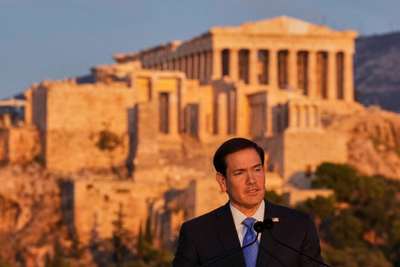
US Secretary of State Marco Rubio speaks at the Pnyx hill, where ancient Athenians held democratic assemblies, with the ancient Parthenon temple atop the Acropolis in the background, in Athens, Greece October 7, 2026.

Marco Rubio’s invocation of ancient Persia in a speech championing Western power has given Tehran an opportunity to present itself as a defender of Iranian identity, even as critics recall the Islamic Republic’s own record of disparaging pride in the country’s pre-Islamic rulers.

The US secretary of state’s October 7 address in Athens drew on Xerxes’ invasion of Greece in 480 BC to celebrate Western resilience, before contrasting Western traditions of sacrifice with what he called the Iranian leadership’s “cult of death.”

The remarks drew objections even from critics of the Islamic Republic, who argued that opposition to clerical rule does not diminish Iranians’ attachment to their ancient history.

Iranian officials seized on that sensitivity to cast themselves as defenders of the country’s ancient heritage. Parliament speaker Mohammad Bagher Ghalibaf accused Iran’s adversaries of seeking to erase ancient civilizations and warned Washington that it would meet the fate of Persia’s defeated enemies.

“Those who chase Alexander’s legacy will share Valerian’s fate: you will kneel,” he wrote on X on Friday, referring to the Roman emperor captured by the Sasanian king Shapur I.

The history Khamenei dismissed

That embrace of ancient Persian power contrasts with slain Supreme Leader Ali Khamenei’s criticism of the very campaign Rubio recounted.

Addressing army commanders in April 2012, Khamenei cited Xerxes’ invasion of Greece as an example of military force serving rulers’ political ambitions rather than national interests. He described an army returning defeated, its ships wrecked, and associated the campaign with Iran’s historical taghut, a religious term used to condemn illegitimate or ungodly rule.

“These were not for national interests,” he said.

In 2018, Khamenei dismissed pride in the rule of the ancient Kayanian and Achaemenid dynasties as illusory, arguing that national esteem should rest on tangible achievements in contemporary society.

Those remarks complicate the authorities’ present effort to speak for Iranians offended by Rubio’s account. One Persian-language X user mocked government supporters’ sudden concern for Xerxes, contrasting it with their past ridicule of ancient Persian figures and people visiting historical sites.

The struggle over these symbols predates the current war. During Nowruz in March 2025, crowds gathered at Persepolis and the tombs of Hafez and Ferdowsi while authorities promoted religious mourning coinciding with the holiday.

After the June 2025 war with Israel and the United States, patriotic music entered the leadership’s own ceremonies: Khamenei asked eulogist Mahmoud Karimi to perform “Ey Iran Iran” at a July mourning gathering, a separate song from the better-known anthem.

Later, media reports documented a statue of the mythical archer Arash in Tehran, banners likening Iranian missiles to his legendary arrows, and a billboard depicting Benjamin Netanyahu kneeling before an ancient Persian emperor.

By November 2025, authorities had also unveiled a statue depicting Valerian’s submission to Shapur I. Such imagery associated the state’s confrontation with foreign powers with a national history reaching far beyond the Islamic Republic.

A propaganda opening

Speaking at the Pnyx with the Acropolis behind him, Rubio recounted the Persian destruction of Athens’ sanctuaries and the city’s subsequent rebuilding. He also praised the Spartans’ last stand at Thermopylae, presenting ancient Greek traditions as foundations of Western courage, ambition and duty.

His explicit attack on contemporary Iran targeted its rulers, whom he called “radical mullahs.” But placing that criticism within a speech celebrating resistance to Persian armies prompted objections to the implied continuity between ancient conflict and today’s war.

Historian Touraj Daryaee told the Tehran Times that treating the ancient wars as a confrontation between East and West misrepresented a conflict between an empire and Greek city-states. He also challenged the use of that history to frame the present conflict.

Questions about Rubio’s historical framing also came from admirers of the speech. Writing in the Spectator, Alexander Munguía praised its defense of the West but argued that its celebration of relentless ambition better resembled Alcibiades, who championed Athens’ disastrous expedition to Sicily, than Pericles, whose wartime strategy emphasized restraint.

US-based Iranian journalist and analyst Omid Memarian warned on X that Rubio “may have just handed Tehran one of the biggest propaganda gifts of this war.”

“It just reframes this war as a civilizational clash. And that plays directly into Tehran’s hands,” he wrote, arguing that the rhetoric helped authorities portray Washington as an enemy of Iran itself rather than its government.

The State Department did not immediately respond to Iran International’s request for comment on the criticism and whether Rubio intended to draw a parallel between ancient Persia and today’s Iranian government.

A distinction between Iran and its rulers

Iranian political analyst Nejat Bahrami disputed the interpretation of Rubio’s speech as an attack on Iranian civilization.

“Rubio’s speech was part of a broader theme that he, the current Trump administration and right-wing political figures in Europe have pursued in recent years: that the West must return to its roots, resist the erosion of Western civilization and preserve Western values,” he told Iran International.

“Contrary to the fuss made by the Islamic Republic, Rubio did not attack Iranian civilization in the speech. He referred to a historical event: the Persian attack on Athens and the destruction that followed, before describing how the Greeks returned and rebuilt. His point was that the West today should similarly follow their example of determination and resilience.”

Rubio had previously drawn an explicit distinction between Iranians and their rulers. At his January 2025 Senate confirmation hearing, he praised Iran’s ancient civilization and culture and Iranians’ pride in their Persian heritage, saying he knew of no country with a greater divide between its people and those governing them.

War puts Iran’s nuclear ambiguity under scrutiny

Oct 10, 2026, 19:54 GMT+1
•
Behrouz Turani
100%
A portrait of slain Supreme Leader Ali Khamenei beside his tomb in Mashhad, Iran.

A revisionist argument is emerging in Tehran over Iran’s nuclear strategy: that its longstanding policy of nuclear ambiguity failed its most important test when it did not deter the United States and Israel from attacking, and should now be reconsidered.

Nezamoddin Mousavi, a former conservative lawmaker with longstanding ties to the Islamic Revolutionary Guard Corps (IRGC), gave unusually explicit expression to that argument this week, declaring that “nuclear ambiguity did not prevent war” and raising the prospect of revisiting Iran’s nuclear doctrine and even its membership in the Nuclear Non-Proliferation Treaty (NPT).

Mousavi, who helped found IRGC-linked media outlets, made the remarks in an interview with Ensaf News, a website close to President Massoud Pezeshkian.

Senior Iranian officials have previously hinted that Tehran could change its nuclear doctrine if sufficiently threatened. But such warnings have generally been directed outward, rather than framed as criticism of an established policy favored by slain Supreme Leader Ali Khamenei.

Mousavi, however, is effectively arguing that a policy intended to preserve strategic uncertainty while stopping short of weaponization failed to provide the deterrence its architects expected.

That diagnosis feeds into a wider debate over what lesson Iran should draw from the war: whether the failure was one of deterrence, requiring greater military leverage, or of escalation management, requiring a different approach to diplomacy.

Iran has long cited Khamenei’s fatwa prohibiting the possession and use of nuclear weapons when confronted with accusations that it might seek a bomb.

Critics, however, have questioned how absolute that prohibition would prove in an existential crisis, especially since Khamenei’s predecessor and founder of the Islamic Republic, Ruhollah Khomeini, held that preserving the state was paramount, taking precedence even over religious obligations.

Against that backdrop, Mousavi said Tehran should reassess its international commitments, the value of NPT membership and its broader deterrence strategy following attacks on Iran’s nuclear facilities.

He stopped short of explicitly advocating the acquisition of nuclear weapons.

His reasoning amounts to three premises and a conclusion: Iran refrained from building a nuclear weapon; ambiguity was supposed to contribute to deterrence; yet Iran was attacked and senior leaders and military commanders were killed. The assumptions underlying Iran’s deterrence strategy, he argues, must therefore be reconsidered.

Beyond Khamenei

Mousavi also ventured into another sensitive subject: whether Khamenei’s death would fundamentally alter Iran’s strategic direction.

He argued that he would not expect dramatic change. Foreign and security policy, he said, is not simply the product of one individual but of institutional thinking and long-term calculations developed over decades.

It reflects a distinctly conservative view of regime continuity: leaders matter, but institutions matter more. Major strategic directions, in this reading, are unlikely to change abruptly regardless of who occupies the highest office.

That also gives the nuclear debate greater significance. If Iran’s strategic direction is fundamentally institutional rather than dependent on one leader, the lessons the establishment draws from the war could outlast the present leadership.

Deterrence or de-escalation?

Not everyone in Tehran is drawing the same lesson.

An article published Wednesday in Etemad newspaper highlighted a competing strand of Iranian political thinking. Where Mousavi sees a failure of deterrence, more moderate voices see a failure to manage escalation.

The hardline argument holds that the United States and Israel seek to weaken Iran regardless of its diplomatic behavior and that negotiations cannot guarantee security while military pressure continues.

The more moderate argument sees the conflict as the product of a broader strategic environment shaped by political, regional, military and economic pressures. For this camp, the lesson is not necessarily that Iran needs greater deterrence, but that it needs more effective crisis management.

The emerging argument in Tehran, then, appears to be shifting from how this war ends to what lesson should be drawn from it: whether greater military and potentially nuclear deterrence offers the best protection against another conflict, or whether security ultimately depends on preventing the next escalation before it begins.

Iran turns on Pakistan as Saudi defense pact takes effect

Oct 9, 2026, 15:23 GMT+1
•
Maryam Sinaiee
100%
Military vehicles travel along a road during what Saudi-backed Yemeni government forces say was an advance against the Iran-backed Houthis, near Dhubab, Taiz Governorate, Yemen, in this still image taken from video released October 5, 2026.

Iran has sharpened its criticism of a Saudi Arabia-Pakistan-Turkey defense pact after it became operational, warning against intervention in Yemen and questioning Pakistan’s role as a mediator between Tehran and Washington.

The trilateral pact entered its operational phase on October 5 following an escalation in Houthi missile and drone attacks on Saudi infrastructure. Turkey and Pakistan said they had begun taking measures to support Saudi Arabia.

Under arrangements discussed by the three countries, Pakistani and Turkish forces are expected to provide military, technical and intelligence support to Saudi Arabia, including defensive capabilities inside the kingdom. Officials have said the forces will not take part in offensive operations in Yemen.

Iranian Foreign Ministry spokesman Esmail Baghaei, asked on Sunday about reports that tens of thousands of Pakistani troops could be deployed to Saudi Arabia, said: “We have also heard this rumor, and we hope it is not true.”

“The countries of the region are well aware that any intervention in the Yemen issue could have undesirable consequences for the region,” he added, expressing hope that pacts such as the Mecca agreement would not be used “against the interests and welfare of the Muslim community.”

The Saudi Arabia-Turkey-Pakistan defense pact, signed in August in Mecca, stipulates that an attack on any one of the three countries will be treated as an attack on all three.

‘Begging for security’

Foreign Minister Abbas Araghchi, without directly referring to the pact, called on neighboring countries to pursue “self-reliance” and a policy based on “genuine brotherhood.” He also said such agreements would not constrain Iran.

Several lawmakers dismissed the pact as largely symbolic. Ahmad Bakhshayesh, a member of parliament’s National Security and Foreign Policy Commission, called it a “paper and political pact.”

Sharper criticism came from committee member Ebrahim Rezaei.

“The Saudis should know that a paper agreement with Turkey and Pakistan will not bring them security, just as years of one-sided milking of the Americans did not bring them security,” he wrote on X. “Correct your policies so that you do not have to beg others for security.”

That tone has hardened as the pact has moved into its operational phase.

Alaeddin Boroujerdi, a member of parliament’s National Security and Foreign Policy Committee, said Thursday that Turkish and Pakistani involvement in the Saudi conflict with Ansarullah, as the Houthis are formally known, would neither weaken the group nor restrict its ability to operate in the Bab al-Mandeb Strait.

“The entry of Pakistan and Turkey will definitely work to their own detriment,” he told ISNA. “They should learn from history ... Saudi Arabia once had a coalition with a large number of countries, but after seven years of war in Yemen, it was defeated.”

‘Regional intervenor’

Iranian criticism has focused more heavily on Pakistan than Turkey, in large part because of Islamabad’s prominent role in mediating between Tehran and Washington.

Lawmaker Ahmad Naderi wrote on X that “Pakistan’s entry alongside Saudi Arabia into the war against the people of Yemen … shows that Pakistan should no longer be considered a mediator but a regional intervenor.”

The Tabnak news website went further, saying Iran viewed the deployment of Pakistani forces to Saudi Arabia as a threat to its security and “will not tolerate Pakistan’s military presence for military operations in the Yemen war.”

It also warned that Pakistan’s increasingly overt alignment with Saudi Arabia could heighten sectarian tensions at home and bring instability to the Iranian-Pakistani border.

Conservative commentator Hassan Hanizadeh similarly accused Saudi Arabia of seeking to create a religious divide, describing a recent meeting in Riyadh involving Saudi, Pakistani and Turkish officials as a sign of “the formation of a Shiite-Sunni polarization in the region.”

Boroujerdi pointed to potential domestic opposition in Pakistan, saying its people were “revolutionary, Muslim and highly sensitive to such issues” and that Islamabad would not have an easy path if it entered the war.

‘Alliance against the oppressed?’

Iranian state media have adopted a more confrontational tone as the pact has become operational, while giving extensive coverage to warnings from Houthi officials directed at Turkey and Pakistan.

Tasnim described the development as “Turkey and Pakistan join the Saudi war against the Yemeni people,” while Nour News, which is close to Iran’s Supreme National Security Council, asked: “Mecca alliance or alliance against the oppressed people of Yemen?!”

In a Thursday commentary, Tasnim warned that if Ankara and Islamabad participate in attacks on Yemen, “they may be directly harmed through attacks on their ships, interests and perhaps even their own territory.”