• العربية
  • فارسی
BrandBrand
  • Iran Insight
  • Politics
  • Economy
  • Analysis
  • Special Report
  • Opinion
  • Podcast
  • Live TV
  • Iran Insight
  • Politics
  • Economy
  • Analysis
  • Special Report
  • Opinion
  • Podcast
  • Live TV
  • Theme
  • Language
    • العربية
    • فارسی
  • Iran Insight
  • Politics
  • Economy
  • Analysis
  • Special Report
  • Opinion
  • Podcast
  • Live TV
All rights reserved for Volant Media UK Limited
volant media logo

Gunfire heard as county-naming protest turns violent in central Iran

Oct 13, 2026, 11:00 GMT+1Updated: 12:32 GMT+1

A protest over the name of a newly created county in central Iran turned violent after security forces moved to disperse demonstrators, with videos sent to Iran International capturing gunfire, tear gas and injured protesters.

The gathering took place on Sunday in Meymeh, a city in Isfahan province, where residents have objected to the new administrative district being named “Meymeh and Vazvan” rather than simply “Meymeh.”

Videos received by Iran International show demonstrators in the streets, tear gas in the area and people with bloodied clothing receiving medical treatment. Gunshots can also be heard, although it was not immediately clear what type of ammunition was used.

The number of people injured or detained remains unclear.

Local dispute over county name

Residents of Meymeh had campaigned for around two decades for their district to be upgraded to county status. The government eventually approved the change but in August 2024 named the new county Meymeh and Vazvan, combining the names of two cities.

Some Meymeh residents argue that their city’s historical identity should be reflected in the county name and have repeatedly called for the decision to be reversed. Officials have said the name should also recognize Vazvan.

The dispute culminated in Sunday’s street protest shortly before the new county administration was due to begin operating.

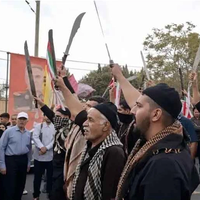
Footage showed some protesters carrying Islamic Republic flags and portraits of late Supreme Leader Ali Khamenei, underscoring the local nature of the dispute rather than an explicitly anti-government demonstration.

Security presence increases

The protest continued into the evening before security forces intervened and fired tear gas, according to videos and information received by Iran International.

Witnesses told Iran International that several protesters were wounded and detained, including some who were later taken into custody at hospitals. Iran International could not independently establish the number of arrests or verify the circumstances of each reported injury.

Reports from Meymeh on Tuesday indicated an increased security presence following the confrontation.

Most Viewed

Tehran seizes on Rubio’s Xerxes remarks to champion a past it once disparaged
1
INSIGHT

Tehran seizes on Rubio’s Xerxes remarks to champion a past it once disparaged

2

Iran officials hinted at land incursions if US resumes strikes - WSJ

3

Iran hardliners back threats to strike Persian Gulf digital infrastructure

4

Meta, Google remove Iran matchmaking app after child marriage report

5

Iran-US diplomacy stalls as Houthi attacks on Saudi Arabia intensify

Spotlight

  • Tehran raises the stakes, betting Washington will blink
    ANALYSIS

    Tehran raises the stakes, betting Washington will blink

  • Houthi airport strikes carry echoes of Iran’s aviation threats, experts say

    Houthi airport strikes carry echoes of Iran’s aviation threats, experts say

  • Iran hardliners back threats to strike Persian Gulf digital infrastructure

    Iran hardliners back threats to strike Persian Gulf digital infrastructure

  • Can US sanctions derail Iran’s China trade route?
    ANALYSIS

    Can US sanctions derail Iran’s China trade route?

  • Machete-wielding men at IRGC-backed rally revive scrutiny of crackdowns
    ANALYSIS

    Machete-wielding men at IRGC-backed rally revive scrutiny of crackdowns

Banner
Banner
Banner
Banner
•
•
•

More Stories

Iran says six killed as armed clashes intensify in southeast

Oct 13, 2026, 10:12 GMT+1
100%

The Revolutionary Guards said on Tuesday that five members of an alleged kidnapping cell and one of its personnel were killed near Zahedan, while separate reports said more than 20 members of an Iran-backed militia were killed or wounded in the area.

The IRGC Ground Force’s Quds regional headquarters said its forces located the group in the Kurin area after an engineer working on construction projects west of Zahedan was abducted a day earlier.

It said five members of the group were killed, the hostage was freed and one member of its forces was killed during the operation.

According to the statement, the kidnappers had links to armed groups and intended to take the engineer across Iran’s border into a neighboring country.

The statement supersedes an earlier report by the IRGC-affiliated Tasnim news agency, which had put the number of people killed in the operation at three.

More than 20 Fatemiyoun fighters reported killed or wounded in Taftan

Haalvsh, which covers developments in Sistan-Baluchestan, said more than 20 Fatemiyoun members were killed or wounded in fighting that continued for more than seven hours on Tuesday in the mountainous Chah Ahmad and Arzan Tak areas of Taftan County.

Citing local sources and eyewitnesses, Haalvsh said the first group sent into the area at around 6 a.m. included Fatemiyoun fighters traveling on about 18 motorcycles from a nearby base.

The outlet said armed men who had taken positions in the mountains opened heavy fire on the group. It said the dead and wounded were later removed in military vehicles.

  • Over 90 killed in six months as clashes escalate in Iran's southeast - report

    Over 90 killed in six months as clashes escalate in Iran's southeast - report

  • Iranian security forces face wave of deadly attacks in restive southeast

    Iranian security forces face wave of deadly attacks in restive southeast

  • Police officer killed in armed attack near Zahedan as violence continues in southeast Iran

    Police officer killed in armed attack near Zahedan as violence continues in southeast Iran

Fatemiyoun is an Iran-backed Shiite militia made up largely of Afghan fighters and organized with support from the Revolutionary Guards. Its members have fought alongside Iranian forces in regional conflicts.

Haalvsh said reinforcements arrived in more than 40 vehicles, accompanied by reconnaissance and combat drones.

The outlet reported continued mortar and heavy-weapons fire toward the surrounding heights after some of the armed men withdrew from the main area of fighting. It also said residents could hear drones overhead.

The identities and affiliation of the armed men involved in the Taftan clashes remained unclear.

Attacks on police and military personnel

Sistan-Baluchestan, which borders Pakistan and Afghanistan, has seen a series of armed attacks and security operations in recent weeks.

On October 9, Iranian state media reported that Nosrat Eftekhari, a senior police official responsible for cultural and social affairs in the province, was killed in a roadside bombing on the Cheshmeh Ziarat road near Zahedan.

A day earlier, a member of a police commando unit was killed in an armed attack near Nosratabad. A separate attack on a vehicle carrying Iranian Army personnel near Nikshahr killed another serviceman.

On September 23, an armed confrontation in Saravan killed Hossein Zarifi, a commander with the IRGC’s Sajjad base, according to the Guards’ Quds regional headquarters. Haalvsh separately reported that another intelligence official was killed and at least 13 other personnel were wounded.

At least five members of the Fatemiyoun, an Iran-backed Shiite militia made up largely of Afghan fighters and organized with support from the Revolutionary Guards, were also reported killed in an armed attack near Zahedan on October 2.

More than 90 killed since March - HRANA

The US-based Human Rights Activists News Agency said Monday that at least 94 people had been killed and 33 wounded in 63 armed incidents across southeastern Iran between March 31 and October 10.

HRANA said attacks on patrol vehicles and military convoys were the most common incidents it recorded, followed by targeted shootings. It also reported increased use of mines, rocket-propelled grenades and heavier weapons by armed groups, while government forces used drones, artillery and armored vehicles in some operations.

The group said the People’s Fighters Front, an alliance formed in December 2025 that includes Jaish al-Adl and several smaller Baluch armed groups, had taken responsibility for six incidents documented in its report. Most attacks remained unattributed or could not be reliably linked to a particular group, HRANA said.

Sistan-Baluchestan, one of Iran’s poorest provinces and home to much of the country’s Sunni Baluch minority, has long seen armed confrontations between government forces and Baluch groups. Recent incidents have increasingly involved attacks on police posts, military vehicles and senior security personnel.

Iran officials hinted at land incursions if US resumes strikes - WSJ

Oct 13, 2026, 08:03 GMT+1
100%
Members of the Iranian Army take part in a military exercise dubbed Fatehan of Kheibar, in the northwestern parts of Iran / File photo.

Some Iranian officials have privately suggested Tehran could send forces into neighbouring countries if the United States launches new strikes, the Wall Street Journal reported on Tuesday, citing people familiar with the warnings.

The newspaper did not identify the officials, specify which countries could be targeted by such incursions or provide details about when the warnings were delivered.

The report said Iranian officials have warned regional governments, both publicly and privately, that Tehran would widen its response across the Middle East if US attacks resume.

Iran has separately warned Arab officials that Saudi oil facilities could be targeted in a renewed conflict, according to people cited by the Journal. Mohsen Rezaei, Iran’s top national security official, said publicly on Sunday that Tehran could also target the United Arab Emirates, as well as regional data centers and internet cables.

US forces and warships threatened

The Iranian government has also told mediators that it could target US personnel more aggressively, including by trying to sink American warships in the Middle East and kill their crews, the Journal reported, citing people familiar with the warnings.

Iranian missiles came close to US warships during attacks in September, according to the report.

  • US pressure threatens Iran’s political survival but may not bring concessions

    US pressure threatens Iran’s political survival but may not bring concessions

  • Iran may be restoring activity at nuclear-linked site struck by Israel

    Iran may be restoring activity at nuclear-linked site struck by Israel

The Journal said Washington is also preparing for the possibility of renewed fighting, with a third aircraft carrier strike group and another Marine expeditionary unit heading toward the Middle East. The Pentagon is considering sending additional air-defense equipment and munitions to regional bases, it added.

President Donald Trump said last week that he would not order an attack on Iran before the November 3 midterm elections, although US officials have said the military is preparing options for further strikes.

Nuclear sites and military facilities reinforced

Iran has meanwhile reinforced defenses around nuclear sites and other sensitive facilities, the Journal reported.

Satellite imagery analyzed by the Institute for Science and International Security showed new passive defenses, including dirt barriers, around the Natanz and Pickaxe Mountain nuclear sites, according to the report.

The Journal also said Iran has used the pause in major direct fighting to rebuild missile and drone production facilities and replenish its arsenal.

Iranian officials have publicly said airports, ports and power plants are being prepared to operate under wartime conditions. State media have also shown pro-government rallies and military-related training, while billboards in Tehran have advertised civilian courses involving shoulder-fired anti-aircraft weapons and sniper rifles.

The report said the preparations reflect Tehran’s expectation that fighting with the United States could resume after the US midterm elections.

Meta, Google remove Iran matchmaking app after child marriage report

Oct 12, 2026, 20:43 GMT+1
100%
A photo by an NGO highlighting child marriage. Undated

Meta and Google removed Iran’s “Adam and Eve” matchmaking app and related promotional accounts after an investigation found girls as young as 13 were being listed as prospective spouses, US-based rights group HRANA said Monday.

“The exploitation of children is a horrific crime and we work aggressively to fight it on and off our platforms,” a Meta spokesperson told HRANA. “We investigated the information provided by HRANA and identified external links to underage marriage services. We have removed these entities from Meta platforms.”

Google separately told the group: “The app was removed from Google Play on October 9 for violating our policies.”

HRANA said the action followed an Oct. 8 investigation and a joint appeal by 24 civil society groups urging the companies to remove the app and strengthen protections against services facilitating underage marriage.

The platform had previously drawn scrutiny after Iran’s reformist Shargh newspaper reported in November 2025 that parents could register children as young as 13 as marriage candidates. Reporters were able to create a full profile for a girl born in 2012 without encountering an age restriction or identity barrier.

Shargh said profiles of users under 18 were concentrated in poorer regions where early marriage is more common, with girls most frequently listed between the ages of 13 and 16 and boys between 16 and 18.

The platform’s executive manager, Mohammad-Hossein Asghari, defended the policy at the time, saying Iranian law obliged the service to accept users who fell within the statutory marriage ages.

“Article 1041 of the Civil Code sets the marriage age at 13 for women and 15 for men,” Asghari said. “From a legal standpoint we are obliged to accept membership and cannot block someone who falls within the age range set by law.”

Around 300,000 people had attempted to register with the platform and about 70,000 profiles were active following identity checks and psychological screening, according to Asghari. Minors under 15, he said, were required to have a parent complete the registration form and staff would speak directly with the child before approval.

Child-rights advocates quoted by Shargh warned that formalizing marriage involving minors through a widely promoted digital platform risked further normalizing the practice.

Iran’s Statistical Center recorded about 25,900 marriages involving girls under 15 in 2022, down from roughly 32,000 a year earlier.

Suspect in plot to attack Iran journalists sought embassy visit, UK court hears

Oct 12, 2026, 20:39 GMT+1
100%
Court sketch from Woolwich Crown Court. Credit: SWNS/Julia Quenzler

A man accused of plotting an attack on Iran International journalists in Britain discussed an “embassy” visit with one contact and told another he had been promised £150,000 and help resolving his criminal case in Iran, a London court heard.

Messages presented at Woolwich Crown Court showed Mostafa Sepahvand seeking a meeting with a man saved in his phone as “Navid Embassy ‌Bro,” while separate exchanges detailed his demands for money and assurances relayed by contacts in Iran.

Sepahvand, 41, is on trial alongside Farhad Javadi Manesh, 46, and Shapoor Qalehali Khani Noori, 57. All three deny charges under Britain’s National Security Act.

Prosecutors allege they gathered information for Iranian intelligence in preparation for serious violence against at least one target, with Sepahvand expected to carry out an attack and the other two helping to prepare it. The alleged targets included Iran International journalists Mojtaba Pourmohsen and Kambiz Hosseini.

In a message to Navid dated March 28, 2025, Sepahvand wrote: “hello bro, are you well [w]ill come to see you at the embassy”.

Navid replied that something was troubling him and that he would explain that evening.

The contact was saved under the Persian name “Navid Barar Sefarat,” rendered in court as “Embassy Bro,” and associated with a UK telephone number. The exchanges presented did not establish his role or whether he worked for an embassy. The quoted message did not identify which embassy Sepahvand meant.

A day later, Sepahvand sent Navid a link to an auction listing for a 2024 Mercedes-Benz GLE 450.

On April 2, he wrote: “Brother I am waiting for you call me [w]ill send this friend of mine there”.

Further exchanges followed on April 3. When Sepahvand asked Navid to answer, Navid replied that he was on the phone. An April 30 message asking why Navid had not responded went unanswered.

The purpose of the proposed meeting and any connection between those exchanges and the alleged surveillance operation were not established in the messages described in court.

In separate communications with Mostafa Ghorbani, Sepahvand discussed the financial costs of locating individuals and promises to resolve his legal difficulties in Iran.

In a March 20 voice recording, previously aired during the trial, Sepahvand said he had been promised £150,000 as well as help with his court case if he completed the task.

“They have sent me £3,500, and they keep sending me fifty addresses,” he said, complaining about the money he had spent visiting locations.

Ghorbani also relayed assurances that Sepahvand’s case would be resolved once the work was done, that he would be provided with a house and that people would meet him at the airport.

Sepahvand repeatedly complained that the addresses supplied to him proved incorrect and that the work exposed him to arrest. In a March 20 voice message, he described it as “very seriously illegal” and demanded money to cover expenses.

He said locating the individuals required people to attend addresses and keep watch, and that others would be unwilling to take those risks without payment.

The hearing also examined Sepahvand’s communications with Vahid Malmir, whom he repeatedly questioned about a possible role in criminal investigations.

“I knew from very first day that you were with the criminal investigation department, but I couldn’t bring myself to say it,” Sepahvand wrote on March 28.

In another message, he asked: “Tell me the truth are you an officer with the criminal investigation”.

Malmir responded with assurances that he was at Sepahvand’s service, without explicitly confirming such a role.

Later exchanges returned to Sepahvand’s demands for a formal resolution of his Iranian case.

On April 25, he complained that he had repeatedly been told the matter was resolved even though no court ruling had been issued. He said he would stand at the previously discussed addresses if the ruling came through.

The following day, he claimed that a contact named Amin was threatening him and had said his case would not be resolved until he took action.

In earlier sessions, jurors heard evidence about photographs of locations associated with the journalists, information about Hosseini’s social media accounts and communications concerning Iran International’s offices.

Prosecutors have said Sepahvand’s wish to resolve his Iranian criminal conviction was relevant to his motivation. Jurors were previously told not to treat the conviction itself as evidence against him.

According to the prosecution’s account of his defense, Sepahvand accepts conducting surveillance for Iran but says he feared the consequences of refusing and deliberately did a poor job. Prosecutors reject that explanation.

Javadi Manesh and Noori accept visiting locations and taking photographs and videos but say they did not know they were assisting Iranian intelligence.

Over 90 killed in six months as clashes escalate in Iran's southeast - report

Oct 12, 2026, 18:52 GMT+1
100%

Armed attacks and security operations in southeastern Iran have left at least 94 people dead and 33 wounded since March 31, with fighting growing more frequent and involving heavier weapons, US-based human rights group HRANA reported Monday.

The group recorded at least 63 armed incidents between March 31 and October 10, especially in Sistan and Baluchestan province.

The escalation has coincided with the US and Israeli conflict with Iran. HRANA said Iranian authorities had focused much of their attention on western and northwestern Iran while a sustained pattern of armed attacks and security operations developed in the southeast.

Attacks on patrol vehicles and military convoys were the most common incidents, with 17 recorded cases, followed by 14 targeted shootings. Seven of the shootings occurred outside victims' homes or workplaces or along their commuting routes.

HRANA also reported a shift toward heavier weapons and more complex attacks.

On October 2, a vehicle allegedly linked to the IRGC Quds Force's Fatemiyoun Brigade was targeted with a booby trap and gunfire near Zahedan.

Five days later, an attack on a police headquarters in Jalegh reportedly involved mines, rocket-propelled grenades and semi-heavy weapons. On October 9, a roadside bomb struck the route of a police convoy near Zahedan.

The People’s Fighters Front, an alliance formed in December 2025 that includes Jaish al-Adl and smaller Baluch armed groups, claimed six of the attacks documented by HRANA, while Ansar al-Furqan claimed one. Most attacks remained unclaimed or could not be reliably attributed, HRANA said.

Government forces also used drones, artillery, armored vehicles and heavy weapons in several operations, HRANA said. In Jahadabad, Gharibabad and Manzalab, homes and sites of armed confrontations were demolished, blown up or set on fire.

The report warned that the use of such weapons in residential areas increased the risk of civilian casualties and property damage.

The region has a long history of clashes between Iranian security forces and Sunni Baluch militants. Jaish al-Adl emerged around 2012 as a successor to Jundullah and has repeatedly targeted security forces, including in a 2019 suicide bombing that killed 27 Revolutionary Guards.