Taliban-run Afghanistan could get ‘land of its own’ on Iran’s coast, MP says
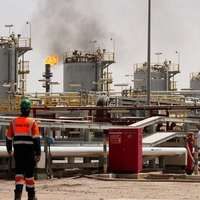
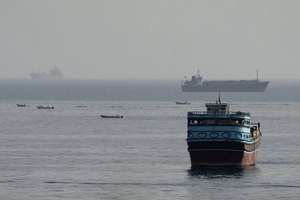
Chabahar port in southeastern Iran.
Iran has reached a preliminary understanding to allocate land at Chabahar to Taliban-run Afghanistan to build infrastructure for moving its goods to the sea, an Iranian lawmaker said.
Mohsen Zangeneh told Sahar TV during a visit to Afghanistan that the arrangement envisaged about 10 hectares along the waterfront inside Chabahar port and more than 100 hectares in the special zone in an initial phase. The Afghan government would invest in developing the facilities, he said.
“He proposed that we set aside an area in Chabahar for Afghanistan—in other words, that Afghanistan could have land of its own in the free zone at Chabahar port,” Zangeneh said, referring to Afghanistan’s industry minister.
Zangeneh did not specify whether the land would be leased or transferred into Afghan ownership. He said the Afghan side had requested more space within the port itself, but limited coastal land made that difficult.
“We reached this preliminary understanding during this visit and, God willing, we will follow up on it,” he said.
The discussions also covered wider industrial cooperation, a joint industrial park and a goal of increasing bilateral trade to $10 billion, according to Iranian media reports. Zangeneh described the land proposal as a way for Afghanistan to develop the infrastructure needed to transport its goods through Chabahar.
Baloch activists questioned how local residents would benefit, pointing to longstanding problems with housing, employment, infrastructure and access to basic services. They said arrangements for Afghan economic activity in Chabahar dated back to 2012, but questions about the share of development going to Baloch communities remained unanswered.
The Balochistan Human Rights Documentation Network said more than half of Chabahar’s population had at one point lived in informal settlements, with their expansion becoming a major problem for the area.
Against that backdrop, the group said, allocating land for foreign economic activity without disclosing its precise location, ownership arrangements, contract terms or duration of use had heightened concerns. It also questioned the lack of detail about local participation and employment.
Activists called on authorities to identify who would receive the land, disclose investment commitments and explain what obligations would apply to hiring local workers. They also sought clarity on how local communities would share in the revenue and business opportunities generated by the project.
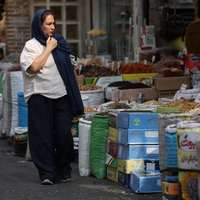
A woman walks past sacks of nuts, dried fruits and other goods at a market in Iran.
More than two-thirds of respondents to an Iran International Instagram poll said the Trump administration’s pressure on the Islamic Republic is hurting ordinary Iranians more than the authorities.
More than 56,000 people took part in the October 8 poll, with 68% saying ordinary people bear the greatest burden of US pressure. Another 23% said both the public and the government suffer, while 9% said the authorities are affected most.
Men accounted for approximately 76% of respondents and women for 24%.
The largest age group was 25 to 34, representing about 38% of participants, followed by those aged 35 to 44 at 29%. Respondents aged 18 to 24 and 45 to 54 each accounted for 12%.
Thousands of comments accompanying the poll reflected differing views on the economic consequences of US pressure, the Islamic Republic's responsibility for worsening living conditions and whether external pressure could bring political change.
Rising prices dominate concerns
The most common concern among respondents who believed ordinary Iranians were suffering most was the deterioration in daily living conditions.
Many cited rising prices, declining purchasing power, shrinking incomes and the growing financial burden on low-income households.
Others pointed to difficulties accessing medicine and medical treatment, arguing that people with fewer financial resources were particularly vulnerable to economic restrictions.
"Only ordinary people are being crushed under the pressure," one respondent wrote.
Several participants argued that even when US measures target the Islamic Republic, their economic consequences ultimately reach households through higher prices and reduced access to essential goods.
Officials seen as insulated from hardship
Another recurring theme was the perceived gap between the living standards of ordinary Iranians and those of government officials.
Some respondents argued that access to wealth, foreign currency, privileged positions and state resources allowed officials and their associates to avoid some of the hardships experienced by the wider population.
"The main burden falls on the people. The government would even be happy to see people becoming poorer every day," one respondent wrote.
Other participants said the Islamic Republic also suffers from economic restrictions through reduced revenues and limited access to financial resources, but can pass some of those costs on to the public.
For these respondents, the issue was not simply whether sanctions hurt the government or the public, but how the economic burden was distributed.
Economic hardship versus hopes for political change
The sharpest disagreement concerned whether the immediate economic costs of US pressure could be justified by the prospect of political change.
Some respondents acknowledged that ordinary Iranians were suffering but considered the hardship acceptable if it weakened the Islamic Republic or helped bring about a different political system.
"People will endure it because this suffering is worth it for a free Iran tomorrow," one wrote.
Others questioned whether worsening economic conditions would produce meaningful political change.
They argued that household finances could deteriorate far more quickly than external pressure could affect the country's political leadership.
A woman shops at a market selling nuts, dried fruits and spices in Iran.
Several respondents held both US policies and the Islamic Republic's economic management responsible for the hardships facing Iranians.
Some likened sanctions to a painful medical treatment, reflecting a willingness among certain supporters of external pressure to accept short-term suffering in pursuit of longer-term political goals.
Others rejected that calculation, arguing that the prospect of political change remained uncertain while the immediate costs to families were already evident.
A divided view of US pressure
Although 68% of respondents believed ordinary Iranians were bearing the greatest burden, their answers did not necessarily show opposition to all forms of US pressure.
Some viewed the economic consequences as unacceptable, while others regarded them as a painful but potentially necessary means of weakening the Islamic Republic.
Likewise, respondents who believed the government was suffering most did not necessarily dismiss the economic difficulties facing households.
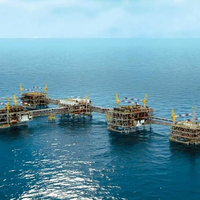
File photo from Saudi Aramco website shows Marjan offshore field
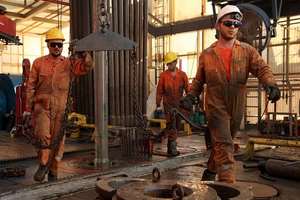
Saudi Aramco has hired a US engineering firm to upgrade an offshore oil field it shares with Iran, which has fallen far behind several neighbors in developing shared energy reserves.
KBR said on October 6 that it would provide engineering and project execution services for offshore processing facilities, gas compression and power systems at Marjan in the Persian Gulf. The work is intended to maintain production capacity and improve associated-gas processing. The company did not disclose the contract’s value.
The award follows a wider expansion of Marjan, whose total budget was put at $21 billion by industry publication Oil & Gas Middle East in a 2023 report.
Aramco said the Marjan project added 300,000 barrels a day of production capacity at the end of 2025. The expansion was designed to bring the field’s capacity to 800,000 barrels a day.
Iran calls its side of the reservoir Forouzan. Iran Open Data estimated Iranian production at about 35,000 barrels a day in a January 21 assessment, attributing the country’s wider difficulties developing shared fields to underinvestment and management constraints.
Saudi Arabia has also expanded its gas-processing infrastructure. Aramco said the Tanajib plant began operations in December 2025 and was expected to reach a raw-gas processing capacity of 2.6 billion cubic feet a day in 2026, handling supplies from both Marjan and Zuluf.
On the Iranian side, the Oil Ministry’s SHANA news agency reported in February that a project to collect gas otherwise burned off at Forouzan and other offshore fields was 76% complete. It said operations were expected to begin in 2028, subject to financing.
Saudi Arabia and Kuwait advance disputed gas project
Saudi Arabia and Kuwait are also moving ahead with development of the Durra offshore gas field, which Iran calls Arash and claims a share of.
Industry publication MEED reported in August that Al-Khafji Joint Operations had awarded contracts for two offshore packages and one onshore package worth an estimated $6.7 billion. The venture is jointly owned by Aramco Gulf Operations Company and Kuwait Gulf Oil Company, subsidiaries of the two countries’ state energy companies.
Iran says part of the field extends into its waters and that it should participate in development. Saudi Arabia and Kuwait reject that claim and maintain that rights to the field belong exclusively to them.
Iran’s wider production gap
The disparity extends to fields Iran shares with other neighbors. In its January assessment, Iran Open Data estimated UAE production from shared oil fields at 130,000 barrels a day, against 58,000 for Iran.
It put Iraq’s extraction from shared oil fields at roughly twice Iran’s and Qatar’s oil-layer output from the South Pars/North Field reservoir at 13 times Iran’s.
Oman was an exception: the assessment put each country’s production from the Hengam field, known as West Bukha in Oman, at about 10,000 barrels a day.
Iran’s national crude production has since fallen sharply during the war. The International Energy Agency estimated output at 2.16 million barrels a day in August, down from 3.59 million in February—a decline of about 40%.
Reports that the Islamic Republic sent $200 million to Lebanon's Hezbollah have drawn anger from Iranians struggling with rising living costs, low wages and medicine shortages, according to messages sent to Iran International.
Citizens accused the authorities of prioritizing financial support for regional allies over the needs of Iranians, contrasting the reported payment with their own incomes, government subsidies and mounting household expenses.
In messages, several people described struggling to afford basic necessities, while others questioned why the Islamic Republic was directing resources abroad during Iran's economic crisis.
Hezbollah payments dwarf Iranian wages
"You give each Hezbollah family 8 billion rials, but deposit a 5000,000-rial food allowance for each Iranian and then take even that back a few hours later. This country's money belongs to its people, not Hezbollah," one citizen said.
Another compared the payments with compensation given to Iranian soldiers.
"A soldier who spent eight months under missile fire with no way to escape received seventy million rials in combat pay. Then you gave Hezbollah 8 billion rials from our money," the citizen said.
Reuters reported on October 7, citing two people with direct knowledge, that Hezbollah received $200 million from Iran in September and planned initial payments of $3,000 per family, prioritizing approximately 50,000 families displaced by the war.
The reported transfer has been disputed by Washington. The US State Department disputed the reported transfer. Spokesperson Tommy Pigott accused Hezbollah of trying to “save face with fake stories about cash influxes from Iran”, saying the group “can claim whatever it wants, but the money is not there”.
Pigott said Tehran was suffering under a US blockade of its oil exports and that Washington would continue targeting Hezbollah's finances through sanctions while supporting the Lebanese government's efforts to rebuild the country's south.
At an exchange rate of approximately 2.67 million rials per dollar on Iran's open market, $3,000 amounts to roughly 8 billion rials.
A teacher in Tehran with 18 years of experience compared the payments with his annual salary.
"My salary for an entire year is about 3 billion rials, yet you gave 8 billion rials of our money to the Lebanese," the teacher said.
A local government employee with 29 years of service and a master's degree said his total monthly income was 350 million rials.
Citizens in Neyshabur and Malard also criticized the reported payments, saying the Islamic Republic was directing national resources toward allied groups abroad while Iranians faced poverty and declining purchasing power.
Islamic Republic officials have not formally confirmed the reported $200 million transfer, and the US government has rejected the account.
"Hezbollah has been decimated and caused misery for hundreds of thousands of innocent Lebanese. It is now trying to save face with fake stories about cash influxes from Iran," US State Department spokesperson Tommy Pigott said in a statement. "It can claim whatever it wants, but the money is not there."
Families sell belongings to afford basic necessities
Several citizens described the financial pressures facing their families, including difficulties paying for medicine, food and other essentials.
One person said her husband and son had been forced to sell their mobile phones to cover household expenses, contrasting the family's financial difficulties with the reported funding for Hezbollah.
Another described the rising cost of medication for her father.
"I bought just three blood pressure and heart medications for my father, and they cost 85 million rials. I didn't have enough money to buy the rest of his medicines. Insulin is also unavailable. Previously, these medicines did not even cost 5 million rials," the citizen said.
Other citizens described struggling to afford food and household expenses despite receiving government subsidies and food vouchers.
One person said the authorities treated modest increases in food assistance as a financial burden while continuing to spend substantial sums supporting allied groups in Lebanon.
Anger over Islamic Republic's spending priorities
Some calculated how many Iranian households could benefit from the reported $200 million payment, arguing that the money could help tens of thousands of families struggling with living expenses.
One person directed criticism at Supreme Leader Mojtaba Khamenei over the allocation of national resources.
"You have abandoned your own nation and are giving the Iranian people's money to the Lebanese. It is not your father's inheritance. Charity begins at home," the citizen said.
Another questioned the priorities of President Masoud Pezeshkian and his deputy, saying their public emphasis on serving Iranians conflicted with the financial support directed toward Hezbollah.
The citizen also expressed concern that such funding could contribute to continued armed conflict and civilian deaths.
Several others described the reported payment as part of the Islamic Republic's longstanding policy of financing allied armed groups across the Middle East.
Reuters reported in June that Hezbollah was awaiting additional financial support from Iran after suffering heavy losses in its war with Israel.
The US Treasury Department previously said Iran had transferred over $1 billion to Hezbollah during the first 10 months of 2025.
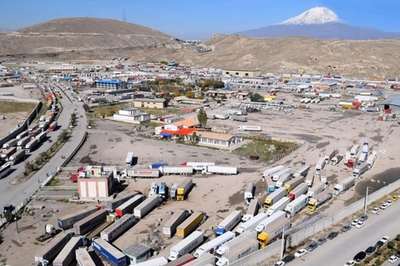
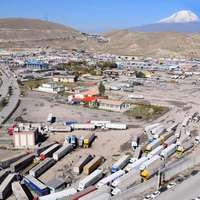
File photo: Trucks at the Bazargan border crossing between Iran and Turkey, with Mount Ararat in the background.
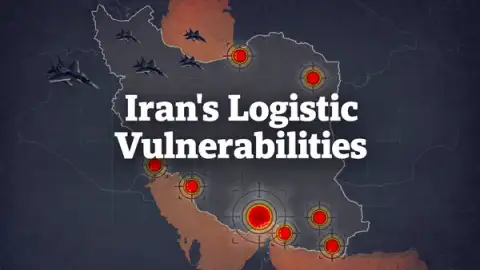
The widening reach of US sanctions across Iran’s transport and industrial networks has raised alarms in Tehran that Washington is seeking to close off the alternative trade routes the country has relied on to circumvent years of economic pressure.
Recent US measures have targeted Iran’s national railway system and major automakers including Iran Khodro and SAIPA, alongside foreign facilitators involved in their supply chains, while pressure has also expanded across aviation, maritime transport and financial networks.
The pattern has prompted some Iranian commentators to warn of what they describe as “network encirclement”: rather than trying to stop Iranian trade at a single chokepoint, sanctions raise the cost of moving money and goods across multiple routes simultaneously.
But Iranian economists and industry analysts are divided over how much additional pressure that can produce after years in which businesses have adapted to sanctions, and whether domestic dysfunction now poses a greater threat to industry than new US designations.
Closing alternative routes
Moderate outlet Khabar Online described the emerging strategy as “network encirclement,” arguing that modern economic blockades do not require borders to be physically sealed.
Instead, pressure can be applied simultaneously through financial sanctions, transport restrictions, higher insurance and compliance costs, and measures targeting companies and intermediaries that facilitate trade.
The importance of alternative routes was illustrated in a recent report by Mehr News Agency examining how Iran has sought to compensate for restrictions on maritime trade and rising insurance costs in the Persian Gulf.
The report highlighted truck traffic through northwestern crossings including Bazargan, Astara and Jolfa, connecting Iran with Turkey, the Caucasus and Russia. It argued that expanding land and rail corridors could reduce dependence on maritime shipping.
But Washington is increasingly targeting some of those alternatives as well.
Recent US sanctions have included Iran’s national railway system and major automakers, while also targeting facilitators in the UAE, Turkey, Hong Kong and India involved in supply chains.
Donya-e-Eghtesad described the measures as an expansion of pressure from maritime routes to overland trade, including networks used to obtain automotive parts.
An economy that has learned to adapt
Whether that approach can substantially increase pressure on Iran is less clear.
Industry analysts cited by Donya-e-Eghtesad said major Iranian automakers have developed extensive domestic sourcing after years of sanctions and reduced dependence on direct relationships with foreign manufacturers.
Eqtesad News went further, arguing that the latest measures against automakers and rail companies may carry greater political and psychological significance than immediate economic consequences.
Iran’s automotive industry has operated without direct partnerships with major international manufacturers for more than eight years and already relies heavily on intermediaries to obtain foreign components, it said.
The outlet argued that sanctions may therefore be producing diminishing returns, while domestic problems including price controls, supply-chain mismanagement and regulatory bottlenecks increasingly constrain production.
Economist Rasoul Safarahang made a similar argument in Khabar Online, saying an economy that has spent years adapting to sanctions is likely to respond to additional pressure by developing informal workarounds rather than immediately altering government policy.
Pressure extends to aviation
Aviation represents another potential pressure point because of its dependence on international maintenance, insurance, fuel and other services.
Iranian media have reported that US restrictions now cover 27 Iranian airlines, potentially affecting not only passenger travel but also time-sensitive cargo and the movement of industrial equipment and other goods.
Khabar Online estimated that restrictions on commercial aviation could cause between $3.5 billion and $5.2 billion in losses through reduced trade, tourism and supply-chain disruption, although the report did not provide sufficient detail to independently assess that estimate.
The outlet argued that longer transport times and more expensive alternative routes could ultimately feed through into higher domestic prices.
The debate in Iranian media therefore reflects two competing assessments of Washington’s strategy.
One sees sanctions as closing the routes Iran has used to adapt to earlier restrictions. The other sees an economy already so accustomed to sanctions that additional designations produces less leverage, while Iran’s own structural economic problems pose the greater threat.
A senior hardline Iranian lawmaker has been named in an allegation involving unauthorized excavation for antiquities and treasure, while parliament is also examining a reported excavation case involving an unnamed member of the legislature.
Investigative journalist Yashar Soltani said he had obtained documents indicating that Mojtaba Zolnouri, a lawmaker from Qom and a figure associated with the hardline Paydari Front, was involved in unauthorized digging for historical artifacts and treasure.
“After oil, the Paydari camp is now after treasure,” Soltani wrote on X on Tuesday.
“I have obtained documents indicating that Mojtaba Zolnouri, the lawmaker representing Qom, was involved in unauthorized excavation in search of historical artifacts and treasure,” he added.
Soltani did not publish the documents or say where or when the excavation allegedly took place. The allegation has not been independently verified, and Zolnouri has not publicly responded.
Parliament examining excavation case
Journalist Zahra Abdollahi separately said the issue of a lawmaker involved in excavation for buried treasure had been raised at a recent meeting of parliament’s Internal Affairs and Councils Committee and referred to the body that oversees lawmakers’ conduct.
“At a recent meeting of parliament’s Internal Affairs and Councils Committee, the issue of a lawmaker’s misconduct in connection with digging for treasure and buried antiquities was raised, and it was decided that the matter should be reviewed by the board overseeing lawmakers’ conduct,” she wrote on X.
Abdollahi did not identify the lawmaker, meaning there is no public evidence establishing that the parliamentary case concerns Zolnouri.
She said she had obtained an official document addressed to a prosecutor concerning excavation at a residential property in a historically sensitive area. According to her account, the letter called for the work to be halted.
Abdollahi said she planned to release further details of the document.
Paydari link comes amid oil-sales scrutiny
Soltani tied his latest allegation to a separate controversy surrounding Iran’s sanctions-era oil sales.
“I previously said that one of the four recipients of 85 million barrels of oil was the son-in-law of the Paydari Front spokesperson,” he wrote.
The reference was to Ruhollah Razavi, whose name has appeared in reporting on the network of trusted intermediaries, known in Iran as “trustees,” used to sell sanctioned oil and move the proceeds back to the country.
The wider system has come under growing scrutiny over billions of dollars in oil revenues that were not returned to Iran. An Iran International investigation found that members of one network collectively failed to repatriate $11 billion, while confidential documents showed 86 million barrels of oil had been assigned to four intermediaries who already owed money from previous sales.
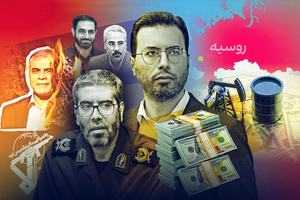
Iran International also reported this week that senior IRGC commander Hossein-Reza Sadeghi and his son Saeed played central roles in efforts to preserve an IRGC Intelligence oil-sales network and shift its financial operations from the United Arab Emirates to Russia.