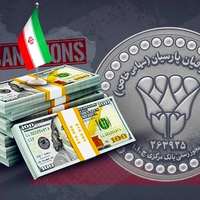
Iran’s Bank Parsian, under US sanctions, used its foreign-exchange arm to move millions of dollars abroad through a network of intermediaries, according to an Iran International investigation based on leaked internal correspondence and transaction records.
The documents, covering the period from November 2022 to May 2023, show how Iran’s central bank and other financial institutions used Parsian Exchange, also known as Sarrafi Parsian, to facilitate payments outside Iran.
The transactions involved multiple layers of banks, companies and individuals, according to the records.
Bank Parsian is a private-sector Iranian bank that the US Treasury designated in October 2018, in an action against a network of companies financing the Basij paramilitary force.
The correspondence shows that four years after the designation, Bank Parsian was still arranging international payments through layered channels.
In most cases, no foreign currency actually left Iran. Foreign currency proceeds from oil, petrochemical and other exports were held in accounts overseas. At Bank Parsian’s instruction, Parsian Exchange transferred funds held in those accounts to overseas bank accounts designated by Iranian importers.
But the payments did not appear to come from the Iranian government, sanctioned banks or the Central Bank of Iran (CBI). Instead, they appeared to originate from private companies, with Parsian Exchange acting as an intermediary.
The process
In a typical transaction documented in the files, an Iranian importer—such as carmaker Iran Khodro—sought foreign currency from the CBI to pay a supplier overseas.
The CBI sold the foreign currency to Bank Parsian, according to the documents. The funds were then held at another Iranian bank in an account belonging to a separate individual or company, described in the records as a “trustee”.
The documents showed that Parsian Exchange facilitated the movement of this money between foreign accounts.
Many of the recipient accounts identified in the documents were held at banks in the United Arab Emirates, China and Hong Kong.
The documents show that, by structuring the transactions through these layers, Parsian Exchange obscured the money trail.
Iran International found no evidence that the banks in the UAE and China knowingly facilitated Iran’s efforts to circumvent US sanctions.
Bank Parsian and Parsian Exchange did not respond to Iran International’s requests for comment.
People behind the letters
Parsian Exchange is a subsidiary of Bank Parsian. The bank directly owns 90% of the company, with the remaining roughly 10% held through Parsian Financial Group, its investment arm.
Iran International identified 33 instruction letters in the leaked documents that directed the movement of UAE dirhams, Chinese yuan and US dollars, with a total value of roughly $36 million.
Almost all the letters were signed by Alireza Alaei, Bank Parsian’s head of international affairs. He joined Parsian Exchange’s board as vice chairman in early 2020 and has served as chairman since mid-2020.
Many of the letters were addressed to Rasoul Salehi Oskouei, Parsian Exchange’s chief executive. Official records show he joined the company’s board in early 2018 and has served as vice chairman and chief executive since early 2020.
Salehi Oskouei had also served at another bank-owned exchange company. More than 12 years before joining Parsian Exchange, he sat on the board of Sepehr Exchange, an affiliate of Bank Saderat, from early 2006 to mid-2008
A review of Parsian Exchange’s current and former executives shows a recurring pattern of ties to Bank Parsian and Setad, the economic conglomerate controlled by Iran’s supreme leader.
Alaei joined the company’s board in early 2020 as a representative of Tamin Andish Pars, a Bank Parsian affiliate, and remains on the board. He also served on the board of Parsis Kish starting in 2015, representing Parsian Insurance.
Hesam Shams Alam, who served on Parsian Exchange’s board from 2010 to 2014, had also sat on the board of Bank Parsian. In 2013, he joined the board of Tadbir Investment Group as a representative of Tadbir Industry and Mine Development, an affiliate of Setad.
Instructions for payments
The letters follow a consistent pattern. Alaei sent them to the international departments of other Iranian banks, including Saman, Shahr, Eghtesad Novin, Tourism Bank, Bank Melli and Bank Mellat, all sanctioned by the United States.
The letters were typically sent about 10 days after the banks purchased foreign currency from the Central Bank of Iran. In its letters to the other banks, Bank Parsian said the foreign currency had been “purchased from the central bank” and was being held “in a trustee account” at the recipient bank.
This is where Parsian Exchange came in. Bank Parsian asked the third-party bank to transfer the funds through Parsian Exchange to the ultimate beneficiary.
The subject line of each letter described the funds as being transferred via an intermediary, meaning the payment abroad was made in the name of a private individual or company rather than an Iranian bank or the state.
In a letter dated early 2023, Alaei sent a letter to the international division of the Tourism Bank. He asked the bank to transfer $990,000 held in a trustee account to an account belonging to SEALION General Trading Limited. A review of public records shows the company was active in Hong Kong.
In May 2023, Alaei asked Tourism Bank’s international affairs division to transfer $750,000 to an account held by SAHERI TRADING LIMITED, also registered in Hong Kong.
Bank-owned exchanges
More than 500 licensed exchange companies are currently registered in Iran, 28 of them owned by banks.
By revenue, Parsian Exchange ranks second among them.
Adjusted to September 2026 prices, Melli Exchange, affiliated with Bank Melli, reported annual operating revenue of 1,253 trillion rials. Parsian Exchange ranked second with 1,168 trillion rials, followed by Omid Sepah Exchange, affiliated with Bank Sepah, with 1,129 trillion rials.
Iranian banks began setting up exchange companies more than two decades ago.
Sepehr Exchange, owned by Bank Saderat, was the first exchange company established by an Iranian bank on 25 July 2004. Parsian Exchange followed two weeks later.
Sepah, the state-owned bank with long-standing ties to the armed forces, owns three separate exchange companies. Bank Melli also operates Melli Exchange.
Sanctions
Parsian Exchange has never been named on the US sanctions list. Under US rules, however, a company owned 50 percent or more by a sanctioned entity is automatically covered by the same sanctions, so US persons are already barred from dealing with it.
In April 2026 the U.S. Treasury sanctioned a company it identified as Bank Parsian’s “rahbar”—a private firm that manages the bank’s overseas payments—and in July 2026 an exchange house it said had contracts with the bank.
The United States has targeted bank-owned exchange companies since 2008, when it sanctioned the exchange arm of the Export Development Bank of Iran.
For about a decade, no new sanctions were imposed targeting exchange companies linked to the Islamic Republic until 2018.
By September 2026, the United States had sanctioned a total of 20 exchange companies based in Iran, including six bank-owned exchanges: Export Development Exchange, Dey Exchange, Sina Exchange, and Hekmat Iranian, Ansar and Omid exchanges, all three of which are subsidiaries of Bank Sepah.
More than three years after Joe Biden took office as president, Washington sanctioned five Iranian exchange companies on June 25, 2024: Hekmat Iranian Exchange, affiliated with the former Hekmat Iranian Bank; Omid Exchange, affiliated with Bank Sepah; Sadaf Exchange; Siavash Nourian Exchange; and Atropars Exchange.
It was the largest round of sanctions targeting Iranian exchange houses since Trump left office.
After Trump returned to the presidency, a new wave of sanctions on Iranian exchange houses began in 2025. By September 2026, the United States had sanctioned 11 more exchange houses.
Senior IRGC commander Hossein-Reza Sadeghi and his son Saeed played central roles in efforts to preserve an IRGC Intelligence oil-sales network and shift its financial operations from the United Arab Emirates to Russia, an Iran International investigation found.
Two informed sources told Iran International that Sadeghi, a senior adviser to the Revolutionary Guards commander-in-chief, and his son were at the center of efforts to shift the mechanism for transferring sanctioned oil revenues from the UAE to Russia.
The sources linked the changes to the departure of Oil Minister Mohsen Paknejad.
On Sunday, the IRGC-affiliated Fars news agency reported that Iran’s Central Bank had found an alternative route to repatriate money held by oil intermediaries trusted by the Islamic Republic, known as “trustees,” and transferred $1.5 billion in Iranian oil revenues through Russia’s banking system.
Hours after the report, Paknejad resigned and President Masoud Pezeshkian accepted his resignation.
The two sources said Paknejad’s removal and the change in the money-transfer route were part of an effort to preserve the IRGC Intelligence Organization’s oil-sales corruption network.
Saeed Sadeghi’s role in Iran’s oil sector
Although Saeed Sadeghi currently holds no official Oil Ministry position, he has for years been a trusted Revolutionary Guards figure in Iran’s oil industry.
During Ebrahim Raisi’s presidency, he became chief executive of Amir Kabir Petrochemical Company. He previously served as deputy for legal affairs and contracts at the oil, gas and petrochemical holding company of the Guards’ Khatam al-Anbiya Construction Headquarters and at Shastan Investment Holding, which is affiliated with the Defense Ministry.
Two months after Pezeshkian took office, Sadeghi was appointed chief executive of Naftiran Intertrade Company (NICO). In September 2025, he was removed just one week after being appointed director of international affairs at the National Iranian Oil Company.
His removal came after it emerged that trustees had failed to return $8 billion in proceeds from oil sales to Iran.
After anti-government protests broke out in January, several establishment figures said economic pressure stemming from corruption among the trustees had caused the unrest.
Mehdi Kharatian, director of the Hayat-e Siasat think tank and an analyst close to the Islamic Republic, compared “the trustees’ failure to return the dollars” to “the pager operation in Iran” during a video podcast.
Iran International’s sources said Sadeghi traveled to Moscow at his father’s request a week before the start of the 40-day war, apparently to avoid possible judicial proceedings.
He remained in Russia until the war ended and worked on moving the financial network used to handle proceeds from sanctioned Iranian oil sales from the UAE to Russia, the sources said.
Shift from UAE to Russia
On June 6, Mohammad Javad Bavand, a former deputy head of the IRGC Intelligence Organization’s economic affairs division, was appointed the oil minister’s special assistant for sales.
Bavand had held the same position under Raisi and previously represented IRGC Intelligence on the Supreme National Security Council committee tasked with circumventing sanctions.
On June 17, Central Bank Governor Abdolnaser Hemmati visited Mir Business Bank in Moscow alongside Iran’s ambassador to Russia.
Bank Melli Iran owns all shares in the bank, which is registered in Moscow and has operated since 2002. Mir Business Bank provides correspondent accounts and services for ruble and foreign-currency transactions, connecting Iranian banks with Russia’s banking network.
The US Treasury sanctioned the bank in 2018 for providing financial services to sanctioned Iranian entities.
Iran International’s sources said proceeds from oil sold by the trustees are to be returned to Iran through Russia’s Mir financial network, which they said replaced SWIFT following US banking sanctions.
IRGC Intelligence builds new network
IRGC Brigadier General Hossein-Reza Sadeghi was tasked with completing the IRGC Intelligence Organization’s network for selling Iranian oil, according to Iran International’s sources.
Sadeghi has held senior oversight positions within the Revolutionary Guards, including heading the office responsible for special oversight of IRGC Intelligence on behalf of the Guards’ commander-in-chief. He has also served as deputy coordinator of the IRGC Intelligence Protection Organization.
The sources said the establishment of the IRGC trustee network was approved by Mehdi Sayyari, the new acting head of the IRGC Intelligence Organization.
At the same time, a separate network of oil intermediaries linked to Iran’s Intelligence Ministry, known as Shayan, came under scrutiny by the ministry’s internal security unit. Shayan, the ministry’s director-general for fuel and energy, was subsequently removed from his post.
Previous investigations traced billions in oil proceeds
One week later, Iran International identified nine trustees in the network, including children of senior security figures, among them Ali Rezaei, son of Supreme National Security Council Secretary Mohsen Rezaei.
Members of the network have collectively failed to return $11 billion in proceeds from Iranian oil sales, Iran International’s investigation found.
Two weeks later, Iran International published two confidential documents showing that Mohammad Javad Bavand, an IRGC-linked official in the Oil Ministry, had assigned the sale of 86 million barrels of Iranian oil to four trustees who already owed money from previous sales.
Iran International’s sources said that after the reports were published, IRGC commander Abdollah Zeighami, also known as Moshfegh and deputy head of the Revolutionary Guards’ media headquarters, held a confidential meeting with Bavand and Mostafa Ahadi, a former deputy for economic affairs at IRGC Intelligence who now serves as deputy head of Unit 600 of the IRGC Intelligence Organization.
The sources said the meeting focused on suppressing reporting about corruption involving IRGC-linked oil trustees.
Iran International’s sources said Sunday’s transfer of $1.5 billion in oil proceeds from Russia to Iran marked the completion of the Revolutionary Guards’ project.
Paknejad resigned hours later.
The sources said Paknejad had himself played a central role in establishing oil-sales corruption networks involving two of the Islamic Republic’s security agencies. He was removed after the new IRGC Intelligence network had been completed, while all the trustees remained free.
File photo of workers at an industrial facility in Iran.
Workers across several sectors in Iran say employers are delaying or splitting wage payments, cutting benefits and warning staff they could lose their jobs for protesting, as inflation and rising living costs deepen pressure on households.
Messages sent to Iran International by employees at companies spanning the automotive, energy, pharmaceutical and aviation industries describe wages arriving weeks or months late, with some workers saying they have taken second jobs to cover everyday expenses.
Several employees said their salaries were being paid in installments rather than on schedule. Others described losing workplace benefits or being told to resign if they objected to payment delays.
Delayed wages and disappearing benefits
Two workers at Megamotor, a subsidiary of automaker Saipa, criticized the company's wage and benefit payments in messages to Iran International.
Salary payments became irregular after the 40-day war, one worker said.
“We are suffering greatly and do not know how we can provide for our families.”
Another Megamotor employee said some wages and benefits, including overtime and meal allowances, were no longer being paid to workers, while managers and supervisors continued to receive overtime and other benefits.
Low pay at Saipa Yadak has forced most employees to work for the Snapp ride-hailing service from the afternoon until late at night, an employee of the auto-parts company said.
Some of the company's resources are spent on government ceremonies or large payments to senior managers, the employee added.
Workers at Bahman Motor are also facing financial and psychological pressure, an employee of the automaker said.
The company has declined to make payments to employees even as it continues constructing new industrial buildings, according to the employee.
File photo of workers carrying out construction and maintenance work in Iran.
The accounts come as Iran's economic problems have deepened in recent months alongside the Islamic Republic's regional policies, tighter sanctions and a sharp decline in the value of the national currency.
Rapid inflation and declining purchasing power have increased pressure on household budgets and made basic goods harder to afford for a broad section of the population.
Iran International reported in August that workers at mines and companies had gone months without receiving wages.
Workers say complaints put jobs at risk
Employees at other companies described wages being divided into installments and said challenging the delays could put their jobs at risk.
Salaries at Imen Tak Pishro in Jajrud are paid in installments and employees who object are warned they could be dismissed, one worker told.
Another employee previously told Iran International that their employer paid three months of overdue salaries in two installments.
Mapna has not paid workers at 25 power plants for 40 days, an employee of the company said.
At pharmaceutical company Arya Tinagen, salaries remained unpaid 11 days into the month, an employee said.
“The company has cut all employee benefits, from meals to the monthly benefit card. If we complain, they tell us to resign and leave.”
Messages in recent days have also described overdue wages, unpaid insurance contributions and warnings of dismissal across a range of workplaces.
An employee at Yasuj University of Medical Sciences said at the time that staff had gone three months without salaries and were warned they could lose their jobs if they pursued their demands.
Second jobs and unemployment fears
For some workers, irregular wages and rising living costs have made additional employment a necessity. For others, the concern is whether their main job will survive at all.
An employee at Ata Airlines said inflation, the rising exchange rate and aviation sanctions had led the carrier to cut jobs.
The airline had previously borrowed billions of tomans in an effort to avoid dismissing employees, according to the worker.
Employees at Kish Air said they had been instructed not to report for work until further notice and had not received a year's worth of performance-related payments.
Concerns extend beyond individual companies.
Large numbers of factories at the Shamsabad industrial estate have shut down, one person familiar with employment conditions there told Iran International.
The person said they had filled out around 50 job applications for factories in the industrial estate without receiving an offer.
The accounts follow broader signs of concern about employment. In an Iran International survey published in August, 92% of respondents said they had witnessed unemployment among people around them.
Iran’s currency fell to another record low against the dollar on Sunday, extending its decline during a US campaign aimed at restricting the Islamic Republic’s oil exports and financial flows.
The dollar traded at 2.723 million rials on the open market earlier on October 4, up 1.3% from the previous day.
The euro climbed above 3.06 million rials and the British pound surpassed 3.59 million rials.
US pressure targets oil revenue
Washington has sought in recent weeks to restrict the Iranian government's financial lifelines through a naval blockade, efforts to prevent Iranian oil exports and measures targeting channels used to move oil revenue.
US Treasury Secretary Scott Bessent said on October 3 that Iran would have no oil cargoes on the water this week and would earn no revenue from such shipments, describing it as a first.
Bessent described the US military campaign, naval blockade and economic isolation of the Islamic Republic as interconnected elements of Washington’s strategy.
Iranian parliament deputy speaker Ali Nikzad had earlier said the United States would “never” be able to reduce Iran’s oil exports to zero.
Government moves to curb currency slide
Iranian authorities are seeking ways to contain the currency’s decline and inflation as economic pressure increases.
Tasnim news agency, which is affiliated with the Revolutionary Guards, reported on Sunday that five Iranian banks were selling up to $10,000 to each person over 18 at a rate of 2.57 million rials per dollar on the second day of an official foreign currency program.
The banks participating in the program are Mellat, Tejarat, Melli, Saderat and Saman, according to Tasnim.
Lawmaker Mehdi Kouchakzadeh criticized the central bank program during an online parliamentary session on Sunday, questioning why it had been introduced at what he described as a time of severe foreign currency shortages.
“Other than their friends, dealers and thieves, who can afford to buy this $10,000?” Kouchakzadeh said. “This is money for butterfly skin patients and struggling people that is going into the pockets of capitalists and thieves.”
Kouchakzadeh called the policy a “crime” and urged parliament speaker Mohammad Bagher Ghalibaf to prevent its implementation.
The physical management of foreign currency was of “fundamental importance,” Ghalibaf said in response, promising to pursue the issue.
Supreme National Security Council Secretary Mohsen Rezaei attended a meeting of the government’s economic coordination headquarters on October 3 and said the country was going through one of its most difficult periods.
Despite the deepening economic crisis and growing pressure on citizens, the Islamic Republic continues to pursue policies that have fueled confrontation, particularly its standoff with the United States and its nuclear program.
File photo: Ships dock at Anzali Port on Iran’s Caspian Sea coast
With war disrupting Iran’s southern trade routes, Tehran is looking north to the Caspian for alternatives. But the available evidence suggests they cannot replace its crucial oil exports.
More cargo moving across the Caspian could help Iran keep supplies coming in. But rising freight totals do not show whether Tehran has found a practical alternative for exporting oil.
To establish that, we need to know what is being shipped, where it is going and what trade it replaces.
Grain and industrial goods can ease shortages; crude needs its own export infrastructure and buyers. Iran’s oil swaps at Neka show both what the northern route can offer and what it cannot.
What the freight numbers measure
Russia’s Ministry of Transport reported 1.8 million tonnes of freight on the trans-Caspian route in 2025 and 1.3 million tonnes in the first half of 2026. It separately reported maritime freight of 2.8 million tonnes in 2025 and about 4.5 million tonnes in the first seven months of 2026.
The figures point to increased activity, but the ministry does not break the cargo down by Iranian origin, Iranian destination or commodity.
The North–South Transport Corridor spans several countries, routes and modes. Cargo can transit Iran without being Iranian trade or move between other participating countries.
A corridor-wide increase could reflect transit shipments, trade between third countries or Iranian goods rerouted from elsewhere. The aggregate numbers do not distinguish among them.
Nor should the route and maritime figures be added together as if they measure the same flow. The ministry presents them separately and does not provide enough detail to establish how their coverage overlaps.
Evidence of genuine substitution requires knowing what cargo moved, where and which route it replaced. Grain rerouted from a southern port to northern Iran would demonstrate substitution for that cargo.
A shipment merely transiting Iran would demonstrate corridor use, not replacement of lost Iranian trade.
Imports and exports are different problems
Northern routes can still be valuable for Iran. Food, feed and industrial inputs can support domestic supply during a disruption. But that resilience should not be confused with replacing oil revenue.
Around 90% of Iran’s crude exports normally pass through Kharg Island in the Persian Gulf, according to Reuters. Bringing goods into northern Iran does not automatically provide the terminals, pipelines and shipping arrangements needed to move Iranian crude to international buyers.
Iran’s ports have nominal annual capacity of about 300 million tonnes, but only around 30 million tonnes is in the north, according to figures cited by Al Jazeera. One large vessel in the south can potentially carry as much cargo as 20 Caspian ships.
The question is not simply whether trade can move north, but whether those routes can serve the same economic purpose at comparable scale.
Neka was not an oil-export system
Iran’s Neka terminal was connected by pipeline to refineries in Tehran and Tabriz. Under previous oil-swap arrangements, crude from Caspian producers was delivered to Neka and processed in northern Iran. Iran then made an equivalent volume of its own crude available for export through Kharg.
The arrangement helped supply northern refineries while freeing Iranian crude elsewhere for export. It did not eliminate reliance on southern export infrastructure.
Swap volumes peaked at about 110,000 barrels per day in June 2006, fell to almost zero by 2011 and did not subsequently resume at scale, according to Lee and Kalyuzhnova. Changes in relative pricing were among the factors that made the route less attractive.
Infrastructure alone therefore does not create a durable oil route. The economics of each barrel, the terms of any swap and the availability of buyers matter too.
Any claim that Neka now provides a meaningful export alternative requires current evidence: how much crude is arriving, whether it is being refined, swapped or exported, and where any exported Iranian barrels actually leave the country.
Who controls the alternative?
Moscow’s transport ministry links freight growth to Russian-Iranian cooperation and identifies the unfinished Rasht–Astara railway as a key project.
The more important question is whether Iranian access depends on a limited number of suppliers, carriers, financiers or cross-border arrangements. Iran could gain another route while still having little control over the terms on which it operates.
That is not inevitable. A corridor involving several suppliers and transport partners could give Tehran more options.
The test is whether cargo can move regularly at competitive cost, with workable payment and customs arrangements, without a single partner becoming a bottleneck.
What would an alternative look like?
The available figures establish that activity on parts of the northern corridor has increased. They do not establish how much Iranian trade has been rerouted, whether those routes are commercially sustainable or whether they can substitute for oil-export capacity.
The Caspian may give Iran useful alternatives for specific shipments. Whether that amounts to strategic diversification depends on what Iran can move, at what scale, where it can send it and who sets the terms.
For now, rising freight totals are a starting point for that analysis, not proof that Iran has built a northern substitute for its oil-export system.
Russian President Vladimir Putin and Iranian President Masoud Pezeshkian attend a meeting in Ashgabat, Turkmenistan December 12, 2025.
A leaked Russian government roadmap obtained by Fox News put the share of Russia-Iran trade settled in national currencies at 68%, far below Moscow’s public claims that nearly all bilateral trade had shifted to rubles and rials.
The push to settle bilateral trade outside the dollar has drawn renewed US scrutiny. Last month, the US Treasury imposed new sanctions on Russia’s VTB Bank, in part for its role in creating a ruble-rial settlement system.
On Thursday, Treasury also targeted the Russia-linked A7 Network, describing it as a “shadow banking network” used by Iran to evade sanctions. It said A7’s sub-agents formed a money-laundering and sanctions-evasion mechanism connected to Russian illicit finance that Iran used to move funds, including for oil sales and weapons procurement.
Both governments have spent years insisting they don’t need the dollar, but the amount of trade settled in each other’s currencies isn’t a number you need to announce unless you’re trying to convince people that sanctions aren’t working.
Sanctions leverage only works if people believe it is there. To convince people otherwise, Russia has since 2019 announced a rising share of its Iran trade settled in rubles and rials: from 40 percent to 50, 60, 80, until Putin himself claimed 95 percent in January 2025.
The Islamic Republic communicates in broad proclamations rather than Soviet-style quarterly statistical reports: its central bank governor said in November 2024 that Iran had “completely excluded the dollar” and traded only in rubles and rials.
But the internal plan, approved in September 2024, put it at 68 percent, with a goal of 71 by 2026.
The reality doesn’t fit the claim
The Kremlin’s claim of a working ruble-rial payment system is harder to sustain when the two sides have an imbalance in trade, because that can leave one side without enough of the other’s currency to meet demand. Russian figures put 2023 bilateral trade at about $4 billion, comprising $2.7 billion in Russian exports and $1.3 billion in Iranian exports.
The two countries also simply do not like holding each other’s currencies. Russia’s central bank described its problem with currencies like the rial in 2023: they are “often non-convertible or only partially convertible,” carry “higher volatility,” and trade in markets too thin to hedge.
Iranian exporters, according to Iran’s Resistance Economy Think Tank, refuse rubles when they can, and if they accept them sell them for dirhams as quickly as possible.
The usual fix for a shortage like this is a central bank swap line, which Iran and Russia signed in July 2024. Two years on, however, the only money either side has publicly put behind it was a 1 billion-ruble deposit, worth about $10 million at the time, at VTB to cover “possible ruble shortages,” and any further draw would leave Russia holding rials as collateral — a currency it cannot sell at home and that has lost 29 percent against the ruble since January.
An Iranian MP says Russia has offered a $20 billion ruble loan that Iran has not taken.
The trade goes around it
If the ruble-rial system worked as advertised, Iranian merchants wouldn’t be paying exchange houses in Dubai and Turkey to reach Russian suppliers.
Iranian MP Meysam Zohourian told Fars News in June that before the war even essential goods bought from Russia were routed through the UAE and settled in dirhams.
Fars asked in August why merchants still settle Russia trade through exchange houses and trustees in Turkey.
Iran’s central bank governor, Abdolnaser Hemmati, called his June trip to Moscow “an operational mission to untie the knots” in foreign trade, starting with letters of credit for Iranian merchants.
What the number counts
Whatever number is claimed, it doesn’t measure money moving between Russia and Iran — it’s a bookkeeping instrument, recording which currency left a Russian company’s account, not what currency reached the other side.
If a Russian importer’s bank takes rubles out of its account, converts them to dollars, and pays the seller in dollars, Russia’s Central Bank counts that as a ruble settlement, despite a contract priced in dollars and a seller that receives dollars.
The number also leaves out trade arranged without conventional cross-border payments. When countries are cut off from the international financial system, it’s easier to move goods than money, and Russia and Iran have increasingly turned to barter and swap arrangements.
Moscow has made barter official policy. The economy ministry issued a government manual for barter contracts in 2023, and a Russian economist says Iran is the one trading partner where barter accounts for a real share of the trade.
Russia and Iran have also pursued energy swaps. Swap deliveries of petroleum products had begun by late 2022, while the two sides were discussing a broader arrangement covering up to 5 million tons of oil and 10 billion cubic meters of gas a year. Trade conducted through such arrangements would not necessarily appear in the national-currency settlement percentage.
What the mismatch tells you
Russia and Iran’s coordination is real, but both countries overstate the impact. The public number, announced for propaganda value, doesn’t even match the government’s internal goal.
And the mechanism is in reality a cobbled-together assortment of poorly working, mismatched payment arrangements that don’t serve either side well except in their fight against the international financial system.