In the days since the fighting subsided, Iran's political establishment has offered an unusually public glimpse into divisions that have long remained largely behind closed doors.
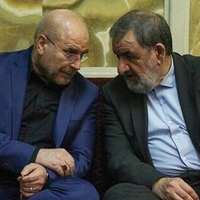
State television abruptly cut short a pre-recorded interview with Parliament Speaker Mohammad Bagher Ghalibaf as he discussed the use of blocked Iranian funds abroad, prompting accusations that politically sensitive remarks had been censored. State broadcaster IRIB insisted the interview had always been scheduled to air in two parts.
Elsewhere, hardliners heckled Foreign Minister Abbas Araghchi during a visit to Karbala, chanting "death to the appeaser" and "we don't want pretense" as Tehran pursues negotiations with Washington. Establishment commentators have also begun openly discussing ideas that, until recently, would have been politically difficult to imagine entering the public conversation.
Individually, each episode could be dismissed as another example of factional politics inside the Islamic Republic.
Taken together, however, they point to something more significant.
They suggest the post-war debate inside Tehran is no longer simply about diplomacy, sanctions or military strategy.
It is increasingly about how the Islamic Republic must adapt if it is to preserve power in the wake of one of the greatest shocks in its 47-year history.
"The question isn't whether they're engaging in soul-searching," Alex Vatanka, a senior fellow at the Middle East Institute, told Eye for Iran. "They have to."
For Vatanka, the significance of this moment is not that the Islamic Republic has suddenly embraced reform.
It is that the war appears to have stripped away old assumptions.
"I think there is a lot more clarity today than there was before the war," he said. "The regime knows the old model failed. The question now is what comes next."
He believes survival—not reform—is driving the conversation.
"If you're in the business of surviving, you don't want this to happen to you again," he said. "Maybe this is the moment you change course."
That should not be mistaken for moderation.
"You don't do it because you love the people of Iran," Vatanka said. "You do it because you want to survive."
The debate itself could prove destabilizing.
"When the knives are out within the regime, they go after each other in vicious ways," Vatanka warned, arguing that competition between rival factions could intensify as different camps attempt to shape the Islamic Republic's post-war future.
Behnam Ben Taleblu, senior director of the Iran Program at the Foundation for Defense of Democracies, argues that understanding those debates first requires understanding the nature of the political system itself.
"It is not straight-up Islamic theocracy," he said.
Instead, he described the Islamic Republic as a political project drawing on multiple ideological traditions.
"A traditional Shia marja has basically taken Karl Marx, the Quran and Plato and put it together and created a political system on top of that."
That, Taleblu argues, is why outsiders should be careful not to confuse adaptation with transformation.
"I think it is a real battle within this regime of how best to preserve the prerogatives and the privileges of power while also sacrificing as little as possible on the ideology."
Even if institutions evolve, he says, the guiding principles may not.
"Real transformation comes with behavior. It comes with substance—not style."
Historian Shahram Kholdi remains skeptical that the current debate represents a genuine break with the past.
"Any difference that has existed between any of these people, in my opinion, has always been one of degree rather than in kind," he said. "Tactics are different. Worldviews, strategies, expectations and demands are all the same."
Rather than seeing reform, Kholdi sees a political elite trying to preserve the system after one of its most serious crises.
But he also believes the post-war period could intensify competition among rival centers of power.
"If Ghalibaf and his ilk manage to get the upper hand... the rest of the gang would feel completely insecure, and that intra-conflict then would materialize into a hot conflict within them," he said.
"And that may very well spell their final doom once and for all."
Whether that prediction proves correct remains to be seen.
What is already clear is that the conversation unfolding inside Tehran has moved beyond the immediate consequences of the war.
It has become a debate about the future of the Islamic Republic itself.
In July 2006, Henry Kissinger argued that Iran's leaders would eventually have to decide whether they were governing "a cause or a nation."
Today, that question is no longer being asked only by foreign observers. Increasingly, it appears to be one the Islamic Republic is asking itself.