Ayatollah Khomeini's body in refrigerated glass enclosure at Tehran's prayer grounds. June 1989
Iran is preparing an unprecedented security operation for the funeral of Supreme Leader Ali Khamenei, seeking to prevent a repeat of the deadly crowd crushes that marred the burials of Ayatollah Ruhollah Khomeini in 1989 and General Ghasem Soleimani in 2020.
Iran is preparing an unprecedented security operation for the funeral of Supreme Leader Ali Khamenei, seeking to prevent a repeat of the deadly crowd crushes that marred the burials of Ayatollah Ruhollah Khomeini in 1989 and General Ghasem Soleimani in 2020.
More than four months after Khamenei's death, authorities say he will be buried on July 9 following five days of ceremonies across Iran and Iraq. The unusually long delay, officials say, reflects wartime conditions and security concerns, underscoring the political and logistical complexity of burying the Islamic Republic's longest-serving supreme leader.
The funeral will also be the first major state ceremony under Supreme Leader Mojtaba Khamenei, making it an important test of the new leadership's ability to project authority and maintain order.
The body will lie in state for three days at Tehran's Mosalla prayer complex before a funeral procession through the capital. It will then be taken to the Shiite holy cities of Najaf and Karbala before returning to Iran for ceremonies in Qom and burial in Mashhad, Khamenei's birthplace, at the shrine of Imam Reza, the eighth Imam of Shiite Islam.
Foreign Minister Abbas Araghchi visited Baghdad this week to coordinate with Iraqi officials on the cross-border procession.
Authorities have yet to announce who will lead the funeral prayer, traditionally one of the ceremony's most symbolic moments. If Mojtaba Khamenei, who has not appeared publicly since his father's death, attends, some observers believe he could lead the prayer himself, although officials have given no indication that will happen.
Security takes center stage
Iranian officials have repeatedly stressed that crowd management and security will be their foremost priorities.
Gholamhossein Mozaffari, governor of Razavi Khorasan Province, where Khamenei will be buried, has suggested helicopters could be used during parts of the operation to help control crowds and ensure the safe movement of the coffin.
It remains unclear whether such measures would be confined to Mashhad or employed throughout the ceremonies.
Protecting senior officials, managing crowds and transporting the coffin across several cities in two countries is likely to require one of the largest security operations in the Islamic Republic's history.
First Vice President Mohammad Reza Aref has described Khamenei's funeral as "the most important event of the 21st century," reflecting the political and symbolic significance authorities attach to the occasion.
Lessons from Khomeini's funeral
Iran's caution is rooted largely in the chaotic funeral of Islamic Republic founder Ayatollah Ruhollah Khomeini following his death on June 3, 1989.
His body lay in state at Tehran's Mosalla before funeral prayers led by Grand Ayatollah Mohammad Reza Golpayegani.
The following day, however, hundreds of thousands of mourners surged toward Khomeini's coffin as it was transported to the burial site. Security forces lost control as people attempted to touch the coffin, damaging it and tearing the burial shroud.
Authorities were forced to evacuate the body by helicopter and return it to Jamaran for re-shrouding before postponing the burial until the following day.
State media claimed attendance reached around 10 million people, although foreign estimates were considerably lower. Numerous people were reported injured and others are believed to have died in the crush, though no official casualty figure was ever released.
Khomeini was initially buried in a simple grave near Tehran's Behesht-e Zahra cemetery. The site was later transformed into a vast mausoleum complex.
Another tragedy
The funeral of Ghasem Soleimani after he was killed in a US drone strike near Baghdad airport on January 3, 2020, became the largest state funeral in Iran since Khomeini's.
His body was carried through several Iraqi and Iranian cities before reaching his hometown of Kerman, where a crowd crush and the collapse of barriers killed at least 56 people and injured more than 200, forcing officials to delay the burial.
The twin disasters at the funerals of Khomeini and Soleimani continue to shape Iranian planning for large state ceremonies.
By emphasizing crowd control, carefully staged processions and extraordinary security, officials appear determined to ensure Khamenei's funeral is remembered not for chaos, but as a demonstration of the state's ability to manage one of the most consequential events in the Islamic Republic's history.
An illustration showing an ancient Iranian soldier and a Revolutionary Guard member holding a weapon together, displayed during a November 7 ceremony in Tehran where a statue of pre-Islamic Persian King Shapur I was unveiled.
Tehran’s unveiling of a towering statue depicting the Roman Emperor Valerian kneeling before pre-Islamic Persian King Shapur I has renewed criticism of the Islamic Republic’s appeal to nationalist sentiment following the June war with Israel.
For over forty years, the theocracy purged ancient Persian history from schoolbooks, replacing it with post-Islamic narratives. But after the 12-day conflict with Israel, officials have turned to the distant pre-Islamic past to rally a divided society.
From murals of ancient kings and soldiers to patriotic songs added to Shi’ite mourning ceremonies performed before Supreme Leader Ali Khamenei, Tehran now embraces imagery once deemed heretical by its own revolutionary ethos.
The statue unveiled in Tehran's Revolution Square
'Kneel before Iran' campaign
Tehran’s Revolution (Enghelab) Square was the scene of an unusual spectacle on Friday as officials unveiled a massive bronze statue depicting Roman Emperor Valerian kneeling in submission before Sassanid King Shapur I, commemorating Iran’s victory at the Battle of Edessa (260 AD).
The event was held under the slogan “Kneel before Iran,” part of what authorities describe as a campaign to project “national unity and historical pride” following the June war with Israel.
Tehran Mayor Alireza Zakani, a staunch ultraconservative, said on X: “Enmity with Great Iran can only end in kneeling before this historic nation.”
Municipal official Davood Goodarzi said the installation would be accompanied by visual displays depicting “other victories of Iranians over foreign aggressors,” including the defeat of British forces by local commander Rais-Ali Delvari, Mirza Kuchak Khan’s resistance against Russian troops, and Surena’s triumph over Rome at the Battle of Carrhae in 53 BCE.
The goal, Goodarzi said, is “strengthening concepts such as national dignity, social unity, and Iranian identity.”
The statue, he said, would remain temporarily at Revolution Square before being moved to a city gateway “where it will stand as the first emblem of Iran before diplomats and foreign visitors.”
Unveiled women were allowed to attend the unveiling ceremony—an uncommon scene at events organized by Tehran’s ultra-hardline municipality.
The turn to the pre-Islamic past
The sharp reversal also recalls remarks once made by Khamenei. In a 2011 speech, he asserted that “all the great military victories of this nation came after Islam,” dismissing pre-Islamic accounts as “things that are not documented.”
In 1987, he had said that prophets triumphed over kings such as Cyrus and that “nothing remains of these monarchs in history but names remembered with derision.”
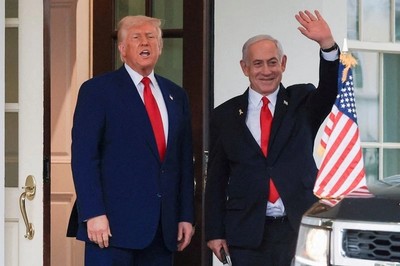
Nevertheless, pro-government social media accounts have now gone so far as to circulate posters equating Khamenei himself with Shapur, showing him standing with a staff as Benjamin Netanyahu and Donald Trump kneel before him. The caption reads: “You will kneel before Iran.”
Image circulating by hardliners on social media
'Hypocrisy'
Pro-government figures have hailed the move as a patriotic success. Conservative political reporter Hossein Saremi posted: “Today’s grand Iranian gathering showed that people and the state share one essence: Iran itself. Nothing can take our homeland away.”
Others, however, called the spectacle “hypocrisy.” Journalist Gholamhossein Pashaei wrote on X: “Every year you close Pasargadae to stop people from celebrating Cyrus Day, yet you unveil Shapur’s statue in Enghelab Square with drums and fireworks during Fatimiyya (mourning period)!”
Dissident commentator Hamid Asafi called the ceremony “a perfect snapshot of the Islamic Republic’s contradictions.”
On Telegram he wrote: “A week ago they closed Cyrus’s tomb out of fear of the crowds, and now they glorify Shapur in the same breath. The Islamic Republic fears living history but poses for selfies with its corpse.”
He added: “They know people no longer respond to rosaries and sermons. That’s why they’ve brought history back to the stage—in a controlled costume. If they can’t erase the past, they’ll try to own it.”
The irony deepened as UNESCO formally recognized Cyrus’s Charter as one of the earliest human-rights documents.
President Masoud Pezeshkian wrote on X: “Iran, the cradle of dialogue, justice, and coexistence, can still inspire peace today.”
Users swiftly replied, questioning how such pride could coexist with a government that blocks access to Cyrus’s tomb each year to those wishing to visit it on his birthday.