Iran's forces beat Baluch women protesting over mines and local resources
Baluch women were beaten during protests over local mining projects in southeastern Iran, renewing attention on the Islamic Republic’s treatment of one of the country’s poorest and most heavily policed minorities.
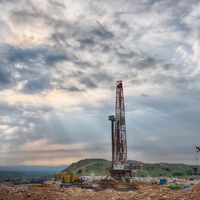
The incidents were reported in Faryab county in Kerman province and in Taftan county in Sistan and Baluchestan, where residents had gathered to protest mining projects they say have damaged local livelihoods or excluded native communities from the benefits of natural resources.
The Baluch rights group Haalvsh said at least eight Baluch women were injured and six people, including three women, were arrested on Wednesday after forces attacked a protest over a chromite mine in Pashmoki, a village in Faryab county.
According to Haalvsh, residents were protesting what they described as the transfer of mining benefits to people with influence while local communities remain deprived of the economic gains. Videos published by the group show uniformed forces confronting women and other residents, with several women seen being pushed, struck or beaten.
Haalvsh said the detainees had been taken to an unknown location and their families had not received clear information about their condition or whereabouts.
The Pashmoki incident came less than 48 hours after Haalvsh reported another assault on Baluch women protesting activity linked to the Taftan gold mine in Sistan and Baluchestan province.
In that case, women in Sarsiah village said forces insulted, threatened and beat them after they objected to the mine’s impact on local water, farmland and daily life. Haalvsh said one woman was injured in the head after being struck with the butt of a weapon.
The immediate disputes are local, but the anger around them is rooted in a much wider sense of exclusion. Residents say mining projects are damaging water resources, disrupting villages and enriching others while Baluch communities remain poor.
Sistan and Baluchestan has long been one of Iran’s most deprived provinces. Its mostly Sunni Baluch population has faced discrimination, underdevelopment and heavy security pressure under the Islamic Republic. The region has repeatedly seen deadly crackdowns, including the 2022 “Bloody Friday” killings in Zahedan.
Human rights groups have also documented the disproportionate use of executions against Baluch prisoners, especially on drug-related charges. Amnesty International said Baluch people accounted for 29% of Iran’s drug-related executions in 2023 despite making up about 5% of the population. Iran Human Rights said Baluch prisoners represented 17% of drug-related executions in 2024, while forming an estimated 2% to 6% of Iran’s population.
Molavi Abdolhamid, the influential Sunni cleric in Zahedan, has repeatedly criticized the execution of Baluch prisoners. He said in 2023 that many people executed on drug-related charges had been accused of sales worth as little as $15 to $20, and that poverty, unemployment and lack of infrastructure had pushed some people in the region into smuggling fuel, goods or drugs as a lifeline.
That background is why the beatings at the mine protests have resonated beyond the two villages. The images show Baluch women, among the most marginalized voices in Iran, confronting security forces over the basic question of who benefits from the wealth beneath their land.
The Islamic Republic often frames unrest in Baluch areas through the language of security, smuggling or separatism. But the protests in Pashmoki and Sarsiah point to another reality: communities demanding water, livelihood, dignity and a say over local resources, and being met with batons, threats and arrests.
As Tehran and Washington move toward a memorandum to end the war and reopen the Strait of Hormuz, messages from inside Iran show anger that the deal speaks of uranium, Lebanon and money, while ordinary Iranians remain absent from the text.
The messages, sent to Iran International on Thursday, reflect grief, suspicion and political anger after details emerged of the memorandum between Tehran and Washington.
The agreement outlines a halt to the war, a 60-day negotiation period, steps toward reopening the Strait of Hormuz, possible oil waivers and discussions over frozen assets and sanctions relief.
But for many Iranians who responded, the central question was not what the Islamic Republic might receive, or whether Washington would enforce the terms. It was why ordinary Iranians appeared absent from the agreement.
“We gave our fallen, we endured more hunger and poverty, there was war, we moved further away from our dreams, we were hurt, we were killed unjustly, but uranium was the main issue,” one message said. “In these several clauses of the agreement, there was no word about the people of Iran.”
Another message described the memorandum as an agreement signed “over the bodies of Iran’s children,” referring to what the sender said were 42,000 lives lost.
The message reflected a broader anger among several respondents who saw the deal as a bargain made after months of bloodshed and repression.
Some directed their anger at US President Donald Trump, saying they had hoped Washington would side more clearly with the Iranian people. “Trump is a businessman who first sees his own profit and his country’s interests, and it does not matter to him what has happened or what will happen,” one message said.
Another sender wrote: “Tell Trump that your betrayal has remained so deeply in our hearts and minds that if one day America and Europe need the help of the people of Iran, not a single person will come toward you.”
Others focused on Mohammad Bagher Ghalibaf, the lead Iranian negotiator expected to sign the memorandum in Switzerland on Friday. Ghalibaf has defended the document and urged officials to focus on improving the economy, but one message accused him of speaking more about Lebanon than about Iranians.
“Mr. Ghalibaf, in the same speech where you said we should fix people’s economy, you spoke several times more about Lebanon than about the people of Iran, and said the first clause of the agreement is also Lebanon,” the message said.
The 14-point memorandum includes a provision on ending military operations on all fronts, including Lebanon, and ensuring Lebanon’s sovereignty and territorial integrity. It also includes provisions on the Strait of Hormuz, oil exports, frozen assets, sanctions and Iran’s nuclear program.
US officials have since sought to limit expectations, saying the memorandum does not provide Tehran with automatic access to frozen assets, immediate sanctions relief or direct US funding.
They said any economic benefit would depend on Iranian compliance and progress toward a final deal, particularly on nuclear issues.
Inside Iran, however, the messages show that many are judging the agreement less by its financial mechanisms than by what it signals politically.
Some saw it as proof that the Islamic Republic’s long confrontation with the United States had ended in failure. “We are not fooled by the regime’s propaganda,” one message said. “The current memorandum between Iran and America was a definite defeat for the Islamic Republic’s 47-year policy.”
Another urged patience and unity, framing the deal as part of a longer process of weakening the system. “Be patient, regime change is happening, although at a gentle speed,” the message said. “Just stay united and give each other hope.”
But several messages were more despairing than hopeful. One sender compared the moment to a scene in a war film where a soldier, after fighting through chaos, suddenly stands still in shock and cries.
“That is how we, the people of Iran, feel with the news of the negotiations,” the message said.
Another asked why no country had insisted that Iranians themselves had rights that should be part of any settlement. “Why was there no one anywhere in the world to say that we, the people of Iran, had the right to live?” the message said. “Why should the human rights of all people in the world be respected except those of Iranians?”
A senior US official on Wednesday read out a 14-point memorandum of understanding between the United States and Iran that outlines a high-level understanding to halt the war in Iran and open the Strait of Hormuz.
The agreement defers many of the most difficult issues, including how to wind down Iran's nuclear program, until a final deal is reached, and paves the way for a broader 60-day negotiation period due to begin in Switzerland on Friday.
The document, titled "Islamabad Memorandum of Understanding between the United States of America and the Islamic Republic of Iran," was read out to reporters by the US official as follows:
1. The United States of America and the Islamic Republic of Iran and their allies in the current war, by signing this MoU (Memorandum of Understanding), declare the immediate and permanent termination of military operations on all fronts, including in Lebanon, and undertake from now on not to initiate any war or any military operation against each other, and to refrain from the threat or use of force against each other, and ensuring the territorial integrity and sovereignty of Lebanon. The final deal will confirm the permanent termination of the war on all fronts, including in Lebanon, and other provisions of this paragraph.
2. The United States of America and the Islamic Republic of Iran undertake to respect each other's sovereignty and territorial integrity, and to refrain from interfering in each other's internal affairs.
3. The United States of America and the Islamic Republic of Iran commit to negotiating and achieving the final deal in maximum 60 days extendable with mutual consent.
4. Immediately upon the signing of this MoU, the United States of America will begin the removal of its naval blockade and any disturbances or impediments against the Islamic Republic of Iran, and will fully end the naval blockade within 30 days. During this period, the traffic of vessels will be in proportion to the numbers of pre-war traffic being restored by the Islamic Republic of Iran. The United States of America further undertakes to remove its forces from the proximity of the Islamic Republic of Iran within 30 days after the final deal.
5. Upon the signing of this MoU, the Islamic Republic of Iran will make arrangements using its best efforts for the safe passage of commercial vessels with no charge for 60 days only from the Persian Gulf to the Sea of Oman and vice versa. The traffic of commercial vessels will immediately start and, considering the need for removing the technical and military obstacles and de-mining by the Islamic Republic of Iran, will be instated within 30 days. The Islamic Republic of Iran will conduct dialog with the Sultanate of Oman to define the future administration and maritime services in the Strait of Hormuz, in discussion with other Persian Gulf littoral states in line with the applicable international law and the sovereign rights of coastal states of the Strait of Hormuz.
6. The United States of America undertakes with regional partners to develop a definitive, mutually agreed plan with at least USD 300 billion for the reconstruction and economic development of the Islamic Republic of Iran. The mechanism for the implementation of this plan will be finalized as part of final deal within 60 days. All required licenses, waivers, and permissions needed for the relevant financial transactions will be granted by the United States of America.
7. The United States of America undertakes to terminate all types of sanctions against the Islamic Republic of Iran, including the United Nations Security Council resolutions, i.e. IAEA Board of Governors resolutions, and all unilateral US sanctions, primary and secondary, in an agreed upon schedule as part of the final deal. The Islamic Republic of Iran and the United States of America acknowledge the critical importance of the sanctions termination issue above mentioned and express their intentions to immediately address these issues in the negotiations in order to achieve mutual agreement on them.
8. The Islamic Republic of Iran reaffirms that it shall not procure or develop nuclear weapons. The United States of America and the Islamic Republic of Iran have agreed to resolve the disposition of stockpiled enriched material pursuant to a mechanism that will be mutually agreed upon, in accordance with the schedule mentioned in paragraph seven with the minimum methodology to be down blending on site under the supervision of the IAEA. The two parties also agreed to discuss the issue of enrichment and other mutually agreed matters related to the Islamic Republic of Iran's nuclear needs, based on a satisfactory framework being agreed upon in the final deal. The final deal will confirm the provisions of this paragraph. The United States of America and the Islamic Republic of Iran acknowledge the critical importance of the nuclear issues above mentioned and express their intention to immediately address these issues in the negotiations in order to achieve mutual agreement on them.
9. Pending the final deal, the United States of America and the Islamic Republic of Iran agree to maintain the status quo. The Islamic Republic of Iran will maintain the current status quo of its nuclear program and the United States of America will not impose any new sanctions and will not deploy additional forces in the region.
10. The United States of America undertakes that immediately upon the signing of this MoU and until the termination of sanctions, US Department of Treasury will issue waivers for the export of Iranian crude oil, petroleum products, and derivatives, and all associated services, including banking transactions, insurances, transportation, etc.
11. The United States of America undertakes to make fully available for use the frozen or restricted funds and assets of the Islamic Republic of Iran. Upon the implementation of this MoU, the United States of America and the Islamic Republic of Iran will mutually agree on the procedures related to the release of these funds during the negotiation. Such funds, whether retained in the original account or transferred, shall be made fully usable for payment to any ultimate beneficiary designated by the Central Bank of the Islamic Republic of Iran. The United States of America undertakes to issue all necessary licenses and authorizations accordingly.
12. The United States of America and the Islamic Republic of Iran agree that an executive mechanism will be established to monitor the successful implementation of this MoU and the future compliance of the final deal.
13. After signing this MoU, and subject to the beginning of the implementation of paragraphs 1,4,5,10 and 11 of this MoU, and the continuing implementation of these measures, the United States of America and the Islamic Republic of Iran will start negotiations regarding the final deal exclusively on the other paragraphs.
14. The final deal will be endorsed by a binding UNSC resolution.
Law enforcement personnel survey the scene outside the U.S. Consulate after shots were fired, in Toronto, Ontario, Canada, March 10, 2026. Picture taken with a mobile phone.
A Toronto police operation targeting suspects linked to the March attack on the US Consulate has uncovered what investigators believe is a far-reaching network connecting a series of shootings across the Greater Toronto Area to actors operating beyond Canada's borders.
According to confidential information obtained by Iran International from police sources, investigators have identified a traceable logistics, supply and equipment pipeline linking suspects in the Toronto shootings to individuals and networks originating in Tehran.
The findings have raised concerns among investigators that criminal groups in Canada may have been used to facilitate operations tied to broader geopolitical objectives.
The revelation comes as Toronto police continue to investigate a network allegedly responsible for dozens of shootings across the GTA.
The investigation intensified following an early-morning raid in which Constable Marc Pinizzotto was killed during an exchange of gunfire. Ballistic testing later linked firearms recovered at the scene to 27 separate shootings, according to Toronto Police.
Police Chief Myron Demkiw said investigators uncovered a recurring pattern in which teenagers and low-level gang members were allegedly recruited through encrypted messaging applications such as Telegram, WhatsApp and Signal to carry out attacks for payment.
In some cases, the recruits were allegedly instructed to film the shootings as proof that the assignments had been completed.
Among those charged is 18-year-old Sheldon Tracy-Stewart, who was wounded and arrested during the raid. Another suspect, 19-year-old Zara Jabbi, remains at large.
The Toronto investigation has unfolded alongside a separate U.S. terrorism case involving Mohammad Baqer Saad Dawood al-Saadi, an Iraqi national charged in New York.
According to U.S. court documents, prosecutors allege that al-Saadi played a role in coordinating attacks linked to Iranian interests abroad.
Federal investigators say he acknowledged in a recorded conversation that associates connected to his network carried out the shooting at the US Consulate in Toronto, allegedly in retaliation for US actions against the Islamic Republic.
The allegations have not been tested in court.
The emerging picture has also renewed attention on an armed attack targeting Iranian-Canadian activist Salar Gholami in Toronto earlier this year.
In the early hours of March 1, gunmen fired at a sports club owned by Gholami, a prominent opposition activist whose facility has served as a gathering place for anti-government events and demonstrations. At least 17 rounds struck the building.
Gholami believes the attack should be examined alongside the broader network now under investigation. Security footage, he said, showed a young masked gunman whose profile resembled the recruits allegedly used in other GTA shootings.
Authorities have not publicly linked the attack on Gholami's club to the wider investigation. But members of Canada's Iranian community argue that threats against dissidents deserve closer scrutiny as investigators work to determine the full extent of the network's operations.
Iran players walk past Iranian fans holding official and pre-revolutionary flags, in Los Angeles, US, June 16, 2026
Iran’s World Cup match with New Zealand was not just a football game but a rare glimpse into the trauma and deep divisions many Iranians carry at home and abroad.
As Iran twice came from behind to draw 2-2 at SoFi Stadium in Inglewood, California, fans cheered different goals for different reasons. Some celebrated every Iranian attack. Others openly rooted against a team they view as inseparable from the Islamic Republic.
The divided reactions reflected a question that has become increasingly fraught since January 8-9, 2026, when the Islamic Republic launched a nationwide crackdown on anti-regime protesters that killed tens of thousands of unarmed civilians: can one support Team Melli without supporting the state it represents?
The trauma of those events continues to reverberate far beyond Iran's borders.
At SoFi Stadium, one fan wore a custom jersey marked "8-9," a reference instantly recognizable to many Iranians as the dates of the deadliest two nights in Iran's modern history.
"I felt proud to be Iranian, but with a mixed bag of emotions, carrying the weight of everything that the regime has done and what the people have suffered," actress and activist Nazanin Nour told Iran International.
Nour said she ultimately decided to attend the game despite her conflicted feelings because the regime has taken so much from Iranians worldwide, and she did not want it to deprive her of the joy of the sport as well.
"I think everybody's feelings are informed by their pain and trauma and everything that we've witnessed over the last not just few months but 47 years," she said. "It makes sense that everybody feels like this is a really weird time but still a time to be proud of who we are and where we come from."
A team added
Since the 2022 Woman, Life, Freedom protests, players have faced scrutiny over whether they sing the national anthem, meet state officials or publicly support protesters.
Supporters and critics alike increasingly view the national team through a political lens because it officially represents the Islamic Republic.
While some players and football federation officials have shown alignment with the state, others have faced pressure for expressing solidarity with anti-government protests or refusing to sing the national anthem.
Former Iranian national team goalkeeper and coach Mohammad Rashid Mazaheri has been held by Iranian authorities since late February 2026 after criticizing the leader in an Instagram post.
For many Iranians, his case is another reminder of how even prominent athletes can face severe repercussions—even death—for expressing dissent.
"We're a world away from past World Cups, when, regardless of politics, Iranians inside the country and across the diaspora were united behind Team Melli," said Holly Dagres, a senior fellow at the Washington Institute.
That unity was perhaps best illustrated in 1998, when Iran's victory over the United States sparked celebrations from Tehran to Los Angeles.
Pride and protest
Before kickoff, hundreds of protesters gathered outside SoFi Stadium waving anti-government signs and the pre-revolution Lion and Sun flag in a city home to one of the world's largest Iranian diasporas.
Despite FIFA's ban on the Lion and Sun flag, videos circulating online showed numerous fans displaying it inside the stadium.
Among those in attendance was activist Mersedeh Shahinkar, who was blinded in one eye after being shot directly in the eye by security forces during the 2022 protests. Shahinkar, who later fled Iran and now lives in the United States, arrived carrying a Lion and Sun flag.
Shahinkar confronted supporters of the Islamic Republic both inside and outside the stadium, where tensions at times spilled into verbal confrontations and some spectators called fans carrying Iran’s current flag "terrorists."
At times, Shahinkar pointed to the empty eye socket left after she was shot during the 2022 protests, a reminder of the price many Iranians have paid in opposing the state.
Iranian-American news anchor Shally Zomorodi later posted a video to Instagram with tears in her eyes, saying two men confronted her husband over his Lion and Sun logo.
"The hardest part of tonight," she wrote. "Two Iranian men saw my husband with the Lion Sun logo on his shirt and started cursing at him and tried to start a fight with Bruce."
But the atmosphere was not uniformly hostile, said Nour, who witnessed fans carrying Lion and Sun flags sitting near supporters displaying Iran’s official flag.
"I just saw people enjoying a game and being respectful of each other's opinions," she said.
Inside the stadium, boos rang out during the national anthem while many fans appeared to cheer individual players rather than the state they represent.
After the match, Iranian goalscorer Ramin Rezaeian pushed back when asked by a US journalist about fans whistling and booing during the national anthem.
"That's none of your business," he said. "What happens between Iranians is our own matter, and we will resolve it ourselves."
The same arguments played out far from California.
In North Vancouver, home to a large Iranian Canadian community, some crowds—even those displaying Iran's pre-revolutionary flag—erupted in cheers when Iran scored against New Zealand.
A sign of just how complicated the issue can be.
"We're here for the players only," Zina Monjazeb of Los Angeles told Reuters. "We're not here supporting the regime, at all."
Others rejected that distinction entirely.
"We believe that this is not the Iranian team. This is the Islamic regime," Naderi Alizadeh, 39, of San Diego, told Reuters.
In one scene captured on social media, Iranian player Mehdi Taremi is seen handing his shirt to a fan displaying the Lion and Sun flag.
For some Iranians, Team Melli remains a source of national pride distinct from the state it represents. For others, the jersey has become inseparable from the government behind it.
Ninety minutes of football did not resolve the argument. But for one night, it revealed just how deeply it now runs.
G7 leaders for a family photo before a cultural performance and concert during the G7 summit, in Evian-les-Bains, France, June 16, 2026.
G7 leaders welcomed on Wednesday the announcement of a deal between the United States and Iran, saying it offered a major opening to prevent Tehran from acquiring a nuclear weapon and address regional and missile-related threats.
“We welcome the announcement of a deal between the United States and Iran, secured under the strong leadership of President Trump, with the support of mediating countries,” the leaders said in a statement on geopolitical issues.
They said the agreement provided “an historic opportunity to prevent Iran from acquiring any nuclear weapon and tackling the threats related to its regional and ballistic activities.”
“We support and are ready to contribute to its implementation,” the statement said.
The Group of Seven also backed further diplomacy after the US-Iran memorandum of understanding, saying any follow-on negotiation should address threats posed by Iran “in the region and beyond” and include relevant partners, including the International Atomic Energy Agency.
“We reaffirm that Iran will never obtain a nuclear weapon,” the leaders said.
On Lebanon, the G7 tied its support to an immediate ceasefire and the disarmament of Iran-backed Hezbollah.
“In Lebanon, we support, through an immediate robust ceasefire, the Lebanese leadership’s efforts to achieve the disarmament of Hezbollah and the monopoly of arms, and to protect Lebanon’s territorial integrity and sovereignty with the appropriate international security guarantees,” the statement said.
The leaders also backed the resumption of traffic through the Strait of Hormuz, saying “the right of transit passage without restrictions or tolls is the bedrock of international trade.”
They said a multinational defensive initiative led by France and the UK could help protect merchant vessels, reassure shipping operators and verify the removal of mines.
The G7 also pledged to reduce global vulnerability to the Strait of Hormuz by accelerating the diversification of energy supply routes and increasing energy stocks.