Iranian teens say rising costs turn simple wishes into distant dreams
Simple pleasures, personal goals and everyday purchases have become out of reach for many Iranian teenagers, who told Iran International that economic hardship is reshaping their lives and dimming their hopes for the future.
Messages sent by teenagers described a growing gap between what they need and what their families can afford, with some saying even routine activities and modest purchases now feel unattainable.
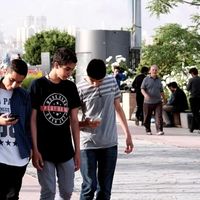
Iranian youth use their mobile phones as they walk at a park in Tehran
Simple pleasures, personal goals and everyday purchases have become out of reach for many Iranian teenagers, who told Iran International that economic hardship is reshaping their lives and dimming their hopes for the future.
Messages sent by teenagers described a growing gap between what they need and what their families can afford, with some saying even routine activities and modest purchases now feel unattainable.
One teenager said upgrading a computer has become unrealistic after the price of an 8GB DDR5 memory module rose to around 500 million rials (over $280).
Iran's minimum monthly wage is currently worth around $90-$110, depending on exchange-rate fluctuations, while estimates from labor experts put average monthly earnings for many workers at roughly $150.
"With these conditions, buying or upgrading a computer has become a dream," the teenager said.
Another wrote that a mobile phone purchased for 500 million rials (over $280) in February is now worth 930 million rials (over $520).
Others pointed to the disappearance of simple recreational activities from their lives. A 15-year-old said swimming pool fees have more than doubled since early April, while another said that a bicycle that once cost 300 million rials (around $170) now sells for 620 million rials (about $350).
"We Iranian teenagers and young people have reached a point where eating one good meal makes us happy, while our peers in other countries have many things to enjoy," one message said.
Embarrassed to ask
Several teenagers said financial pressure has not only reduced their expectations but also left them feeling ashamed to express their needs.
They described watching their parents struggle with rising living costs and choosing to remain silent about things they want or need.
An 11-year-old girl said her birthday falls in September but she is embarrassed to ask her father to organize a celebration.
She questioned why having a birthday party should be considered a wish rather than a normal part of childhood.
A group of teenagers sit on a bench with skateboards, looking at their phones and talking outside a building.
A 14-year-old wrote: "Whenever I ask my parents for something, they say they don't have the money. I feel ashamed when I sit at the dinner table."
Another 15-year-old said gym membership fees had tripled.
"I feel guilty asking for things I need because I know dealing with these prices is not easy for my parents," the teenager wrote.
Some others said they increasingly feel like a burden on their families. One wrote that their parents regularly give up their own wishes to provide for their children, while another said the feeling of being an extra weight on the family has become constant.
A 14-year-old girl said she feels guilty whenever her parents buy something for her and has become pessimistic about her future.
Adult worries replace childhood concerns
Some said their attention has shifted from hobbies, friendships and future plans to concerns about war, economic conditions and daily news.
"Whenever I think about war and ceasefires, I cry," one teenager wrote. "Why can't I enjoy life like other teenagers or go to school wearing what I want?"
A 12-year-old asked why children should be preoccupied with current events instead of enjoying their free time.
Several said the issues occupying their minds resemble adult concerns rather than those usually associated with adolescence.
"I should be thinking about having fun and playing, not working or worrying about politics and the price of gold and dollars," one teenager wrote.
Comparisons with teenagers abroad appeared frequently in the messages.
A 16-year-old girl said she works instead of pursuing leisure activities and is often too exhausted to remain on her feet.
A university entrance exam candidate wrote that seeing graduation celebrations in other countries leaves the strongest sense of longing.
Growing uncertainty about the future
Several teenagers said they struggle to imagine a future for themselves at a stage in life when they should be exploring talents, setting goals and pursuing ambitions.
An 18-year-old said the country's conditions have left little motivation even for ordinary daily life, let alone planning for the future.
Another wrote that, despite being only 18, they are already watching their hopes and ambitions fade.
A 15-year-old said economic pressure, exhaustion and disappointment have become part of everyday life and make long-held aspirations feel impossible to achieve.
Some said uncertainty is even shaping major life decisions.
A ninth-grade student wrote that although they would like to choose an academic path based on personal interests, the future feels so unpredictable that passion has become a luxury.
Instead of focusing on dreams, the student said thoughts are dominated by rising prices, war and the memory of those who have died, creating a sense of being trapped with no clear path forward.
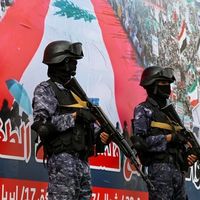
Iranian authorities are continuing to use children in security-related activities, including checkpoints and participating in military-themed programs, according to messages sent by citizens to Iran International.
Accounts from several provinces described children and teenagers taking part in checkpoint operations and handling weapons at state-sponsored gatherings, despite international conventions that call on governments to keep minors away from military and security activities.
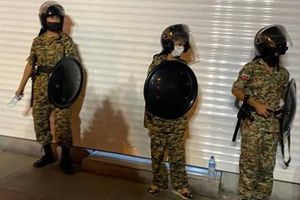
“Recession, inflation, poverty and hardship are rampant, and this is a sign of economic collapse,” a resident of Fereydunkenar, north of Iran, said. “They have set up checkpoints with children aged 10 to 12 and gather people around city squares with food and payments to show strength.”
Children in military-style uniforms and riot gear stand at a checkpoint in Iran. Image quality has been enhanced using AI.
Iranian authorities are continuing to use children in security-related activities, including checkpoints and participating in military-themed programs, according to messages sent by citizens to Iran International.
Accounts from several provinces described children and teenagers taking part in checkpoint operations and handling weapons at state-sponsored gatherings, despite international conventions that call on governments to keep minors away from military and security activities.
“Recession, inflation, poverty and hardship are rampant, and this is a sign of economic collapse,” a resident of Fereydunkenar, north of Iran, said. “They have set up checkpoints with children aged 10 to 12 and gather people around city squares with food and payments to show strength.”
A resident of Tehran province described what he said was the growing presence of minors at checkpoints in Shahriar, near Tehran.
A child dressed in a military-style uniform attends a public gathering in Iran.
“Almost all the checkpoints in Shahriar are run by children under 16 holding flashlights. It is truly absurd,” the resident wrote.
Military training at public gatherings
Citizens also described state-organized events where children were given access to firearms and military training activities.
A resident of Tehran said children had been deployed at checkpoints during public events and that authorities had also set up stations distributing tea and refreshments.
Similar accounts emerged from other parts of the country.
“At the entrance to Bastak in Hormozgan province, they hand rifles to children every night,” one resident said.
Another citizen from Kelardasht in Mazandaran province reported seeing children being taught how to handle weapons.
Long history of youth mobilization
The use of minors in military and security-related activities has a long history in the Islamic Republic.
During the Iran-Iraq War, thousands of teenagers were sent to the front lines, and many were killed in military operations. In the decades that followed, military-oriented instruction continued through school programs such as “Defensive Readiness” classes and student Basij activities.
File photo showing a child at the front line during the Iran-Iraq War.
Student Basij organizations and university Basij branches have for years operated within educational institutions, recruiting young people into structures linked to the security establishment.
Human rights advocates argue that linking formal education with military and paramilitary activities risks normalizing violence and militarization among children and adolescents.
Iran is a party to the United Nations Convention on the Rights of the Child, which requires states to protect children from involvement in military activities and provide a safe environment for their development and education.
Expansion of military imagery
The reports coincide with a broader increase in the public display of military equipment across Iran.
In recent months, images have circulated showing missiles, military hardware, Revolutionary Guards speedboats and light and heavy weapons displayed in public spaces, schools, state-organized gatherings and media programs.
Child rights advocates view such measures as part of a wider effort to normalize the presence of weapons in children's daily lives and to militarize public space.
The growing involvement of children and teenagers in government-organized activities, checkpoints and military programs may also reflect efforts to cultivate future generations of ideologically aligned supporters and security personnel, according to critics of the policy.
People cross a street in Tehran, with the Alborz mountains visible in the background.
Iranians in several cities described wages being consumed by rent, food and healthcare costs, according to messages received by Iran International on Wednesday.
A government employee in Dorud, in western Lorestan province, said a monthly salary of 20 million tomans, about $115 at the current rate, no longer covered basic needs.
“Half of this wage goes to rent, and the other half goes to medicine and doctors,” the message said. “Nothing is left for food and clothing.”
Another message said a salary below 50 million tomans, about $287, could no longer support a family of four, while one person said only three million tomans, about $17, remained from their monthly pay by the end of the month.
“With this situation, we have to fill ourselves with bread and water,” the message said.
Healthcare costs were also cited as a growing burden. A 51-year-old resident of Isfahan said an orthopedic visit cost one million tomans, about $6, and two prescribed scans would have cost four million tomans, about $23, each.
“I did not have the money, so I gave up,” the resident said.
Another message said medicine had become scarce and sharply more expensive, while insurance covered almost none of the costs of visits, treatment or tests. A monthly prescription that previously cost 200,000 tomans, about $1, had risen to 1.35 million tomans, about $8, the message said.
A separate message from Isfahan said most autism centers in the city had raised fees by 80%, leaving them far less crowded.
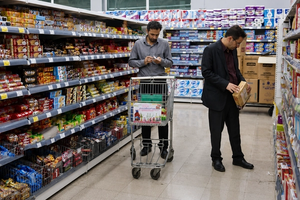
Others pointed to daily goods becoming unaffordable, citing a simple ice cream at 80,000 tomans, about 46 cents, and a 1.5-liter bottle of water at 35,000 tomans, about 20 cents.
“This is no longer inflation,” one message from Shahreza said. “It is swelling and bruising.”
Messages sent to Iran International point to a renewed wave of security and social pressure in several Iranian cities, as prospects for a possible agreement and the continuation of the ceasefire between the Islamic Republic, Israel and the United States have become more serious.
According to the messages, morality patrol activity has resumed in cities including Isfahan, Rasht and Anzali, with officers targeting not only women over mandatory hijab but also men whose clothing is deemed outside official norms, including those wearing shorts.
Several messages said people had been detained and taken to police vans over clothing-related cases. Citizens also reported that officers were photographing people in public spaces.
One person said plainclothes agents in Isfahan had been warning women and girls in the streets over their clothing and putting them under pressure.
In Rafsanjan, one citizen said that after women supporting the government confronted her over hijab, armed officers later went to nearby locations looking for her.
Messages from other areas also pointed to wider controls, including checks of citizens’ mobile phones.
The accounts come alongside reports of shop closures in Rasht over hijab-related cases.
In Arak, a women’s sports club was reportedly sealed after security forces entered the premises and arrested several coaches.