• العربية
  • فارسی
Brand
  • Iran Insight
  • Politics
  • Economy
  • Analysis
  • Special Report
  • Opinion
  • Podcast
  • Iran Insight
  • Politics
  • Economy
  • Analysis
  • Special Report
  • Opinion
  • Podcast
  • Theme
  • Language
    • العربية
    • فارسی
  • Iran Insight
  • Politics
  • Economy
  • Analysis
  • Special Report
  • Opinion
  • Podcast
All rights reserved for Volant Media UK Limited
volant media logo

Iran and UAE clash at BRICS foreign ministers meeting

May 14, 2026, 11:01 GMT+1
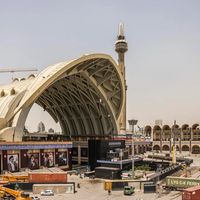
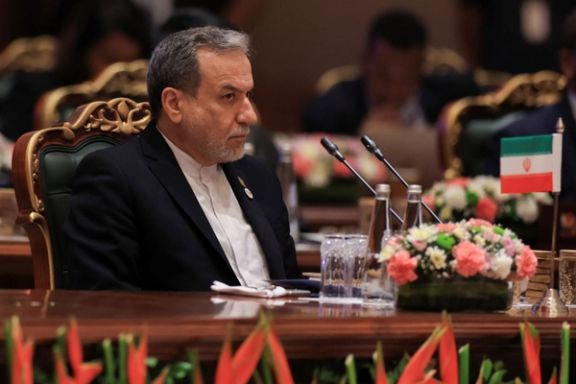
Iran's Foreign Minister Abbas Araqchi attends the BRICS foreign ministers' meeting at Bharat Mandapam in New Delhi, India May 14, 2026.

Iran’s foreign minister accused the United Arab Emirates on Thursday of direct involvement in military operations against Iran, escalating Tehran’s criticism of regional states during a BRICS meeting in New Delhi.

Abbas Araghchi made the remarks in response to comments by the Emirati representative and added that he had avoided naming the UAE in his main speech “for the sake of unity.”

“But the truth is that the UAE was directly involved in the aggression against my country,” Araghchi said. “When the attacks started, they didn't even issue a condemnation.”

He accused Abu Dhabi of providing bases, airspace, territory, intelligence and other facilities to the United States and Israel during the attacks.

Araghchi said Iran had not attacked the UAE, but had targeted US military bases and facilities on Emirati soil.

He urged the UAE to reconsider its policy toward Iran, saying neither the US military presence nor ties with Israel had protected it.

His remarks came against the backdrop of the war involving Iran, the United States and Israel, during which Tehran said it targeted US military positions in response to attacks on Iran.

They also followed reports that Israeli Prime Minister Benjamin Netanyahu had visited Abu Dhabi during the war and that Israel had provided the UAE with military equipment. The UAE rejected reports of the visit.

Araghchi cited the reports in his remarks, saying the UAE had become “an active partner in this aggression.”

The office of Israeli Prime Minister Benjamin Netanyahu said Wednesday he had made a secret visit to the United Arab Emirates during the US-Israeli war with Iran earlier this year and met UAE President Sheikh Mohammed bin Zayed.

Most Viewed

Cambridge probes Iran scholar over alleged fabricated interviews
1

Cambridge probes Iran scholar over alleged fabricated interviews

2
SPECIAL REPORT

How one Tehran hospital became a window into Iran’s January massacre

3

Iran and UAE clash at BRICS foreign ministers meeting

4

Iran executes man over accusations of spying for Israel

5
VOICES FROM IRAN

Tehran quake stirs dark humor, hopes for renewed strikes

Banner
Banner

Spotlight

  • Xi may help Trump on Iran, but at a price
    ANALYSIS

    Xi may help Trump on Iran, but at a price

  • Tehran and Beijing close ranks as Trump heads to China
    INSIGHT

    Tehran and Beijing close ranks as Trump heads to China

  • Iran looks to China for guarantees in future US deal
    INSIGHT

    Iran looks to China for guarantees in future US deal

  • How one Tehran hospital became a window into Iran’s January massacre
    SPECIAL REPORT

    How one Tehran hospital became a window into Iran’s January massacre

  • Iranians told to post pro-government content to regain internet access
    VOICES FROM IRAN

    Iranians told to post pro-government content to regain internet access

  • Fog of war meets fog of law in the Strait of Hormuz
    OPINION

    Fog of war meets fog of law in the Strait of Hormuz

  • Iran to cast regional conflict as resistance to US power at BRICS meeting

    Iran to cast regional conflict as resistance to US power at BRICS meeting

  • Iran-UAE breakdown leaves Iranian expats in limbo

    Iran-UAE breakdown leaves Iranian expats in limbo

•
•
•

More Stories

Iran to cast regional conflict as resistance to US power at BRICS meeting

May 14, 2026, 10:40 GMT+1

Iran sought to rally BRICS countries against US and Israeli military action on Thursday, casting the regional conflict as resistance to American power as concerns over maritime security and energy disruption dominated the bloc’s foreign ministers meeting in New Delhi.

Foreign Minister Abbas Araghchi urged the bloc to oppose what he called the politicization of international institutions and take action against countries violating the UN Charter.

“The West's false sense of superiority and immunity must be shattered by all of us,” Araghchi said in a statement during the gathering.

His remarks come as Iran faces deepening economic strain, a collapsing currency and growing public frustration at home, weakening the image of resilience officials have sought to project.

High inflation and repeated protests over living costs have laid bare Iran’s domestic vulnerabilities, even as Tehran seeks to project itself as a challenger to Western influence.

The two-day meeting opened under the shadow of the Iran-US-Israel war, exposing divisions within an expanded BRICS bloc split by competing regional interests and differing ties with Washington.

  • Fog of war meets fog of law in the Strait of Hormuz

    Fog of war meets fog of law in the Strait of Hormuz

The United States and Israel launched strikes on Iran on February 28 targeting military bases, missile infrastructure, nuclear facilities and senior commanders in an effort to weaken Tehran’s military capabilities and nuclear program.

Iran launched missile and drone attacks on Israel, US military assets and infrastructure linked to American allies in the Persian Gulf region.

Indian Foreign Minister Subrahmanyam Jaishankar warned that instability around key shipping lanes threatened the global economy.

India's Foreign Minister Subrahmanyam Jaishankar shakes hands with Iran's Foreign Minister Abbas Araqchi during the BRICS foreign ministers' meeting at Bharat Mandapam in New Delhi, India May 14, 2026.
100%
India's Foreign Minister Subrahmanyam Jaishankar shakes hands with Iran's Foreign Minister Abbas Araqchi during the BRICS foreign ministers' meeting at Bharat Mandapam in New Delhi, India May 14, 2026.

“Safe and unimpeded maritime flows through international waterways, including the Strait of Hormuz and the Red Sea, remain vital for global economic well-being,” Jaishankar said in opening remarks.

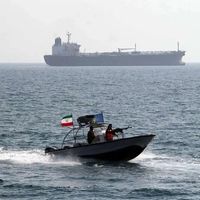
Iran has disrupted shipping through the Strait of Hormuz following joint US and Israeli strikes on its territory, issuing warnings to commercial vessels and tankers in the strategic waterway.

Traffic through the strait, which carries roughly one-fifth of global oil and gas trade, declined sharply as tanker operators suspended transit and vessels rerouted over security concerns.

The disruptions drew criticism from Western governments, Persian Gulf Arab states and shipping groups, which warned that threats to one of the world’s most important maritime chokepoints could destabilize global trade and energy markets.

BRICS was founded by Brazil, Russia, India and China before South Africa joined in 2011. The bloc later expanded to include Egypt, Ethiopia, Indonesia, Iran and the UAE.

  • IRGC-linked media calls for fees on Hormuz undersea internet cables

    IRGC-linked media calls for fees on Hormuz undersea internet cables

Iran presses bloc for response

Araghchi used his address to accuse Washington and Israel of carrying out attacks against Iran and urged BRICS countries to take a firmer position on the conflict.

“Iran is asking BRICS members and all responsible members of the international community to explicitly condemn violations of international law by the United States and Israel,” he said.

Araghchi also portrayed BRICS as part of an emerging global order less dominated by Western powers and said developing countries faced similar political and economic pressure from Washington.

India's Foreign Minister Subrahmanyam Jaishankar addresses the BRICS foreign ministers' meeting at Bharat Mandapam in New Delhi, India May 14, 2026.
100%
India's Foreign Minister Subrahmanyam Jaishankar addresses the BRICS foreign ministers' meeting at Bharat Mandapam in New Delhi, India May 14, 2026.

His comments did not address Iran’s own military and proxy activities across the region, including attacks by Iran-backed armed groups in Iraq, Yemen and Lebanon against neighboring countries and US-linked targets in recent years.

Tehran also launched missile and drone attacks on Arab states aligned with Washington during the conflict, targeting military facilities and energy infrastructure in the UAE, Qatar, Bahrain, Kuwait and Saudi Arabia.

The regional governments condemned the strikes as violations of sovereignty that threatened regional stability and energy supplies.

  • Iran-UAE breakdown leaves Iranian expats in limbo

    Iran-UAE breakdown leaves Iranian expats in limbo

Differences inside BRICS have complicated efforts to reach a unified position on the conflict, particularly between Iran and the UAE, which support opposing sides in the war.

Despite the divisions, diplomats said discussions were continuing toward a possible joint statement before the meeting concludes on Friday.

Tehran quake stirs dark humor, hopes for renewed strikes

May 13, 2026, 21:10 GMT+1

A series of tremors in and around Tehran late Tuesday stirred shock, dark humor and political despair among residents, with some initially mistaking them for renewed US-Israeli strikes.

On Tuesday night, Iran’s Seismological Center said a 4.6-magnitude quake struck near Pardis, east of Tehran, at a depth of 10 kilometers, with no immediate reports of casualties or major damage. A series of nine smaller earthquakes also struck the area overnight.

“This is what life is like for us inside Iran: an earthquake happens and my mother says, ‘I wish it were bombing instead.’ The result of 47 years of Islamic rule,” one message sent to Iran International said.

The reactions came against the backdrop of a fragile ceasefire after more than two months of war that began on February 28 with a US-Israeli bombing campaign on Iran.

Donald Trump said Monday that the ceasefire with Iran was “on life support” after rejecting Tehran’s response to a US proposal aimed at ending the war.

The ceasefire has been in place since April 7, but Trump has repeatedly threatened to end it if Iran failed to reach an agreement with Washington.

One message captured the bitter humor with which some residents viewed the quake amid fears of renewed conflict, suggesting divine intervention had stepped in where Trump had not.

“Trump dragged this out so much that God stepped in,” the message said.

Several residents said they initially mistook the shaking for renewed strikes.

“The earthquake at 11:40 p.m. on Tuesday in Tehran was really terrifying. For a few seconds, we thought the attacks had started again,” one Tehran resident said.

Another resident in eastern Tehran’s Tehranpars district said the tremor felt like a nearby missile strike.

“We are in eastern Tehran, in Tehranpars. Tuesday night’s earthquake shook and rattled our house so badly that we thought a missile had hit next to our home,” the resident said.

Several messages described the tremors as reviving memories of the recent war, when residents had become used to distinguishing between air defense fire, missiles, drones and explosions.

“Around 9 p.m. on Tuesday, an earthquake was felt in Tehran, but the one that came at 11:45 p.m. was felt very strongly. The whole house shook and the chandeliers rattled. It felt like the experience we had during those 40 days of war,” one message said.

Another resident said the earthquake and the sound of a storm afterward produced conflicting emotions.

“When the earthquake happened and then the sound of the storm afterward, we thought we were under attack again. We felt fear and relief at the same time,” the resident said.

In Pardis, east of Tehran, residents reported repeated tremors through the night.

“In Pardis, from 8 p.m. until 1 a.m., there were three relatively strong earthquakes. People rushed into the streets in fear and gas stations became crowded,” one message said.

One resident said a sudden dust storm added to the confusion.

“We were sitting at home, the weather was nice, and suddenly the air became extremely dusty and the sky filled with dirt and dust. Even though the war experience has taught us to distinguish between air defense fire, missiles and drones — or judge from the sound and shaking how close an explosion is — when the earthquake happened, for a few seconds we could not tell whether it was an attack or something else,” the resident said.

Other messages reflected mistrust and speculation about whether the tremors were linked to underground missile activity or even a possible nuclear test near Parchin.

“Could the earthquake have been caused by the criminals’ underground missile activities? Especially considering Tehran naturally sits on a fault line and their underground activities were exposed during the war,” one person said.

Another message said there was speculation online that the quake’s epicenter near Parchin meant Iran may have carried out a nuclear test rather than experienced a natural earthquake.

One message accused state television of failing to quickly cover the earthquake because authorities feared people would pour into the streets.

“State TV was not covering the earthquake because they were afraid people would pour into the streets. Human lives are so worthless to them as long as they can stay in power a little longer,” the message said.

Tehran and Beijing close ranks as Trump heads to China

May 13, 2026, 18:20 GMT+1
•
Maryam Sinaiee

Ahead of Donald Trump’s arrival in Beijing, Iranian officials rejected suggestions that US pressure could weaken Iran-China ties amid growing speculation over a possible Chinese mediation role in the Iran conflict.

Iranian ambassador to China Abdolreza Rahmani-Fazli wrote Monday on X that relations between Tehran and Beijing “are stronger than any US effort aimed at changing China’s position toward Iran through pressure.”

Chinese Foreign Ministry spokesman Guo Jiakun reinforced that message Monday, saying Beijing’s position remained “clear and consistent” and that the priority should be preventing renewed war and further escalation.

Crucially, Beijing also signaled opposition to any US-led blockade of the Strait of Hormuz, saying such actions were “not in the common interests of the international community.”

Observers viewed last week’s meeting in Beijing between Iranian Foreign Minister Abbas Araghchi and Chinese Foreign Minister Wang Yi as an effort to coordinate positions ahead of the expected Trump-Xi talks.

During the meeting, Wang said China was prepared to play a “greater role” in regional peace efforts and encouraged dialogue between Iran and Persian Gulf Arab states.

Trump pressure Xi over Iran

Western media reports indicate Trump plans to press Xi over China’s economic and strategic ties with Iran, particularly oil purchases and alleged military assistance.

While Trump acknowledged he would raise the issue, he also said before departing for Beijing that he did not believe Xi’s cooperation was strictly necessary to manage the crisis.

Tensions between Washington and Beijing over Iran have intensified in recent weeks following the seizure of a Tehran-linked cargo vessel near the Strait of Hormuz.

In a CNBC interview, Trump criticized what he described as China’s “unexpected support for Iran,” saying he had anticipated greater understanding from Beijing.

Former US ambassador Nikki Haley also alleged on X that the seized vessel was carrying chemicals intended for Iran’s missile program, presenting the case as evidence of growing Chinese support for Tehran.

China’s expanding regional role

At a May 8 press conference in Beijing, Rahmani-Fazli said Tehran and Beijing had agreed to advance Xi’s four-point regional security initiative.

The proposal emphasizes peaceful coexistence, respect for sovereignty and territorial integrity and adherence to international law as foundations for stability in the Persian Gulf and the broader Middle East.

Iranian outlet Khabar Online described the initiative as part of Beijing’s broader effort to position itself as a major diplomatic mediator in the region while distancing itself from what it called US unilateralism.

The outlet argued that the approach could strengthen Iran’s negotiating position and increase pressure on Washington to accept at least some Iranian demands.

Rahmani-Fazli said Monday that any future agreement with Washington “must inevitably include guarantees from major powers” and ultimately be raised at the UN Security Council.

Could China become a mediator?

So far, China has largely pursued a cautious approach to the confrontation between Iran and the United States, avoiding direct involvement while calling for de-escalation.

Still, some Iranian analysts believe Beijing may now be willing to take on a more active diplomatic role.

Former Iranian ambassador to China Mohammad Keshavarzzadeh told Shargh newspaper that Chinese officials appeared interested in facilitating negotiations and reducing tensions.

Iranian Foreign Ministry spokesman Esmail Baghaei also suggested Beijing could use Trump’s visit to warn against what Tehran describes as unlawful US pressure and its consequences for regional and global stability.

At the same time, some Iranian analysts believe China may be uneasy with Tehran’s threats to restrict access through the Strait of Hormuz.

Former Iranian diplomat Kourosh Ahmadi told Nour News that Beijing’s primary concern remains preserving open trade routes essential to its export-driven economy.

According to Ahmadi, this could push China to place greater emphasis on protecting the legal status of international waterways and opposing any disruption in Hormuz that might set precedents elsewhere.

Disputes over Chinese support for Iran

Last month, Trump called on Xi not to send weapons to Tehran and claimed China had offered assurances on the matter.

In recent days, the US State Department sanctioned three Chinese satellite companies accused of assisting Iranian military operations by providing imagery linked to Iranian military activity. Beijing rejected the allegations.

The US Treasury Department also sanctioned several companies in mainland China and Hong Kong accused of helping supply weapons-related materials to Iran.

Beijing does not recognize US sanctions on Iranian oil exports and has instructed domestic companies not to comply with American restrictions targeting so-called “teapot” refineries purchasing Iranian crude.

The moves underscore growing US efforts to pressure Beijing over its ties with Tehran ahead of the Trump-Xi meeting.

Cambridge probes Iran scholar over alleged fabricated interviews

May 13, 2026, 14:54 GMT+1
•
Benjamin Weinthal

A University of Arkansas Iranian-American professor fired from her tenured position in late March is now facing investigations in Britain over allegations of academic misconduct tied to her research on Iran.

Cambridge University Press, which published a book by University of Arkansas professor Shirin Saeidi based on her Cambridge PhD dissertation, is investigating claims that the work contains fabricated or unauthorized interviews with female victims of the Iranian government.

Iran International has also learned that Cambridge University is reviewing allegations related to Saeidi’s PhD dissertation itself.

University of Arkansas President Jay Silveria dismissed Saeidi over matters unrelated to the Cambridge investigations. She has appealed her termination, and the university’s Board of Trustees is set to review the case on May 21.

Saeidi’s book, Women and the Islamic Republic: How Gendered Citizenship Conditions the Iranian State, is now under scrutiny in Britain.

A spokesperson for Cambridge University Press told Iran International that the publisher “takes all complaints about our publications seriously” and is continuing to investigate the allegations “according to standard COPE guidelines.”

COPE, the Committee on Publication Ethics, is an organization that addresses ethical standards in scholarly publishing.

Iran International obtained a copy of a complaint submitted to Cambridge University Press by Maryam Nouri, author of the memoir In Search of Liberation, accusing Saeidi of fabricating interviews and using her work without permission.

Nouri, who was imprisoned by the Islamic Republic in 1985 while pregnant and later gave birth in prison, wrote that “I am writing to submit a formal complaint regarding the unethical and unauthorized use of my personal memoir and the fabrication of interview material by Dr. Shirin Saeidi.”

She added: “I never met with Ms. Shirin Saeidi, nor have I had any interview with her in the city of Cologne or in any other city in Germany.”

According to Nouri, Saeidi used material from her memoir “in both her doctoral dissertation and her published book without my written or verbal permission, for her own personal benefit, including advancing her academic credentials, university status, and professional position.”

“I consider this misuse a clear violation of my personal rights and dignity, and I strongly condemn it,” she wrote.

A Cambridge University spokesperson told Iran International that the university “takes allegations of academic misconduct seriously” and that concerns raised would be reviewed “in line with the relevant University policies and procedures.”

In a series of posts published on X in December, former Iranian political prisoner Nasrin Parvaz also denied ever being interviewed by Saeidi.

“I never knew Saeidi, and I never had an interview with her,” Parvaz wrote, adding that Saeidi had only used the Farsi version of her memoir published more than two decades earlier.

Numerous requests for comment sent by Iran International to Saeidi and her attorney, JJ Thompson, went unanswered.

Saeidi had already drawn controversy prior to her dismissal from the University of Arkansas. The university had previously disciplined her for allegedly using official university letterhead in an appeal seeking the release of Hamid Nouri, an Iranian official convicted in Sweden in 2022 over his role in the mass execution of political prisoners in 1988.

Saeidi has said she had permission to use the letterhead.

Lawdan Bazargan, director of the Alliance Against Islamic Regime of Iran Apologists (AAIRIA), who first publicized Saeidi’s support for Hamid Nouri, later began examining the sourcing in Saeidi’s academic work.

Bazargan told Iran International that several former political prisoners named in Saeidi’s dissertation and book had publicly denied being interviewed by her, raising broader questions about documentation, recordings, consent forms, and sourcing.

“The credibility of oral history research depends entirely on documentation, informed consent, and verifiable sourcing,” Bazargan said.

“If key testimonies cannot be substantiated, then the scholarly foundation of the book itself comes into question, because its central arguments rely heavily on those contested interviews.”

Bazargan also called for scrutiny of the supervisory process behind Saeidi’s Cambridge dissertation, including the role of her PhD supervisor, Professor Glen Rangwala. Iran International sent a request for comment to Rangwala.

Saeidi also drew criticism over social media posts praising former Supreme Leader Ali Khamenei and defending the Iranian establishment during the recent war. Her X account has since been suspended.
Suspected IRGC agent offered Briton money to target journalist - Jewish Chronicle

May 13, 2026, 09:18 GMT+1

A British-Iranian man said a suspected Iran-linked agent offered him £40,000 ($53,000) to kill a London-based journalist critical of Tehran, the Jewish Chronicle reported.

The man, identified by the pseudonym “Nima,” told the newspaper he reported the incident to British police after returning to the UK and warned the journalist, who works for a Persian-language broadcaster.

Nima, who has lived in Britain for about a decade and works as a bartender, said the encounter began during a holiday in southern Europe, where he visited an Iranian restaurant and met two men, including one he recognized from Iran.

The man initially discussed plans to open a bar in London and asked for Nima’s contact details, presenting the approach as a business proposal, according to the report.

Alleged murder proposal

Nima said a second meeting took a darker turn when the man arrived with two others and began referring to personal details about his life in Britain and relatives in Iran.

“He told me: ‘You are a decent man. You have family in Iran who need your support. I would like to offer you a job, with an initial payment of £40,000,’” Nima told the Jewish Chronicle.

According to the report, the man referred to an Iranian journalist in London with whom Nima had argued online and said he wanted to “punish” him, asking whether Nima could carry out the act or find someone else to do so.

Nima said he was offered 20,000 pounds in cash immediately and the remaining amount after identifying the journalist’s location. He said the men appeared to believe the journalist lived in a safe house.

The suspected operative did not directly identify himself as an IRGC member, Nima said, but an acquaintance suggested he held influence in Iran and referred to “Sepah” - the Persian name for the IRGC –while discussing possible help for Nima’s family.

  • Iranian assaulted in London amid concern over threats to regime critics

    Iranian assaulted in London amid concern over threats to regime critics

  • Three charged over attempted arson at Iran International office in London

    Three charged over attempted arson at Iran International office in London

  • Suspected Iran-linked group claims north London Jewish ambulance arson

    Suspected Iran-linked group claims north London Jewish ambulance arson

  • Two men charged with spying for Iran targeting London Jewish community

    Two men charged with spying for Iran targeting London Jewish community

Security concerns in Britain

The alleged approach comes amid heightened concern in Britain over Iranian-linked threats targeting dissidents, journalists and Jewish institutions.

Iran-aligned group Harakat Ashab al-Yamin al-Islamia has said it carried out attacks on Jewish sites in Britain and Europe, including incidents involving two north London synagogues last month.

MI5 Director General Ken McCallum has warned repeatedly that Iran, acting through the IRGC, poses what he described as a “potentially lethal” threat in Britain. British authorities have disrupted multiple alleged Iran-linked plots since 2022 targeting dissidents, journalists and Jewish or Israeli-linked individuals, according to British officials.