Jailed Iranian Nobel laureate hospitalized after losing consciousness twice
Narges Mohammadi
Iranian Nobel Peace Prize laureate Narges Mohammadi was urgently transferred from Zanjan Prison to a hospital on Friday after losing consciousness twice and suffering a severe deterioration in her health, her lawyer and the Narges Foundation said.
The Narges Foundation said in a statement Mohammadi was moved by ambulance to a local hospital in Zanjan in northwestern Iran after prison doctors concluded her condition could no longer be managed inside the prison.
She was admitted to the coronary care unit, according to her lawyer Mostafa Nili.
Nili said Mohammadi had experienced extreme blood pressure fluctuations, acute chest pain and repeated episodes of severe distress in recent days. He said she first fainted after a sudden drop in blood pressure and was given IV fluids and anti-nausea medication in the prison clinic.
After emergency services arrived, Mohammadi initially declined transfer to a Zanjan hospital, citing warnings from two cardiologists that her history of three angiographies and stent placement made treatment in Zanjan dangerous and required care by her own medical team, Nili said.
A few hours later, she lost consciousness again. A neurologist then ordered urgent hospitalization, saying her neurological condition had become the immediate clinical priority despite her serious cardiac issues.
The foundation said Mohammadi’s family had sought proper medical care for weeks and described the hospital transfer as a “last-minute” step that may have come too late.
It said specialists had recommended her transfer to Pars Hospital in Tehran, where her own medical team could treat her.
According to the foundation, Zanjan’s forensic medical commission had already recommended a one-month suspension of her sentence for medical treatment, but prosecutors made it contingent on approval from Tehran.
Mohammadi was re-arrested on December 12, 2025, and sentenced on February 8, 2026, to an additional seven and a half years in prison, bringing her cumulative sentence to more than 18 years.
People inspect the site of a residential building damaged by a strike, amid the US-Israeli conflict with Iran, in Karaj, Iran, April 3, 2026.
Dozens of residents in Tehran displaced by a 40-day war with the US and Israel said municipal authorities ordered them to vacate temporary hotel housing despite unsafe homes and limited aid, according to interviews published by Etemad newspaper on Thursday.
Several of those affected said they were told to leave by the end of the week after calls from Tehran’s crisis management body, even though official inspections had deemed their homes uninhabitable.
“I was told I had to leave the hotel by the end of the week, even though my home is unsafe and I have nowhere to go,” one resident said, describing a call from a municipal official who noted reconstruction had not begun due to lack of funds.
People inspect the site of a residential building damaged by a strike, amid the US-Israeli conflict with Iran, in Karaj, Iran, April 3, 2026.
Unsafe homes, no rental support
A resident, who lived in a seventh-floor apartment damaged by a nearby missile strike in March, described shattered windows and debris that rendered both the unit and building access unusable. Emergency services later confirmed the structure was unsafe.
Despite this, the resident said no rental assistance or deposit support had been offered. “They told me I should find housing myself because there is no budget,” the resident added.
Other displaced residents reported receiving similar instructions. Many said they lacked the financial means to rebuild or secure new housing, leaving them at risk of homelessness.
Under earlier municipal pledges, affected households were to receive temporary accommodation, rental support, and reconstruction assistance.
Updated figures increased aid for household goods to 4 billion rials (about $2,200), rental deposits to 20 billion rials (about $11,000), and monthly rent support to 400 million rials (about $220).
However, residents said these commitments have not been consistently fulfilled.
Average income in Iran is around $150 to $200 per month, while the minimum wage is typically below $100.
Civilians react on a street as tensions rise during the US–Israeli conflict with Iran, with one man speaking on the phone while others look on in concern.
Delays and conditions on compensation
Some families whose homes were destroyed said they were instructed to pay for basic household items upfront and submit receipts for reimbursement, which could take up to 10 months.
Others said even smaller grants had limited impact. One resident who received 2.5 billion rials (about $1,400) said it was insufficient to replace essential items such as a refrigerator, stove, and bedding.
“We lost everything in the strike and could not even recover clothes,” the resident said. “With that money, we could only buy a few basic items.”
In some cases, families forced to leave hotels reported moving into improvised spaces. One household said they had lived for months in a 30-square-meter storage room after being unable to afford rent.
Residents with damaged vehicles described similar difficulties in seeking compensation. Several said they were told by representatives of insurance that earlier claims from a previous conflict in June had not yet been settled.
“They told me there is no timeline for paying these damages,” one vehicle owner said after visiting an insurance office.
Official figures show that thousands of vehicles and tens of thousands of residential units were damaged in the 40-day conflict, adding to earlier destruction from a previous 12-day escalation in June.
A man inspects a car buried under rubble inside a damaged building following strikes during the US–Israeli conflict with Iran.
City council response highlights gaps
A spokesperson for Tehran’s city council acknowledged reports of inconsistencies and said cases of forced eviction without support should be reviewed.
“This should not happen, and if such cases exist, they must be followed up,” Alireza Nadali said, adding that municipal policy ties the end of hotel stays to securing alternative housing.
The official also pointed to the scale of damage and budget constraints, adding that assistance programs were introduced voluntarily and may face delays.
At the same time, the council emphasized that reconstruction responsibilities differ depending on the level of damage and local planning rules, which has led to varied outcomes across districts.
The accounts raise questions about the oversight role of the city council and the implementation of municipal commitments. Residents interviewed said many promises remained unfulfilled months after the initial damage.
Efforts to obtain direct comment from municipal crisis officials were unsuccessful, according to the report.
File photo of a man reading a copy of Iran newspaper on a Tehran street
Iran ranked among the world’s worst countries for press freedom in 2026 as global conditions hit a 25-year low, with legal pressure on journalists intensifying across multiple regions, Reporters Without Borders said.
More than half of all countries now fall into “difficult” or “very serious” categories, with the global average score at its lowest since the index began, the organization said.
“Iran remains near the bottom of the ranking, held back by the regime’s own repression and the US-Israeli war on its soil,” Reporters Without Borders wrote.
Iran anchored in ‘very serious’ category
Iran ranked 177th out of 180 countries, placing it firmly in the “very serious” category on the global press freedom map, according to the index.
The map shows Iran shaded in the darkest category, alongside a group of countries where conditions for journalists are considered most restrictive.
The report links Iran’s position to longstanding constraints on media and the use of legal and security frameworks to prosecute journalists or limit reporting.
Press freedom has declined steadily worldwide, with less than 1% of the global population now living in countries classified as having a “good” environment for journalism.
Russia and China shape restrictive landscape
Russia and China remain central to the global decline, both through domestic policies and the spread of their legal models abroad.
Russia ranked 172nd, with authorities using laws tied to extremism and national security to detain journalists and restrict independent reporting.
China ranked 178th and continues to hold more journalists in prison than any other country, with its censorship and legal frameworks increasingly replicated across the Asia-Pacific region.
Across that region, 21 of 32 countries are now classified as having “difficult” or “very serious” press freedom conditions.
Syria posts rare improvement
Syria recorded the sharpest improvement in the 2026 index, climbing 36 places following political changes after the fall of Bashar al-Assad’s government in late 2025.
Despite that shift, the map visualization shows much of the Middle East and parts of Asia still dominated by darker shades, indicating persistent risks for journalists across the region.
Legal pressure drives global decline
The legal environment for journalism deteriorated in more than 60% of countries over the past year, reflecting wider use of national security laws and criminal charges against reporters.
These legal tools have become central to controlling information, often reinforced by economic pressure and political messaging against independent media.
The findings point to a global shift in how press freedom is constrained, with legal systems now playing a defining role in shaping access to information and the boundaries of public reporting.
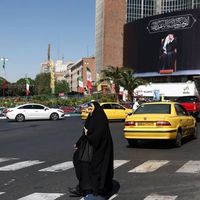
People walk in Tehran Bazaar, amid a ceasefire between US and Iran, in Tehran, Iran, April 21, 2026.
With US-Iran talks in Pakistan in doubt after Iran's foreign minister left Islamabad and President Trump canceled the planned trip by US negotiators, veteran journalist Eli Lake says Washington should use its leverage not only on the nuclear file, but to help the people of Iran.
Iranian Foreign Minister Abbas Araghchi was in Islamabad on Saturday, where he met Pakistani Prime Minister Shehbaz Sharif and army chief Asim Munir as Pakistan continued efforts to mediate between Tehran and Washington.
A Pakistani source involved in the talks told Reuters that Araghchi conveyed Tehran’s demands and concerns about US positions during the visit. Iranian state media also said he delivered Iran’s response to proposals in a meeting with Munir before leaving Islamabad for Oman and Russia.
Iranian officials had earlier said Araghchi had no plan to meet US officials in Pakistan.
Lake, a journalist at The Free Press and host of the Breaking History podcast, told Eye for Iran that the Islamic Republic is seeking negotiations as a lifeline after major military, economic and political setbacks.
“Their backs are against the wall and these negotiations they hope are going to be a lifeline,” Lake said.
But he argued that any renewed diplomatic track should begin with pressure on Tehran over the Iranian people.
“If I was Vice President Vance, I would say… the first thing I’d say is, you need to turn back on the internet if you’re going to get these financial lifelines. You need to release political prisoners,” Lake said.
He added that Washington should also demand an end to executions.
The remarks come as Iran’s internet blackout has entered its 57th day, according to NetBlocks, with international connectivity still largely severed amid worsening conditions inside the country.
Lake said the US should recognize that “our best allies are the Iranian people on the ground,” and warned against strikes on civilian infrastructure such as power plants, saying they would hurt ordinary Iranians more than the Islamic Republic.
The diplomatic maneuvering has also unfolded amid signs of deepening disagreement inside Tehran. Mohammad Bagher Ghalibaf, the parliament speaker, has stepped down as head of Iran’s negotiating team amid internal disputes, with Saeed Jalili floated as a possible replacement and Araghchi seeking greater control of the talks.
Lake said he believes the fractures inside the Islamic Republic are genuine.
“At the end of the day, with enough pressure, they’re probably going to start turning on each other,” he said.
He argued that the Islamic Republic has lost legitimacy and that Iran’s future will ultimately be decided by Iranians themselves.
Three Baha’i women from Rafsanjan, a city in Iran’s southeastern Kerman province, were sent to prison on Saturday to serve four-month sentences on the charge of “propaganda against the system,” according to information received by Iran International.
The women – Boshra Mostafavi, Nahid Naimi and Didar Ahmadi – were transferred to Kerman prison after being sentenced by an appeals court in the province. According to information received by Iran International, the judge told them during the proceedings: “You are Baha’i, and in an Islamic country you must pay the price for being Baha’i.”
The three had earlier been acquitted by a criminal court in Rafsanjan for lack of evidence, but that ruling was challenged by the local prosecutor and later overturned.
Mostafavi was transferred to prison while pregnant.
Anti-government protesters gather in the streets of Tehran during nationwide unrest in January 2026.
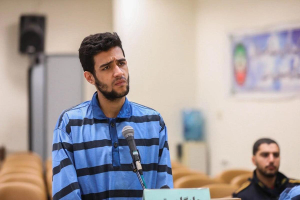
Iran executed a man on Saturday over his involvement in January anti-establishment protests, whom authorities said acted on behalf of Israel’s Mossad intelligence service.
Judiciary-affiliated media identified him as Erfan Kiani and said his death sentence had been upheld by the Supreme Court before being carried out early in the morning.
Authorities said Kiani led a group in the central city of Isfahan that carried out acts including damaging public and private property, setting fires, using Molotov cocktails, blocking roads and attacking security forces during the unrest.
State media described him as a key figure in efforts to create “fear and chaos,” framing the case as part of what officials say is a broader campaign against foreign-backed activity.
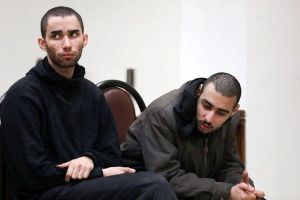
The execution comes amid an ongoing crackdown following the January protests, with several people executed in recent weeks on similar charges. Earlier this month, authorities executed two men accused of attempting to storm a military site and access weapons, while another man was put to death over allegations he set fire to a mosque during the unrest.
Rights groups, including Amnesty International, have repeatedly raised concerns over the use of capital punishment in protest-related cases, saying defendants are often convicted in unfair trials and based on confessions obtained under duress.