• العربية
  • فارسی
Brand
  • Iran Insight
  • Politics
  • Economy
  • Analysis
  • Special Report
  • Opinion
  • Podcast
  • Iran Insight
  • Politics
  • Economy
  • Analysis
  • Special Report
  • Opinion
  • Podcast
  • Theme
  • Language
    • العربية
    • فارسی
  • Iran Insight
  • Politics
  • Economy
  • Analysis
  • Special Report
  • Opinion
  • Podcast
All rights reserved for Volant Media UK Limited
volant media logo
INSIGHT

Did Araghchi’s tour signal leverage or isolation?

Behrouz Turani
Behrouz Turani

Iran International

Apr 28, 2026, 03:01 GMT+1
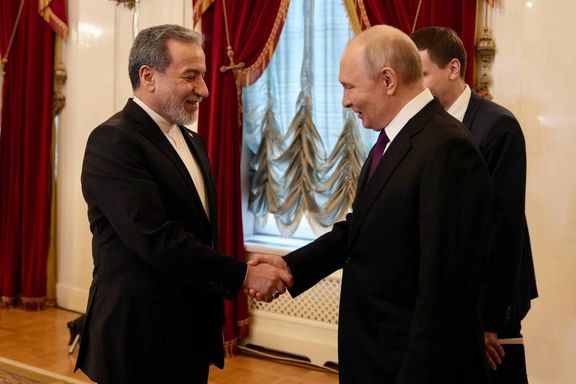
Russia's president Vladimir Putin greets Iran's foreign minister Abbas Araghchi in St Petersburg, April 27, 2026

In Tehran, Abbas Araghchi’s whirlwind regional tour is being presented as evidence that Iran still has diplomatic options and regional leverage.

But behind the official narrative, even Iranian media and senior officials are beginning to acknowledge a harsher reality: talks with Washington are stalled, allies are limited and the country’s room to maneuver is narrowing.

The reformist daily Shargh wrote on Monday that the visits revealed “clear signs of a deadlock in negotiations with Washington.”

In an interview with ISNA, Araghchi himself acknowledged that “the first round of talks in Islamabad failed to reach its objectives,” blaming what he described as “the United States’ excessive demands.”

Media in Tehran have portrayed Araghchi’s visits to Pakistan, Oman and Russia as part of an effort to break the impasse with Washington through regional diplomacy.

But leaks in US media suggest Tehran’s message remains uncompromising: end the US blockade of the Strait of Hormuz as a precondition for immediate talks on Iran’s nuclear program.

That demand underscores the gap between Tehran’s public message of diplomacy and the harder line it may still be taking behind closed doors.

The idea that Tehran can quickly repair relations with neighboring states also appears optimistic. Regional capitals still vividly remember Iran’s recent strikes on the United Arab Emirates, Qatar, Kuwait, Bahrain and Saudi Arabia.

While Tehran insists diplomatic channels remain open, only a handful of neighbors appear willing—or able—to engage.

Oman, traditionally a trusted mediator, may have less incentive to play that role after Tehran’s recent actions and amid Washington’s hesitation. Russia, meanwhile, is increasingly viewed with suspicion inside Iran, where critics accuse Moscow of exploiting Tehran’s isolation without offering meaningful support.

Yet despite the impasse, signs of a possible diplomatic opening remain.

Pakistan’s active mediation has positioned Islamabad as an important hub for indirect US-Iran communication, suggesting both sides still see value in keeping channels open.

In Washington, President Donald Trump’s recent references to an “agreement in principle,” including possible limits on uranium enrichment in exchange for sanctions relief, suggest discussions may have moved from whether to talk toward what terms might be acceptable.

Economic pressure is also pushing both sides toward pragmatism.

In Iran, the economy is buckling under war, inflation and disruption to oil exports. In the United States, rising gasoline prices are creating domestic political pressure.

The so-called pragmatists in Tehran appear increasingly willing to pursue compromise to preserve stability. Hardliners, especially among a younger generation of officials, increasingly frame the conflict as existential and may see concessions as surrender.

If they conclude Washington’s ultimate goal is regime change rather than policy change, pressure could grow for nuclear escalation rather than restraint.

Washington’s insistence that Iran halt all uranium enrichment and remove previously enriched material remains a central sticking point. The Strait of Hormuz is another.

The United States has reportedly conditioned any pause in military action on the complete and safe reopening of the waterway. Any renewed Iranian interference with shipping could trigger immediate retaliation and collapse diplomacy.

Israeli strikes on Iranian nuclear or leadership targets—or retaliatory actions by Hezbollah or the Houthis—could drag both Tehran and Washington into a cycle neither fully controls.

For now, the immediate question is no longer whether Washington and Tehran are talking. It is whether either side is prepared to soften their demands before events overtake diplomacy.

And in Tehran, where the costs of war are rising by the day, that question is becoming harder to ignore.

Most Viewed

The hidden target in US war on Iran may be China
1
PODCAST

The hidden target in US war on Iran may be China

2
INSIGHT

Unity or fracture? Tehran battles Trump’s narrative of disarray

3

Is the US blockade working? It depends who you ask

4
INSIGHT

Is Ghalibaf becoming Iran’s Khrushchev?

5
EXCLUSIVE

New intelligence exposes IRGC-linked network targeting Israeli, Western sites

Banner
Banner

Spotlight

  • Iran’s foreign trade suffers wartime collapse
    ANALYSIS

    Iran’s foreign trade suffers wartime collapse

  • Did Araghchi’s tour signal leverage or isolation?
    INSIGHT

    Did Araghchi’s tour signal leverage or isolation?

  • Why a blockade would not halt Iran’s oil overnight
    ANALYSIS

    Why a blockade would not halt Iran’s oil overnight

  • Iran football chief with IRGC past to visit Canada for FIFA event
    EXCLUSIVE

    Iran football chief with IRGC past to visit Canada for FIFA event

  • New intelligence exposes IRGC-linked network targeting Israeli, Western sites
    EXCLUSIVE

    New intelligence exposes IRGC-linked network targeting Israeli, Western sites

  • Is Ghalibaf becoming Iran’s Khrushchev?
    INSIGHT

    Is Ghalibaf becoming Iran’s Khrushchev?

•
•
•

More Stories

Why a blockade would not halt Iran’s oil overnight

Apr 28, 2026, 00:53 GMT+1
•
Umud Shokri

Amid Iran’s closure of the Strait of Hormuz and the ensuing US blockade, an old energy fantasy has resurfaced that cutting off a country’s oil exports works like flipping a switch. But reality is less cinematic and far more uncomfortable.

If Iran faced a serious maritime blockade, its oil system would not collapse overnight. It would absorb the shock, adapt, and only gradually tighten under pressure.

That distinction between sudden failure and slow strain is not just technical. It is the difference between a crisis markets can price instantly and one that unfolds in uneasy stages.

As Washington says its blockade is tightening around Tehran, understanding that distinction matters.

Kharg Island: The pressure point

Nearly all of Iran’s crude exports flow through Kharg Island, which handles about 90 percent of outbound shipments. On a typical day, that means roughly 1.5 to 2 million barrels moving through its loading facilities.

Kharg is more than a transit point. It is also a buffer. With storage capacity estimated at between 20 and 30 million barrels, the island allows Iran to keep producing even when export schedules fluctuate.

Under blockade conditions, that flexibility becomes a liability. If tankers cannot load or leave reliably, crude begins accumulating in storage. At current export levels, even the upper bound of capacity could be filled in a matter of weeks.

The island would not fail immediately. But it would begin operating under a visible constraint: every additional barrel has fewer places to go.

When storage becomes a bottleneck

Oil systems are built with redundancy. Storage tanks, pipelines and floating storage options all provide breathing room. That is why disruption rarely produces instant collapse.

In a blockade scenario, Iran would likely continue exporting in reduced and irregular ways at first. Some cargoes might slip through via evasive shipping practices. Others could be rerouted or delayed. Meanwhile, crude that cannot be exported would accumulate in storage tanks on Kharg and elsewhere.

But storage is finite. As tanks fill, flexibility narrows. The system shifts from optimizing flows to managing congestion.

Operators are no longer asking how to move oil efficiently, but how to avoid hitting physical limits. This is the quiet phase of disruption: no dramatic cutoff, just a steady tightening that forces increasingly constrained choices.

Adaptation under pressure

Iran’s oil sector is no stranger to operating under constraint. Years of sanctions have trained it to improvise.

Cargoes could still move through ship-to-ship transfers and opaque shipping routes designed to obscure origin and destination. Parts of the tanker fleet could be repurposed as floating storage to buy time offshore as onshore tanks fill.

Production would not stop overnight but would likely be trimmed gradually, with operators calibrating output to avoid overwhelming storage while trying to preserve reservoir integrity.

Domestic refiners could absorb some additional crude, and inland storage might be stretched, though both options are limited and cannot fully offset lost export capacity.

These responses would not neutralize the impact of a blockade. But they would slow its effects, allowing the system to continue functioning in a constrained and increasingly inefficient state.

The result is not resilience so much as endurance: the ability to delay more severe disruptions.

The limits beneath the surface

What happens underground imposes its own discipline.

Oil reservoirs are not infinitely flexible. Shutting in production, especially in mature fields, can damage reservoir pressure and reduce long-term recovery.

That means Iran cannot simply halt output the moment storage fills. Production cuts must be sequenced carefully, prioritizing fields that can be shut in safely while protecting long-term capacity.

The system slows, recalibrates and absorbs damage where it must, all while trying to avoid irreversible losses.

Pressure builds, markets adjust

For global markets and policymakers, the difference between a sudden cutoff and a gradual squeeze is critical.

A sharp disruption would trigger immediate price spikes and emergency responses. A slower, adaptive contraction produces a different dynamic. Prices may rise in stages. Other producers have time to respond.

Strategic reserves can be deployed more deliberately. Trade flows can be rerouted.

Yet this slower progression carries its own risks. It creates uncertainty rather than clarity and tempts decision-makers to underestimate the severity of the situation, even as constraints tighten.

No switch, just strain

A blockade of Iran’s oil exports would not look like a sudden shutdown. It would resemble a system under mounting pressure, adapting in real time while steadily losing room to maneuver.

For Iran, the effect is less a collapse than a managed deterioration. Revenues would erode, costs would rise, and each workaround would become harder to sustain.

For global markets, the danger lies in misreading that slow burn as stability.

By the time constraints converge into something more acute, the system may already be far closer to its limits than it appears.

Iran, US clash at UN over Strait of Hormuz closure

Apr 27, 2026, 23:15 GMT+1

Iran and the United States traded accusations at the United Nations on Monday over the Strait of Hormuz, as the archfoes’ weeks-long standoff over the strategic waterway continued to disrupt global energy supplies and world trade.

At a Security Council debate on maritime security, the U.S. envoy accused Tehran of holding the global economy “hostage,” while Iran’s envoy denounced Washington as “pirates and terrorists” for targeting commercial vessels.

“The world’s critical waterways are not bargaining chips that belong to any one country,” U.S. envoy Dorothy Shea told the council.

She said Iran was using the strait “like its own moat and drawbridge” and accused Tehran of laying sea mines, firing on civilian ships and threatening to charge tolls to allow vessels through.

Iran’s ambassador to the UN, Amir Saeid Iravani, rejected the accusations and said the United States was “acting like pirates and terrorists” by targeting commercial vessels through “coercion and intimidation,” terrorizing crews, seizing ships and “taking crew members hostage.”

He said countries condemning Iran over the strait “do not dare” criticize Washington’s actions and insisted Tehran’s measures were “grounded in its rights and obligations under the law of the sea and its national laws.”

The Strait of Hormuz, which links the Persian Gulf to the Gulf of Oman and the Arabian Sea, typically handles around 20% of the world’s daily oil and liquefied natural gas supplies.

Before the U.S.-Israeli war on Iran began on February 28, between 125 and 140 ships passed through the strait each day. In the past 24 hours, only seven vessels have done so, according to ship-tracking data.

Iran closed the strait after the start of U.S. and Israeli military operations against the Islamic Republic and launched attacks on Arab Gulf states, prompting Washington to begin enforcing a naval blockade on Iran-related shipping.

Hundreds of ships and an estimated 20,000 seafarers remain stranded inside the Gulf, according to maritime analysts.

UN Secretary-General António Guterres appealed directly to the parties to restore maritime traffic.

“Open the strait,” he said, “let ships pass, no tolls, no discrimination, let trade resume, let the global economy breathe.”

Arsenio Dominguez, secretary-general of the International Maritime Organization, also weighed in, saying Iran could neither legally close the strait nor impose fees on vessels using it.

“There is no legal basis for any country to introduce payments, tolls, fees or discriminatory conditions on international straits,” he told the council.

Dominguez warned that crews were under “significant risks and considerable psychological strain” and said the longer the crisis continues, “the greater the risk of serious accidents, including environmental accidents.”

Is Ghalibaf becoming Iran’s Khrushchev?

Apr 27, 2026, 04:06 GMT+1
•
Mehdi Jedinia

Reports that Mohammad Bagher Ghalibaf may have been sidelined from Iran’s negotiations with the United States have revived an old question from Soviet history: can an insider reform a rigid ideological system without becoming one of its casualties?

Ghalibaf may be emerging not as Iran’s Mikhail Gorbachev, but as something closer to Nikita Khrushchev—an establishment figure attempting controlled change not to dismantle the Islamic Republic, but to preserve it.

The Majles speaker, a former IRGC commander with deep ties inside the security establishment, has in recent weeks appeared to sit at the center of Tehran’s debate over diplomacy or confrontation.

Supporters of diplomacy see negotiations as a way to stabilize the system and prevent further confrontation with the West. Hardline factions warn that concessions would undermine the ideological foundations of the Islamic Republic.

US President Donald Trump, intentionally or not, has helped fan the flames by publicly portraying Iran’s leadership as divided, echoing the way Washington’s rivalry with the Soviet Union often intensified internal debates in Moscow.

The comparison with Gorbachev has appeared before in Iranian politics. During the reform movement of the late 1990s, President Mohammad Khatami was frequently described as “Iran’s Gorbachev.”

Hardliners used the label to attack him, while parts of the opposition embraced it in the hope that his reforms might accelerate the system’s collapse.

In reality, neither Khatami nor his allies accepted that role. Their reforms were framed as an effort to strengthen the Islamic Republic rather than dismantle it. More importantly, the structure of power at the time made a Gorbachev-style transformation nearly impossible.

Supreme Leader Ali Khamenei held ultimate authority and maintained the balance between rival factions, limiting both reformist ambitions and hardline overreach.

The conditions today are markedly different. Iran has endured direct external military pressure, and the legitimacy of the system has been shaken by recent protests. A younger generation appears deeply alienated from the ideological foundations of the state.

At the same time, the supreme arbiter who once managed factional competition no longer appears able—or willing—to impose the same discipline.

In such circumstances, change may come not from a reformist outsider but from a figure embedded within the system itself. Ghalibaf fits that description. His background in the IRGC, his political experience, and his connections across multiple factions give him a platform few others possess.

Yet any move toward accommodation with Washington provokes resistance from ideological loyalists who view compromise as betrayal, even as warnings grow that without meaningful change the system could buckle under pressure from abroad and deepening discontent at home.

Here the Soviet analogy becomes harder to ignore.

Khrushchev’s reforms were intended to strengthen the Soviet system, not dismantle it. But attempts to modernize rigid structures often produce consequences their architects cannot control.

In 1964, Khrushchev was quietly pushed aside by his colleagues and officially “retired due to old age and ill health.”

If Iran’s leadership ultimately chooses a path of limited reform to preserve the state, Ghalibaf could still emerge in such a role. But if the system rejects even controlled adaptation, he may instead become an early casualty of its resistance to change.

Iran’s new military-led order may mean greater dangers abroad

Apr 27, 2026, 02:40 GMT+1
•
Shervin Shahrestani

The Islamic Republic that has emerged from the killing of Iran's Supreme Leader Ali Khamenei may prove more operationally aggressive than the one it replaces, analysts say.

Dominated by the Revolutionary Guards, the leadership in Tehran may be less constrained by theology and more driven by revenge.

This is an assessment by analysts tracking the post-war power shift in Tehran, as a string of attacks on Jewish and Israeli targets have taken place since the Feb. 28 US-Israeli strikes. 

Across Europe, an Iran-linked group calling itself Harakat Ashab al-Yamin al-Islamia has claimed several attacks, including the targeting of Jewish volunteer ambulances in London, a synagogue in Belgium and a synagogue and Jewish school in the Netherlands. 

In Azerbaijan, an alleged Iranian plot targeting the Israeli embassy in Baku and Jewish community sites was foiled by authorities. 

Danny Citrinowicz, a senior researcher at the Institute for National Security Studies in Tel Aviv, says the post-Ali Khamenei Islamic Republic is likely to become more operationally aggressive, with sleeper cells and lone-wolf attacks posing a growing threat to Tehran’s adversaries.

"Lone wolves are a bigger threat," Citrinowicz told Iran International, referring to the act of an individual committing a violent act alone without a direct order.

"You just need to create the atmosphere," Citrinowicz said. "It will lead to someone saying, I'm going to do something." 

Citrinowicz describes the Islamic Republic in 2026 as "Iranian Revolution 3.0" — its third iteration since 1979 — in which a military junta has taken control of the founding doctrine of clerical rule, Velayat-e Faqih, with the IRGC dominating all meaningful decisions.

It is a regime that has demonstrated, through the foreign fighters it brought in to suppress its own population during the January 2026 uprising, that it harbors sizable loyal support outside its borders. 

"The regime will try to present itself as a continuation of Ali Khamenei's regime," Citrinowicz said.

Yet the IRGC-dominated leadership still faces a limitation in its power, inheriting a government whose revolutionary appeal has long outlasted its domestic popularity. 

Iran International reported that around 800 members of Iraqi militia groups — including Kataib Hezbollah and Harakat al-Nujaba — entered Iran days before the January 2026 crackdown that killed tens of thousands of protesters.

Proxy Shia forces from Turkey, Afghanistan and Pakistan have also been reported inside Iran. 

The Pakistani contingent — the Zainabiyoun Brigade — is an armed wing rooted in Tehran's ideological network, drawn from South Asia's Shia communities. But one militia is only part of the picture.

Simon Wolfgang Fuchs, an associate professor at the Hebrew University of Jerusalem, describes Lahore-based cleric Jawad Naqvi as running a sprawling and sophisticated Shia seminary operation in Lahore, Pakistan. 

The seminary produces Qom-trained scholars, high-quality social media content, and an explicit political model.

"He's really someone who says we have to implement the Iranian model in Pakistan," Fuchs told Iran International. Naqvi's political model draws inspiration from Hezbollah, Fuchs argues — a Shia minority that embraced Velayat-e Faqih and came to dominate Lebanon's political field.

"The vision and the boldness to simply claim that you could also dominate the state is definitely there," Fuchs said, though he cautioned the comparison has limits — Pakistan's Shia community has no history of armed resistance. 

"Iran's efforts to gain a following as the legitimate leader of the Shia (community) has paid off somewhat in South Asia," said Cliff Smith, a fellow at the Middle East Forum who visited Indian-administered Kashmir and documented Iranian influence on the ground.

"The idea of Iran is stronger outside its borders than it is inside." 

India, home to between 20 and 40 million Shia — the second-largest such population after Iran — has received less scrutiny than its neighbour. 

Smith observed during time spent in Kashmir that New Delhi had effectively tolerated Iranian influence among the Shia community, calculating it served as a useful counterweight to Sunni radicalism from Pakistan.

The wave of protests and unrest that was seen in India following Khamenei's killing has prompted a reassessment, according to Smith. 

"I had one of those people tell me, when they had seen the riots and demonstrations after Khamenei’s death, that I was right. We should have paid attention to this sooner," he said, recalling a contact at an Indian think tank. 

Abhinav Pandya of India's Usanas Foundation argues the blind spot runs deeper than Kashmir, as Iran's influence among Indian Muslims is not confined to Shia communities.

India is home to around 200 million Muslims — the world's third-largest — and Pandya argues the Indian security establishment has been too focused on the Sunni threat to register how deeply the Islamic Republic's influence has taken root among the country's Shia groups. 

"The biggest misunderstanding is that most of the jihadist problem comes from the Sunni Muslims, and the Shias — they don't need to bother about them, Shias are completely loyal," Pandya said.

"So far Shia Muslims have not majorly participated in any terrorist activity... But partly this understanding is problematic." 

For Citrinowicz, the killing of Khamenei —a figure seen as much as a religious leader as a political one — risks transforming Iran's conflict with the US and Israel into something far harder to contain. 

“The killing of him is potentially opening some sort of religious war that I think that we have to make sure it won't expand between the Shias and the state of Israel," he said.

Citrinowicz also warned of an increase in Iranian terror activity abroad. "While they have this kind of capabilities and shared communities all over the world, especially in places like India, definitely we'll see an uptick."

Is the US blockade working? It depends who you ask

Apr 27, 2026, 01:25 GMT+1

Recent tracking data suggesting Iran is still moving millions of barrels of crude despite a US naval blockade has raised fresh questions about the effectiveness of Washington’s effort to choke off Tehran’s oil exports.

TankerTrackers.com on Sunday cited satellite images that it said showed Iran loaded at least 4.6 million barrels of crude at export terminals in recent days, with another four million barrels appearing to have crossed the US blockade line.

The figures suggest Tehran retains at least some ability to keep oil flowing despite a US naval blockade launched nearly two weeks ago and repeated claims from Washington that the operation is crippling Iran’s maritime trade.

How effective has the blockade been?

US Central Command has portrayed the blockade as increasingly effective.

In its latest update on April 25, CENTCOM said US forces had “redirected” 37 vessels since the blockade began against ships entering or departing Iranian ports on April 13.

US forces have also expanded enforcement beyond the Persian Gulf, intercepting or seizing tankers in the Indian Ocean and Arabian Sea suspected of carrying Iranian crude.

Washington has framed the operation less as a hermetic seal than an economic squeeze. US officials argue the blockade’s effectiveness should be measured by whether Iran’s revenues are being cut.

Independent maritime trackers, however, paint a more complicated picture.

How is Iran still moving oil?

Shipping intelligence firm Lloyd’s List Intelligence reported this week that at least 26 vessels linked to Iran, including 11 oil and gas tankers and two very large crude carriers, have sailed in and out of Iranian ports since the blockade began.

The Financial Times, citing cargo tracking firm Vortexa, reported the figure could be as high as 34 Iran-linked tankers bypassing the blockade line in the Strait of Hormuz, including six outbound tankers carrying around 10.7 million barrels of crude.

Vortexa has also identified multiple fully laden tankers slipping past US warships. Bloomberg reported that a wider flotilla may have moved roughly nine million barrels around the blockade in recent days.

Iran’s so-called shadow fleet has long relied on tactics such as switching off AIS transponders, spoofing vessel locations, conducting ship-to-ship transfers, relabeling cargoes and using front companies to disguise ownership and destinations.

Since the blockade began, shipping analysts have observed vessels “going dark” near Iranian terminals before reappearing beyond the enforcement line.

Others have hugged coastal routes or moved through narrow shipping lanes where interception becomes more politically and operationally difficult.

What impact is the blockade having?

Even so, the blockade appears to be having an impact.

Traffic through the Strait of Hormuz has dropped sharply from normal levels, insurers have raised premiums, and some buyers have reportedly delayed or canceled purchases amid legal and logistical uncertainty.

Higher freight rates and longer voyages are also increasing costs for Iranian exports and for customers, chiefly in China.

The longer the blockade persists, the greater the chance Iran faces storage bottlenecks at export terminals or is forced to shut in production.

For now, the blockade appears to be functioning less as an impenetrable wall than as a bottleneck: slowing, complicating and raising the cost of Iran’s oil trade without stopping it entirely.

That may be enough for Washington to claim success and enough for Tehran to claim survival.