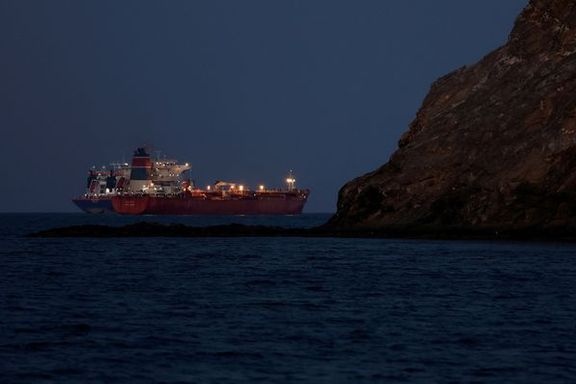
The Callisto tanker sits anchored as the traffic is down in the Strait of Hormuz, amid the US-Israeli conflict with Iran, in Muscat, Oman, March 10, 2026.
Iranian officials and commentators are increasingly portraying control of the Strait of Hormuz not just as a strategic advantage but as a financial asset that could help offset the costs of war.
According to international media reports, including Bloomberg and Lloyd’s List Intelligence, Iran has begun charging oil tankers for safe passage through the Strait of Hormuz.
Iranian outlets such as the state-owned Mehr News Agency and Tabnak—affiliated with Mohsen Rezaei, senior military adviser to Iran’s new leader—had previously reported that Tehran was considering the strait as a potential source of revenue for the Islamic Republic.
News reports say Iran is charging around $2 million per tanker. However, because U.S. sanctions prevent Iran from conducting international banking, it remains unclear what currency is being used and who ultimately receives the payments.
Earlier, Iran’s Foreign Ministry announced that various countries and oil companies should contact Tehran directly to coordinate safe passage.
The idea of monetizing control of the strategic waterway has also been echoed in Iranian political commentary. The IRGC-linked daily Javan wrote that it was Iran’s new leader, Mojtaba Khamenei, who first introduced the concept.
“He revived a forgotten historical truth in the geopolitics of the Persian Gulf,” the newspaper wrote on Tuesday, March 24.
In an editorial titled “The Strait of Hormuz: Iran’s Winning Card in the Post-War Order,” Javan argued that the waterway should become a strategic lever for the Islamic Republic and “the most important fund to compensate Iran’s losses in the war.”
According to the paper, this framework was outlined in Mojtaba Khamenei’s first message to the nation.
Under the heading “A Strategic Package for Compensation of Losses,” the editorial said Iran now needs a comprehensive, multilayered doctrine to prevent circumvention of its new arrangements. Taxes, it said, would be based on “the nature of the cargo” and “the degree of cooperation between the ship’s country of origin and the aggressors.”
Javan estimated that under such a framework regional states would need to pay $50 per barrel to compensate Iran’s losses and contribute to reconstruction efforts.
Ships belonging to Israel and the United States, it added, would be barred from the strait even under a different flag.
Under a section titled “Redefining Negotiations,” the paper said Israeli and U.S. vessels could use the waterway only if one sanction on Iran were lifted for each passage.
The argument rests on the claim—advanced by Iranian commentators—that international law allows states to levy fees to ensure the security of waterways under their control.
With control over several islands and strategic points in the Persian Gulf, and full control of the waterway’s northern shore, Iran holds a uniquely strategic position, the IRGC-linked daily argued.
The paper concluded: “This package sends a clear message to all players inside and outside the region: the era of imposing sanctions on Iran is over, as no country can benefit from Persian Gulf security for free.”
Whether the United States, regional states, or their partners in South Asia would accept Tehran’s unilateral framework and comply with its demands remains uncertain.
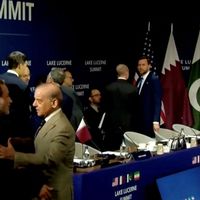
US President Donald Trump looks at Pakistan's Prime Minister Shehbaz Sharif speaking following the official signing of the first phase of the Gaza ceasefire agreement between Israel and Hamas, during a world leaders' summit on ending the Gaza war, in Sharm El-Sheikh, Egypt, October 13, 2025.
Pakistan has offered to host talks between the United States and Iran aimed at ending a war that has rattled global energy markets. Here’s why Islamabad is involved—and whether it could work.
Prime Minister Shehbaz Sharif said Tuesday that Islamabad was “ready and honoured to be the host” for direct or indirect negotiations if both sides agree.
The proposal comes amid reports that Pakistan has been relaying messages between the two sides and could potentially host discussions if they progress to that stage.
Pakistan’s army chief, Field Marshal Asim Munir, spoke with President Donald Trump on March 23, while Sharif held a phone call with Iranian President Masoud Pezeshkian the following day as part of a push for de-escalation.
Trump announced a five-day pause in planned strikes on Iranian energy infrastructure on Monday, saying there had been “productive conversations” about potential diplomacy. Iranian officials, however, insist no direct negotiations with Washington have taken place.
Pakistan is one of several countries—alongside Turkey and Egypt—that appear to be passing messages between Washington and Tehran while encouraging diplomatic contacts.
What role is Pakistan playing?
Pakistan is positioning itself as both messenger and potential host.
Its prime minister and army chief have spoken with leaders in Washington and Tehran while publicly offering Islamabad as a venue should talks take place.
Pakistani officials describe the effort as part of broader back-channel diplomacy aimed at reducing tensions.
Why Pakistan?
Pakistan maintains working relationships with both Iran and the United States, giving it unusual access to the two governments.
Since 1992, Iran’s interests section in Washington—which handles limited diplomatic matters after the two countries severed relations in 1980—has operated under the protection of the Pakistani embassy.
Pakistan also has political and military ties with the United States. That combination allows Islamabad to communicate with both sides while avoiding the perception that it is fully aligned with either.
Has Pakistan tried this before?
Yes, though usually behind the scenes.
In 2019, then-Prime Minister Imran Khan publicly offered to mediate during a period of heightened US-Iran tensions after speaking with leaders in both countries.
Pakistan has periodically offered to help ease regional tensions, though mediation efforts have rarely moved beyond preliminary diplomacy.
Will it actually lead to negotiations?
That remains uncertain.
Iranian officials have publicly insisted that no negotiations with Washington are taking place. The White House has also avoided confirming any talks, saying it will not negotiate through the media.
Israel has meanwhile signaled that its military operations against Iran will continue regardless of diplomatic developments.
Pakistan’s proposal therefore represents a potential diplomatic channel rather than a confirmed breakthrough. Whether talks materialize will depend on whether Washington and Tehran conclude that diplomacy offers a way to limit the conflict.
A woman walks past Azadi Square, amid the US-Israeli conflict with Iran in Tehran, Iran, March 23, 2026.
In history, authoritarian systems usually fall twice: first psychologically, when fear breaks; then politically, when the men with guns hesitate. Iran’s recent shocks look less like a single crisis than a classic collapse sequence unfolding at speed.
The decisive moment in a regime’s collapse is often not the formal end, but the tipping point before it: the moment when the state’s aura of inevitability breaks.
Borders may still be guarded, television may still broadcast, officials may still issue decrees. But something more important has changed. The system no longer functions with confidence.
That pattern runs through modern history. Regimes die when authority thins out, and the forces meant to preserve the system begin to hesitate, fracture, defect or simply wait.
In Russia in 1917, the monarchy’s fate was sealed not only by crowds in the streets but by the refusal of troops and Cossacks to suppress them.
In Iran in 1979, the Shah’s regime effectively ended when the armed forces declared neutrality.
In Romania in 1989, Nicolae Ceaușescu’s fall accelerated when the army switched sides.
In East Germany, the Berlin Wall lost its political meaning the moment the border opening made it unenforceable.
In each case, the end came after something deeper had already broken: the state’s confidence in its own ability to command obedience.
A woman walks on a street in Tehran, Iran, March 22, 2026.
The sequence before collapse
This is why a tipping point is best understood not as a date but as a sequence.
First comes long erosion: economic decline, loss of legitimacy, social anger, distrust inside the ruling camp.
Then comes a catalytic shock: a massacre, a fraudulent election, military defeat, a failed coup, or the death of the ruler around whom the system had been built.
Then comes the most important stage and the hardest to measure: the failed restoration of authority.
The regime still projects continuity, but no longer convincingly. It can still threaten, still punish, still broadcast. But it no longer reassures. Its command no longer feels unquestioned.
Only after that comes the formal end.
A member of a police force stands guard on a street in Tehran, Iran, March 23, 2026.
Iran’s compressed crisis
Iran’s recent trajectory fits that sequence with unusual force, appearing to compress into weeks the kinds of shocks that in other systems were spread over months or even years.
The country entered 2026 already weakened by deep economic distress and nationwide protest. Then came the January 8-9 crackdown.
More than 36,500 were killed, according to classified material Iran International reviewed. Other reporting and rights group assessments also describe the episode as mass killings on an extraordinary scale.
Mass killing can restore fear for a time. It can also destroy legitimacy more deeply and more permanently.
The next shock was even more consequential.
On 28 February, joint US-Israeli strikes killed Supreme Leader Ali Khamenei, abruptly removing the central figure around whom the Islamic Republic had organized authority for decades.
That alone did not prove regime collapse. Systems can survive the loss of a leader if they can replace him quickly and credibly. But that is precisely where the next problem began.
The succession that followed looked less like a confident transfer of power than an emergency move under pressure.
Iran International reported that the IRGC pushed to install a successor outside normal legal procedures amid disarray in the chain of command and fears that people could return to the streets.
Mojtaba Khamenei’s elevation preserved the office, but did not clearly restore authority. A succession in such a system is meant to reassure the Islamic Republic’s core that command still exists and that the center is still holding.
Yet Mojtaba has remained unseen in any ordinary sense. His messages were still being issued only in writing or read by state television anchors over still images, with no direct public appearance or recorded voice.
In a system built around the symbolism and physical presence of supreme authority, that matters. A ruler who does not appear can hold a title, but cannot easily project command.
That, in turn, changes how the growing centrality of the Revolutionary Guards should be read. If the IRGC now appears to dominate more of the state, that does not necessarily mean the system is stronger. It may mean the opposite: that the wider governing structure has hollowed out and power has narrowed to its coercive core.
What can appear as consolidation may, in fact, be contraction.
The moment before the streets
This is also why the absence of a full-scale uprising does not necessarily mean the Islamic Republic has restored confidence.
In collapsing systems, people do not always move at the first sign of weakness. They wait until repression looks less certain, until command appears thinner, until they believe the next confrontation may end differently from the last.
The decisive moment often comes not when society becomes angriest, but when the security forces are no longer sure they can, should, or will do what they did before.
That memory matters in Iran. January showed what happens when the state still has a functioning command structure and is prepared to kill on a massive scale. But the present moment is not January.
The command structure has been hit. The top leadership has been decapitated. The succession has not visibly restored confidence. The war has intensified military, political, and fiscal strain.
Quiet streets, in such a moment, do not necessarily mean submission. They may mean waiting for the right threshold.
What history suggests
None of this means the Islamic Republic’s end is settled. Regimes can survive extraordinary shocks, especially when coercion remains lethal and opposition forces lack a unified organizational center inside the country.
But history suggests a useful distinction. A system is often most vulnerable when it has been reduced to force alone.
That is often the stage at which the outer signs of continuity become misleading. The offices still function. Orders are still issued. Missiles may still fly. But the wider architecture that gave those acts political meaning has begun to fail.
The question is no longer simply whether the Islamic Republic still exists on paper. It does.
The more important question is whether it still functions as a regime in the full sense: with authority that travels clearly, loyalty that holds under pressure, and institutions that do more than keep violence in motion.
History suggests that when those things begin to fail together, the tipping point is no longer far behind.
The sky is illuminated as an Iranian missile lands in Israel, amid the U.S.-Israeli conflict with Iran, as seen from Tel Aviv, Israel, March 12, 2026.
Iranian state media continued issuing warnings against the United States even after President Donald Trump said Monday that the two countries had held “constructive” talks—and that he was therefore postponing planned strikes on Iran’s power grid.
Exchanging threats—sometimes several times a day—has become the dominant mode of communication between Tehran and Washington.
The IRGC-linked Fars News Agency denied that any contact had taken place between the two sides, while a senior commander escalated the rhetoric live on Iran’s state broadcaster.
“We will hit you so hard that your dentures will be knocked out of your mouth.”
Major General Abdollahi of the IRGC’s Khatam al-Anbia Headquarters also vowed to deploy “a new secret weapon that will bring an end to the enemy’s operations.”
Over the past two days, following Trump’s threat to strike Iran’s power-generation infrastructure unless Tehran unconditionally opens the Strait of Hormuz, several Iranian commanders and officials have issued counter-threats.
The core message was captured in an IRGC statement quoted by Entekhab on March 23: “We will respond to any attack immediately and at the same level.”
Entekhab also cited an IRGC spokesperson elaborating on Tehran’s position: “They hit schools and hospitals, but we did not reciprocate. If they attack power plants, we will strike power plants in countries that host US bases.” That would include much of the Middle East.
In a March 22 post on X, Esmail Saghab Esfahani, Iran’s vice president for energy optimization and strategic management, responded to Trump’s ultimatum.
“The Strait of Hormuz game has put so much pressure on Trump that he has issued a 48-hour ultimatum—unaware that the next move, which is the destruction of the most important electricity and water infrastructure of the Zionist regime and the United States in the region, will put even more pressure on him,” he wrote.
Saghab Esfahani also suggested that residents of Israel and people in countries hosting Iran’s adversaries would be wise to store water and charge their phones during those 48 hours.
Nour News, an outlet close to Iran’s Supreme National Security Council, responded with a mix of defiance and warning.
“Trump’s threat to destroy Iran’s electrical infrastructure is an explicit admission of a war crime and a sign of desperation,” it said.
In the hours before Trump’s deadline, a different narrative was circulating among many Iranian social-media users—particularly within opposition circles.
Rather than targeting infrastructure that ultimately serves the Iranian public, they urged the United States and Israel to focus on dismantling the security apparatus that underpins the state’s repressive machinery.
The tension was heightened further by an IRGC statement announcing what it described as a shift in Iran’s military doctrine—from a defensive posture to an offensive one.
As for ordinary Iranians, many appear increasingly anxious about how attacks on infrastructure might affect their already strained daily lives.
In Tehran—unlike in US markets—there has been no calm after Trump’s announcements. The drums of war are growing louder.
File photo shows Iran's Parliament Speaker Mohammad-Bagher Ghalibaf (third from right in the front row) among IRGC generals
Whether real or not, President Donald Trump’s statement that Iran has reached out for talks is already having an impact: fueling mistrust within Tehran leadership while easing tensions in global oil markets, even as Iranian officials deny any such contact.
President Trump said on Monday that Iran had reached out to Washington for talks after the US threatened to strike Iranian energy infrastructure.
He said, “They called, I didn’t call. They want to make a deal, and we are very willing to make a deal.”
He also claimed that the United States had been speaking to “a top person” in Iran, though not to the new supreme leader, and added that “we don’t know whether he is living.”
At the same time, Trump said the threatened strike on Iran’s major power plants had been paused for five days. Oil prices fell after his remarks, while Iran’s foreign ministry denied that any such talks had taken place.
But the importance of Trump’s remarks is not only in the news itself. It is also in what the statement is designed to do.
Trump is trying to achieve two things at once.
First, he is using ambiguity as a political and psychological weapon inside the Islamic Republic. By saying he has been talking to a very senior Iranian figure without naming that person, he is planting doubt and suspicion among what remains of the leadership.
In current conditions, that matters. Iran’s leaders are living in hiding. Command centers are disrupted. Communications are limited out of fear of interception and assassination.
Meetings are difficult, if not impossible. In that setting, a statement like this will be deeply unsettling. Each senior figure will now be asking: Who is talking to Washington? Who is looking for an off-ramp? What is being hidden from the others?
By naming no one, Trump makes everyone in Tehran wonder who is talking to Washington.
This does not affect only the top. Lower-ranking officials also hear the same message. If they begin to believe that some of their leaders are quietly searching for a way out, they will become more uncertain, more demoralized, and more open to defection.
At the same time, hardliners will turn even more aggressively against figures they see as less rigid and begin looking for the supposed traitor within the system, especially after Trump suggested that even Mojtaba Khamenei is unaware of these contacts.
Some reports pointed to Mohammad Bagher Ghalibaf as the possible figure involved. Ghalibaf himself denied that and called the reports fake news aimed at influencing financial and oil markets.
But in an atmosphere like this, denial does not cancel out the effect. It creates new questions instead of closing them down. Some will ask: What if Ghalibaf is lying? Others will ask: what if someone else is involved?
The foreign ministry’s denial will have the same effect. In a system already shaped by fear and mistrust, public denials can deepen suspicion rather than contain it.
In a leadership living in hiding, ambiguity is not just rhetoric. It is a weapon.
Some hardline members of parliament, including Hamid Rasaei, have already gone public and started asking questions. That is exactly what Trump wants to achieve.
Second, Trump is also sending a message to the markets. By talking about a possible deal and pausing strikes on critical Iranian infrastructure, he signaled that the conflict will not move immediately into a more dangerous phase.
The effect was immediate: oil prices fell. This also gave Trump an off-ramp of his own. It allowed him to step back, for now, from a strike on Iran’s power plants while still claiming momentum and leverage.
So even if these contacts are real, limited, exaggerated, or deliberately ambiguous, the statement is already producing an outcome Trump wants: psychological pressure inside Tehran and calmer energy markets outside it.
That is the core point. This is not a normal diplomatic process. We do not know whether these talks are real, serious, or meaningful in any conventional sense. But that is no longer the only question. The statement itself is already doing political and economic work. It is widening mistrust inside the Islamic Republic and helping calm panic in global oil markets.
But there is a deeper question. Even if the reports are true, even if someone inside the system is involved in real contacts, can he actually deliver anything that matters? Will IRGC commanders listen? Will the men sitting behind the missile launchers take their cue from a political figure seeking an off-ramp? Or will they see whoever is talking to Washington not as a decision-maker, but as a traitor who deserves punishment or death?
That is the real uncertainty. The problem is not only whether there is a channel. It is whether anyone on the Iranian side still has the authority to make that channel meaningful.
Since Donald Trump threatened to target Iran’s power plants, anxiety has surged among Iranians at home and abroad, many warning that this directly targets people’s lives, not the government.
Inside Iran, fears of widespread blackouts have prompted many citizens to prepare for worst-case scenarios. In the past two days social media reports indicate that many have rushed to purchase home generators, batteries, radios, flashlights, water, food, medicine, and fuel in the past two days.
Users on X, many among whom use the hashtag #SpareIranPowerPlants warn that destroying power plants could trigger “the complete collapse of other vital infrastructures,” including water systems, sewage networks, the internet, and mobile communications, and could lead to food shortages and the breakdown of healthcare services.
“Striking power plants only helps the Revolutionary Guards (IRGC) portray its savagery as legitimate and could be the biggest miscalculation of this war,” one user posted.
Trump postpones ultimatum
On Monday, as Trump’s 48-hour deadline to Tehran drew near, he wrote on Truth Social that he had ordered the Pentagon to halt “all military attacks” on Iran’s power plants and energy infrastructure for five days.
Trump said “very good and constructive talks” aimed at a “complete resolution of hostilities in the Middle East” had taken place over the past two days between Tehran and Washington and added that discussions would continue through the week.
According to Axios, officials from Turkey, Egypt, and Pakistan have been mediating and passing messages between Tehran and Washington in recent days.
In a phone interview with CNBC, Trump described the talks as “very intense” and said he remained hopeful for a “very significant outcome.”
Iran's foreign ministry spokesman, Esmaeil Baghaei, rejected any talks with Washington over the past 24 days, saying that Tehran's position on the Strait of Hormuz and its conditions for ending the war have not changed.
Diverging interpretations
The five-day pause has temporarily eased tensions but deepened uncertainty over Washington’s intentions. In Iran, some interpreted the pause as a retreat.
Mohammad Hossein Khoshvaght, a former government official with close ties to the ruling establishment wrote: “As predicted, Trump backed down from the threat of attacking our power plants in the face of Iran's power and resolve, showing that he only understands the language of strength and submits to it!”
Some others described the move as deception or an attempt to stabilize global markets.
A pro-government user wrote: Trump's contradictory behaviors indicate that we are dealing with a clear pattern of ‘deception operations’.”
“Just a few days ago, he claimed there was no one in Iran to negotiate with, and now he's talking about delaying the attack and engaging in dialogue. This fluctuation is not a sign of Trump's strength, but rather an effort to reduce the pressures of war and manage global public opinion,” he added.
Yet others, particularly among the opposition, appear confused by what they see as inconsistencies in Trump’s positions.
“So, while Trump was holding ‘deep, precise, and constructive’ negotiations with the Islamic Republic, he set a 48-hour ultimatum to strike Iran's energy infrastructure, and when he felt he'd had a ‘very good and constructive’ negotiation, he extended the ultimatum by five days?” a user asked.
Responsibility and blame
Some among the opposition argue that the responsibility for the crisis lies with the Islamic Republic and the IRGC.
“We must firmly demand that the Islamic Revolutionary Guard Corps accept Trump’s 48-hour ultimatum to reopen the Strait of Hormuz If we are truly concerned about ‘Iran’,” dissident academic Ali Sharifi-Zarchi posted on X.
From a legal perspective, UK-based human rights lawyer Mohammad Moghimi warned that destroying power grids would “jeopardize access to water, food, and medical care” and argued that attacking civilian infrastructure is “a clear violation of international law and a war crime.”
Exiled prince's position
Iran's exiled Prince Reza Pahlavi on Sunday called on Trump and Benjamin Netanyahu to avoid targeting civilian infrastructure while maintaining pressure on the Iranian government.
“Iran’s civilian infrastructure belongs to the Iranian people and to the future of a free Iran. The Islamic Republic’s infrastructure is the machinery of repression and terror used to keep that future from becoming reality,” he wrote on X, adding: “Iran must be protected. The regime must be dismantled.”
In a separate post, he added: “President Trump is right (about Peace Through Strength). This regime only understands strength… When Iran is free, the world will have lasting peace.”