• Iran Insight
  • Politics
  • Economy
  • Analysis
  • Special Report
  • Opinion
  • Podcast
All rights reserved for Volant Media UK Limited
volant media logo
  • العربية
  • فارسی
Brand
  • Iran Insight
  • Politics
  • Economy
  • Analysis
  • Special Report
  • Opinion
  • Podcast
  • Iran Insight
  • Politics
  • Economy
  • Analysis
  • Special Report
  • Opinion
  • Podcast
  • Theme
  • Language
    • العربية
    • فارسی

Iran students adopt monarchist symbols as protests grow for third day

Feb 23, 2026, 12:32 GMTUpdated: 13:56 GMT
A scene of Iranian student protests on February 23, 2026

A wave of Iranian student activism adopting the pre-1979 Lion and Sun emblem has gathered pace in recent days, as protests entered a third consecutive day on Monday and spread across universities in Tehran, Isfahan and Mashhad.

Statements circulated by students at the University of Tehran, Amirkabir University of Technology and Isfahan University of Technology announced the creation of Lion and Sun associations, calling for secular governance, territorial integrity and free elections, and voicing support for exiled Prince Reza Pahlavi as a transitional figure.

At the University of Tehran, a founding statement said students were acting “in solidarity with the people of Iran” and in memory of those killed in recent protests, including four students from the university.

A combination image shows altered university logos featuring the pre-1979 Lion and Sun emblem, shared by student groups during recent campus protests in Iran.

Similar statements were reported at Allameh Tabatabaei University, Iran University of Science and Technology and a branch of Islamic Azad University in Sari.

Videos shared by activists showed students raising the Lion and Sun flag on some campuses and chanting “Javid Shah” (Long live the Shah), alongside slogans such as “Death to the dictator,” “Woman, Life, Freedom,” and “Neither Gaza nor Lebanon, my life for Iran.”

Some students also referenced the former names of their institutions before the 1979 Islamic Revolution.

At Al-Zahra University, protesters chanted that the university should revert to its pre-revolution name, Farah Pahlavi University. A day earlier at Sharif University of Technology, students echoed calls to restore its former name, Aryamehr – a title used by Mohammad Reza Pahlavi during the pre-1979 monarchy.

In several instances, protesters burned the flag of the Islamic Republic.

Pro-government Basij-affiliated students held counter-gatherings on some campuses, where they burned US and Israeli flags and chanted slogans including “Death to the Shah,” a phrase closely associated with the 1979 revolution that toppled the monarchy.

Threats of legal action and dormitory searches

University authorities and security forces signaled a tougher response as demonstrations spread.

The president of Sharif University of Technology, Masoud Tajrishi, warned students that the gatherings were “illegal” and said judicial authorities could intervene.

“The prosecutor has said this is not only a university matter and that we must step in,” he said, adding that some students had already been barred from entering campus and that the university could shift to fully virtual classes if unrest continued.

At Beheshti University in Tehran, security forces reportedly searched dormitory rooms late on Sunday in an effort to identify and detain protesting students.

Some students said they had received text messages informing them that disciplinary cases had been opened and that they were temporarily suspended pending committee decisions.

In Mashhad, students at local universities said participants in rallies had been threatened with expulsion.

At Amirkabir University, videos showed clashes between protesters and Basij members, with students accusing them of attempting to disrupt what they described as peaceful gatherings.

Most Viewed

Iran agrees €500 mln arms deal with Russia to rebuild air defenses - FT
1

Iran agrees €500 mln arms deal with Russia to rebuild air defenses - FT

2

Iran students rally at major universities to honor slain protesters

3

Dancing for the dead: How protest massacre is rewriting Iran’s mourning rituals

4

Iran rules out interim deal in US talks, keeps military on alert during diplomacy

5
EXCLUSIVE

Iran protester dies after torture in Guards’ custody, source says

Banner
Banner

Spotlight

  • How Tehran whitewashes its crimes abroad
    SPECIAL REPORT

    How Tehran whitewashes its crimes abroad

  • Iranian students burn flag, signaling a new phase in state–society rupture
    ANALYSIS

    Iranian students burn flag, signaling a new phase in state–society rupture

  • Iran protester dies after torture in Guards’ custody, source says
    EXCLUSIVE

    Iran protester dies after torture in Guards’ custody, source says

  • Dancing for the dead: How protest massacre is rewriting Iran’s mourning rituals

    Dancing for the dead: How protest massacre is rewriting Iran’s mourning rituals

  • Film shot inside Iran breaks censorship ground with intimate scenes

    Film shot inside Iran breaks censorship ground with intimate scenes

  • Why war may no longer be the worst outcome for Tehran
    ANALYSIS

    Why war may no longer be the worst outcome for Tehran

  • Grassroots ‘Red Lion and Sun' network emerges in Iran after crackdown

    Grassroots ‘Red Lion and Sun' network emerges in Iran after crackdown

  • Iran students rally at major universities to honor slain protesters

    Iran students rally at major universities to honor slain protesters

•
•
•

More Stories

Iran protester dies after torture in Guards’ custody, source says

Feb 23, 2026, 09:51 GMT
•
Shahed Alavi

A 35-year-old protester arrested after January demonstrations in Mashhad died in hospital after weeks in a coma caused by severe torture in Revolutionary Guards intelligence detention, according to information received by Iran International.

Arash Tolou Sheikhzadeh was detained on February 6 when agents from the intelligence arm of the Islamic Revolutionary Guards Corps raided his home about a week after he shared videos of protests held in Mashhad on January 8 and 9.

After several days without contact and with his phone switched off, his mother went to his apartment and found it ransacked, with broken windows and no sign of her son, a source close to the family said.

Guards intelligence officials later confirmed he was in custody but refused to allow visits or calls and warned the family to remain silent, saying their other son could face consequences if they spoke publicly, the source added.

Iranian slain protester Arash Tolou Sheikhzadeh

Transfer to hospital in critical condition

On February 12, the family learned through a hospital contact that Arash had been transferred to Velayat Hospital in Mashhad with broken arms, legs and severe head injuries, including a damaged skull. He was admitted to intensive care with a level of consciousness of 2.5 and placed on a ventilator.

The first time his mother was allowed into the hospital, she could only see him from behind a glass partition after repeated requests, the source said.

“His head was bandaged, his hands and feet were bandaged, and he was completely unconscious,” the source said. “When she asked why her son was like this, the officer told her, ‘We did nothing. He had a stroke.’”

Family members said Arash had not been injured during the protests and had continued going to work in the days before his arrest.

Life support cut despite signs of improvement

Arash’s condition showed relative improvement during his stay in intensive care, according to a hospital source who contacted the family. His level of consciousness rose from 2.5 to 5 over three days.

Despite this, his ventilator was switched off on February 15, leading to his death, the source said.

“His condition was clearly getting better,” the source said. “But they turned off the ventilator and effectively killed him.”

When relatives went to the hospital after learning of his death, security personnel denied them access and told them he was alive and had been moved to another ward, the source added.

Burial under tight security

Authorities informed Arash’s mother on February 20 that his body would be handed over the next day. They imposed conditions including no autopsy, a quiet burial and attendance limited to immediate relatives.

“They said they would hand over the body. You are not allowed an autopsy. A quiet burial, only first-degree relatives. Wearing bright clothes, clapping, celebrating, dancing – none of that is permitted. Very quietly. Otherwise, we will not release the body,” the source said.

The body was delivered on Saturday, February 21, at Behesht Reza cemetery in Mashhad, where plainclothes and uniformed forces were deployed in large numbers. The handover was delayed beyond the announced time, the source said.

Despite warnings not to open the shroud, Arash’s mother and relatives briefly uncovered his face before burial.

“When they brought the body, his face was bruised and swollen and there was a clear baton mark on his fractured skull,” the source said. “They tortured him badly.”

Flowers placed on grave during a memorial for Arash Tolou Shekhzadeh.

A young man active on social media

Arash, born on December 14, 1988, lived alone in Mashhad and worked as a barista at a café. His Instagram posts showed an interest in social and political issues. He had used the hashtag “Revolution 1401” in support of the “Woman, Life, Freedom” uprising and in one earlier post criticized what he described as superstitious religious beliefs, warning that ignorance lay at the root of many problems.

Arash’s mobile phone remains in the possession of Guards intelligence, the source close to the family said. Friends have noticed that his Instagram account appears to remain active, suggesting that security agents may be monitoring the social media activity of his contacts.

Dancing for the dead: How protest massacre is rewriting Iran’s mourning rituals

Feb 22, 2026, 15:39 GMT
•
Maryam Sinaiee

Iran’s January massacre of protesters has left scars far beyond the streets. In cemeteries and hometowns, families are transforming centuries-old mourning rites into defiant celebrations of lives cut short.

In a striking break from convention, thousands of families gathering for 40th-day rituals in homes and cemeteries across the country in recent days replaced the traditionally solemn, religiously infused ceremonies with clapping, cheering, and dancing — open displays of defiance.

The iconoclastic ceremonies have angered state supporters. Alireza Dabir, a conservative politician and former wrestling champion, lashed out at grieving families. “Their children got killed and they’re dancing over the corpses. I can't help but take a dig at these useless people. May God give these useless people some brains,” he told reporters.

But for many mourners, the dancing is neither celebration nor denial. It is a refusal to grieve on prescribed terms. The music and dance have become a language of protest — one that transforms funerals into acts of collective memory and, perhaps, the foundation of a new tradition.

Raha Bohloulipour was 23, a student of Italian language at Tehran University. On social media, she wrote about justice and equality and appeared in videos laughing lightheartedly with friends. Before leaving home for what would be the last time, she posted a simple message on Instagram: “Woman, Life, Freedom forever.” She was shot on a street in Tehran.

At her 40th-day memorial in Firouzabad, her hometown in southern Iran, hundreds gathered as her parents danced solemnly to traditional Qashqai folk music, waving green kerchiefs — her favorite color. Some parents in other places danced as long as they could, then broke into tears and collapsed into the arms of relatives, wailing.

Mourners in Mobarakeh in central Iran danced to a pro-monarchy anthem in an act of defiance at the 40th-day memorial for protester Rostam Mobarakabadi, who was shot dead by security forces on January 9 in Esfahan.

The song references Kaveh the Blacksmith, a mythological figure who leads an uprising against the tyrant Zahhak.

Weddings at memorials

When a young unmarried person dies in Iran, families often erect a hejleh: a mourning display decorated with flowers, candles, mirrors, lights and framed photographs. The structure resembles a wedding canopy, symbolizing a life cut short before marriage.

This time, however, the symbolism has expanded beyond décor. Confetti was thrown into the air as women cheered and danced beside the grave of a young man, shouting, “There’s a wedding here.”

At another cemetery, a bride-to-be dressed in white danced and cried, waving her bouquet over a grave. Outside a shrine where only religious songs would once have been permitted, mourners danced with red kerchiefs to a pop song, blurring the line between wedding and wake.

Roots in ancient traditions

The fusion of music, mourning, and defiance is not entirely new in some tribal regions.

The Malekshahi and Shuhan tribes recently held a traditional Chamara ritual on the 40th day of Saeed Tarvand, a 33-year-old oil engineer and father of a three-year-old who was killed in Abadan.

A very large crowd dressed in mourning attire gathered in his village in Ilam province. A riderless horse with an empty, inverted saddle, adorned in black and red and flanked by rifles and cartridge belts, was paraded through the crowd. Drums beat, wind instruments known as sornai played solemnly, and men carrying sticks performed a symbolic war dance — an ancient choreography of sorrow and resistance.

Political defiance and divergence from state ideology

The memorials are highly charged political spaces. Mourners chant “Death to Khamenei", “Death to the Dictator”, and "Long Live the King”, referring to Prince Reza Pahlavi. Crowds also vow to continue the path of the fallen until “Iran is free” or until “the mullahs are in shrouds.”

Instead of clerical speeches and Quranic recitations, many families have chosen to read heroic verses from the Shahnameh, Iran’s national epic, invoking pre-Islamic symbols of resistance, or to sing revolutionary songs inspired by it.

At the 40th-day ceremony for 30-year-old truck driver Rostam Mobarakabadi, his mother held his photograph high above her head, stamping her feet resolutely and leading the crowd in a revolutionary song invoking “Kaveh the blacksmith,” a legendary symbol of uprising against tyranny.

In Firouzabad, Raha’s grandfather drew on a different literary reference. In his speech, he called her “The Little Black Fish,” the protagonist of a beloved children’s story about a curious fish who leaves her narrow stream to explore the world despite warnings and fear — a tale widely read as an allegory of individual freedom and courage.

The language, too, reflects a shift. Rather than calling the dead “martyrs” — shahid — many families now describe them as “javid-nam,” meaning their names will be eternal. The distinction between these matters greatly in a country where martyrdom is closely tied to state ideology. Authorities have reportedly banned the use of “javid-nam” on some gravestones, reinforcing the political weight of the term.

Mohammad-Javad Akbarin, a dissident Islamic scholar living in exile in France, said the 40th-day gatherings show that society is “dissociating itself from the state and the ideology that it promotes”.

“Instead of religious lamentations, it sings songs; instead of religion, it speaks of the homeland; and it describes its beloved not as shahid, but as one whose name will be eternal,” he told Iran International.
Iran students rally at major universities to honor slain protesters

Feb 22, 2026, 10:24 GMT

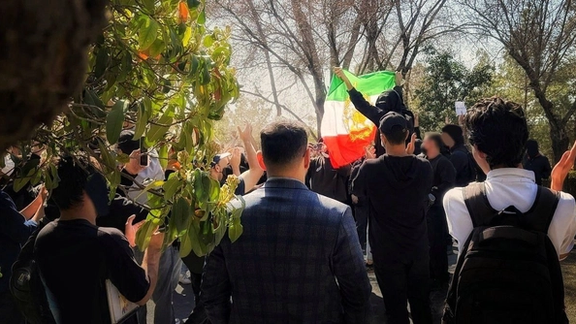
Students at several major Iranian universities held rallies on Sunday to commemorate those killed in recent protests and to voice opposition to the Islamic Republic, according to student groups and local media.

At the University of Tehran, students gathered outside the central library chanting “Death to the dictator,” the United Students Telegram channel reported.

Similar gatherings were held at Ferdowsi University of Mashhad, Iran University of Science and Technology, Sharif University of Technology and Khajeh Nasir University in Tehran.

Students at Iran University of Science and Technology and Sharif University chanted: “We swear by the blood of our comrades, we will stand to the end,” according to videos and reports shared by student groups.

Security was tightened at some campuses. The Khajeh Nasir student newsletter reported that access to its Seyed Khandan campus in Tehran was limited to one entrance on Sunday morning and that Basij members entered the campus in coordination with security forces.

The newsletter said the Basij were seeking to identify students, build disciplinary or legal cases and steer the planned gathering toward violence.

Large rallies were also held on Saturday in Tehran and Mashhad, with students at Sharif and Amirkabir universities of technology and medical sciences universities chanting pro-monarchy and anti-Supreme Leader Ali Khamenei slogans.

University officials and the government urged calm.

Hossein Goldansaz, the University of Tehran’s vice president for student and cultural affairs, said he would “in no way support students” if protests turned violent. “If they observe red lines, we will grant them permission. Anti-establishment slogans waste students’ time,” he said.

The Science Ministry said it would not allow insecurity on campuses. In a post on X following tensions at a Saturday memorial event at Sharif University of Technology, a media adviser to the science minister said: “We will not allow the university environment to become unsafe.”

Protests at Sharif University were met with force, as Basij paramilitary forces affiliated with the IRGC were deployed to crack down on the demonstrators.

IRGC commanders hold meetings in hospitals, sources say

Feb 21, 2026, 12:50 GMT
•
Reza Akvanian

Islamic Revolutionary Guards Corps commanders have held meetings inside hospitals in recent days, hospital staff told Iran International, raising concerns over the growing militarization of civilian spaces and potential risks to patients, medical workers and the public.

Several military commanders and IRGC personnel convened sessions inside the medical facility over the past week, accompanied by security teams and holding discussions unrelated to healthcare, a hospital employee in Tehran said. The source spoke on condition of anonymity due to fear of repercussions.

“The presence of these individuals, along with their protection units, has alarmed staff because the meetings had nothing to do with medical matters,” the employee said.

The reports come against a backdrop of previous allegations that security forces used public institutions during unrest, blurring the line between civilian and military functions.

Use of civilian sites during protests

During the January 8 and 9 protests and the days that followed, multiple accounts described security operations from within public buildings. Witnesses and local media reported gunfire at demonstrators from inside a governor’s office and from the roof of a hospital in Gorgan. In Arak and Sari, schools were used to station forces and hold detainees.

  • Who was behind Iran’s deadly crackdown?

    Who was behind Iran’s deadly crackdown?

Similar reports emerged from Shiraz, Gorgan and Tehran describing the deployment of armed personnel in hospitals and, in some cases, gunfire from the rooftops of medical centers toward protesters. Authorities have not publicly clarified the scope or legal basis of such deployments.

Security forces have also gathered in recent days at certain sports stadiums and arenas, a move sources describe as an effort to shield personnel and equipment from potential US or Israeli strikes by embedding them in densely populated civilian areas.

Iranian military and clerical officials visit a hospital ward, speaking with medical staff.

“No justification for human shields”

Jamshid Barzegar, a political analyst and journalist, said the shift of military activity into hospitals reflects a pattern long seen in the Islamic Republic’s regional alliances.

“The Islamic Republic has once again brought inside the country a criminal pattern it has tested for years through its proxy forces in the region: militarizing civilian spaces and using civilians as human shields.”

Barzegar argued that similar tactics had been employed by allied groups in Syria, Gaza, Lebanon and Yemen, placing military assets in or near civilian infrastructure.

“Now that the Islamic Republic has cast the shadow of war over Iran, we are seeing the same methods being applied domestically,” he said. “In the bloodiest and largest crackdown on public protests in Iran’s history during January 8 and 9 and the days after, the presence of security forces resembled the conduct of extremist groups.”

Moving senior IRGC meetings into hospitals and deploying forces in stadiums and schools, Barzegar said, exposes civilians to heightened danger in any potential conflict.

“This is not only a sign of strategic weakness, but a message that the lives of ordinary Iranians carry little weight in the government’s calculations,” he said.

Under the Geneva Conventions and their additional protocols, he added, using medical facilities for military purposes can jeopardize their protected status under international humanitarian law.

  • From call-up to cleanup: An operative’s insider account of Tehran’s killing nights

    From call-up to cleanup: An operative’s insider account of Tehran’s killing nights

“When commanders enter hospitals with protection teams and hold non-medical meetings, they are effectively taking patients and medical staff hostage to their own security considerations,” Barzegar said. “There is no justification for using civilians as human shields.”

Legal risks and accountability

Hossein Raisi, a human rights lawyer and academic, said international humanitarian law strictly prohibits converting civilian facilities such as hospitals, clinics, places of worship and historic sites into venues for military operations.

“Any party that knowingly turns a civilian site into a center of military activity during armed conflict commits a war crime,” Raisi said.

Even if an adversary attacks such a location, causing casualties or damage, that attack may also constitute a war crime if carried out deliberately and without regard for civilian protection, he added.

Security forces gather in a school courtyard during the January protests in Iran.

“Transferring military command functions into an active hospital where patients and medical staff are present does not transform that location into a legitimate military target,” Raisi said.

“Civilians are not aware of these hidden changes and have no meaningful opportunity to leave.”

If military units or equipment are placed near schools, children or medical facilities with knowledge that an attack could cause civilian deaths, those responsible could face serious legal consequences, Raisi said.

“Under the laws of war, both sides have an obligation to minimize harm to civilians,” he noted.

“If casualties occur because civilians were deliberately exposed to risk, responsibility can attach to those who created that situation as well as to those who launched an unlawful attack.”

'They finished him off': father recounts hospital killing of teen protester

Feb 20, 2026, 22:02 GMT
•
Negar Mojtahedi

The breathing tube was already in his mouth when, according to his father, the final shot was fired. It is one of many accounts emerging from Iran’s January protest crackdown.

Seventeen-year-old Sam Afshari had been taken to Madani Hospital in Karaj, near Tehran, after being shot on January 8 during protests near Mehran Square in the city’s Azimieh district. Witnesses later told his family that doctors were attempting to save him and that he was still conscious when asked his name.

“He had the breathing tube in his mouth. They came and shot him. A final bullet,” his father, Parviz Afshari, told Iran International’s English podcast Eye for Iran.

That day, protests spread across Iran as demonstrators took to the streets demanding an end to the Islamic Republic. Sam was among them.

“They went for a free Iran,” Parviz said. “They went out to protest with bare hands. But they returned to their families with bullets in the back of the head and bullets in the back.”

Sam was his only child—an unimaginable loss, his father said, that many Iranian families are now struggling to understand and explain.

Sam Afshari as a toddler in Iran.

Sam was born in 2008 in Karaj and had turned 17 just weeks before his death. He was studying computer networks and hoped to continue his education abroad.

“This year he was supposed to come here so we could sort out his papers,” his father said, speaking from Germany. “He wanted to continue his studies, go to university and study computer engineering.”

His father described him as cheerful and ambitious.

“He joked a lot. We laughed so much,” Afshari said. “We were always in video contact, talking about the future.”

“I don’t think he went out because of poverty,” he added. “He went out because of his beliefs. He wanted democracy and the right to speak his mind.”

According to accounts later gathered by the family, Sam was shot from behind near a security police post at Mehran Square. Residents in a nearby apartment building attempted to pull the wounded teenager into their parking area to protect him.

Security forces arrived shortly afterward and took him away, his father said.

“They took my child with them.”

A hospital employee later informed the family that Sam had been transported to Madani Hospital along with other injured protesters. Witnesses told relatives that when medical staff asked his name, he answered “Sam,” indicating he was still conscious.

Hours later, he was dead.

"At the hospital they finished him off with a shot to the back of the head. The bullet came out through his cheek," Parviz said.

Because internet access had been cut during the unrest, Afshari said he did not learn what had happened until days later, when communication was briefly restored. Family members searched hospitals and morgues before his brother located the name “Sam Afshari” on a list of the dead at Beheshte Sakineh morgue in Karaj.

When Sam’s mother was brought to identify the body, she initially could not recognize him because of severe injuries.

“One side of my child’s face was destroyed,” Afshari said. “The back of his head too.”

She confirmed his identity only after asking officials to uncover a tattoo on his chest bearing the word “Mother” written in Latin script.

“When they saw the tattoo, they realized, yes, tragically — it was Sam.”

According to the family, authorities initially ordered that Sam be buried quietly at night in a remote area. After negotiations and payments, relatives secured permission to bury him closer to Karaj, but cemetery space was scarce.

“There were so many graves,” his father said. “They said there was simply no space.”

At Kalak-e Bala cemetery in Karaj, Sam was buried above another young protester because burial plots were already filled.

“Under his grave there is another martyr, Amir Bayati, and above is my son, Sam Afshari,” Afshari said.

Relatives described morgue halls crowded with bodies and refrigerated trucks waiting outside — scenes they said reflected the scale of deaths families were confronting in the days after the crackdown.

'He wanted a free Iran'

As the interview continued, Afshari’s grief gave way to anger and appeals for accountability.

“This is no longer the time for my tears. Now I feel rage,” he said. “If nothing happens, the blood of our children will be trampled. Our people—90 million human beings—are now hostages. Hostages of the Islamic Republic.”

He urged the international community not to remain silent. “The terrorist Islamic Republic must be brought to an end,” he said.

Throughout the interview, he returned repeatedly to the future his son never had.

“He had so many dreams, and I had so many dreams for him,” he said. “We buried this child with thousands of dreams.”

For Afshari, the story ends where it began—with a teenager who left home hoping for a different future. “He went for a free Iran,” his father said. “And we buried him instead.”