US boosts fighter aircraft at bases in Jordan, Saudi Arabia - FT
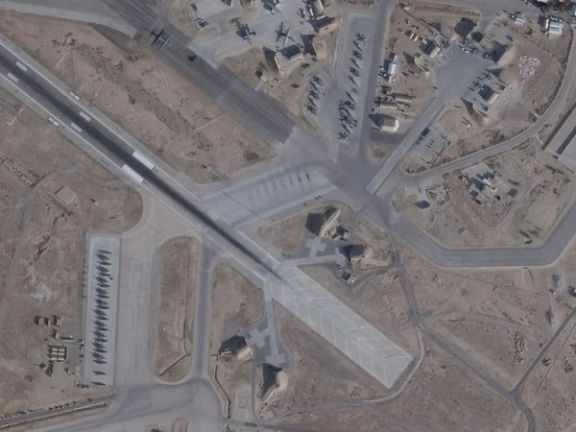
The United States has increased aircraft deployments at bases in Jordan and Saudi Arabia, the Financial Times reported, citing satellite tracking analysis and defense experts.
A tracker run by Tel Aviv University estimates at least 66 fighter jets are now at Muwaffaq Salti Air Base in Jordan, according to the report.
Eighteen of the aircraft visible in imagery are F-35 fighter jets, two former defense officials and an air force expert who reviewed the images told the FT. The expert also identified 17 F-15s and eight A-10 aircraft at the base.
Satellite images also show additional aircraft at Prince Sultan Air Base in Saudi Arabia, including E-3 airborne warning and control system planes as well as C-130 and C-5 transport aircraft, the report said.





US House Foreign Affairs Committee Chairman said he believes Iran will not meet US demands and could face US military action.
“I expect that Iran does not take the diplomatic off-ramp and that it comes to a strike for the president to protect the homeland of the United States of America, which absolutely this is against an imminent threat against the American people,” Brian Mast told Fox News.
Exiled Iranian Princess Noor Pahlavi said Iran’s current ruling system “has never been this close” to falling and urged US President Donald Trump to support Iranians seeking change.
Speaking in an interview with The California Post, Pahlavi appealed to Trump for help, saying Iranians were “begging” for support.
Speaking in an interview with The California Post, Pahlavi appealed to Trump for help, saying Iranians were “begging” for support.
“It’s literally a government waging war on its own citizens. It’s just incredibly painful to watch, to hear about. And it’s hard for people here to see and hear about. But it’s our responsibility not to look away,” she said.
"The regime has never been this weak," she added.
Iran has agreed a secret €500 million arms deal with Russia to acquire thousands of advanced shoulder-fired missiles in a major effort to rebuild air defenses damaged during last year’s war with Israel, the Financial Times reported on Sunday.
The agreement, signed in Moscow in December, commits Russia to deliver 500 man-portable Verba launch units and 2,500 9M336 missiles over three years, the FT reported, citing leaked Russian documents and several people familiar with the deal.
The Verba is described as one of Russia’s most modern shoulder-fired, infrared-guided air defense systems, capable of targeting cruise missiles, low-flying aircraft, and drones. Operated by small mobile teams, it allows forces to create dispersed defenses without relying on fixed radar installations, which are more vulnerable to strikes, the report said.
Under the €495 million contract, deliveries are scheduled in three tranches from 2027 through 2029, the FT said, adding that one person familiar with the transaction suggested a smaller number of systems could have been delivered earlier.
Tehran formally requested the systems last July, days after the end of a 12-day conflict in which the US briefly joined Israel in strikes on Iran’s three key nuclear facilities, according to a contract seen by the newspaper.
A former senior US official told the FT that Moscow likely viewed the agreement as a way to repair ties with Tehran after failing to come to its ally’s aid during the June conflict.
The deal was negotiated between Rosoboronexport, Russia’s state arms export agency, and the Moscow representative of Iran’s Ministry of Defense and Armed Forces Logistics (MODAFL), FT’s report said.
The contract was arranged by Ruhollah Katebi, a Moscow-based MODAFL official who previously helped broker Iran’s sale of hundreds of Fath-360 close-range ballistic missiles for use in Russia’s invasion of Ukraine.
One Russian Ilyushin Il-76TD cargo plane has made at least three runs from Mineralnye Vody in Russia’s northern Caucasus to the Iranian city of Karaj in the past eight days, FT’s report said. At least one more Il-76 flew the same route in late December.
Iran reportedly received up to six Russian Mi-28 attack helicopters in January and operated one of them in Tehran this month.
According to documents seen by the newspaper, Rosoboronexport is selling the 9M336 missiles at €170,000 per unit and the launch systems at €40,000 each.
The deal also includes 500 “Mowgli-2” night-vision sights designed to track aircraft and other targets in darkness, the report added.
Unlike larger Russian strategic air defense systems such as the S-300 and S-400, the Verba systems do not require extensive training or integration and can be deployed more quickly, FT’s report said.
The report added that Verbas have not played a significant role in Russia’s defenses against Ukrainian drone attacks, which could make Moscow more willing to part with them than other air defense systems.
Iran has agreed a secret €500 million arms deal with Russia to acquire thousands of advanced shoulder-fired missiles in a major effort to rebuild air defenses damaged during last year’s war with Israel, the Financial Times reported.
The agreement, signed in Moscow in December, commits Russia to deliver 500 man-portable Verba launch units and 2,500 9M336 missiles over three years, the FT reported, citing leaked Russian documents and several people familiar with the deal.
Click here to read more.
Iran’s January massacre of protesters has left scars far beyond the streets. In cemeteries and hometowns, families are transforming centuries-old mourning rites into defiant celebrations of lives cut short.
In a striking break from convention, thousands of families gathering for 40th-day rituals in homes and cemeteries across the country in recent days replaced the traditionally solemn, religiously infused ceremonies with clapping, cheering, and dancing — open displays of defiance.
The iconoclastic ceremonies have angered state supporters. Alireza Dabir, a conservative politician and former wrestling champion, lashed out at grieving families. “Their children got killed and they’re dancing over the corpses. I can't help but take a dig at these useless people. May God give these useless people some brains,” he told reporters.
But for many mourners, the dancing is neither celebration nor denial. It is a refusal to grieve on prescribed terms. The music and dance have become a language of protest — one that transforms funerals into acts of collective memory and, perhaps, the foundation of a new tradition.
Raha Bohloulipour was 23, a student of Italian language at Tehran University. On social media, she wrote about justice and equality and appeared in videos laughing lightheartedly with friends. Before leaving home for what would be the last time, she posted a simple message on Instagram: “Woman, Life, Freedom forever.” She was shot on a street in Tehran.
At her 40th-day memorial in Firouzabad, her hometown in southern Iran, hundreds gathered as her parents danced solemnly to traditional Qashqai folk music, waving green kerchiefs — her favorite color. Some parents in other places danced as long as they could, then broke into tears and collapsed into the arms of relatives, wailing.
Mourners in Mobarakeh in central Iran danced to a pro-monarchy anthem in an act of defiance at the 40th-day memorial for protester Rostam Mobarakabadi, who was shot dead by security forces on January 9 in Esfahan.
The song references Kaveh the Blacksmith, a mythological figure who leads an uprising against the tyrant Zahhak.
Weddings at memorials
When a young unmarried person dies in Iran, families often erect a hejleh: a mourning display decorated with flowers, candles, mirrors, lights and framed photographs. The structure resembles a wedding canopy, symbolizing a life cut short before marriage.
This time, however, the symbolism has expanded beyond décor. Confetti was thrown into the air as women cheered and danced beside the grave of a young man, shouting, “There’s a wedding here.”
At another cemetery, a bride-to-be dressed in white danced and cried, waving her bouquet over a grave. Outside a shrine where only religious songs would once have been permitted, mourners danced with red kerchiefs to a pop song, blurring the line between wedding and wake.
Roots in ancient traditions
The fusion of music, mourning, and defiance is not entirely new in some tribal regions.
The Malekshahi and Shuhan tribes recently held a traditional Chamara ritual on the 40th day of Saeed Tarvand, a 33-year-old oil engineer and father of a three-year-old who was killed in Abadan.
A very large crowd dressed in mourning attire gathered in his village in Ilam province. A riderless horse with an empty, inverted saddle, adorned in black and red and flanked by rifles and cartridge belts, was paraded through the crowd. Drums beat, wind instruments known as sornai played solemnly, and men carrying sticks performed a symbolic war dance — an ancient choreography of sorrow and resistance.
Political defiance and divergence from state ideology
The memorials are highly charged political spaces. Mourners chant “Death to Khamenei", “Death to the Dictator”, and "Long Live the King”, referring to Prince Reza Pahlavi. Crowds also vow to continue the path of the fallen until “Iran is free” or until “the mullahs are in shrouds.”
Instead of clerical speeches and Quranic recitations, many families have chosen to read heroic verses from the Shahnameh, Iran’s national epic, invoking pre-Islamic symbols of resistance, or to sing revolutionary songs inspired by it.
At the 40th-day ceremony for 30-year-old truck driver Rostam Mobarakabadi, his mother held his photograph high above her head, stamping her feet resolutely and leading the crowd in a revolutionary song invoking “Kaveh the blacksmith,” a legendary symbol of uprising against tyranny.
In Firouzabad, Raha’s grandfather drew on a different literary reference. In his speech, he called her “The Little Black Fish,” the protagonist of a beloved children’s story about a curious fish who leaves her narrow stream to explore the world despite warnings and fear — a tale widely read as an allegory of individual freedom and courage.
The language, too, reflects a shift. Rather than calling the dead “martyrs” — shahid — many families now describe them as “javid-nam,” meaning their names will be eternal. The distinction between these matters greatly in a country where martyrdom is closely tied to state ideology. Authorities have reportedly banned the use of “javid-nam” on some gravestones, reinforcing the political weight of the term.
Mohammad-Javad Akbarin, a dissident Islamic scholar living in exile in France, said the 40th-day gatherings show that society is “dissociating itself from the state and the ideology that it promotes”.
“Instead of religious lamentations, it sings songs; instead of religion, it speaks of the homeland; and it describes its beloved not as shahid, but as one whose name will be eternal,” he told Iran International.