US warned Iraq of oil sanctions, freezing ties over Iran ties - Reuters
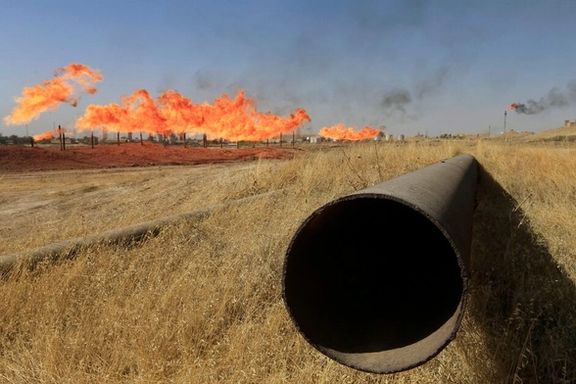
Flames emerge from flare stacks at oilfields in Kirkuk, Iraq October 18, 2017.
US officials told Iraqi leaders Washington would starve Baghdad of oil revenue if it kept up economic links with Iran and would suspend ties if politicians deemed close to Iran became ministers, Reuters reported on Friday citing sources.
The warnings would mark a sharp uptick in rhetoric on Iraq by the administration of US President Donald Trump as it pursues its maximum pressure campaign of sanctions against its Mideast arch-nemesis Iran.
Citing three Iraqi officials and a source familiar with the matter, the news agency reported that US Charge d'Affaires in Baghdad Joshua Harris conveyed the warnings in conversations over the past two months with Iraqi officials from across its fractured political spectrum.
Iran relies closely on the banking sector its Western neighbor, where recent parliamentary polls kept Shi'ite Muslim parties in the ascendant and delivered gains for politicians from the kaleidoscope of militias and parties backed by Tehran.
The Islamic Republic's own economic lifeline of oil exports is under heavy pressure from US sanctions, even if export levels remain buoyant one year into Trump's second term, and Iraqi financial instruments help it skirt US curbs.
Following a 2003 US invasion, the United States has maintained de facto control over Iraqi oil revenues and its preponderant banking and financial puts the funds within its reach.
"The United States supports Iraqi sovereignty, and the sovereignty of every country in the region," Reuters quoted a US State Department spokesperson as saying in response to a request for comment. "That leaves absolutely no role for Iran-backed militias that pursue malign interests, cause sectarian division, and spread terrorism across the region."
US warnings also broached cutting off engagement with Baghdad if 58 members of parliament Washington views as linked to Iran are elevated by Prime Minister Shia al-Sudani to cabinet positions.
"The American line was basically that they would suspend engagement with the new government should any of those 58 MPs be represented in cabinet," Reuters quoted an Iraqi officials as saying.
"They said it meant they wouldn't deal with that government and would suspend dollar transfers," the source added.
Forming the new cabinet is due to take months and the US moves did not appear to be linked to a recent deadly crackdown on protestors in Iran, which resulted in new US sanctions on Iranian officials and oil shipping networks.
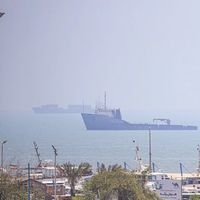
An oil tanker docks at an Iranian port in this file photo.
The US Treasury on Friday slapped new sanctions on ships and their owners it accuses of enriching the Iranian state and fueling its repression following mass killings of protestors earlier this month.
The measures targeting nine vessels from what the United States dubs Iran's "shadow fleet", their owners and management firms, saying their activities have together exported hundreds of millions of dollars’ worth of Iranian oil and petroleum products.
“The Iranian regime is engaged in a ritual of economic self-immolation—a process that has been accelerated by President Trump’s maximum pressure campaign. Tehran’s decision to support terrorists over its own people has caused Iran's currency and living conditions to be in free fall,” US Treasury Secretary Scott Bessent was quoted as saying in a statement.
“Today’s sanctions target a critical component of how Iran generates the funds used to repress its own people. As previously outlined, Treasury will continue to track the tens of millions of dollars that the regime has stolen and is desperately attempting to wire to banks outside of Iran."
The new US sanctions come after the treasury last week announced sanctions on several top Iranian commanders and the country's powerful security chief Ali Larijani, whom it accused of being "architects" of the violence.
Iranian security forces opened fired on protestors nationwide in violence that culminated on Jan. 8-9 this month which medics and government sources told Iran International claimed the lives of at least 12,000 people.
The number may be more than 20,000, the UN special rapporteur on human rights in Iran said Thursday, citing reports from doctors inside the country.
Venezuelan opposition leader Maria Corina Machado speaks with Iranian activist Masih Alinejad in Washington.
Venezuelan opposition leader Maria Corina Machado said democratic governments must raise the cost for Iran’s rulers to stay in power in an interview with Iranian activist Masih Alinejad.
Machado said Iran and Venezuela were bound by deep cooperation between their rulers, even as people in both countries rise up against repression.
“The Iranian people, the Venezuelan people, we are fighting the same struggle,” she said. “These regimes have been cooperating for many years, exchanging resources, information, technology, agents and weapons.”
She said authoritarian governments help each other bypass pressure and maintain control, while democracies often stop at statements.
“Dictators help each other, they exchange technology, resources, they help each other bypass sanctions and they support each other in international forums,” Machado said. “Democratic governments stay at statements and declarations that at the end do not serve the people.”
Machado said people in Iran had reached a breaking point and were calling on the world to respond.
“We reach a point where the people start asking the world to react and to support,” she said. “What we are asking for is to stop the killings and to save lives.”
She criticized what she described as double standards among democratic governments that condemn repression while maintaining economic ties.
“You sign declarations talking about freedom and equality and respect for human rights, then you do business with these regimes,” Machado said. “You buy oil from these regimes and you keep their assets and resources in your own financial systems.”
US President Trump meets with Venezuelan opposition leader Maria Corina Machado in the Oval Office, in Washington, DC, US, released January 15, 2026.
Praise for Trump action
Machado praised Donald Trump for taking decisive action against Venezuelan President Nicolas Maduro and said it showed what firm leadership could achieve.
“Finally in Venezuela we’re seeing President Trump making a tremendous important decision,” she said. “Bringing a criminal to justice is precisely what the world needs.”
She said the move sent a signal beyond Venezuela.
“It has brought a lot of hope,” Machado said. “This is a milestone.”
Machado said repression continues when dictators see little cost in using force.
“When you’re dealing with criminals, the only way they will leave is when the cost of staying in power is higher than the cost of leaving,” she said.
She said opposition movements cannot succeed alone without coordinated international pressure.
“We have done everything that any civic movement can do and they are killing us,” Machado said. “What we are asking for is applying law enforcement and cutting the resources they use to fund repression.”
Machado said the fall of Iran’s ruling system would have consequences far beyond the country.
“Imagine how the world will look once the Iranian criminal regime falls,” she said. “This is a unique moment in history.”
She said cooperation among opposition groups and diasporas was essential.
“These regimes help each other, and we the people need to connect and coordinate,” Machado said. “Regardless of how far away we are, we are united in this aspiration.”
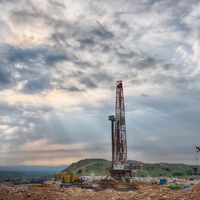
An offshore rig on Iran's Abouzar oil field in the Persian Gulf
One year after US President Donald Trump returned to the White House and revived the "maximum pressure" sanctions on Iran from his first term, available data show the country’s energy exports remain largely intact.
Data from the commodity intelligence firm Kpler, seen by Iran International, show that in 2025 Iran delivered an average of 1.38 million barrels per day (bpd) of crude oil and gas condensate to China—a decline of just 7 percent compared with 2024.
After Iranian oil exports to Syria halted in December 2024, China effectively remained Tehran’s sole buyer of crude oil over the past year.
Unlike crude oil, Iran’s petroleum product exports—fuel oil (mazut), naphtha and liquefied petroleum gas (LPG)—are relatively diversified, with shipments mainly destined for China, the United Arab Emirates, Malaysia and Singapore.
According to Kpler, Iran exported an average of 190,000 bpd of naphtha and 256,000 bpd of fuel oil last year, a combined decline of about 13 percent compared with 2024.
The drop, however, was driven not by tighter US sanctions but by Iran’s worsening domestic gas shortages, which forced power plants and industrial facilities to burn more fuel oil, reducing volumes available for export.
Data from tanker-tracking firms Kpler and Vortexa show that the modest decline in crude oil exports was offset by increased shipments of natural gas and LPG.
Iran has also continued exporting natural gas to Turkey and Iraq.
Tehran and Baghdad don’t publish official figures, but data from Turkey’s energy ministry indicate that natural gas imports from Iran increased about 9 percent during the first 11 months of last year compared with the same period in 2024.
One reason US sanctions have struggled to significantly curb Iran’s energy exports has been the continued operation of the so-called shadow fleet—a network of oil tankers that transport sanctioned crude through flag changes, disabled tracking systems, ship-to-ship transfers, and opaque ownership structures.
According to estimates by TankerTrackers, roughly 1,500 oil tankers worldwide were involved in shadow fleet activity last year, with nearly 40 percent linked to Iranian oil shipments.
Although the United States stepped up sanctions on such tankers in 2025, existing data suggests that hundreds of non-sanctioned vessels remain active in transporting Iranian oil through opaque trading routes and intermediary networks, undermining the enforcement capacity of US measures.
Further data from Kpler indicate that widespread domestic protests in Iran in recent weeks have had no noticeable impact on the country’s oil and petroleum product export volumes.
While China has remained the sole buyer of Iranian crude oil and condensate, the United Arab Emirates—one of Washington’s closest regional allies—has emerged as the largest importer of Iranian fuel oil, accounting for nearly 70 percent of those exports.
Estimates by Iran International put the total value of Iran’s exports of crude oil, petroleum products, and natural gas last year—excluding discounts and the costs of sanctions evasion—at roughly $60 billion.
The figure highlights the gap between early US projections that Iran’s oil exports would collapse by as much as 90 percent and the far more limited impact visible in the data so far.
Mark Levin, host of Life, Liberty and Levin on Fox News
US conservative commentator Mark Levin told Iran International on Thursday that Iran has effectively become a “concentration camp” amid a deadly crackdown on protests, urging the United States to act to help topple the Islamic Republic.
“I can only speak for myself. I don’t need any more reminding about how bad this regime is and that somebody better do something about it, because if it’s not us, nobody’s going to do anything about it,” Levin said.
Levin said recent reports of increased US military deployments to the region suggested Washington was keeping its options open, although he said he had no insight into whether military action was being considered.
“Most revolutions, including America’s own, needed outside help,” he said. “What is happening in Iran is a counter-revolution against a regime that rules by force and fear.”
Levin also criticized decades of US engagement with Tehran, arguing that successive administrations believed the Islamic Republic could be managed through negotiations.
“This is an ideological regime,” he said. “They talk, they negotiate, but they have no intention of abandoning their mission, and that is why they so brutally suppress their own people.”
Iran has faced widespread internet disruptions during renewed unrest, with only limited information reaching the outside world through satellite connections and virtual private networks.
“I can tell you that tens of millions of Americans stand with the people of Persia. There’s no question about it,” Levin said. “We know the regime there is Hitleresque, Nazi-like. The regime is slaughtering innocent people, especially young people, raping them, and pillaging towns. We know that regime is the enemy of the American people. They’ve made that abundantly clear.”
Iran International has reported that at least 12,000 people have been killed since the protests began, while CBS News has cited estimates placing the death toll as high as 20,000.
Sources told Iran International on Wednesday that hospitals and morgues are facing shortages of body bags, forcing authorities to store bodies in corridors and other areas.
“We know they still want to build nuclear weapons. They back terrorism in our country, throughout Europe, and across the Middle East, but the people they terrorize the most are the Persian people,” Levin said. “I feel horrible about what’s taking place, and all I can do is use my platforms to draw as much attention to this as I can.”
Levin said Iranians possess a long civilizational history distinct from other countries in the region and said those who emigrate to the United States often integrate successfully and contribute to American society.
“If the people of Iran were free, the contributions they could make to science, culture, and technology would be extraordinary,” he said. “Instead, they are focused on survival under repression.”
A grieving man embraces the body of a loved one shrouded in a body bag at the Kahrizak Forensic Center south of Tehran
A wounded Iranian protester played dead inside a plastic body bag for three days to hide from security forces and heard what he believed to be fellow protestors being summarily executed, a rights group reported on Thursday.
The IHRDC reported that the teenager, whose name it withheld for his safety, was held among bodies of slain protestors transferred to the Kahrizak Forensic Center south of Tehran where he stayed motionless until his family eventually found him alive.
It added it was not able to independently verify the account as a nationwide internet blackout persists in Iran.
The youth, who is under 18, was in critical condition after suffering gunshot wounds.
“During the three days he was held among the bodies transferred to Kahrizak, he heard the ringing of cell phones among the corpses and smelled the intense stench of decay,” the Iran Human Rights Documentation Center said, citing the teenager’s account.
The group said the young man described hearing gunfire after sounds from wounded detainees, suggesting they were summarily executed.
“The witness reported that whenever groans from the wounded were heard, they were shortly followed by the sound of gunfire and the cessation of the groaning, strongly indicating that security forces delivered fatal shots to wounded individuals who were still alive,” IHRDC said.
“These details raise serious concerns regarding the treatment of the wounded, violations of the right to life, and extrajudicial killings, including of minors, during the suppression of protests,” the rights group added.