Iran's funds already withdrawn from Venezuela, chamber chief says
A person holds a doll in the likeness of Venezuela's President Nicolas Maduro dressed in a superhero costume, as people attend a march calling for his release, after he and his wife Cilia Flores were captured following US strikes on Venezuela, in Caracas, Venezuela January 4, 2026.
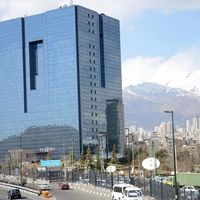
Money held by Iran in Venezuela has already been withdrawn, the head of the Iran-China Joint Chamber of Commerce said on Monday, as questions grow over Iran’s investments following the arrest and transfer of Venezuelan President Nicolas Maduro by the United States.
“Anyone who had money in Venezuela has already taken it out,” Majidreza Hariri said, responding to concerns about Iranian assets worth an estimated two billion dollars.
He added that instability in Venezuela had been evident for at least five to six months, leaving ample time for Iranian funds to be withdrawn, and warned against attempts to use the crisis as a pretext to write off debts.
He said Iran-Venezuela Bank has not functioned as an effective commercial bank in recent years as financial transactions between the two countries were not conducted through this bank.
According to Iran’s foreign ministry on Monday, economic and diplomatic relations with Venezuela remain intact in the wake of Maduro’s arrest, and political developments do not automatically alter bilateral ties.
“Relations between states are based on mutual respect and interests,” said spokesperson Esmail Baghaei earlier in the day.
He said Iranian diplomats and citizens in Venezuela are safe and that Tehran continues to monitor the situation closely.
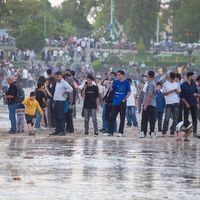
Protesters take to the streets in southern Tehran’s Naziabad neighborhood on January 6, 2026, Tehran, Iran.
Protests continued across Tehran and other parts of the country on Sunday, with security forces deployed in large numbers around the capital’s main bazaar and major shopping centers as demonstrations entered their eighth day.
Many shops in the bazaar in Tehran remained closed, while plainclothes security agents were reported in nearby streets, according to videos and information received by Iran International.
Videos showed crowds chanting slogans at security forces as tear gas was fired and motorcycle-mounted units were deployed along Jomhouri Street in Tehran.
Overnight protests were reported in dozens of cities, with demonstrations continuing in Tehran neighborhoods including Narmak, Naziabad, and Hafez Street, as well as in provincial cities such as Sangsar in Semnan province, Nurabad-e Mamasani in Fars province, Sari in Mazandaran province, and Malekshahi in Ilam province.
Labor, retiree, civil, and teachers’ organizations inside Iran also issued statements backing the protests, citing inflation, unemployment, and economic pressure.
Internet disruptions across parts of Iran
Internet access was reduced or effectively cut off in several parts of the country on Sunday, particularly in areas where protests were more intense.
Residents in cities including Asadabad in western Iran, Kermanshah, Dezful, Malekshahi, Malard, Marvdasht, Kuhdasht, Borazjan, Mashhad, Shiraz, and parts of Tehran reported severe disruptions, with some saying it took hours to send a single text message.
Opposition figures pay tribute to slain protestors
Iran International has verified the identities 16 protestors who have been killed during the protests.
Some sources have reported a higher number of fatalities. US-based human rights group, Human Rights Activists News Agency (HRANA), reported the deaths of at least 19 protestors on Sunday.
Iran International's investigations to verify reports regarding the identities and final number of those killed in cities including Azna, Marvdasht, Malekshahi, Hefshjan, and Farsan are still ongoing.
Iran’s exiled prince Reza Pahlavi paid tribute to the slain protesters, saying in a post on X that he honored their memory and vowed to hold those responsible to account.
“I honor and keep alive the memory and names of our compatriots who were killed in Iran’s national uprising,” Pahlavi said in a post on X.
Addressing the families of slain protestors, Pahlavi said: “On this irreversible path, I stand shoulder to shoulder with you.”
“I assure you that those who ordered and carried out these crimes will be identified and, without doubt, punished,” he added.
Addressing Iran’s Supreme Leader Ali Khamenei, he said: “By spilling the blood of the purest children of this land, you and your network have brought your own downfall closer. We will not back down and will continue until the complete destruction of your anti-Iranian regime.”
Komala Party Leader Abdullah Mohtadi on Sunday offered condolences to the families of slain protesters, and condemned what he described as a “major crime” by the Iran's Revolutionary Guards in Malekshahi, Ilam province.
"The great force of the popular movement will ultimately sweep away the apparatus of oppression and crime," he added in a post on X.
An Iranian man feeds birds in a street in Tehran, Iran, December 20, 2025.
A social media post by a prominent Silicon Valley investor has ignited an unusual discussion among global entrepreneurs: what it would take to invest in a future Iran after the fall of the Islamic Republic.
Josh Wolfe, co-founder of Lux Capital, a New York-based venture capital firm known for backing deep-tech companies in fields such as artificial intelligence, semiconductors, aerospace, and biotechnology, asked fellow investors on X whether they were prepared to deploy capital in a “free Iran” once political conditions change.
Addressing American investors, family offices, and asset managers, Wolfe urged them to begin thinking about how to support Iranian technologists and entrepreneurs when Iran is free and... opportunity is unleashed.”
The post quickly drew attention from senior figures across the technology and investment world, reflecting growing interest in frontier markets shaped by geopolitical transformation.
Among the most prominent responses came from Jeff Huber, a veteran Silicon Valley executive who previously led Google Maps and Google Ads before co-founding Triatomic Capital, an investment firm focused on infrastructure, energy transition, and advanced technologies.
Huber replied in Persian, writing simply, “Count on me,” a gesture that was widely shared among Iranian users as a sign of solidarity and intent.
Another notable response came from Michael Granoff, founder and managing partner of Maniv Mobility, an Israeli venture capital firm specializing in transportation and energy technologies.
Granoff pointed to his firm’s experience investing in the United Arab Emirates following the Abraham Accords, which normalized relations between Israel and several Arab states.
“We’d love to be the first to invest in a free Iranian startup,” Granoff wrote, explicitly linking potential investment in Iran to precedents set by rapid capital flows following political normalization elsewhere in the region.
The exchange also attracted responses from Iranian entrepreneurs in the diaspora, including business founders and professionals based in Canada, Australia, and Europe, many of whom offered to contribute expertise in healthcare, technology, and management during a future reconstruction phase.
While some users criticized the discussion as premature amid ongoing repression and protests inside Iran, the reaction from high-profile investors indicated a broader shift: the idea that Iran’s post-Islamic Republic future is no longer viewed solely through a political or security lens, but increasingly as a potential economic and technological opening.
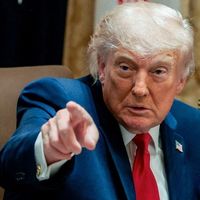
Tehran snapped back into protest mode following two nights of relative quiet, shortly after Donald Trump warned the United States was “locked and loaded” to intervene if Iran kills peaceful demonstrators.
In a message published on his Truth Social account, Trump warned that if Iran’s rulers kill peaceful protesters, the United States would act to save the Iranian people.
"If Iran shots and violently kills peaceful protesters, which is their custom, the United States of America will come to their rescue. We are locked and loaded and ready to go."
Iran’s leaders rejected Trump’s warning, accusing Washington of violating the UN Charter and “inciting violence and terrorism,” according to a Foreign Ministry statement.
Iran also warned in a letter to the UN that Tehran would “exercise its rights decisively” if attacked and hold the US fully responsible for any intervention.
Officials including Parliament Speaker Mobammad Bagher Ghalibaf and top security official Ali Larijani also threatened that US forces and bases in the region could become “legitimate targets” if Trump’s warning turned into military action.
Capital unrest
After a brief lull on Wednesday and Thursday, protests in the capital resumed in multiple districts, with crowds chanting against the ruling establishment as security forces deployed in large numbers and used tear gas and batons to disperse gatherings.
Protests were also held in dozens of other cities including the holy cities of Mashhad and Qom as well as Shiraz, Hamadan, and Zahedan, a city in Iran’s restive southeast which was n epicenter of protests in 2022.
The US-based Human Rights Activists News Agency (HRANA) says at least eight protesters have been killed nationwide since the latest wave of unrest began on Dec. 28.
Prince’s call
Exiled Prince Reza Pahlavi urged Iranians to “take control of the streets” in Tehran and other major cities through a simultaneous mass presence and road blockades, telling supporters to move in small, cohesive groups from neighborhood streets toward central arteries.
The prince said a “million-strong” wave would overwhelm security forces and could prompt some to retreat or even join the people, describing such a takeover of the capital’s streets as an essential step toward bringing down the Islamic Republic.
Prominent activists
Several prominent Iranian dissidents including renowned filmmaker Jafar Panahi and jailed Nobel Peace Prize laureate Narges Mohammadi issued a joint statement calling for a peaceful transition away from the Islamic Republic, saying that Iran is at a critical juncture amid mounting economic and political pressures.
“We stand with the people to reclaim the right to a dignified life, freedom, justice, human dignity, and sovereignty over our own destiny,” the statement said, published on Mohammadi's official account on X.
The signatories, including figures such as dissident filmmaker Mohammad Rasoulof, political prisoners Mostafa Tajzadeh and Rasoul Qadiyani, say a renewed wave of civil resistance “taking over the streets” reflects a national will to remove what they call the illegitimate regime and build a democratic order based on popular sovereignty, justice and normal relations with the world.
In Hamadan, two protesters sit facing each other and flash the victory sign.
No one can say with certainty whether the current protests will spiral into a revolution. But analysts tell Eye for Iran it is becoming harder to ignore signs that Iran’s theocracy may be entering a period of repeated crises that challenge its ability to function as a state.
Some analysts now warn that Iran may be entering the early stages of regime collapse — not through a single dramatic event, but through a slow erosion of state capacity.
What makes this round different is not only the fury in the streets. It is the growing uncertainty within the clerical establishment, which is leaning more heavily on coercion while projecting less confidence than before.
The protests began with the plunging rial. They have since widened into a broader test of whether the government can still manage a country living in constant crisis. Demonstrations that started in Tehran’s electronics markets have spread across provinces, bazaars and campuses, with chants increasingly aimed at the ruling system itself.
Live fire and deaths have fueled anger, while rare scenes in a religious city like Qom and other cities show crowds refusing to retreat.
A system running out of answers
Shayan Samii, a former US government appointee said the anger goes beyond economic hardship — it reflects a belief that the future has narrowed.
“They are upset because the value of their currency has gone down the drain,” he said. “There is nothing to look forward to.”
That sense of closure, he argued, is what pushes ordinary Iranians to take risks despite repression — a difficult dynamic for a state that relies heavily on deterrence and coercion.
Journalist and author Arash Azizi described protests appearing not only in major cities but in towns once seen as politically quiet.
“There is discontent everywhere,” he said — but protesters “lack leadership” and “lack organization.”
Without that, he warned, unrest can erupt and fade without producing structural change, even as each round leaves the system more brittle.
From an intelligence perspective, Danny Citrinowicz, former head of the Iran branch in Israeli military intelligence, said the deeper issue is not simply mismanagement but the absence of any workable path forward.
“The main problem the regime has is that it has no silver-bullet solution to the economic problems in Iran,” he said. Even if authorities find temporary fixes, “the problem will stay.”
Economic calm, in other words, may only pause — not resolve the crisis.
Cracks inside the ruling class
It is not only public anger that is shifting, said Alex Vatanka of the Middle East Institute but the mood among elites themselves.
“I have certainly not ever seen this level of hopelessness inside the Iranian regime,” he said.
That kind of discouragement, he added, can be more consequential than unrest alone, opening space for miscalculations and internal rivalries that become harder to contain.
Former US State Department official Alan Eyre cautioned against assuming outside forces can engineer rapid political change.
“Regime change is wildly improbable in Iran right now,” he said — warning that intense external pressure could strengthen hard-liners or push Iran toward greater militarization.
His remarks followed comments by Donald Trump that the United States was “locked and loaded” if Iranian authorities kill protesters — language that energized some activists while raising fears of escalation among others.
Why this wave feels different
Bozorgmehr Sharafeddin, head of Iran International Digital, argued that this round cuts deeper because it points to a crisis of state survival rather than policy error.
“This protest is not about inflation,” he said. “This is about the collapse of the Iranian economy.”
He also noted that international reaction came immediately — a contrast with earlier cycles when global attention arrived more cautiously and later.
Across the conversation, one theme recurred: the state still has the means to suppress dissent — but it is doing so with increasing uncertainty about what comes next.
Protesters are directing anger at the foundations of clerical power, not merely the officials administering policy. Reform promises carry less credibility. And senior figures themselves acknowledge problems they cannot easily fix.
That does not guarantee revolution and it does not mean collapse will come overnight. But analysts say a government that relies primarily on coercion while showing visible doubt from within no longer projects stability.
What emerges, they warn, is a system still capable of force yet less certain of itself with every passing crisis.
You can watch Episode 84 of Eye for Iran on YouTube or listen on any podcast platform of your choosing.
The long-range air defense system called Arman is displayed during an unveiling ceremony in Tehran, Iran, in this picture obtained on February 17, 2024
Iran’s official defense export agency is offering to sell ballistic missiles, drones and other advanced weapons systems to foreign governments in exchange for cryptocurrency and barter, Financial Times reported on Thursday.
The Ministry of Defence Export Center, known as Mindex, presents itself as the export arm of Iran’s defense ministry. It advertises more than 3,000 products across categories including armaments, rockets and missiles, aviation, marine platforms, and radar and optical systems.
The portal’s payment terms say contracts can be settled using “digital currencies,” local currencies in the buyer’s country and barter arrangements, alongside more traditional bank transfers.
Mindex’s online platform, hosted on an Iranian cloud provider already blacklisted by Washington, says decades of experience in overseas sales and says it works with a number of foreign clients.
A frequently asked questions section reassures potential buyers that “given the general policies of the Islamic Republic of Iran regarding circumvention of sanctions, there is no problem in implementing the contract,” and promises that purchased products will reach their destination “as soon as possible,” FT reported.
According to the center’s own “About us” page, Mindex began its marketing activity in 1989 and is “affiliated to the Ministry of Defence and Armed Forces Logistics,” (MODAFL) a ministry that has been under US sanctions since 2007 for supporting Iran’s missile and conventional arms programs.
Washington has repeatedly targeted MODAFL‑linked front companies and procurement networks, warning that foreign entities supplying or buying military hardware through such channels risk secondary sanctions and potential exclusion from the US financial system.
Recent US designations have also singled out Iran‑linked “shadow banking” and crypto networks accused of helping Tehran move money for oil and weapons sales outside formal banking channels, underscoring the risks for buyers using digital assets to pay Mindex.
US Treasury in recent months has sanctioned multiple Iran‑linked networks accused of using front companies and alternative payment channels to facilitate weapons transfers to partners such as Russia and Venezuela, warning that digital currencies do not shield transactions from enforcement.