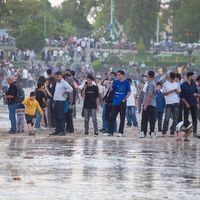
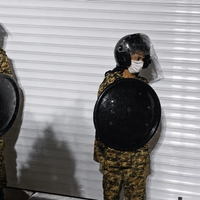
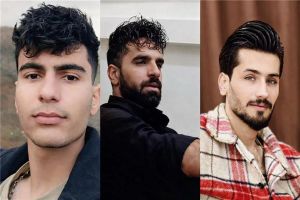
In Hamadan, two protesters sit facing each other and flash the victory sign.
No one can say with certainty whether the current protests will spiral into a revolution. But analysts tell Eye for Iran it is becoming harder to ignore signs that Iran’s theocracy may be entering a period of repeated crises that challenge its ability to function as a state.
Some analysts now warn that Iran may be entering the early stages of regime collapse — not through a single dramatic event, but through a slow erosion of state capacity.
What makes this round different is not only the fury in the streets. It is the growing uncertainty within the clerical establishment, which is leaning more heavily on coercion while projecting less confidence than before.
The protests began with the plunging rial. They have since widened into a broader test of whether the government can still manage a country living in constant crisis. Demonstrations that started in Tehran’s electronics markets have spread across provinces, bazaars and campuses, with chants increasingly aimed at the ruling system itself.
Live fire and deaths have fueled anger, while rare scenes in a religious city like Qom and other cities show crowds refusing to retreat.
A system running out of answers
Shayan Samii, a former US government appointee said the anger goes beyond economic hardship — it reflects a belief that the future has narrowed.
“They are upset because the value of their currency has gone down the drain,” he said. “There is nothing to look forward to.”
That sense of closure, he argued, is what pushes ordinary Iranians to take risks despite repression — a difficult dynamic for a state that relies heavily on deterrence and coercion.
Journalist and author Arash Azizi described protests appearing not only in major cities but in towns once seen as politically quiet.
“There is discontent everywhere,” he said — but protesters “lack leadership” and “lack organization.”
Without that, he warned, unrest can erupt and fade without producing structural change, even as each round leaves the system more brittle.
From an intelligence perspective, Danny Citrinowicz, former head of the Iran branch in Israeli military intelligence, said the deeper issue is not simply mismanagement but the absence of any workable path forward.
“The main problem the regime has is that it has no silver-bullet solution to the economic problems in Iran,” he said. Even if authorities find temporary fixes, “the problem will stay.”
Economic calm, in other words, may only pause — not resolve the crisis.
Cracks inside the ruling class
It is not only public anger that is shifting, said Alex Vatanka of the Middle East Institute but the mood among elites themselves.
“I have certainly not ever seen this level of hopelessness inside the Iranian regime,” he said.
That kind of discouragement, he added, can be more consequential than unrest alone, opening space for miscalculations and internal rivalries that become harder to contain.
Former US State Department official Alan Eyre cautioned against assuming outside forces can engineer rapid political change.
“Regime change is wildly improbable in Iran right now,” he said — warning that intense external pressure could strengthen hard-liners or push Iran toward greater militarization.
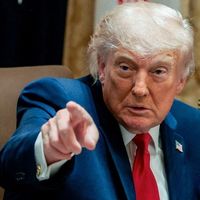
His remarks followed comments by Donald Trump that the United States was “locked and loaded” if Iranian authorities kill protesters — language that energized some activists while raising fears of escalation among others.
Why this wave feels different
Bozorgmehr Sharafeddin, head of Iran International Digital, argued that this round cuts deeper because it points to a crisis of state survival rather than policy error.
“This protest is not about inflation,” he said. “This is about the collapse of the Iranian economy.”
He also noted that international reaction came immediately — a contrast with earlier cycles when global attention arrived more cautiously and later.
Across the conversation, one theme recurred: the state still has the means to suppress dissent — but it is doing so with increasing uncertainty about what comes next.
Protesters are directing anger at the foundations of clerical power, not merely the officials administering policy. Reform promises carry less credibility. And senior figures themselves acknowledge problems they cannot easily fix.
That does not guarantee revolution and it does not mean collapse will come overnight. But analysts say a government that relies primarily on coercion while showing visible doubt from within no longer projects stability.
What emerges, they warn, is a system still capable of force yet less certain of itself with every passing crisis.
You can watch Episode 84 of Eye for Iran on YouTube or listen on any podcast platform of your choosing.
US President Donald Trump salutes a US Army soldier as he observes a military demonstration with US Army Major General Walter "Walt" Piatt, the Commanding General of the Army's 10th Mountain Division at Fort Drum.
A phrase used by US President Donald Trump in support of Iran’s protesters carries a specific military meaning, analysts say, going beyond political rhetoric to signal a state of readiness for action.
In a message published on his Truth Social account, Donald Trump warned that if Iran’s rulers kill peaceful protesters, the United States would act to save the Iranian people.
"If Iran shots and violently kills peaceful protesters, which is their custom, the United States of America will come to their rescue. We are locked and loaded and ready to go."
The phrase “locked and loaded” is a classic military expression in English, meaning a weapon is armed, ammunition is in place, and it is ready to fire. Its roots lie in military training, particularly in the US armed forces, and the term has appeared in military literature since at least the eighteenth century.
Formally incorporated into weapons manuals around the time of World War II, the expression has long carried an operational and warning connotation. It is not merely a metaphor or casual figure of speech, but language traditionally used to indicate readiness for immediate action.
The expression has also become widely familiar through popular culture. In Hollywood war films, beginning notably with the 1949 film Sands of Iwo Jima starring John Wayne, “lock and load” is commonly used to signal the imminent start of combat. The phrase has since been embedded in video games such as Call of Duty and Battlefield, where it typically precedes intense fighting scenes.
Trump has used similar language in previous high-tension situations, including during confrontations involving North Korea and Syria.
Senior US officials have also employed the term in moments of crisis, signaling that the military option is not only under consideration but operationally prepared.
'US ready for military action'
International relations scholar Kamran Matin described Trump’s wording as an explicit threat that could be interpreted as readiness for military action.
Matin told Iran International that in Trump’s latest remarks, the scope of the threat appeared to expand beyond Iran’s missile or regional activities to include the government’s violent response to domestic protests.
At the same time, he cautioned that Trump’s personal style must be taken into account, noting that the president is known for shifting positions and statements that allow for multiple interpretations.
However, Matin said that verbal threats do not always translate into action.
Despite signs of military preparedness by the United States and Israel in the region, Matin emphasized that there remains a significant gap between verbal threats, actual military readiness, and the political decision to launch a direct attack.
US President Donald Trump warned on Friday that the United States is “locked and loaded” if Iranian authorities use lethal force against protesters.
Washington would step in if protesters are violently killed, Trump said in a post on Truth Social.
“If Iran shoots and violently kills peaceful protesters, which is their custom, the United States of America will come to their rescue,” he wrote. “We are locked and loaded and ready to go.”
Protests turn deadly
Trump’s remarks came as protests in Iran reached a fifth consecutive day on Thursday, with at least seven protesters reported killed by security forces. Demonstrations spread to new cities, including the clerical stronghold of Qom, where crowds openly called for the downfall of the theocracy.
Earlier, a US official said the protests reflect deep public anger at years of government failure. In a written statement on Thursday, a spokesperson for the United States Department of State described the unrest as an expression of the Iranian people’s “understandable anger.”
“The protests reflect the understandable anger of the Iranian people at their government's failures and excuses,” the official said, accusing Tehran of neglecting the economy, agriculture, water and electricity for decades while “squandering billions on terrorist proxies and nuclear weapons research.” The statement also cited Iran’s involvement in acts of “terrorism against the United States and its allies.”
Demonstrations were reported across dozens of locations, from Tehran and Isfahan to Lorestan, Mazandaran, Khuzestan, Hamadan and Fars. Protesters chanted slogans directly targeting the ruling system and Supreme Leader Ali Khamenei.
Pro-monarchy slogans dominated many rallies, highlighting how the unrest has moved beyond economic grievances into open political defiance. Security forces used live fire in several cities, including Nurabad in Lorestan and Hamedan in western Iran, where videos showed officers shooting at demonstrators who remained in the streets despite the crackdown.
The long-range air defense system called Arman is displayed during an unveiling ceremony in Tehran, Iran, in this picture obtained on February 17, 2024
Iran’s official defense export agency is offering to sell ballistic missiles, drones and other advanced weapons systems to foreign governments in exchange for cryptocurrency and barter, Financial Times reported on Thursday.
The Ministry of Defence Export Center, known as Mindex, presents itself as the export arm of Iran’s defense ministry. It advertises more than 3,000 products across categories including armaments, rockets and missiles, aviation, marine platforms, and radar and optical systems.
The portal’s payment terms say contracts can be settled using “digital currencies,” local currencies in the buyer’s country and barter arrangements, alongside more traditional bank transfers.
Mindex’s online platform, hosted on an Iranian cloud provider already blacklisted by Washington, says decades of experience in overseas sales and says it works with a number of foreign clients.
A frequently asked questions section reassures potential buyers that “given the general policies of the Islamic Republic of Iran regarding circumvention of sanctions, there is no problem in implementing the contract,” and promises that purchased products will reach their destination “as soon as possible,” FT reported.
According to the center’s own “About us” page, Mindex began its marketing activity in 1989 and is “affiliated to the Ministry of Defence and Armed Forces Logistics,” (MODAFL) a ministry that has been under US sanctions since 2007 for supporting Iran’s missile and conventional arms programs.
Washington has repeatedly targeted MODAFL‑linked front companies and procurement networks, warning that foreign entities supplying or buying military hardware through such channels risk secondary sanctions and potential exclusion from the US financial system.
Recent US designations have also singled out Iran‑linked “shadow banking” and crypto networks accused of helping Tehran move money for oil and weapons sales outside formal banking channels, underscoring the risks for buyers using digital assets to pay Mindex.
US Treasury in recent months has sanctioned multiple Iran‑linked networks accused of using front companies and alternative payment channels to facilitate weapons transfers to partners such as Russia and Venezuela, warning that digital currencies do not shield transactions from enforcement.
The fifth day of protests in Iran became the deadliest so far, with at least seven protesters killed by security forces, as rallies spread to new cities including the clerical stronghold of Qom, where protesters called for the downfall of the theocracy.
Demonstrations were reported across dozens of locations, from Tehran and Isfahan to Lorestan, Mazandaran, Khuzestan, Hamadan, and Fars, with protesters chanting slogans directly targeting the ruling system and the Supreme Leader Ali Khamenei.
For the first time in the past five decades, pro-monarchy slogans have come to dominate the chants.
Security forces used live fire in several cities, including Nurabad in Lorestan and Hamadan in western Iran, where videos showed officers shooting at demonstrators who remained in the streets despite the crackdown.
Protesters killed by security forces
The US-based Human Rights Activists News Agency (HRANA) has so far documented the deaths of at least seven protesters, mostly killed on Thursday.
Iran International has managed to speak with the families of three victims.
In Lorestan, 28‑year‑old barber Shayan Asadollahi was killed after security forces in pickup trucks opened fire on protesters in the city of Azna on Thursday, a relative told Iran International.
Iran International also spoke with the relatives of Dariush Ansari Bakhtiarvand in Fooladshahr and Amir‑Hessam Khodayarifard in Kuhdasht, who were killed on Wednesday night.
The unrest has taken on a distinctly anti‑government tone, with protesters in Bandar Abbas chanting “Death to the entire system” and "Long live the Shah (King)”, while pro-monarchy graffiti and slogans appeared in Esfahan and Sistan and Baluchestan.
Recent reports said evening and nighttime demonstrations in multiple cities including Bandar Abbas, Azna, Hamedan, Qom, Qazvin and Babol.
In the restive southeast, a group of Baluch prisoners urged residents of Sistan and Baluchestan to join the “wave of freedom” and support demonstrations across the country, recalling that the province was one of the main hotspots of the 2022 Woman, Life, Freedom protests and repeatedly faced deadly crackdowns.
Iranian protesters chanted pro-monarchy slogans in Qom, a core stronghold of Shiite clerics and the Islamic Republic, signaling a major symbolic breach in a city long seen as politically untouchable.
Spectators at a football match in Esfahan were also filmed chanting “Reza Shah, may your soul rest in peace,” underscoring the prominence of pro‑monarchy slogans in this wave of protests.
They called on people to reclaim streets they said “belong to the people, not dictators,” and to make chants such as “Death to the dictator” and “Freedom, justice, Iranian republic” echo “like thunder across Iran.”
Caution and support
The Paris‑based Narges Foundation, run by the family of jailed Nobel laureate Narges Mohammadi, issued a statement on her official X account declaring that “silence is not an option” as streets once again see live fire, tear gas, beatings and mass arrests, and urging solidarity with families of those killed, detainees held incommunicado and the wounded denied safe treatment.
Former senior lawmaker Heshmatollah Falahatpisheh, who once headed parliament’s National Security and Foreign Policy Committee, warned in his own X post that “all the ideologies of the world are not worth the tears of one mother” and urged Iranians to ensure their hands “do not get stained with the blood of even one Iranian.”
A screen-grab from a video that appears to show protestors in Iran's southern city of Marvdasht chant against Supreme Leader Ali Khamenei, January 1, 2026
As protests once again ripple across Iran, the country’s political establishment is moving quickly to revive an economic reform agenda that many Iranians say no longer speaks to the core of their anger.
While demonstrators chant against the entire system, the government of President Masoud Pezeshkian has focused its response on reshuffling economic managers and pressing ahead with long-delayed currency reforms, betting that technical fixes can still defuse a crisis that has increasingly become political.
The renewed unrest was triggered by a sharp bout of currency volatility that briefly pushed the U.S. dollar to around 1.45 million rials on the open market, intensifying already high inflation and accelerating the erosion of purchasing power.
“Protesting the dollar is protesting instability; protesting a life that cannot be planned,” wrote journalist Mustafa Danandeh in the daily Ettelaat. “People who do not know whether six months from now their rent will double, medicine will be available, or their job will survive.”
A new old face
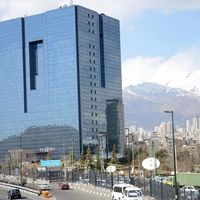
In response, Pezeshkian reshuffled the leadership of the Central Bank of Iran, reappointing Abdolnaser Hemmati and reviving a controversial push toward a single exchange rate—an idea long advocated by economists but repeatedly stalled by politics, sanctions and entrenched interests.
Hemmati, a prominent centrist figure, had been forced out less than seven months into his tenure as economy minister after parliament impeached him over exchange-rate volatility.
His return—this time to a post that does not require parliamentary approval—has infuriated hardline lawmakers and highlighted widening rifts within the political elite.
“This explicitly ignores parliament’s vote and shows disregard for the will of representatives,” said Zeynab Gheisari, an ultra-hardline lawmaker from Tehran. Another hardline legislator, Amir-Hossein Sabeti, said the move demonstrated the government’s “disregard for the people and the country’s economy.”
In his first public remarks after the appointment, Hemmati laid out familiar priorities: controlling inflation, managing the foreign exchange market and tightening oversight of banks.
It’s the economy—or is it?
The reform effort centers on dismantling Iran’s multi-rate currency regime, a system dating back to the Iran–Iraq war of the 1980s, when preferential exchange rates were introduced to subsidize essential imports. Over time, the widening gap between official and market rates turned the system into a major source of rent-seeking, corruption and uncertainty.
As the business news outlet Tejarat News noted, the policy “failed to provide sustainable support for domestic producers and created severe uncertainty for investment and production planning.”
The Entekhab news site cautioned that in an economy burdened by sanctions, fiscal shortfalls and political distrust, inflationary expectations tend to regenerate quickly once short-term interventions fade.
On Thursday, the president announced the immediate elimination of the subsidized exchange rate of 285,000 rials per dollar for basic goods and animal feed imports, saying the subsidy would instead be transferred directly to consumers to eliminate “rent, bribery and corruption.”
In unusually blunt remarks, Pezeshkian acknowledged that public anger was directed at the state itself. Dissatisfaction, he said, was the government’s responsibility, adding that “there is no need to look for America to blame.”
Many protesters appear keenly aware that Pezeshkian’s authority is tightly constrained by entrenched power centers, a reality reflected in slogans that target the theocratic system itself and its supreme leader rather than the exchange rate.